

Cyber risk is an operational risk that can directly halt production, impair safety systems, and expose your organization to regulatory and financial consequences. For oil and gas operators, this is not a theoretical concern. Adversaries are actively targeting operational technology (OT) and industrial control systems (ICS) across upstream, midstream, and downstream environments, and the consequences of a successful attack range from forced shutdowns to environmental incidents and BSEE enforcement actions. The single most important action you can authorize today is a rapid OT asset visibility audit — because you cannot protect what you cannot see.
Key authorities confirm the urgency:
- Dragos reports that 73% of OT ransomware incidents began with VPN or credential reuse, and ransomware cases reaching OT-support virtualization caused significant multi-day operational disruption.
- CISA and NIST SP 800-82 provide the primary ICS security guidance framework for U.S. critical infrastructure operators, including oil and gas.
- BSEE expects offshore operators to demonstrate cybersecurity governance as part of their safety management obligations.
- GAO findings confirm that cybersecurity risk must be managed as an integral component of enterprise risk management, not as a separate IT function.
Table of Contents
- Why cyber risk in oil production is an operational priority
- Where are your oil production systems most exposed?
- What attack scenarios actually reach operational impact?
- How cyber incidents create regulatory and safety exposure in the U.S.
- How to embed cyber risk in governance and board reporting
- Prioritized mitigations for OT/ICS environments in oil production
- Detection and incident response that works in OT environments
- A practical 30/90/180-day roadmap for managing OT cyber risk
- What should you authorize right now?
- Key Takeaways
- A vCISO's perspective on cyber risk in oil production
- CisoSafe helps oil and gas operators close the OT security gap faster
- Selected authoritative sources for practitioners
Why cyber risk in oil production is an operational priority
Cyber incidents in oil production do not stay in the server room. They move into the plant floor, the control room, and the regulatory record. The operational consequences fall into four categories that decision-makers and boards need to understand clearly.
Production loss and forced shutdowns. When ransomware or a destructive attack reaches OT-support virtual machines or historian systems, operators lose visibility and control of critical processes. Every OT ransomware case in Dragos's 2025 reporting that touched OT-support virtualization resulted in significant, multi-day operational disruption. That is not a near-miss statistic — it is a production-loss event with direct revenue impact.
Safety and environmental exposure. Safety instrumented systems (SIS) and process control systems (PCS) are increasingly connected to corporate networks and remote monitoring platforms. Academic research published in PMC confirms that cybersecurity practices for SIS consistently lag functional safety approaches, leaving a gap that adversaries can exploit to defeat safety independence. A cyber manipulation of a SIS does not just create a cybersecurity incident — it creates a potential process safety event.
Financial and reputational damage. Beyond direct production loss, operators face force majeure disputes, insurance complications, and reputational exposure with partners and regulators. ThreatMon's 2026 reporting documents a surge in data breaches and ransomware targeting oil and gas, with credential theft serving as the primary commodity for initial access brokers who sell entry to the highest bidder.
Regulatory consequences. BSEE, CISA, and state-level regulators are increasing scrutiny of cybersecurity governance for energy operators. A cyber incident that affects safety systems or causes an environmental release can trigger reporting obligations and enforcement actions that compound the operational damage.
| Impact dimension | Sector-specific metric or pattern |
|---|---|
| OT ransomware disruption rate | cases touching OT-support VMs caused multi-day shutdowns |
| Dominant initial access vector | VPN/credential reuse in 73% of OT ransomware incidents (Dragos) |
| Threat trend | Surge in data breaches and ransomware targeting oil and gas in 2026 (ThreatMon) |
| SIS security gap | Cybersecurity practices for SIS lag functional safety approaches (PMC research) |
| Visibility gap | Internet-facing field devices frequently absent from IT asset inventories (Dragos) |
The single most cited operational impact: every OT ransomware incident that reached OT-support virtualization in Dragos's 2025 case data caused significant multi-day operational disruption.
Where are your oil production systems most exposed?
The attack surface in oil production is wider than most IT teams realize, and it is distributed across three distinct operating environments that each carry different risk profiles.
Upstream: wellsite and remote telemetry
Upstream assets are geographically dispersed and often connected via satellite links, cellular gateways, and remote telemetry units (RTUs). Wellsite programmable logic controllers (PLCs) and field gateways frequently run legacy firmware with no patch path. Satellite and cellular connections used for remote monitoring are often outside the IT security perimeter entirely. Dragos has documented adversaries using internet-facing cellular gateways as first-pivot vectors to reach deeper OT networks. For a deeper look at upstream-specific risk factors, the drilling operations cyber risk guide covers asset-level vulnerabilities in detail.
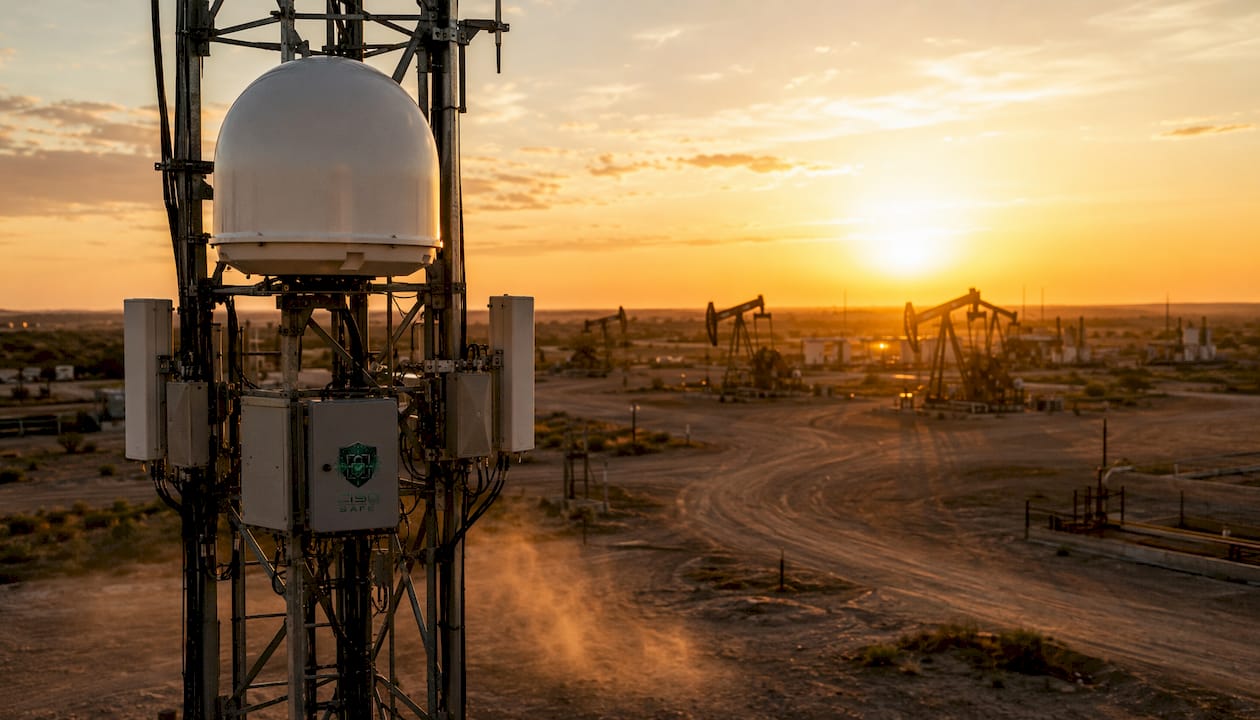
Midstream: pipeline SCADA and compressor stations
Midstream environments rely on SCADA systems that span hundreds or thousands of miles, with remote access connections maintained by both internal engineers and third-party vendors. Compressor station HMIs and cellular gateways are common blind spots. Flat network architectures — where a vendor laptop can reach a SCADA server without crossing a security boundary — are still common in midstream operations.

Downstream: refinery ICS and historian systems
Refinery environments carry the highest consequence for a safety incident, given the proximity of process hazards. Historian servers, HMIs, and engineering workstations are frequent targets because they hold configuration files and alarm data that adversaries use to plan future attacks. Default credentials on HMIs and unmanaged engineering workstations connected to both the corporate and OT networks are persistent vulnerabilities across the sector.
Common blind spots across all segments:
- Unmanaged field devices not in any IT or OT asset register
- Default credentials on PLCs, HMIs, and cellular gateways
- Vendor remote access connections with no session monitoring or time limits
- Flat OT networks with no zone-based segmentation
- Internet-facing edge devices with no firewall or access control
Pro Tip: Start your OT visibility audit by querying your IT team for a list of all devices with cellular or satellite connectivity. Then compare it against your OT engineering team's field device list. The gap between those two lists is your most immediate exposure — and it is almost always larger than leadership expects.
For offshore environments, the offshore platforms cyber protection guide covers additional asset classes specific to marine production infrastructure.
What attack scenarios actually reach operational impact?
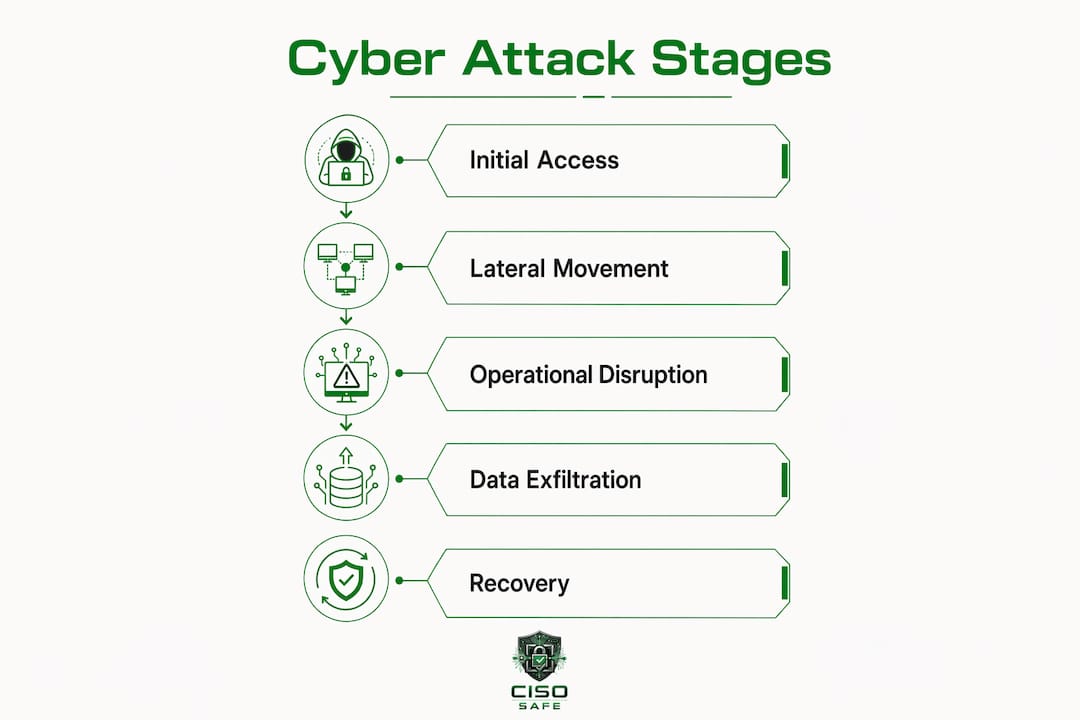
Understanding the mechanics of how cyber attacks move from initial access to production disruption helps operations leaders prioritize detection and response investments. The following patterns, drawn from Dragos and ThreatMon threat intelligence, represent the most operationally consequential scenarios in oil production today.
Credential abuse and VPN pivoting. An attacker obtains valid VPN credentials — through phishing, credential theft, or purchase from an initial access broker — and authenticates as a legitimate user. From there, they move laterally through a flat network to reach OT-support systems, historians, or engineering workstations. This is the dominant initial access path in OT ransomware incidents.
Internet-exposed edge device compromise. A cellular gateway or remote access server with default credentials or an unpatched vulnerability is identified through internet scanning. The attacker gains a persistent foothold in the OT network perimeter without needing to breach the corporate IT environment at all.
Reconnaissance and data exfiltration for future attacks. Dragos has documented adversary groups — including VOLTZITE and AZURITE — that exfiltrate engineering configuration files and alarm data over extended periods without causing immediate disruption. The goal is to build operational intelligence for a future physical-impact attack. This pattern is particularly dangerous because it looks like normal network activity until it is too late.
Ransomware targeting OT-support infrastructure. Ransomware deployed against ESXi hypervisors or OT-support VMs does not need to touch a PLC directly to cause a production shutdown. When the historian, the engineering workstation, or the SCADA server VM goes offline, operators lose visibility and control — and the plant stops.
Supply chain and third-party access exploitation. Vendor remote access sessions with excessive privileges and no monitoring are a well-documented entry point. A compromised vendor laptop connecting to your OT network carries whatever malware or credential theft tools the attacker has already installed.
Watch for these behavioral signals in your logs: unusual historian queries from engineering workstations, credential dumps on domain controllers accessible from OT networks, and large outbound data transfers from systems that should not be communicating externally.
How cyber incidents create regulatory and safety exposure in the U.S.
For U.S. oil and gas operators, a cyber incident that affects OT systems does not stay within the cybersecurity domain. It crosses into safety, environmental, and regulatory territory quickly.
The independence of SIS from process control systems, required under IEC 61508 and IEC 61511, is undermined when both systems share network infrastructure or remote access pathways. Research published in MDPI confirms that growing connectivity threatens the independence of safety-critical petroleum systems, and that network complexity increases the attack surface in ways that functional safety analyses have not historically accounted for. A cyber manipulation of a SIS that defeats its independence is simultaneously a cybersecurity incident and a process safety failure.
U.S. regulatory expectations:
- BSEE expects offshore operators to address cybersecurity as part of their Safety and Environmental Management System (SEMS). A cyber incident affecting safety systems on an offshore platform can trigger BSEE incident reporting and inspection obligations.
- CISA provides binding operational directives and advisories for critical infrastructure operators, including oil and gas. CISA's ICS-CERT advisories are the primary channel for vulnerability disclosures affecting OT systems used in energy production.
- NIST SP 800-82 is the primary technical reference for ICS security controls in U.S. critical infrastructure. It provides network architecture guidance, access control requirements, and monitoring recommendations adapted for OT environments.
- GAO has found that cybersecurity risk must be part of enterprise risk management for critical infrastructure operators, with defined roles, performance measures, and board-level oversight.
- Reportable event threshold: an operational cyber incident becomes a regulatory reporting obligation when it affects safety systems, causes an environmental release, or meets BSEE's definition of a "near miss" or "incident of safety concern." Operators should define this threshold in their incident response plan before an event occurs, not during one.
Compliance readiness checklist for U.S. oil production operators:
- Assign a named cybersecurity owner for OT environments (operations lead or vCISO).
- Document the OT asset inventory and network architecture for BSEE SEMS review.
- Map all remote access connections and vendor access points.
- Conduct a joint cyber-safety hazard analysis that addresses SIS independence.
- Establish an incident reporting decision tree that identifies when a cyber event triggers BSEE, CISA, or EPA notification.
- Run at least one tabletop exercise annually that includes both IT and OT personnel.
- Maintain evidence of patch and change management decisions for ICS assets.
How to embed cyber risk in governance and board reporting
Cybersecurity risk cannot be eliminated, but it can be managed through informed decision-making aligned with enterprise risk management. That is the GAO's framing, and it is the right one for oil production operators. Cyber risk belongs in the same enterprise risk register as equipment failure, commodity price volatility, and weather-related production loss.
Governance roles and responsibilities:
| Role | Primary responsibility |
|---|---|
| Operations lead | OT asset ownership, change control authority, safety-security integration |
| ICS engineering | Technical decisions on OT network changes, patch approval, monitoring deployment |
| IT security | Corporate network controls, identity management, vendor access provisioning |
| vCISO / advisory | Risk assessment, board reporting, framework alignment, IR planning |
| Legal / communications | Regulatory notification, insurance coordination, public communications |
| Vendor management | Third-party access controls, contract security requirements, audit rights |
Risk matrix dimensions for oil production:
Map each identified risk across four dimensions: affected asset and environment (upstream, midstream, downstream), impact type (safety, production downtime, environmental, financial/reputational), threat vector (remote access, ransomware, supply chain, insider), and mitigation maturity required (policy, people, technology). This structure lets you prioritize investments by consequence and feasibility rather than by threat novelty.
Cost and effort drivers for remediation: asset discovery and OT inventory typically require two to four weeks of engineering time and a passive monitoring tool deployment. Network segmentation is the most capital-intensive control, often requiring firewall hardware, engineering design, and a phased cutover to avoid production disruption. ICS-aware monitoring, vendor access controls, and credential hardening are faster wins that can be completed within 90 days with the right advisory support. For a structured view of assessment types and expected deliverables, the industrial cybersecurity assessment guide provides a practical framework. The cybersecurity governance in energy guide covers board reporting structures and KPI design in more detail.
Prioritized mitigations for OT/ICS environments in oil production
SANS research confirms that a one-size-fits-all security model fails in oil and gas. The controls below are sequenced by operational impact and implementation feasibility, adapted for upstream, midstream, and downstream differences.
- OT asset inventory and visibility (all segments): Deploy passive ICS-aware monitoring — tools like Dragos or Darktrace for OT — before introducing any active scanning. Passive monitoring discovers devices without sending packets that can crash legacy PLCs. Operations lead and ICS engineering should jointly own the resulting asset register.
- Network segmentation (midstream and downstream priority): Establish security zones aligned with process criticality. At minimum, separate the corporate IT network from the OT network, and isolate SIS from PCS. This is the highest-effort control but also the highest-consequence gap when absent.
- Secure remote access and vendor controls (all segments): Replace always-on VPN connections with session-based, monitored remote access. Require MFA for all remote access to OT systems. Implement time-limited vendor sessions with logging. For vendor-specific risk factors, the oil and gas vendor cybersecurity guide covers contract requirements and audit rights.
- Default credential removal and MFA enforcement: Audit all PLCs, HMIs, cellular gateways, and historian systems for default credentials. This is a low-cost, high-impact control that can be completed within 30 days.
- ICS-aware monitoring and alerting: Deploy monitoring that understands OT protocols (Modbus, DNP3, EtherNet/IP) and can detect anomalous historian queries, unusual engineering workstation behavior, and unauthorized configuration changes.
- Backup and offline recovery for historians and ESXi hosts: Maintain tested, offline backups of historian databases, engineering workstation configurations, and hypervisor snapshots. For tested backup and recovery services aligned with OT recovery requirements, Cloud 9's backup and recovery services provide a practical starting point for operators building offline recovery capability.
- Patch and change management adapted for ICS: Patch decisions for OT assets require engineering sign-off and a defined change control window. Never apply patches to production OT systems without a tested rollback plan and operations approval.
Pro Tip: Before deploying any new monitoring or scanning tool in your OT environment, get written sign-off from your ICS engineering lead. Active IT vulnerability scanners have crashed legacy PLCs in oil production environments. Passive-first is not a preference — it is a safety requirement.
Detection and incident response that works in OT environments
Standard IT security tools applied directly to OT systems can cause the very outages you are trying to prevent. SANS guidance is explicit on this point: active scanning and standard endpoint detection and response (EDR) tools can crash legacy PLCs and HMIs. ICS engineering must retain authority over any tool deployment in the OT environment.
Core components of an OT incident response playbook:
- Detection thresholds: Define what constitutes an anomaly in your OT environment — unexpected historian queries, new devices appearing on the OT network, unusual outbound connections from engineering workstations.
- Escalation to engineering: Any OT security alert must route to ICS engineering before any containment action is taken. Engineers understand the safety implications of isolating a system; IT security teams often do not.
- Manual operation procedures: Document and test the ability to operate critical processes manually or in degraded mode. This is your most important resilience control.
- Containment without shutdown: Where possible, isolate affected segments rather than shutting down the entire OT network. Pre-defined isolation procedures reduce decision time during an incident.
- Evidence capture: Preserve historian logs, network captures, and system event logs before any recovery action. Regulatory investigations and insurance claims require this evidence.
- Regulatory reporting: Trigger your reporting decision tree within the first hour of a confirmed OT incident. BSEE and CISA notification timelines are short.
Forensics and recovery priorities:
- Preserve historian databases and network logs before reimaging any system.
- Isolate ESXi/hypervisor hosts from the network before attempting recovery.
- Restore from tested offline backups only — never from a backup that was connected to the network during the incident.
- Use pre-written communication templates for internal escalation, regulatory notification, and external communications.
Testing cadence: Run a tabletop exercise that includes both IT and OT personnel at least once per year. Test end-to-end recovery of your historian and SCADA systems at least annually. The offshore facility cybersecurity risk management guide includes playbook templates and tabletop scenario frameworks for production environments.
A practical 30/90/180-day roadmap for managing OT cyber risk
This roadmap is designed for an operations executive or vCISO to present to a board or incorporate into capital planning. It sequences work by operational impact and implementation feasibility.
30-day priorities:
- Authorize a rapid OT asset and remote-access discovery engagement. Scope: passive monitoring deployment, field device enumeration, and vendor access audit.
- Audit all VPN and remote access credentials. Remove default credentials on all internet-facing devices. Enforce MFA for remote access to OT systems.
- Identify all internet-facing gateways (cellular, satellite, remote access servers) and confirm each has a named owner and a current firmware version.
- Brief the board on the current state of OT visibility and the three highest-risk exposures.
90-day priorities:
- Implement network segmentation between corporate IT and OT networks, and between SIS and PCS where technically feasible.
- Deploy ICS-aware passive monitoring on SCADA and historian systems. Establish alert thresholds and an escalation path to ICS engineering.
- Implement session-based, monitored vendor remote access with MFA and time limits.
- Run a joint IT/OT tabletop exercise using a ransomware-on-OT-support-VM scenario.
- Complete a cyber risk assessment that produces a prioritized risk register aligned with your enterprise risk management framework.
180-day priorities:
- Establish a formal patch and change management process for ICS assets, with engineering sign-off requirements and defined change windows.
- Complete a joint cyber-safety hazard analysis that addresses SIS independence and documents residual risk.
- Present a costed maturity roadmap to the board, including remediation priorities, budget ranges, and a 12-month KPI framework.
- Formalize vendor cybersecurity requirements in all OT-related contracts, including audit rights and incident notification obligations.
Board brief template fields: current OT security posture (red/yellow/green by segment), top three risks with likelihood and consequence ratings, recommended actions with budget ranges, and the specific decision requested from the board (funding authorization, policy approval, or resource allocation).
When to hire a vCISO vs. augment internal resources: if your organization lacks a named OT security owner, has no current OT asset inventory, or has never run an IT/OT tabletop exercise, a vCISO engagement delivers faster results than hiring a full-time CISO. A vCISO brings immediate OT security expertise, a structured assessment methodology, and board-ready reporting — without the six-month hiring timeline or the fully-loaded cost of a senior security executive. The vCISO services for oilfield operations guide outlines what a short-term advisory engagement delivers and how to scope it.
What should you authorize right now?
Three actions deliver the fastest reduction in operational exposure and map directly to board-level KPIs.
Authorize an OT visibility audit. You cannot manage risk you cannot see. A passive OT asset discovery engagement typically takes two to four weeks and produces an asset register, a network architecture map, and a prioritized gap list. This is the prerequisite for every other control on this list. It also gives you the evidence base for board reporting and regulatory documentation.
Lock down internet-facing gateways. Cellular routers, satellite modems, and remote access servers with default credentials or unpatched firmware are your most immediate exposure. Closing this gap requires no capital expenditure — only engineering time and a change control window. The operational risk reduction is immediate.
Plan and run an IT/OT tabletop exercise. Most oil production organizations have never tested their response to an OT-specific cyber incident. A tabletop exercise surfaces gaps in escalation procedures, manual operation readiness, and regulatory reporting decision-making before an actual incident forces those gaps into view. Schedule it within 90 days.
Treat cyber risk as an operational discipline, not an IT project. Embed it in your safety management system, your enterprise risk register, and your board reporting cadence. That is the governance posture that BSEE, CISA, and GAO expect — and it is the posture that actually reduces operational exposure.
Key Takeaways
Cyber risk in oil production is an operational discipline that requires OT-specific controls, board-level governance, and a phased remediation roadmap anchored in asset visibility.
| Point | Details |
|---|---|
| OT visibility is the prerequisite | You cannot protect assets you cannot see — authorize a passive OT discovery audit before any other control. |
| Credential hygiene stops most attacks | 73% of OT ransomware incidents began with VPN or credential reuse; MFA and default credential removal are immediate priorities. |
| Ransomware reaches OT through virtualization | Every OT ransomware case that touched OT-support VMs caused multi-day operational shutdowns — protect and back up hypervisor hosts offline. |
| Regulatory exposure is real and specific | BSEE, CISA, and NIST SP 800-82 set concrete expectations; a cyber incident affecting SIS can trigger safety reporting obligations. |
| CisoSafe accelerates the roadmap | CisoSafe's vCISO services deliver rapid OT visibility audits, risk assessments, and board-ready reporting for U.S. oil and gas operators. |
A vCISO's perspective on cyber risk in oil production
The hardest conversation in oil production cybersecurity is not about technology — it is about ownership. When a cyber incident reaches the OT environment, the instinct is to hand it to IT. But the decisions that matter most — whether to isolate a compressor station, whether to switch to manual operation, whether a SIS alarm is a process anomaly or a cyber manipulation — belong to operations and ICS engineering. The vCISO role is to build the governance structure that makes those decisions faster and more defensible, not to make them unilaterally.
The trade-off between safety and security is real but manageable. Passive monitoring does not disrupt production. Network segmentation can be phased around maintenance windows. Vendor access controls add friction that engineers will resist until the first time a vendor connection is the source of an incident. The practical work of a vCISO in this sector is translating those trade-offs into board-level language — turning a risk matrix into a budget request, and turning a tabletop exercise into a regulatory compliance artifact. Organizations that treat cyber risk as an operational discipline, governed the same way they govern process safety, consistently outperform those that treat it as an IT compliance checkbox.
CisoSafe helps oil and gas operators close the OT security gap faster
Oil production operators who need to move from zero OT visibility to a board-ready risk posture in 90 days face a real resource constraint: the expertise required is specialized, the internal bandwidth is limited, and the cost of a full-time CISO is hard to justify for a mid-market operator.
CisoSafe is a Houston-based vCISO firm built specifically for regulated, high-stakes industries including oil and gas. A CisoSafe engagement delivers rapid OT visibility audits, a prioritized risk register aligned with NIST and BSEE expectations, ICS-aware incident response tabletop facilitation, and ongoing strategic advisory — at a fraction of the cost of a full-time security executive. The first engagement produces a current-state assessment, a 30/90/180-day remediation roadmap, and a board-ready risk brief your leadership can act on immediately. To discuss your OT security posture and scope a rapid assessment, contact CisoSafe today.
Selected authoritative sources for practitioners
The following primary sources underpin the guidance in this article. Each is worth reading in full for practitioners building or maturing an OT security program.
- Dragos 2026 OT Cybersecurity Executive Briefing (Oil & Gas): The most operationally specific threat intelligence available for oil and gas OT environments. Covers adversary behaviors, initial access vectors, and ransomware impact patterns with sector-specific data.
- SANS Institute — Prioritized Industrial Cyber Defense in Oil and Gas: The definitive practitioner guide for adapting ICS critical controls to upstream, midstream, and downstream environments. Covers IT/OT collaboration requirements and the risks of misapplied IT tooling in OT.
- NIST SP 800-82 (Guide to Industrial Control Systems Security): The primary U.S. technical reference for ICS security architecture, access control, and monitoring. Required reading for any operator seeking to align with CISA and BSEE expectations.
- BSEE Safety and Environmental Management System (SEMS) guidance: Sets the regulatory expectations for offshore operators, including the cybersecurity governance obligations that intersect with SEMS requirements.
- GAO-23-105789 (Cybersecurity Risk Oversight for Critical Infrastructure): Documents the federal expectation that cybersecurity risk be managed as part of enterprise risk management, with defined roles, performance measures, and board-level accountability.
- PMC — Cybersecurity of Offshore Oil and Gas Production Assets: Academic review of SIS and PCS independence vulnerabilities introduced by digitalization, with recommendations for joint cyber-safety hazard analysis.
- MDPI — Security and Independence of Process Safety and Control Systems in the Petroleum Industry: Covers the network complexity and connectivity risks that undermine IEC 61508/61511 independence requirements, with design recommendations for barrier-based network architecture.
- DOE ONG-C2M2 (Oil and Natural Gas Cybersecurity Capability Maturity Model): A sector-specific maturity model for benchmarking and improving cybersecurity programs across the oil and gas value chain, aligned with enterprise risk management principles.
- ThreatMon — Oil & Gas Under Siege (2026): Current threat landscape summary covering the surge in data breaches, ransomware, and credential theft targeting oil and gas operators, with context on initial access broker activity.