

Drilling operations are defined as one of the highest-risk environments for cyberattacks in the energy sector, primarily because operational technology (OT) systems originally designed without network connectivity now operate alongside modern IT infrastructure. This convergence creates attack surfaces that adversaries actively exploit. The industry term for this threat environment is "IT/OT convergence risk," and understanding it is the foundation of any credible cybersecurity program for drilling. Standards like IEC 62443 and guidelines from the International Association of Drilling Contractors (IADC) exist precisely because the sector recognized this exposure years ago. Yet 94% of the top 400 oil and gas firms have experienced at least one data breach. That figure signals a structural problem, not isolated incidents.
Why drilling operations face cyber risk: the IT/OT convergence problem
The core reason drilling operations face cyber risk is the forced marriage of legacy OT equipment with connected digital systems. Drilling control systems, mud logging units, and safety instrumented systems (SIS) were engineered for reliability and uptime, not security. When operators added remote monitoring, cloud-based analytics, and AI-driven drilling software, they connected these systems to networks that threat actors already know how to penetrate.
Ransomware attacks targeting the energy sector have increased over 40% annually, exploiting exactly this intersection of legacy OT and connected IT infrastructure. That growth rate reflects how attractive drilling environments are to attackers: high operational pressure, costly downtime, and historically weak OT defenses create ideal conditions for extortion.

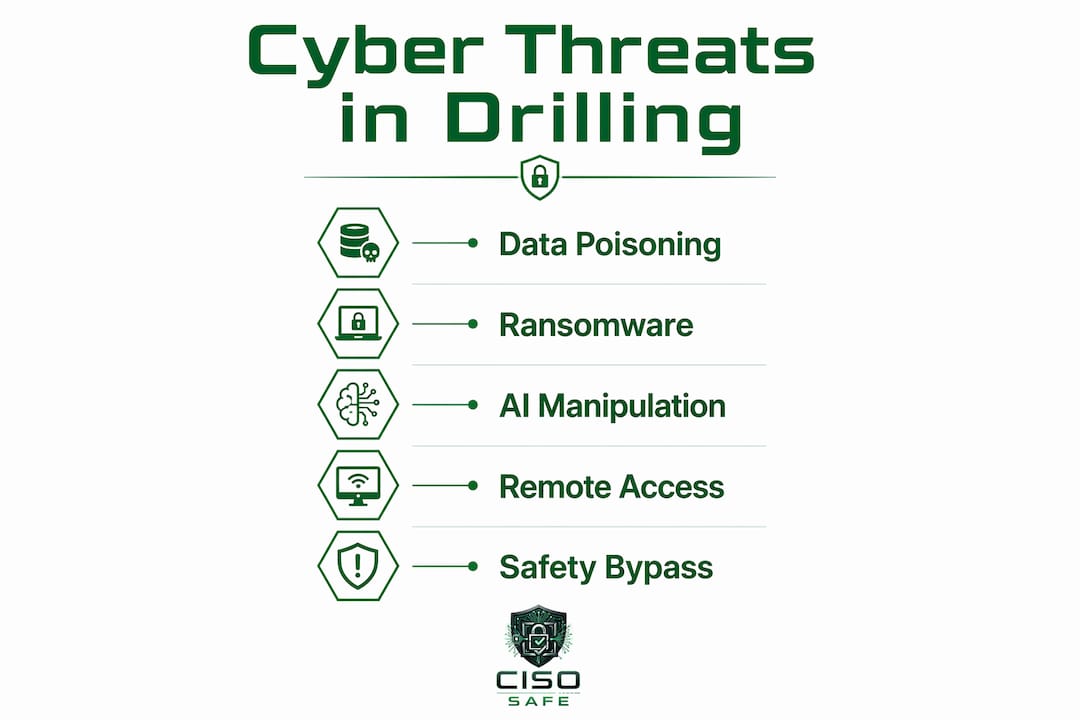
Physical safety compounds the financial risk. Cyberattacks increasingly bypass Safety Instrumented Systems, with state-sponsored actors using intrusions not just to steal data but to directly threaten safety controls. The Triton malware incident demonstrated that adversaries are willing and able to target the last line of defense against catastrophic accidents like explosions or toxic releases. Cybersecurity in drilling is, at its core, a safety issue.
What types of cyber threats specifically target drilling operations?
Drilling environments face a distinct threat profile that differs from standard enterprise IT attacks. The most consequential threats include:
- Ransomware at the IT/OT boundary. Attackers encrypt both business systems and OT historian data simultaneously, forcing operators to choose between paying ransom and halting production. Downtime on an offshore rig can cost hundreds of thousands of dollars per day.
- Stealthy malware in ICS networks. 13% of malware in recent OT incidents operated silently without triggering traditional alerts. This means infections can persist for weeks before any detection, giving adversaries time to map control systems and position for a disruptive payload.
- Data poisoning attacks on AI-driven drilling software. AI applications in drilling rely on streaming sensor data. Attackers who manipulate sensor data can cause AI-driven controls to make incorrect decisions, leading to operational failures and unsafe wellbore conditions. This attack vector is subtle and difficult to detect without data integrity monitoring.
- State-sponsored attacks on safety systems. Nation-state actors target SIS controllers to create conditions for physical damage. These attacks require deep knowledge of drilling physics and control parameters, which sophisticated adversaries now possess.
Pro Tip: Map every data flow between your IT and OT networks before selecting detection tools. Threats like data poisoning are invisible to tools that only monitor network packets without understanding the process values those packets carry.
The evolution of cyber threats in drilling is accelerating as AI integration deepens. Each new automated system added to a rig expands the attack surface available to adversaries.
Why are OT systems in drilling uniquely vulnerable?
Operational technology in drilling carries vulnerabilities that IT security teams rarely encounter in enterprise environments. Four factors define this exposure:
-
Legacy hardware with no patch path. Programmable logic controllers (PLCs) and distributed control systems (DCS) in drilling often run proprietary operating systems with lifecycles measured in decades. Vendors frequently do not release security patches, and applying patches requires controlled shutdowns that operators cannot schedule without significant cost.
-
Proprietary protocols invisible to IT tools. Drilling control systems communicate over protocols like Modbus, DNP3, and OPC-UA. Standard IT security tools do not parse these protocols. Traditional IT cybersecurity tools lack visibility into ICS protocols and operational context, which means sophisticated attacks operating within normal-looking OT traffic go undetected.
-
Connectivity requirements that eliminated air gaps. Remote operations centers, third-party service providers, and cloud analytics platforms all require persistent network connections to rig systems. The air gap that once protected OT environments no longer exists in most modern drilling operations. 26% of oil and gas attack surfaces relate directly to insecure remote access and default credentials.
-
Safety priorities that delay security responses. When a security team identifies a vulnerability in a drilling control system, the remediation path requires coordination with operations, HSE, and the equipment vendor. Patching a live well control system is not comparable to patching a corporate laptop. Vulnerability management findings constitute 31% of issues affecting oil and gas, reflecting how difficult remediation is in this environment.
Understanding OT security governance in the energy sector requires recognizing that security decisions always compete with production priorities. That competition consistently delays remediation.
How do monitoring gaps affect drilling cyber resilience?
The detection confidence problem in drilling cybersecurity is one of the most consequential mismatches in critical infrastructure security. 87% of upstream and midstream operators express confidence in detecting OT breaches within 24 hours. Only 16% rely on continuous OT-native monitoring. That gap between confidence and capability is where attackers operate.
The tools most operators use to monitor OT environments were built for IT networks. They generate alerts based on IP traffic patterns, file system changes, and user authentication events. None of those signals are meaningful in a drilling control network where a PLC communicates with a sensor thousands of times per hour using a protocol the tool cannot read.
The organizational dimension compounds the technical problem:
- IT/OT culture gap. 45% of operators cite the IT/OT culture gap as the largest barrier to advancing security. IT security teams think in terms of data confidentiality and patch cycles. OT engineers think in terms of uptime and process stability. Neither group fully understands the other's constraints.
- Manual detection as a primary method. 27% of operators depend on manual detection by field operators. A driller noticing unusual behavior on a control screen is not a cybersecurity detection mechanism. Adversaries who understand drilling operations can manipulate systems in ways that appear to be normal operational variation.
- Non-standardized risk assessments. The lack of standardized cybersecurity assessment checklists forces drilling contractors to navigate inconsistent and inefficient risk evaluation processes across operators. Each operator prioritizes different controls, which means a contractor's security posture is evaluated differently depending on who is asking.
Pro Tip: Conduct a tabletop exercise that specifically tests your OT detection capability. Ask your security team to demonstrate, not describe, how they would detect a data poisoning attack on your drilling control system. The answer will clarify your actual detection posture.
The variability in cybersecurity assessments across the drilling sector creates compliance fatigue without improving security outcomes. Standardization under frameworks like IEC 62443 addresses this directly.
What strategies can drilling operators use to reduce cyber risk?
Reducing cyber risk in drilling requires a different approach than standard IT security programs. The following strategies address the specific conditions of OT environments:
- Deploy OT-native monitoring tools. Tools built for ICS environments parse Modbus, DNP3, and OPC-UA traffic and establish behavioral baselines for normal process values. Anomalies in control commands or sensor readings trigger alerts that IT tools would never generate. Oil and gas leads all sectors in OT malware detection gaps, and OT-native monitoring is the direct remedy.
- Implement secure remote access architecture. Replace direct VPN connections to OT networks with jump hosts and privileged access workstations. Require multi-factor authentication for all remote sessions. Audit third-party vendor access regularly and revoke credentials immediately after work is complete.
- Adopt risk-based vulnerability management. Prioritize vulnerabilities based on operational impact, not just CVSS scores. A critical vulnerability in a system that cannot be patched without a planned shutdown requires a compensating control, not an ignored ticket. Frame patching decisions around production risk and safety impact.
- Build IT/OT collaboration into security governance. Assign OT security responsibilities to personnel with process knowledge, not just IT credentials. Joint incident response exercises between IT security and operations teams reduce response time and improve detection accuracy.
- Pursue standardized assessment frameworks. Engage with IADC cybersecurity working groups and adopt IEC 62443 as a baseline. Standardized assessments reduce the compliance burden on contractors and produce more consistent security outcomes across the sector.
Pro Tip: Treat remote access security as your highest-priority OT control. Most successful intrusions into drilling OT environments enter through internet-facing remote access systems, not through sophisticated zero-day exploits.
Key Takeaways
Drilling operations face cyber risk because legacy OT systems, IT/OT convergence, and inadequate OT-native monitoring create detection gaps that adversaries exploit before operators realize an intrusion has occurred.
| Point | Details |
|---|---|
| IT/OT convergence is the root cause | Connecting legacy OT systems to modern networks creates the attack surface that adversaries target. |
| Detection confidence exceeds detection capability | 87% of operators believe they can detect breaches, but only 16% use continuous OT-native monitoring. |
| Physical safety is directly at risk | Cyberattacks on Safety Instrumented Systems can cause explosions or toxic releases, not just data loss. |
| Standardized assessments reduce risk | Inconsistent evaluation processes across operators create compliance fatigue without improving security. |
| OT-native tools are non-negotiable | IT security tools cannot parse ICS protocols, making them ineffective for drilling control network monitoring. |
The detection gap is the real crisis
After working with energy sector clients across the Gulf Coast and beyond, the pattern I see most consistently is not a lack of security investment. It is a mismatch between where investment goes and where the actual risk lives. Operators spend on firewalls, endpoint detection, and SIEM platforms. Those tools protect the corporate network. They do not see what is happening inside a drilling control system.
The 87% confidence figure is the most alarming data point in this space. Confidence without capability is more dangerous than acknowledged ignorance, because it stops organizations from asking the right questions. A security team that believes it would detect an OT breach within 24 hours will not prioritize OT-native monitoring. That assumption is exactly what sophisticated adversaries count on.
The physical safety dimension changes the calculus entirely. A ransomware attack on a corporate network is a business continuity problem. A cyberattack that manipulates well control parameters or disables a blowout preventer is a life-safety event. The industry has not fully internalized that distinction in its security investment decisions. IEC 62443 provides the framework. IADC guidelines provide the sector-specific context. What most operators still lack is the OT security expertise to implement both in a way that integrates with their operational reality.
Standardization is the most undervalued lever available to the sector right now. If operators aligned on a common assessment checklist, contractors could demonstrate their security posture once rather than responding to dozens of different questionnaires. That efficiency gain would free resources for actual security improvement rather than compliance documentation.
— vCISO
How CisoSafe supports drilling cybersecurity programs
Drilling operators and contractors who recognize their OT security gaps need more than a framework document. They need experienced security leadership that understands both the compliance requirements and the operational realities of the energy sector.
CisoSafe provides virtual CISO services built specifically for energy sector organizations, including oil and gas operators managing OT environments. The CisoSafe team delivers security assessments aligned to IEC 62443 and IADC guidelines, risk roadmaps that account for operational constraints, and incident response planning that addresses OT-specific scenarios. For drilling organizations that cannot justify a full-time CISO but face enterprise-grade threats, CisoSafe delivers the expertise and governance structure to close the detection and compliance gaps that put operations at risk.
FAQ
Why do drilling operations face higher cyber risk than other industries?
Drilling operations combine legacy OT systems, high-value targets, and costly downtime into an environment that adversaries find highly attractive. The convergence of IT and OT networks in modern rigs eliminates the air gaps that historically protected control systems.
What is the biggest cybersecurity gap in drilling operations today?
The largest gap is between detection confidence and actual detection capability. 87% of operators believe they can detect OT breaches within 24 hours, but only 16% use continuous OT-native monitoring tools capable of seeing ICS-level threats.
How does a cyberattack on drilling affect physical safety?
Attacks targeting Safety Instrumented Systems can disable the controls designed to prevent blowouts, explosions, and toxic releases. State-sponsored actors have demonstrated the capability and intent to target these systems, as the Triton malware incident confirmed.
What is IEC 62443 and why does it matter for drilling?
IEC 62443 is the international standard for industrial cybersecurity, covering security requirements for OT systems and networks. It provides the baseline framework that drilling operators and contractors use to structure their cybersecurity programs and assessments.
How can drilling contractors manage inconsistent cybersecurity assessments from different operators?
Engaging with IADC cybersecurity working groups and advocating for standardized assessment checklists reduces the burden of responding to inconsistent operator requirements. Adopting IEC 62443 as a common baseline gives contractors a defensible security posture that satisfies multiple operator frameworks simultaneously.