

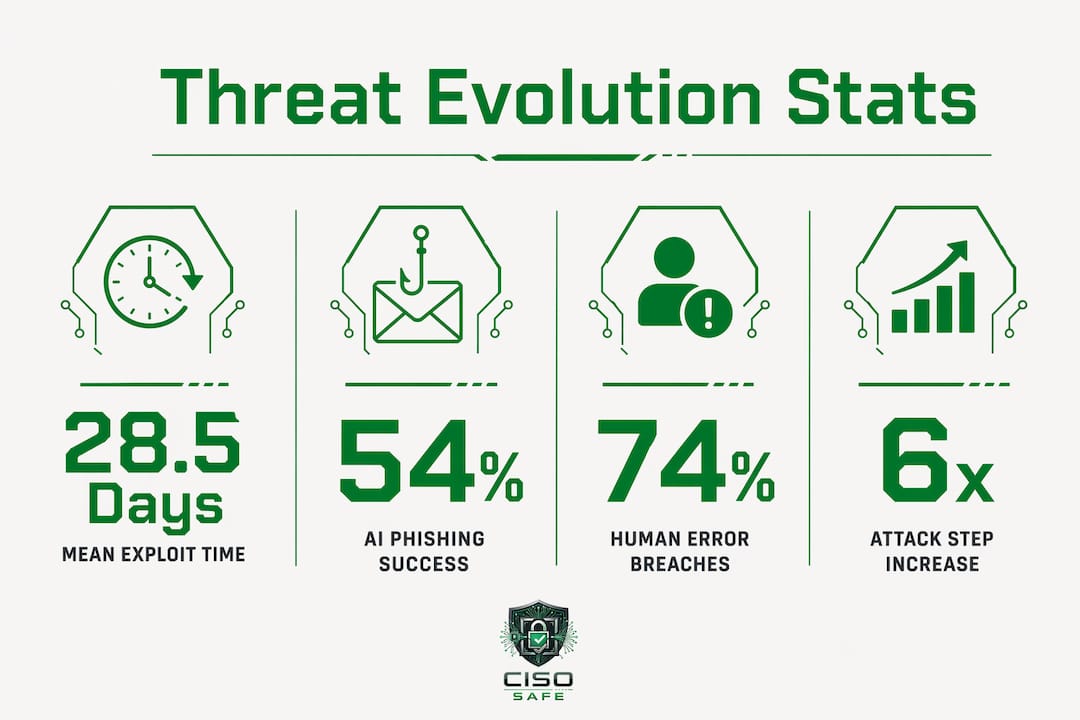
Cyber threat evolution is defined as the continuous acceleration of attacker capabilities driven by AI automation, industrialized cybercrime models, and shrinking vulnerability windows. Understanding cyber threats today means recognizing that the gap between when a flaw is discovered and when it is exploited has collapsed from 61 days to just 28.5 days, according to recent exploit timing data. CISA's Known Exploited Vulnerabilities catalog now receives new entries within a median of 5.0 days of public disclosure. The causes of cyber threats are no longer just technical. They are structural, organizational, and increasingly automated. This guide explains the forces behind why cyber threats evolve rapidly and what that means for your risk management decisions.
Why do cyber threats evolve rapidly?
Cyber threats evolve rapidly because attackers now operate with the same efficiency advantages that technology gives defenders, and often faster. Three forces drive this acceleration: AI-powered attack tooling, industrialized cybercrime business models, and the persistent exploitation of human behavior. Each force compounds the others. An attacker using generative AI to craft phishing content, operating within a ransomware-as-a-service network, and targeting an employee who clicks without thinking represents a threat that no single defensive layer can stop alone. Recognizing these forces is the first step toward building a defense that keeps pace.
How AI and automation accelerate cyberattack development
Generative AI has fundamentally changed the speed and precision of attacks. AI-driven phishing operations now achieve 54% click-through rates compared to 12% for traditional campaigns, a 450% increase in effectiveness. That gap reflects how well AI personalizes lures at scale, producing messages that match a target's writing style, role, and recent activity without any manual effort from the attacker.
The capability ceiling is rising fast. Frontier AI models in early 2026 can complete nearly six times more attack steps than models from 18 months earlier. That means tasks that once required an expert, such as identifying exploitable misconfigurations or chaining vulnerabilities together, are now within reach of low-skilled actors. Funding, not technical knowledge, has become the main limiting factor for sophisticated attacks.

AI also compresses exploit development timelines. Attackers use AI to reverse-engineer patches within hours of release, then build working exploits before most organizations have finished their testing and deployment cycles. This is not a future risk. It is the current operating environment.
The practical implications for security teams include:
- Automated spear-phishing at scale: AI generates thousands of personalized messages per hour, making volume-based filtering less effective.
- Faster vulnerability weaponization: AI tools scan public patch notes and CVE disclosures to identify exploitable logic before defenders act.
- Lower attacker skill thresholds: Pre-built AI attack modules reduce the expertise needed to execute complex intrusions.
- Adaptive malware behavior: AI-assisted malware can modify its own code to evade signature-based detection tools.
Pro Tip: Monitor threat intelligence feeds that specifically track AI-assisted attack indicators, such as unusual phishing language patterns or exploit code appearing within 48 hours of a CVE publication. Services that provide cyber threat intelligence contextualized for your industry give you a meaningful head start.
What happens when patch windows collapse?
The traditional patch management cycle assumed organizations had weeks to test and deploy fixes. That assumption is no longer valid. The median time from vulnerability disclosure to active exploitation now sits at 28.5 days, down from 61 days. The window between public disclosure and CISA's KEV catalog entry has shrunk to just 5.0 days.
The collapse of the patch window changes risk management math entirely. A vulnerability that enters the KEV catalog within five days of disclosure means your team has less than a week to assess, prioritize, and begin remediation before attackers are already using it in the wild. For organizations running quarterly patch cycles, that math does not work.
| Metric | Previous baseline | Current (2026) |
|---|---|---|
| Mean time to exploit | 61 days | 28.5 days |
| Median time to KEV inclusion | 8.5 days | 5.0 days |
| Patch cycle assumption | Weeks available | Days or less |
Attackers do not treat all vulnerabilities equally. Rapid7's 2026 threat analysis shows attackers prioritize vulnerabilities that enable pre-authentication access, repeatable execution, and rapid data theft. That focus matters for defenders. Broad-spectrum patching wastes resources. Contextual exploitability, meaning whether a flaw is reachable, weaponizable, and valuable to an attacker in your specific environment, is the right prioritization lens.
Vulnerability scanning programs that run continuously and feed into risk-ranked remediation queues are now a baseline requirement, not a best practice. Organizations still running monthly or quarterly scans are operating with a blind spot that attackers actively exploit.
How does the human element drive breach risk?
Human behavior remains the most consistent attack vector across all threat categories. 74% of data breaches in 2026 involve human elements including errors, privilege misuse, and social engineering. That figure has held steady across multiple years of reporting, which tells you something important: technical controls alone do not solve this problem.
Social engineering works because it targets decision-making under pressure, not technical knowledge gaps. An employee receiving a well-crafted, AI-personalized email from what appears to be their CFO asking for an urgent wire transfer is not making a technical mistake. They are making a human one. AI makes these scenarios more convincing by incorporating real names, accurate organizational context, and appropriate urgency cues.
The primary human risk vectors include:
- Phishing and spear-phishing: Still the leading initial access method, now enhanced by AI personalization.
- Privilege misuse: Employees with excessive access rights create exposure even without malicious intent.
- Credential reuse: Passwords shared across personal and work accounts give attackers a low-effort entry point.
- Social engineering via voice and SMS: Vishing and smishing attacks bypass email filters entirely.
Pro Tip: Integrate human risk management directly into your security program, not as a separate awareness training checkbox. Behavioral analytics tools that flag anomalous access patterns catch privilege misuse that training alone will not prevent. For legal teams and other high-stakes environments, ABA cybersecurity guidelines provide a useful framework for structuring human risk controls.
How professionalization of cybercrime reshapes threat dynamics
Cybercrime has matured into a structured industry with division of labor, customer support, and service-level agreements. Ransomware-as-a-service platforms now offer specialized roles, affiliate programs, and even refund policies for dissatisfied customers. This model democratizes sophisticated attacks by separating the technical development of attack tools from their deployment.
The implications are significant. An attacker no longer needs to build malware, identify targets, and manage extortion negotiations. They can purchase each capability separately from specialized providers. This division of labor increases attack volume and lowers the skill floor for anyone seeking to cause harm.
The cybercrime ecosystem now resembles a mature enterprise, with R&D investment, quality assurance, and customer acquisition strategies. That structure means defenders are not fighting individual hackers. They are competing against organizations with resources, processes, and incentives to keep improving.
Key structural features of the modern cybercrime industry include:
- Initial access brokers: Specialists who compromise networks and sell access to ransomware operators.
- Exploit kit marketplaces: Platforms offering ready-to-deploy attack tools for specific vulnerabilities.
- Affiliate networks: Revenue-sharing models that recruit deployers without requiring technical expertise.
- Negotiation services: Third-party specialists who handle ransom communications on behalf of attackers.
This industrialization explains why attack volume keeps rising even as individual attacker sophistication varies widely. The National Academies note that AI will continue to elevate near-term cybersecurity risks precisely because it lowers the cost of entry into this ecosystem even further.
Key takeaways
Cyber threats evolve rapidly because AI automation, industrialized cybercrime, and persistent human vulnerabilities each compress the time defenders have to respond.
| Point | Details |
|---|---|
| Patch windows have collapsed | Mean time-to-exploit dropped from 61 to 28.5 days, requiring continuous remediation cycles. |
| AI multiplies attacker efficiency | Frontier AI models complete six times more attack steps than 18 months ago, lowering skill barriers. |
| Human factors drive most breaches | 74% of breaches involve human elements, making behavioral controls as critical as technical ones. |
| Cybercrime is now industrialized | Ransomware-as-a-service separates tool development from deployment, increasing attack volume. |
| Context beats volume in patching | Prioritizing contextually exploitable vulnerabilities yields better outcomes than patching everything at once. |
What I've learned from watching threats outpace defenses
Most organizations I work with understand that threats are getting worse. Fewer understand why the pace keeps accelerating, and that gap in understanding leads to the wrong investments.
The most common mistake I see is treating threat evolution as a technology problem with a technology solution. Teams buy more tools, add more alerts, and still get breached because the fundamental issue is speed. Attackers operate in hours. Most security programs still operate in weeks. No tool closes that gap if your processes and decision-making cycles are still built around monthly patch cycles and annual risk assessments.
The shift I recommend is from periodic to continuous. Continuous vulnerability scanning, continuous threat intelligence ingestion, and continuous human risk monitoring. This is not about spending more. It is about changing the operating rhythm of your security program to match the rhythm of your adversaries.
The second thing I have learned is that AI-enabled attackers require AI-assisted defenders. Human analysts cannot process the volume of signals that modern environments generate. The NCSC's guidance on frontier AI is direct on this point: defenders must blend human expertise with AI-driven monitoring to keep pace. That means investing in platforms that surface high-priority signals, not just more dashboards.
For business leaders, the strategic priority is clear. Fund continuous monitoring and contextual risk prioritization before you fund more perimeter tools. The perimeter is already inside your organization, in your employees' inboxes and your vendors' access credentials.
— vCISO
How CisoSafe supports proactive defense against evolving threats
Staying ahead of rapidly evolving threats requires more than periodic assessments. It requires continuous monitoring, contextual risk prioritization, and expert guidance that scales with your organization.
CisoSafe delivers virtual CISO services built for regulated industries including law firms, energy operators, and compliance-sensitive mid-market organizations. The platform combines AI-powered threat intelligence, automated vulnerability management, and hands-on advisory to give your leadership team clear visibility into risk without requiring a full-time internal security staff. Whether you need to meet SOC 2, HIPAA, PCI DSS, or CMMC requirements, CisoSafe aligns your security program with the speed that today's threat environment demands.
FAQ
Why do cyber threats evolve so much faster now?
AI automation and industrialized cybercrime have compressed attack development timelines significantly. The mean time from vulnerability disclosure to active exploitation has dropped to 28.5 days, and AI tools allow attackers to build exploits within hours of a patch release.
What is the biggest driver of cyber threat evolution in 2026?
Generative AI is the single largest accelerant. It enables personalized phishing at scale, automated exploit development, and lowers the technical skill required to execute sophisticated attacks.
How does human error contribute to evolving cyber threats?
74% of breaches involve human elements such as social engineering, privilege misuse, and credential errors. AI-enhanced social engineering makes these attacks harder to detect and easier to execute at volume.
What is ransomware-as-a-service and why does it matter?
Ransomware-as-a-service is a cybercrime business model where attack tools are developed by specialists and licensed to deployers through affiliate networks. It separates technical expertise from attack execution, increasing the volume and reach of ransomware campaigns.
How should organizations respond to faster exploitation timelines?
Organizations should shift from periodic to continuous vulnerability management and prioritize remediation based on contextual exploitability rather than raw vulnerability counts. Pairing continuous threat monitoring with expert risk prioritization is the most effective response to compressed patch windows.