

Vulnerability scanning is defined as an automated process that evaluates IT assets including networks, servers, endpoints, and applications to identify known security weaknesses and produce prioritized findings for remediation. The industry standard term is "vulnerability scanning," and it sits at the foundation of every mature vulnerability management program. Scanners compare discovered asset versions against databases like the NIST National Vulnerability Database, which catalogs flaws using Common Vulnerabilities and Exposures (CVE) identifiers and scores them with the Common Vulnerability Scoring System (CVSS). For IT professionals and security managers in regulated industries, understanding this process is not optional. It is the first line of defense before auditors, attackers, or regulators find what your team missed.
What is vulnerability scanning and how does it work?
Vulnerability scanning follows a repeatable, four-stage process: asset discovery, fingerprinting, database matching, and reporting. Each stage builds on the last, and skipping any one of them degrades the quality of the final output.
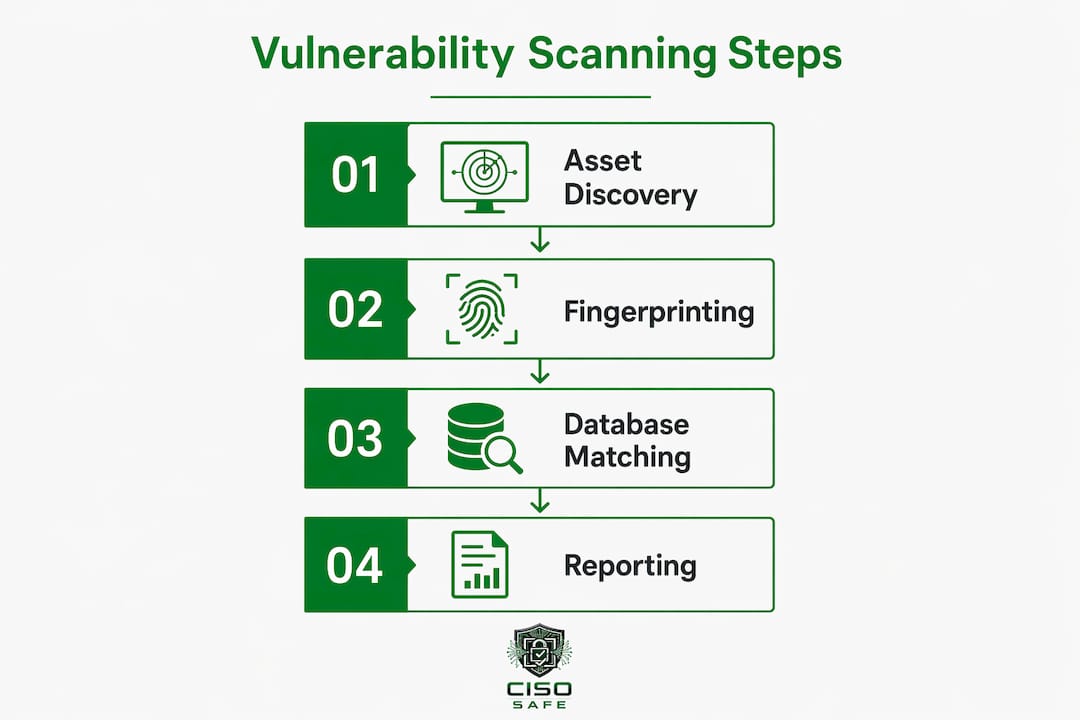
Asset discovery and fingerprinting come first. The scanner maps every reachable device, service, or application on the target scope. It identifies operating system versions, open ports, running services, and installed software. This fingerprint is what the scanner uses to match against known vulnerability databases.

Database matching and scoring happen next. The scanner compares each fingerprinted asset against CVE records and assigns a CVSS severity score to every finding. Not all vulnerabilities pose equal risk, so CVSS scores combined with exploitability context help security teams decide where to focus remediation effort first. A critical CVSS 9.8 finding on an internet-facing server demands immediate action. A medium-severity finding on an isolated internal workstation does not.
The scan then produces a structured report. That report becomes the input to your vulnerability management workflow: prioritize, assign, remediate, and rescan to verify the fix.
Credentialed vs. non-credentialed scanning
The scanning mode you choose changes what you can see. Credentialed scans access internal system states by authenticating directly to the target, reading patch levels, configuration files, and installed software versions. Non-credentialed scans simulate an outsider's view, probing only what is exposed externally. Combining both modes gives you the most complete picture of your attack surface.
Credentialed scanning also reduces false positives by verifying patch and configuration state directly rather than guessing from external banners. For compliance reporting under frameworks like PCI DSS or HIPAA, that accuracy matters. Auditors want evidence, not estimates.
Pro Tip: Run credentialed scans on all internal assets at least monthly and non-credentialed scans on your external perimeter weekly. The two scan types answer different questions and should never substitute for each other.
What types of vulnerability scans exist?
Security teams use several distinct scan types, and the right choice depends on what you are protecting and how it is deployed.
- Network vulnerability scans target IP ranges, routers, firewalls, and servers. Network vulnerability scanning tools like Tenable Nessus and Qualys VMDR are the most widely deployed in enterprise environments.
- Web application scans probe HTTP and HTTPS endpoints for flaws like SQL injection, cross-site scripting, and authentication bypass. Web application scanning tools such as Burp Suite Professional and OWASP ZAP are purpose-built for this layer.
- Host-based scans run directly on an endpoint or server, giving deep visibility into local configuration, user permissions, and installed software.
- Cloud and container scans assess infrastructure-as-code templates, container images, and cloud service configurations for misconfigurations and known CVEs.
- Continuous scanning runs on an automated schedule or triggers on change events, feeding real-time data into a vulnerability management dashboard.
Scheduled vs. continuous scanning: which fits your environment?
| Approach | Best for | Limitation |
|---|---|---|
| Scheduled scanning | Stable, low-change environments | Misses vulnerabilities introduced between scan windows |
| Continuous scanning | Dynamic cloud, DevOps, or high-change environments | Requires more infrastructure and tuning |
| Agent-based scanning | Distributed endpoints, remote workers | Agent deployment and maintenance overhead |
| Agentless scanning | Network devices, legacy systems | Less visibility into internal system state |
Scan-once approaches are operationally ineffective for maintaining security posture because new vulnerabilities arise continuously from updates, misconfigurations, and new deployments. Continuous or high-frequency scanning is the standard for regulated industries where the threat environment changes daily.
How does vulnerability scanning compare to penetration testing?
Vulnerability scanning and penetration testing are not interchangeable. They answer different questions and serve different purposes in a security program.
Scanning is automated and broad. It identifies known weaknesses quickly across a large asset inventory. Penetration testing is manual and targeted. A skilled tester simulates real attacker behavior to validate whether a discovered weakness can actually be exploited and what the downstream impact would be.
The practical difference matters for regulated organizations:
- Scanning tells you what is exposed across your environment.
- Penetration testing tells you what an attacker can actually do with that exposure.
- Scanning produces a broad list of findings; penetration testing produces a validated attack chain.
- Scanning runs continuously or on a schedule; penetration testing typically runs annually or after major changes.
- Scanning alone does not prove exploitability. Validation from penetration testing confirms real attacker risk.
The most effective security programs use both. Scanning feeds a continuous remediation workflow. Penetration testing validates the highest-risk findings and uncovers logic flaws that automated tools miss entirely. Treating scanning as a substitute for penetration testing is one of the most common and costly mistakes security managers make.
What role does vulnerability scanning play in compliance?
Vulnerability scanning is a direct control requirement in most major compliance frameworks. PCI DSS requires quarterly external scans by an Approved Scanning Vendor and internal scans after any significant network change. HIPAA's Security Rule requires regular technical and nontechnical evaluations of security controls. CMMC Level 2 and above require continuous monitoring of system vulnerabilities.
NIST's Security Content Automation Protocol (SCAP) standardizes how security flaw and configuration data is communicated, enabling automated compliance checks and auditable evidence. SCAP-compatible scanners produce output that maps directly to NIST SP 800-53 controls, making audit preparation significantly faster.
The vulnerability management lifecycle in a compliance context follows a clear sequence: discover assets, assess and prioritize findings by CVSS score and business context, remediate or accept risk with documented justification, and rescan to verify closure. Each step generates evidence that auditors can review.
| Compliance framework | Scanning requirement | Scan frequency |
|---|---|---|
| PCI DSS | External ASV scans required | Quarterly minimum |
| HIPAA Security Rule | Technical evaluation of controls | Regular (risk-based) |
| CMMC Level 2+ | Continuous vulnerability monitoring | Ongoing |
| SOC 2 Type II | Vulnerability management as a control | Ongoing with evidence |
Pro Tip: Map your scan findings directly to your compliance framework controls before your audit. A CVSS-scored finding tied to a specific NIST control is audit evidence. An unorganized scan report is just noise.
Scan accuracy depends on how current your vulnerability intelligence is and how complete your asset inventory is. Outdated vulnerability data or missing assets create gaps that give a false sense of security. A cybersecurity maturity assessment can help you identify where your asset inventory and scanning coverage fall short before an auditor does.
Key Takeaways
Vulnerability scanning is the automated foundation of every effective security and compliance program, but its value depends entirely on what you do with the findings after the scan completes.
| Point | Details |
|---|---|
| Core definition | Vulnerability scanning automatically identifies known security weaknesses across networks, servers, and applications. |
| Scanning modes matter | Credentialed scans verify internal patch state; non-credentialed scans show external exposure. Use both. |
| Scanning is not pentesting | Scanning finds known weaknesses broadly; penetration testing validates whether those weaknesses can be exploited. |
| Compliance requires scanning | PCI DSS, HIPAA, CMMC, and SOC 2 all mandate vulnerability scanning as a documented, recurring control. |
| Continuous beats periodic | One-time or infrequent scans miss vulnerabilities introduced between scan windows in dynamic environments. |
What I've learned running scanning programs in regulated environments
Security managers often ask me which scanner to buy. That is the wrong first question. The right question is: what will you do with the findings?
I have seen organizations run weekly Tenable Nessus scans and still fail PCI DSS audits because no one owned the remediation workflow. The scanner produced thousands of findings. The team triaged none of them. The combining of multiple scanning perspectives is necessary to reduce blind spots, but blind spots in your process are more dangerous than blind spots in your tooling.
The second mistake I see constantly is treating asset discovery as a one-time setup task. In oil and gas environments and law firms with distributed offices, assets change weekly. A scanner that does not know a new server exists cannot tell you it is vulnerable. Pair your scanning program with a vendor cybersecurity assessment process so third-party assets and integrations do not fall outside your scan scope.
My honest recommendation: start with credentialed internal scans and external perimeter scans running on a fixed schedule. Get your remediation workflow working before you add continuous scanning. A mature process with a basic tool outperforms a broken process with the top vulnerability scanner on the market every time.
— vCISO
How CisoSafe supports your vulnerability scanning program
CisoSafe works with law firms, energy operators, and compliance-sensitive organizations across the United States to build and manage vulnerability scanning programs that satisfy auditors and reduce real risk.
Our virtual CISO services include scan program design, credentialed and non-credentialed scan configuration, CVSS-based remediation prioritization, and compliance-mapped reporting for SOC 2, PCI DSS, HIPAA, and CMMC. We do not hand you a scan report and walk away. We own the remediation workflow with your team, track closure, and produce the audit evidence your compliance frameworks require. If your organization needs expert-led vulnerability management without the cost of a full-time CISO, CisoSafe delivers that outcome directly.
FAQ
What is vulnerability scanning in simple terms?
Vulnerability scanning is an automated process that checks your IT systems for known security weaknesses and produces a prioritized list of issues to fix. It compares your assets against databases like the NIST CVE catalog and scores each finding by severity.
How often should vulnerability scans run?
PCI DSS requires quarterly external scans at minimum, but most regulated environments benefit from monthly internal scans and continuous or weekly external perimeter scans. Dynamic environments with frequent deployments require continuous scanning.
What is the difference between free vulnerability scanning tools and paid scanners?
Free vulnerability scanning tools like OpenVAS and OWASP ZAP provide solid coverage for specific use cases but typically lack enterprise features like credentialed scanning at scale, compliance reporting templates, and integration with ticketing systems. Paid platforms like Tenable Nessus or Qualys VMDR offer broader coverage and audit-ready reporting.
Do vulnerability scans replace penetration testing?
Vulnerability scans do not replace penetration testing. Scanning identifies known weaknesses automatically; penetration testing manually validates whether those weaknesses can be exploited by a real attacker. Compliance frameworks like PCI DSS require both.
What network vulnerability scanning tools are most widely used?
Tenable Nessus, Qualys VMDR, and Rapid7 InsightVM are among the most widely deployed network vulnerability scanning tools in enterprise and regulated environments. Each supports credentialed scanning, CVSS scoring, and compliance-mapped reporting.