

A vendor cybersecurity assessment is a structured evaluation of a third-party vendor's security controls, policies, and risk posture to determine whether the cyber risk they introduce is acceptable to your organization. Also called third-party security assessment or vendor security evaluation in formal risk management contexts, this process sits at the core of any mature vendor risk management program. Frameworks like NIST SP 800-161 and SOC 2 provide the compliance scaffolding, but the assessment itself is the mechanism that tells you whether a vendor's controls actually protect your data. With supply chain attacks growing in frequency and sophistication, organizations that skip or shortcut this process are leaving their most sensitive systems exposed through their own trusted partners.
What is a vendor cybersecurity assessment and why does it matter?
A vendor cybersecurity assessment is a proactive, risk-informed evaluation designed to answer one question: does this vendor introduce cyber risk we can manage, and if so, how? The output is a decision: onboard the vendor as-is, onboard with contractual safeguards and remediation requirements, or reject the vendor entirely. This distinguishes it from a passive compliance review.
The importance of vendor assessments has grown in direct proportion to how deeply vendors are embedded in modern operations. Law firms share client records with e-discovery platforms. Energy operators connect field systems to third-party monitoring software. Healthcare organizations route patient data through billing vendors. Each connection is a potential entry point for attackers. Vendor security assessments provide the technical foundation within broader third-party risk management, focusing on controls, incident readiness, and monitoring capabilities at a level of granularity that general procurement reviews cannot match.

Regulatory frameworks reinforce this urgency. HIPAA, PCI DSS, CMMC, and SOC 2 all require organizations to demonstrate oversight of third parties who handle regulated data. A documented vendor cybersecurity assessment process is evidence of that oversight. Without it, compliance gaps become audit findings, and audit findings become liability.
What are the core steps in a vendor cybersecurity assessment process?
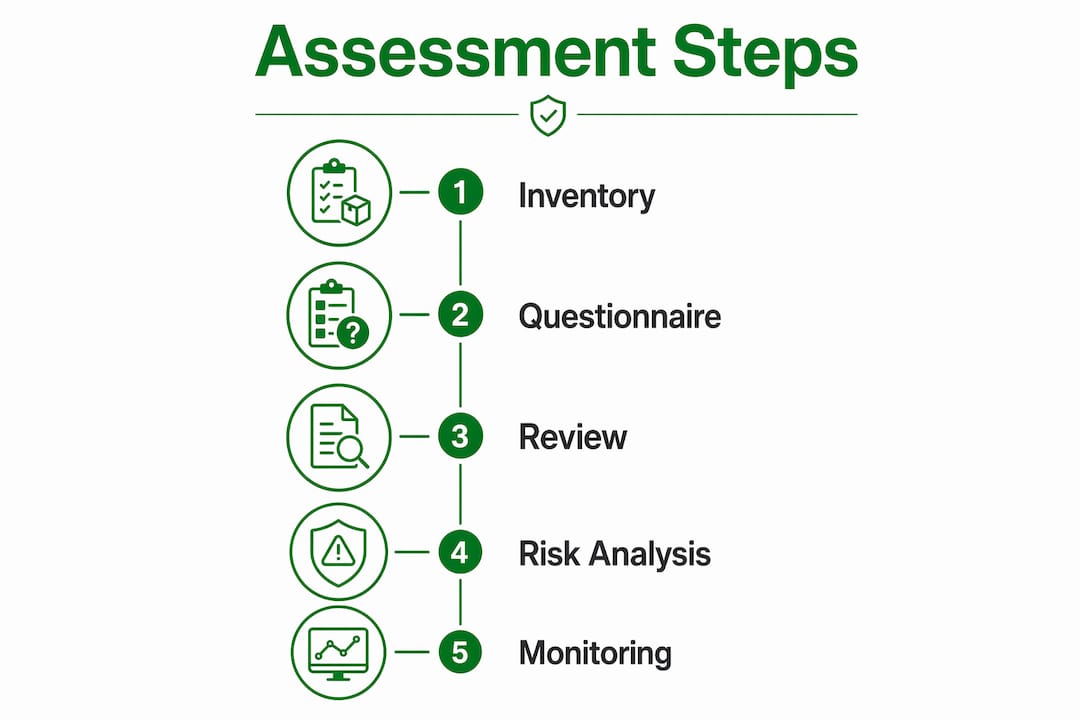
Modern vendor assessments follow a seven-step framework that moves from classification through continuous monitoring. Each step builds on the last, and skipping any one of them produces blind spots.
- Vendor classification. Assign each vendor a risk tier based on the sensitivity of data they access and the criticality of the systems they touch. A payroll processor handling employee PII sits in a different tier than an office supply vendor.
- Scoping. Define what systems, data types, and processes are in scope for the assessment. Scoping prevents both under-assessment of high-risk vendors and wasted effort on low-risk ones.
- Questionnaire deployment. Send a standardized security questionnaire covering access controls, encryption practices, incident response procedures, and subcontractor management. The Shared Assessments SIG and CAIQ are widely used templates.
- Documentation review. Collect and review supporting evidence: penetration test reports, audit logs, security policies, and third-party certifications like SOC 2 Type II or ISO 27001.
- Technical testing and validation. Conduct or commission external scans of the vendor's public-facing infrastructure. Questionnaire responses must be validated against observable technical reality.
- Remediation tracking. Document identified gaps, assign risk ratings, and require vendors to provide remediation timelines. High-severity findings should block onboarding until resolved.
- Continuous monitoring. Schedule reassessments based on risk tier. Critical vendors with sensitive data access require annual comprehensive assessments with quarterly check-ins for security changes.
Pro Tip: Organize your vendor inventory into three tiers before deploying a single questionnaire. Tier 1 vendors get full technical assessments. Tier 2 vendors get abbreviated questionnaires with documentation review. Tier 3 vendors get a lightweight self-attestation. This structure alone cuts assessment overhead by roughly half without reducing coverage where it counts.
The continuous monitoring step is where most programs fall short. A vendor that passes an assessment today can introduce new vulnerabilities next quarter through a software update, a new subcontractor, or a configuration change. Reassessment schedules tied to risk tiers keep your vendor risk posture current rather than historical.
How does a vendor cybersecurity assessment differ from audits and risk assessments?
These three terms are used interchangeably in many organizations, and that confusion leads to real gaps in protection. They serve different purposes and produce different outputs.
A vendor audit verifies that controls a vendor claims to have are actually in place. Audits are typically conducted by independent third parties and produce formal attestation reports. A SOC 2 Type II report is the product of an audit. It tells you that an auditor examined the vendor's controls over a defined period and found them operating as described. Audits are retrospective and point-in-time.
A vendor risk assessment is broader than a cybersecurity assessment. Vendor risk assessments include multiple risk categories such as cybersecurity, compliance, financial stability, operational continuity, and reputational exposure. A vendor risk assessment might flag that a critical supplier is financially distressed or that their geographic location creates regulatory complications. Cybersecurity is one input into that broader picture.
A vendor cybersecurity assessment is the most technically focused of the three. It evaluates specific security controls, tests their effectiveness, and produces a risk-informed recommendation about the vendor relationship. It is forward-looking and decision-oriented.
| Type | Focus | Output | Timing |
|---|---|---|---|
| Vendor cybersecurity assessment | Security controls and cyber risk posture | Risk-informed onboarding decision | Pre-onboarding and periodic |
| Vendor audit | Verification of stated controls | Attestation report (e.g., SOC 2) | Point-in-time, retrospective |
| Vendor risk assessment | Cyber, financial, operational, reputational risk | Holistic risk profile | Pre-onboarding and periodic |
Understanding which tool to use and when prevents organizations from substituting an audit report for an actual assessment. Receiving a vendor's SOC 2 report is not the same as assessing whether that vendor's controls address your specific risk exposure.
What challenges and misconceptions surround vendor cybersecurity assessments?
The most damaging misconception in vendor security evaluation is that a compliance certification equals security. SOC 2 and similar certifications indicate adherence to a framework at a point in time but do not guarantee current security or relevance to your specific risks. A vendor can hold a valid SOC 2 Type II report while running unpatched servers that directly handle your data. The certificate covers what the auditor examined. Your assessment must cover what matters to you.
Several other pitfalls consistently undermine vendor assessment programs:
- Static questionnaires without validation. Questionnaires alone yield incomplete or inaccurate data because vendors self-report. Without technical validation, you are trusting answers rather than verifying controls.
- No reassessment schedule. Treating the initial assessment as permanent is a structural error. Vendor environments change. New software, new staff, new subcontractors, and new attack surfaces emerge continuously.
- Inconsistent depth across vendors. Applying the same lightweight questionnaire to a Tier 1 vendor processing financial data as to a Tier 3 office supply vendor wastes effort in one direction and creates risk in the other.
- Treating assessment as a procurement hurdle. When the security team is brought in only to check a compliance box during procurement, assessments lose their protective function. They need to inform contract terms, SLAs, and ongoing monitoring.
- Manual administration at scale. Organizations managing dozens or hundreds of vendors cannot run effective programs on spreadsheets. Automating vendor assessment processes reduces administrative burden and improves focus on remediating high-risk issues instead of chasing vendor responses.
Pro Tip: Never accept a compliance certificate as a substitute for technical validation. Request evidence of the most recent penetration test, ask about remediated findings, and run an external scan of the vendor's public-facing infrastructure. Thirty minutes of technical review reveals more than a 200-question questionnaire answered by a vendor's marketing team.
How can business leaders implement vendor assessments for compliance and risk management?
Effective implementation requires treating vendor cybersecurity assessments as a program, not a project. A program has defined processes, assigned ownership, and scheduled activities. A project ends. Vendor risk does not.
- Build a vendor inventory and risk tier structure. You cannot assess what you have not cataloged. Map every vendor to the data they access and the systems they connect to. Assign risk tiers based on sensitivity and criticality. This inventory becomes the foundation for every subsequent decision.
- Integrate assessments into the full vendor lifecycle. Assessments are required at multiple lifecycle stages: sourcing, onboarding, periodic review, offboarding, and incident response. A vendor that loses a major client or experiences a breach mid-contract warrants an out-of-cycle assessment.
- Deploy automated tools for questionnaire management and monitoring. Automation enables questionnaire deployment, verification, and monitoring, improving efficiency and accuracy across large vendor populations. Platforms that combine questionnaire management with continuous external scanning give compliance teams real-time visibility without manual overhead.
- Use assessment findings to drive contract terms. Identified gaps should translate directly into contractual obligations. If a vendor lacks multi-factor authentication on systems that access your data, that remediation belongs in the contract with a defined deadline, not in a follow-up email.
- Integrate assessment data with your GRC platform. Vendor risk data sitting in a spreadsheet does not inform governance decisions. When assessment outputs feed into a governance, risk, and compliance platform, leadership gets consolidated visibility into third-party risk alongside internal risk metrics.
- Align assessment frequency with risk tier and regulatory requirements. HIPAA, CMMC, and PCI DSS each carry specific expectations for third-party oversight. Frequency and depth must satisfy both your internal risk appetite and your regulatory obligations.
The organizations that execute this well treat vendor assessment data as a living asset. They update it, act on it, and use it to make better procurement and contracting decisions. The ones that struggle treat it as documentation generated to satisfy an auditor.
Key takeaways
Vendor cybersecurity assessments are the most technically specific and decision-oriented tool in third-party risk management, and no compliance certificate replaces them.
| Point | Details |
|---|---|
| Assessment vs. audit | A cybersecurity assessment produces a risk decision; an audit produces an attestation report. They are not interchangeable. |
| Seven-step framework | Classification, scoping, questionnaires, documentation review, technical testing, remediation, and continuous monitoring form the standard process. |
| Compliance is not security | SOC 2 and similar certifications reflect a point-in-time audit, not current control effectiveness against your specific risks. |
| Automate at scale | Automated tools reduce manual overhead and shift team focus from administration to remediation of high-risk findings. |
| Lifecycle integration | Assessments must occur at sourcing, onboarding, periodic review, offboarding, and incident response, not just at initial procurement. |
The real shift happening in vendor security evaluation
I have worked with organizations across regulated industries, from energy operators in Houston to law firms handling sensitive client matters, and the pattern I see most often is this: the assessment program exists on paper, but it stops at the questionnaire. Leadership believes the vendor is vetted. The security team knows the questionnaire was self-reported and never validated. That gap between perception and reality is where breaches originate.
What I find genuinely encouraging is that the conversation is changing. Business leaders are starting to ask harder questions. They want to know not just whether a vendor is certified, but whether that certification covers the specific systems and data flows relevant to their organization. That is the right question, and it reflects a maturity shift that was not common five years ago.
The next frontier is AI-driven risk scoring. Platforms are beginning to aggregate external threat intelligence, dark web signals, and technical scan data into continuous vendor risk scores that update in near real time. This moves vendor assessment from a scheduled activity to a persistent monitoring function. For compliance officers managing dozens of critical vendors, that shift is significant. It does not eliminate the need for structured assessments, but it dramatically shortens the window between a vendor's security posture changing and your organization knowing about it.
The organizations that will manage third-party risk most effectively over the next several years are the ones building that continuous monitoring capability now, before a supply chain incident forces the issue.
— APM
How Cisosafe supports your vendor assessment program
Cisosafe delivers virtual CISO services and AI-powered compliance tools purpose-built for regulated industries where vendor risk is not theoretical. For law firms, energy operators, and compliance-sensitive mid-market organizations, Cisosafe builds and manages vendor cybersecurity assessment programs that satisfy HIPAA, CMMC, SOC 2, and PCI DSS requirements without requiring a full-time security hire. The vCISO team handles vendor tiering, questionnaire deployment, technical validation, and remediation tracking. The SaaS platform automates reporting and gives leadership clear visibility into third-party risk posture. If your vendor assessment program consists of a spreadsheet and a stack of SOC 2 reports, Cisosafe can close that gap efficiently and cost-effectively.
FAQ
What is a vendor cybersecurity assessment?
A vendor cybersecurity assessment is a structured evaluation of a third-party vendor's security controls, policies, and risk posture. It produces a risk-informed decision about whether to onboard the vendor, onboard with contractual safeguards, or reject the relationship.
How often should vendor cybersecurity assessments be conducted?
Assessment frequency depends on vendor risk tier. Critical vendors with access to sensitive data require annual comprehensive assessments with quarterly check-ins, while lower-risk vendors may require only periodic lightweight reviews.
Is a SOC 2 report the same as a vendor cybersecurity assessment?
No. A SOC 2 report is an audit attestation covering a defined period and scope. A vendor cybersecurity assessment evaluates whether a vendor's controls address your specific risks and data exposure, which a SOC 2 report alone cannot confirm.
What is the difference between vendor risk assessment and vendor cybersecurity assessment?
A vendor risk assessment covers cybersecurity alongside financial, operational, and reputational risks. A vendor cybersecurity assessment focuses specifically on technical security controls, incident readiness, and monitoring capabilities relevant to your data and systems.
Why do static questionnaires fall short in vendor security evaluation?
Static questionnaires rely on vendor self-reporting and capture a single point in time. Without technical validation and continuous monitoring, they cannot reflect a vendor's current security posture or detect changes introduced after the questionnaire was completed.