

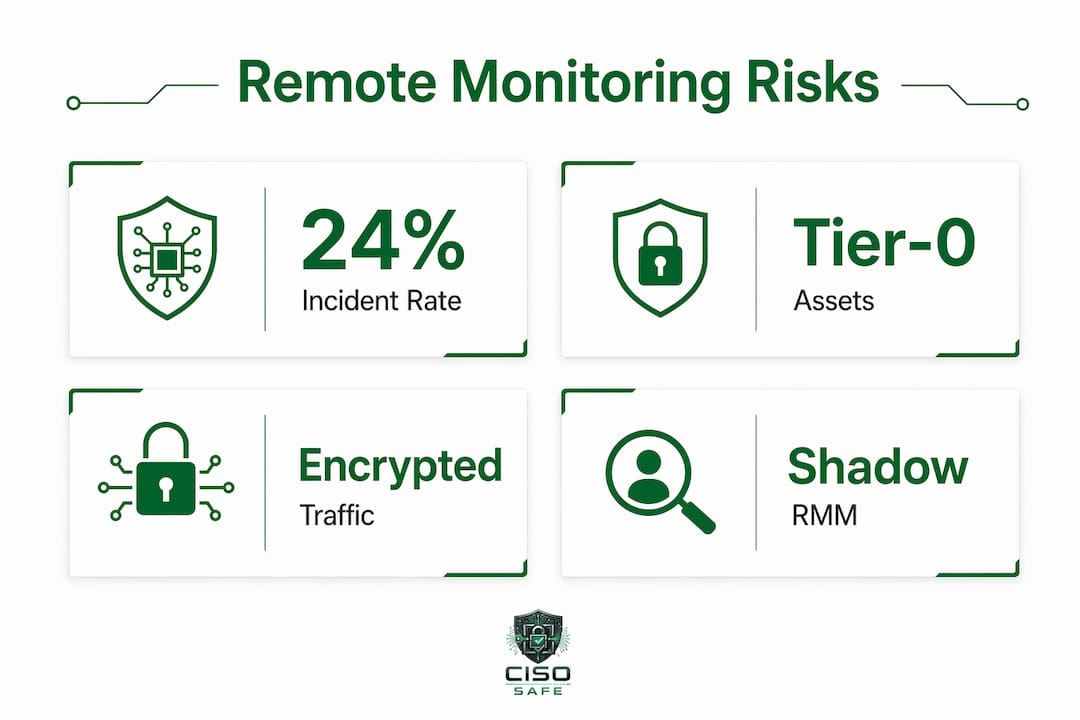
Remote monitoring cyber risk is defined as the set of threats and vulnerabilities that arise when remote monitoring and management (RMM) tools are used to oversee IT systems from outside a physical network perimeter. RMM platforms like ConnectWise, Kaseya, and NinjaRMM give IT teams the ability to patch systems, execute scripts, and access endpoints from anywhere. That same power makes them a prime target for attackers. RMM tool abuse increased 277% year over year in 2026, and these tools were involved in 24% of all analyzed cyber incidents that year. For business leaders and IT managers in regulated industries, understanding this risk is not optional. It is a core part of any serious cyber risk management program.
What is remote monitoring cyber risk and how do RMM tools create it?
RMM tools are designed to give IT administrators full control over managed endpoints. They support remote desktop access, automated patch deployment, script execution, real-time performance monitoring, and software inventory management. These features are genuinely useful. They also create a concentrated point of failure if an attacker gains access.
The core problem is trust. Endpoint security tools, firewalls, and antivirus programs recognize RMM software as legitimate. Traffic from these tools is often encrypted and routed through vendor infrastructure, which means it blends into normal network activity. Attackers exploit this trusted status through a technique called "living off the land," using the tool's own capabilities to move laterally, exfiltrate data, and maintain persistence without deploying custom malware.

| RMM Capability | Operational Benefit | Security Risk |
|---|---|---|
| Remote desktop access | Fast incident response | Unauthorized access to sensitive endpoints |
| Script execution | Automated configuration management | Malicious payload delivery |
| Patch management | Reduced vulnerability exposure | Delayed patches create exploitable windows |
| Encrypted traffic | Privacy and data protection | Conceals attacker activity from network monitoring |
| Multi-tenant management | Centralized IT oversight | Single console compromise affects all managed clients |
Pro Tip: Audit every RMM tool installed across your environment quarterly. Unauthorized or shadow RMM installations are a leading indicator of active intrusion.
What are the main cyber risks of remote monitoring in 2026?
The threat landscape around RMM tools has shifted from opportunistic to deliberate. From 2022 through 2024, RMM software appeared in over 33% of intrusions, primarily for lateral movement and persistence. Attackers no longer need custom malware when a trusted tool already sitting on the network does the job.
One of the most dangerous tactics is multi-RMM redundancy. Adversaries install multiple RMM tools on a compromised system so that removing one does not end their access. A defender who detects and uninstalls ConnectWise may not realize the attacker also installed a second agent running under a different vendor's infrastructure. This redundancy makes eviction extremely difficult without a full incident response engagement.
"Security teams must treat the management infrastructure controlling RMM fleets as tier-0 assets because compromise here allows full network takeover, bypassing endpoint controls entirely." — SentinelOne
RMM management consoles are tier-0 assets. A breach at the management plane gives an attacker the same privileges as your most senior IT administrator, across every device the console manages. For law firms, energy operators, and healthcare organizations, that means exposure of client records, operational technology, and regulated data simultaneously.
| Attack Vector | Description | Incident Rate |
|---|---|---|
| Initial access via RMM | Attacker uses phishing to gain RMM credentials | High |
| Lateral movement | RMM used to pivot between endpoints without malware | Very High |
| Persistence via multi-RMM | Multiple agents installed to survive partial remediation | Increasing |
| Management console takeover | Full network control through admin plane compromise | Critical |
| Data exfiltration | Encrypted RMM channels used to move data out undetected | Moderate to High |
How can organizations detect and mitigate remote monitoring security risks?
Traditional malware signature detection fails against RMM abuse because the software itself is legitimate. Security tools do not flag ConnectWise or NinjaRMM as threats. This means your detection strategy must shift from signature matching to behavioral analysis.
Establishing a baseline of approved RMM usage is the foundation of effective detection. Document which tools are authorized, which endpoints they manage, which relay domains they communicate with, and what normal activity looks like. Any deviation from that baseline, such as a new RMM agent appearing on a workstation or an agent communicating with an unrecognized relay, should trigger a high-severity alert automatically.
Effective mitigation requires controls at multiple layers. The following measures address the most critical exposure points:
- Maintain an approved RMM inventory. Any unrecognized RMM traffic should generate an immediate high-severity alert by default.
- Enforce multi-factor authentication (MFA) on all RMM consoles and administrative accounts without exception.
- Apply privileged access management (PAM). Limit which accounts can access the management console and log every session.
- Automate patch management. Continuous monitoring and automated patching close vulnerability windows before attackers exploit them.
- Segment the management plane. Isolate RMM infrastructure from general corporate networks using firewall rules and VLANs.
- Conduct regular vendor cybersecurity assessments to verify that your RMM provider's own security posture meets your standards.
- Run tabletop exercises that specifically simulate RMM compromise scenarios, including multi-agent persistence situations.
Pro Tip: When responding to a suspected RMM compromise, do not simply uninstall the detected agent. Conduct a full endpoint forensic review first. Attackers anticipate removal and often have secondary agents waiting.
A cybersecurity maturity assessment can help your organization identify exactly where your RMM controls fall short before an attacker does.
What operational and connectivity challenges affect remote monitoring security?
Cybersecurity is not the only source of failure in remote monitoring environments. Over 60% of remote monitoring system failures are caused by connectivity issues rather than cyberattacks. That statistic matters because connectivity failures and security failures often look identical at first. An agent that stops reporting could indicate a network outage or a threat actor who has disabled monitoring to operate undetected.
Industrial environments and IoT deployments add another layer of complexity. Sensors, controllers, and operational technology devices often run on legacy protocols that were never designed for secure remote access. When RMM tools are extended into these environments, the attack surface grows significantly. A misconfigured cloud gateway or an exposed API endpoint can hand an attacker direct access to physical infrastructure.
Cloud misconfiguration and weak access controls in remote monitoring systems expose telemetry data, user records, and critical command interfaces to external threats. This is not a theoretical risk. Publicly exposed RMM dashboards have been discovered through basic internet scanning tools, with no authentication required.
Key operational security controls for remote monitoring environments include:
- Role-based access control (RBAC): Assign the minimum permissions needed for each user or system role.
- End-to-end encryption: Encrypt all telemetry and command traffic, not just the transport layer.
- Zero trust network access: Verify every connection request regardless of source, including internal systems.
- Redundant connectivity with failover monitoring: Detect outages quickly so connectivity failures are not mistaken for security events.
- Regular configuration audits: Review cloud dashboards, API permissions, and access control lists on a defined schedule.
Key Takeaways
Remote monitoring cyber risk is one of the fastest-growing threat categories in regulated industries, driven by the widespread adoption of RMM tools that attackers exploit for persistent, malware-free intrusions.
| Point | Details |
|---|---|
| RMM abuse is accelerating | RMM tools were involved in 24% of cyber incidents in 2026, up 277% year over year. |
| Multi-agent persistence is common | Attackers install multiple RMM tools to survive partial remediation efforts. |
| Behavioral detection is required | Signature-based tools cannot detect RMM abuse; baseline monitoring is the only reliable method. |
| Management consoles are tier-0 assets | Compromise of the RMM admin plane gives attackers full network control. |
| Connectivity failures mask threats | Over 60% of remote monitoring failures stem from connectivity issues, which can conceal active intrusions. |
The management plane is your blind spot
After working with law firms, energy operators, and compliance-sensitive organizations across the United States, I have noticed a consistent pattern. Security teams spend significant effort hardening endpoints and monitoring network traffic, but they treat the RMM management console as an administrative tool rather than a security asset. That is the wrong frame entirely.
The management plane is your largest attack surface. It sits above every endpoint control you have deployed. If an attacker owns the console, they own everything the console touches. I have seen organizations with mature endpoint detection and response programs get completely bypassed because their RMM admin credentials were not protected by MFA and were reused across services.
The other mistake I see regularly is treating RMM security as a vendor problem. Your RMM provider secures their infrastructure. You are responsible for how you configure and use it. Weak access controls, unreviewed agent installations, and no behavioral baseline are your failures, not theirs. Regulated industries operating under frameworks like SOC 2, HIPAA, or CMMC cannot afford to leave that gap open.
The organizations that manage this risk well share one trait. They treat their RMM fleet as a security system that itself requires continuous monitoring, not just as an IT operations tool. That shift in perspective changes everything about how you design controls, respond to incidents, and report risk to leadership.
— vCISO
How CisoSafe helps you manage remote monitoring cyber risks
Organizations in regulated industries need more than general cybersecurity advice. They need a partner who understands the specific risks of RMM environments and can translate that into defensible, audit-ready controls.
CisoSafe delivers virtual CISO services built for law firms, oil and gas companies, energy operators, and other compliance-sensitive organizations across the United States. The CisoSafe team conducts remote monitoring risk assessments, builds approved RMM baselines, and designs continuous monitoring programs aligned to SOC 2, HIPAA, PCI DSS, and CMMC requirements. CisoSafe's AI-powered platform automates vulnerability management and compliance reporting, giving your leadership clear visibility into risk without requiring a full-time internal security team. Contact CisoSafe to schedule a risk assessment and get a clear picture of your RMM exposure.
FAQ
What is remote monitoring cyber risk?
Remote monitoring cyber risk is the threat posed by attackers who exploit RMM tools to gain unauthorized access, move laterally, and maintain persistence inside a network. These tools are trusted by endpoint security systems, which makes the attacks difficult to detect with traditional methods.
Why are RMM tools targeted by attackers?
RMM tools provide administrative access to every managed endpoint, and their traffic is encrypted and treated as legitimate by security software. This makes them ideal for attackers who want to operate inside a network without deploying detectable malware.
How do I detect unauthorized RMM activity?
Establish a documented baseline of all approved RMM tools, relay domains, and normal usage patterns. Any unrecognized RMM agent or anomalous connection should trigger an immediate high-severity alert, as behavioral anomaly detection is the only reliable method against RMM abuse.
What compliance frameworks address RMM security risks?
SOC 2, HIPAA, PCI DSS, and CMMC all include controls relevant to remote access security, privileged access management, and continuous monitoring. Organizations in regulated industries should map their RMM controls directly to these framework requirements.
How does CisoSafe help with remote monitoring security?
CisoSafe provides virtual CISO services and an AI-powered compliance platform that help regulated organizations assess RMM risk, implement behavioral monitoring controls, and maintain compliance with major security frameworks.