

A cybersecurity maturity assessment is a structured evaluation that measures an organization's security capabilities across people, processes, and technology to determine its current readiness and identify gaps. Known formally in the industry as a cybersecurity program maturity evaluation, this process uses a standardized scale to score how repeatable, measurable, and aligned your security controls are with business risk. Frameworks like the NIST Cybersecurity Framework and CIS Controls provide the structure most organizations rely on. For business leaders in regulated industries, understanding this evaluation is the first step toward building a defensible, audit-ready security program.
What is a cybersecurity maturity assessment and how does it work?
A cybersecurity maturity assessment measures security effectiveness on a standardized scale, typically ranging from 0 to 5, moving from ad hoc and reactive practices at the low end to continuously optimized capabilities at the high end. Each level represents a meaningful jump in how well your organization can prevent, detect, and recover from threats. A score of 1 means your team responds to incidents as they happen with no formal process. A score of 4 or 5 means your controls are documented, measured with KPIs, and regularly improved.
The assessment covers three core domains: people (training, roles, accountability), processes (policies, incident response, change management), and technology (tools, configurations, monitoring). No single domain can carry the others. An organization with excellent technology but no documented processes will score lower than one with moderate tools and repeatable workflows.

Regulated industries, including oil and gas, healthcare, and legal services, use these assessments to demonstrate compliance capability to regulators and clients. The assessment produces objective evidence, not just a self-reported checklist. That distinction matters when a regulator or enterprise client asks for proof of your security posture.
What cybersecurity assessment frameworks and models are commonly used?
Cybersecurity maturity models provide a staged structure to assess and advance security capabilities from unprepared to advanced. The three most widely adopted frameworks in the United States are the NIST Cybersecurity Framework (CSF), the CIS Controls, and the Cybersecurity Maturity Model Certification (CMMC). Each takes a different angle.
| Framework | Primary Focus | Best For |
|---|---|---|
| NIST CSF | Risk-based, five-function model | General enterprise and critical infrastructure |
| CIS Controls | Prioritized technical safeguards | SMBs and mid-market organizations |
| CMMC | Defense supply chain compliance | DoD contractors and federal vendors |
NIST CSF organizes security around five functions: Identify, Protect, Detect, Respond, and Recover. It does not prescribe specific tools. Instead, it asks whether your organization has defined, implemented, and measured controls in each area. CIS Controls offers 18 prioritized control groups, making it practical for organizations without a dedicated security team. CMMC is mandatory for companies in the U.S. Department of Defense supply chain and maps directly to NIST SP 800-171 requirements.
All three frameworks use maturity levels or tiers to describe where an organization stands:
- Level 1 (Initial/Ad Hoc): Security activities are informal and reactive.
- Level 2 (Developing): Some processes exist but are not consistently applied.
- Level 3 (Defined): Documented, standardized processes are in place organization-wide.
- Level 4 (Managed): Controls are measured and monitored with defined metrics.
- Level 5 (Optimizing): Continuous improvement is built into the security program.
Benchmarking against peers in your industry adds another layer of value. Knowing your organization scores at Level 2 in incident response while your sector average is Level 3 gives leadership a concrete, defensible reason to invest.
How does the cybersecurity maturity assessment process work?
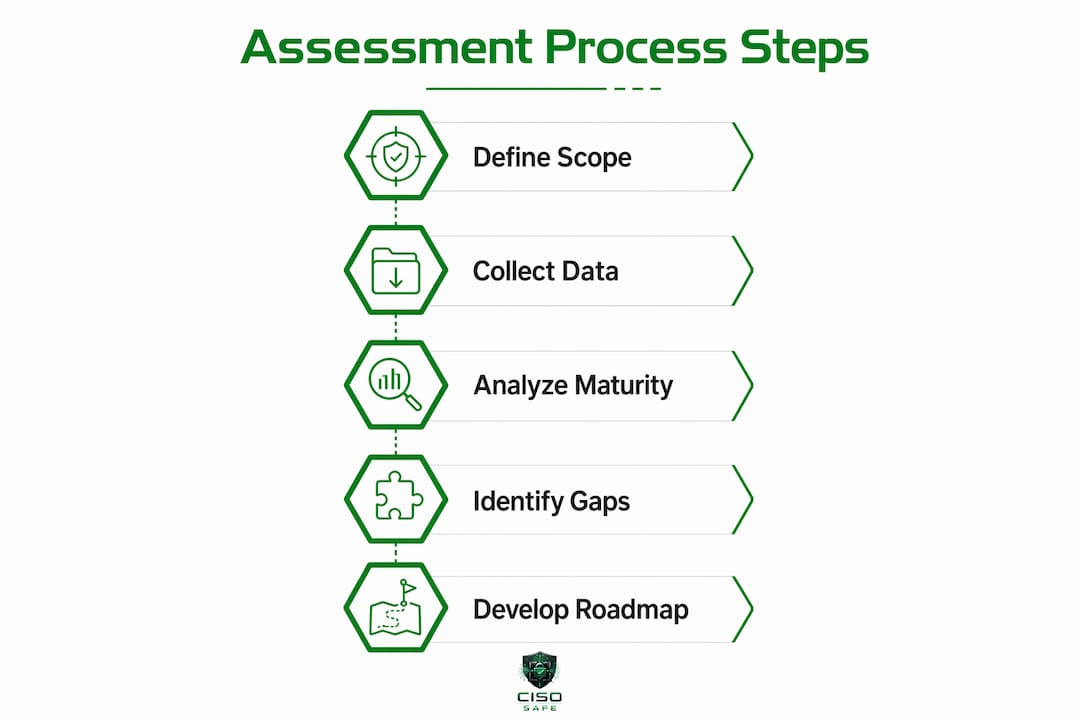
The assessment process follows four structured steps: scoping and framework alignment, current state analysis, gap analysis, and roadmap development. Most engagements also include a reassessment cycle of 6–12 months to track progress and keep the roadmap current.
- Scoping and alignment: Define which business units, systems, and compliance requirements are in scope. Choose the framework (NIST, CIS, CMMC) that fits your regulatory obligations and business context.
- Current state analysis: Collect data through structured interviews with IT, legal, HR, and operations leaders. Review existing policies, procedures, and technical configurations. Run automated scans where applicable.
- Gap analysis: Compare your current capabilities against the target maturity level for each control domain. Identify which gaps carry the highest business risk.
- Roadmap development: Prioritize remediation actions by risk severity and resource availability. Assign owners, timelines, and success metrics to each initiative.
Cross-functional participation is not optional. Security maturity requires consistent processes across HR (employee onboarding and offboarding), legal (contract and data handling), and operations (vendor management and physical access). Limiting the assessment to the IT department produces an incomplete picture and a roadmap that will stall.
Pro Tip: Schedule your first reassessment at six months, not twelve. Early reassessments reveal whether your roadmap priorities were correct and give leadership a progress signal before the annual board review.
Deliverables from a well-run assessment include a scored maturity report by domain, a prioritized gap register, and a multi-year improvement roadmap. Organizations that treat this output as a living document, rather than a one-time report, see measurably better outcomes.
What are common misconceptions about cybersecurity maturity?
The most persistent myth is that buying more security tools increases maturity. Tool sprawl actually reduces maturity scores by creating inconsistent control environments that are harder to monitor and patch. A company running 40 security products with no unified monitoring process will score lower than one running 12 well-integrated tools with documented runbooks.
Higher maturity is about process repeatability, predictability, and alignment with business goals. The question is not "Do you have an endpoint detection tool?" but "Can you prove that tool is configured consistently, monitored daily, and tied to a documented response procedure?" That distinction separates a Level 2 organization from a Level 4 one.
Three other misconceptions are worth addressing directly:
- Maturity assessment is not the same as a risk assessment. A maturity assessment measures capability while a risk assessment prioritizes threats and vulnerabilities. Both are necessary. Maturity shows how well your controls operate; risk assessment shows what matters most to protect.
- Passing a compliance audit does not mean high maturity. Audits verify point-in-time compliance with specific requirements. Maturity measures whether your program can sustain and improve those controls over time.
- Maturity is not an IT problem alone. Cultural friction emerges when assessments expose process weaknesses in HR, legal, or operations. Cross-department buy-in from the start prevents the assessment from becoming a blame exercise.
Pro Tip: Present maturity assessment results to the full executive team, not just IT leadership. When the CFO and General Counsel see the gap register, budget and policy decisions move faster.
How can organizations apply maturity assessment results?
Assessment results are only valuable if they drive decisions. The most effective organizations use their maturity scores to prioritize security investments, build multi-year improvement plans, and align security goals with compliance requirements like SOC 2, HIPAA, PCI DSS, and CMMC.
Key metrics to track after an assessment include remediation time, detection speed, recovery performance, governance closure rates, and employee behavior change. These KPIs connect security activity to business risk in language that boards and executives understand.
A practical application framework looks like this:
| Action | Purpose | Timeline |
|---|---|---|
| Prioritize top 5 gaps by risk | Focus resources on highest-impact improvements | 0–90 days |
| Assign owners to each gap | Create accountability and track progress | 0–30 days |
| Align roadmap to compliance deadlines | Meet regulatory requirements on schedule | Ongoing |
| Schedule reassessment | Measure improvement and update the roadmap | 6–12 months |
| Report progress to leadership | Maintain executive visibility and support | Quarterly |
Iterative reassessments are what separate organizations that improve from those that stall. A roadmap built in January becomes outdated by June if your threat environment, business operations, or regulatory requirements change. Embedding reassessments into your security governance calendar keeps the program aligned with reality.
Organizations in the ISMS Calculator's compliance maturity guidance consistently show that structured, iterative assessments produce faster compliance readiness than one-time audits. The reason is simple: continuous measurement creates accountability that static reports cannot.
Key takeaways
A cybersecurity maturity assessment is the most reliable method for measuring whether your security program can sustain, prove, and improve its controls over time.
| Point | Details |
|---|---|
| Maturity uses a 0–5 scale | Scores measure process repeatability and control effectiveness, not tool count. |
| Frameworks structure the process | NIST CSF, CIS Controls, and CMMC each provide a scored, benchmarkable approach. |
| Four steps drive the process | Scoping, current state analysis, gap analysis, and roadmap development form the core cycle. |
| Reassessment is required | Static reports become outdated; schedule reassessments every 6–12 months to track progress. |
| Results must drive decisions | Tie maturity scores to investment priorities, compliance deadlines, and executive reporting. |
What I've learned after years of running maturity assessments
Most organizations come to their first maturity assessment expecting a technology audit. What they get is a mirror held up to their entire organization. The gaps that surface in HR onboarding, vendor contract language, and legal data handling are almost always more surprising to leadership than any IT finding.
The organizations that improve fastest are not the ones with the biggest security budgets. They are the ones where the CEO or General Counsel treats the gap register as a business risk document, not an IT to-do list. When that shift happens, remediation timelines shrink and cross-department cooperation follows.
One pattern I see repeatedly: organizations treat their first assessment as a destination. They complete it, file the report, and move on. Twelve months later, the threat environment has changed, a new vendor has been onboarded, and the roadmap is obsolete. The assessment was never the point. The continuous improvement cycle it starts is the point.
The future of maturity assessments is moving toward real-time scoring, where controls are monitored continuously and maturity scores update as configurations drift or new risks emerge. Organizations that build this capability now, rather than waiting for a regulator to require it, will have a significant advantage in both security posture and compliance readiness.
— vCISO
How CisoSafe supports your cybersecurity maturity program
CisoSafe delivers virtual CISO services built specifically for regulated industries, including law firms, oil and gas operators, and healthcare organizations across the United States. Every engagement starts with a structured maturity assessment aligned to NIST CSF, CIS Controls, or CMMC, depending on your compliance obligations.
CisoSafe's team translates assessment results into prioritized roadmaps with clear ownership, timelines, and compliance milestones. The AI-powered SaaS portal automates compliance intake, penetration testing, and professional reporting, giving your leadership team real visibility into risk without requiring a full-time internal CISO. For organizations ready to move from reactive security to a measurable, continuously improving program, CisoSafe provides the expertise and structure to get there. You can also explore the ISO 27001 readiness tools available through ISMS Calculator as a complementary starting point for your compliance preparation.
FAQ
What is a cybersecurity maturity assessment in simple terms?
A cybersecurity maturity assessment is a scored evaluation of how well your organization's security controls are defined, implemented, and measured. It uses a 0–5 scale to show where you are now and what it takes to improve.
How is a maturity assessment different from a risk assessment?
A maturity assessment measures how capable and repeatable your security controls are, while a risk assessment identifies and prioritizes specific threats and vulnerabilities. Both are complementary and most organizations need both.
How long does a cybersecurity maturity assessment take?
Most assessments take two to six weeks depending on scope, organization size, and the number of frameworks in play. The resulting roadmap typically covers a 12–24 month improvement horizon.
Which framework should my organization use?
NIST CSF works well for most enterprises and critical infrastructure operators. CIS Controls is practical for SMBs. CMMC is required for any organization in the U.S. Department of Defense supply chain. Your regulatory obligations and industry should drive the choice.
How often should we reassess cybersecurity maturity?
Reassessments should occur every 6–12 months. Organizations facing active compliance deadlines or significant operational changes, such as mergers or new vendor relationships, should reassess more frequently to keep their roadmap accurate.