

Cyber threat intelligence (CTI) is defined as the process of converting raw security data into actionable insights about threat actors, attack methods, and adversary motives that enable organizations to defend proactively. The industry term is "cyber threat intelligence," and it is distinct from raw threat data in one critical way: it adds context, narrative, and recommended action. CrowdStrike, IBM, and Gartner each recognize CTI as a foundational discipline in modern cybersecurity programs. With the average breakout attack now taking 29 minutes, organizations that rely on reactive security alone are already behind before an analyst opens a ticket.
What is cyber threat intelligence and how does it work?
Cyber threat intelligence transforms raw logs, alerts, and indicators into a coherent picture of who is attacking you, why, and what they will likely do next. Raw data tells you an IP address connected to your server. Intelligence tells you that IP belongs to a known ransomware group targeting oil and gas companies in the Gulf Coast region, using a specific phishing technique, and that three similar firms were hit last week.
CTI distinguishes intelligence from raw data by adding context, mechanisms, and organization-specific guidance. Without that layer of interpretation, security teams drown in alerts without understanding which ones matter most. This is why CTI is not a product you buy. It is a discipline you build and continuously refine.

What are the main types of cyber threat intelligence?
CTI is classified into four main types: Strategic, Operational, Tactical, and Technical. Each serves a different audience and answers a different question.
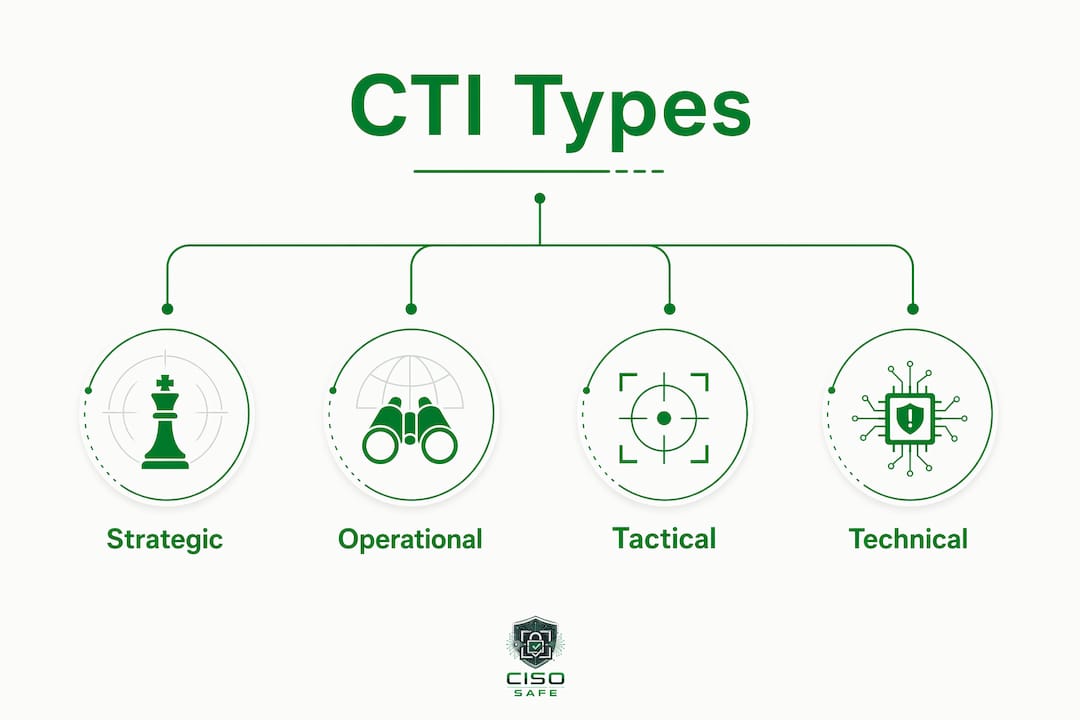
| Type | Purpose | Primary Audience | Example Output |
|---|---|---|---|
| Strategic | Understand industry-level cyber risks and business impact | C-suite, board members | Risk briefings, threat trend reports |
| Operational | Understand active campaigns and attacker intent | Security managers, IR teams | Campaign profiles, adversary playbooks |
| Tactical | Understand attacker techniques, tactics, and procedures (TTPs) | SOC analysts, threat hunters | MITRE ATT&CK mappings, behavioral rules |
| Technical | Identify specific indicators of compromise (IOCs) | Automated systems, tier-1 analysts | IP blocklists, file hashes, malicious domains |
Strategic intelligence bridges IT and business leadership by translating cyber risks into business impacts and investment priorities. A CISO presenting to a law firm's managing partner needs strategic CTI, not a list of IP addresses. Tactical and technical intelligence, by contrast, feed directly into security operations center (SOC) workflows and detection rules.
The most mature programs use all four types in parallel. Executives consume strategic reports monthly. SOC teams ingest technical IOCs in near real time. Operational and tactical intelligence connects the two layers, giving security managers the context to prioritize their response.
How is cyber threat intelligence collected, processed, and analyzed?
The CTI lifecycle includes six phases: planning, collection, processing, analysis, dissemination, and feedback. Each phase builds on the previous one, and skipping any step degrades the quality of the final intelligence product.
- Planning. Define the intelligence requirements. What threats matter most to your organization? What decisions will this intelligence support? A Houston energy company has different priorities than a Chicago law firm.
- Collection. Gather data from internal telemetry (SIEM logs, endpoint alerts), open-source intelligence (OSINT), commercial threat feeds, dark web monitoring, and information sharing groups like ISACs.
- Processing. Normalize and structure raw data so it can be analyzed. This step often involves deduplication, translation of formats, and filtering out irrelevant noise.
- Analysis. Apply human and automated analysis to identify patterns, attribute activity to known threat actors, and assess relevance to your specific environment.
- Dissemination. Deliver finished intelligence to the right audience in the right format. Executives receive executive summaries. SOC analysts receive structured feeds compatible with their SIEM or SOAR platform.
- Feedback. Measure whether the intelligence was useful and adjust collection priorities accordingly.
Neglecting the feedback loop wastes resources and causes programs to drift toward collecting data that nobody acts on. Most organizations skip this step entirely, which is why their CTI programs plateau.
Common collection sources include internal security tools like Microsoft Sentinel and Splunk, commercial feeds from Recorded Future and Mandiant, and open-source repositories like AlienVault OTX and VirusTotal. Dark web monitoring services add coverage for credential leaks and pre-attack chatter that internal tools cannot see.
Pro Tip: Avoid alert fatigue by defining your intelligence requirements before you expand your collection sources. More data is not better intelligence. Relevant, contextualized data is.
What are the key benefits and challenges of implementing CTI programs?
The core benefit of CTI is that it shifts your security posture from reactive to proactive. Instead of responding to breaches after they occur, you anticipate attacker behavior and close gaps before exploitation.
The urgency is real. AI-enabled adversary activity increased 89% in 2025, and attackers are using AI to accelerate intrusion tradecraft, social engineering, and campaign execution. Organizations without CTI programs are defending against threats they cannot see coming.
Ransomware victims increased 21% quarter-over-quarter in early 2024, with 1,075 victims recorded on ransomware leak sites in Q1 alone. That growth rate reflects a threat environment where historical data reliance is no longer sufficient. You need anticipatory intelligence.
Key benefits include:
- Faster incident response. Intelligence pre-loads your team with context, cutting the time from detection to containment.
- Better risk prioritization. CTI tells you which vulnerabilities are actively exploited in your industry, so you patch what matters first.
- Stronger security investments. Strategic intelligence gives executives data to justify budget decisions with board-level clarity.
- Improved third-party risk management. Intelligence on supplier compromises reaches your team before those compromises reach your network.
The challenges are equally concrete. Technical IOCs have a short shelf life, often measured in hours or minutes, while strategic intelligence delivers value over months. Programs that focus exclusively on IOC ingestion burn analyst time on indicators that expire before they are acted upon.
"Defending networks without CTI is like playing chess blindfolded. Intelligence reveals attackers' predictable patterns before they reach your defenses." — Sophos
Treating CTI as a static list of indicators causes alert fatigue and causes teams to miss the context-specific intelligence that actually matters. The fix is dynamic, organization-specific intelligence tailored to your infrastructure and threat profile.
How do security teams and business leaders apply CTI in practice?
CTI application differs significantly by role. SOC analysts use tactical and technical intelligence to write detection rules, hunt for threats, and triage alerts. Business leaders use strategic intelligence to make informed decisions about security spending, regulatory compliance, and risk tolerance.
Practical applications by function:
- Incident response teams use operational intelligence to understand attacker playbooks before and during an active incident, reducing dwell time.
- Threat hunters use tactical TTPs mapped to the MITRE ATT&CK framework to proactively search for adversary behavior that automated tools missed.
- CISOs and security directors use strategic intelligence to build cybersecurity maturity assessments and present risk roadmaps to leadership.
- Executives and board members use strategic briefings to understand which cyber risks affect their industry, their regulatory obligations, and their competitive position.
- Procurement and vendor teams use CTI to evaluate third-party risk, identifying suppliers with known vulnerabilities or recent breach history before signing contracts.
Strategic CTI bridges communication between IT and executives for better resource allocation. Without it, security teams speak in technical terms that executives cannot act on, and executives make budget decisions without understanding the actual risk exposure.
For regulated industries like energy and legal services, CTI also supports compliance. Intelligence on threat actors targeting your sector informs the controls you prioritize under frameworks like CMMC, HIPAA, and SOC 2. You can read more about applying this in the context of energy sector governance and third-party risk programs.
What tools and resources support effective CTI today?
Threat intelligence platforms (TIPs) are the operational backbone of most mature CTI programs. A TIP aggregates feeds from multiple sources, normalizes data formats, and distributes finished intelligence to downstream tools like SIEM, SOAR, and endpoint detection platforms.
Leading commercial TIPs include Recorded Future, ThreatConnect, and Anomali. Open-source alternatives like OpenCTI and MISP provide strong functionality for organizations with limited budgets and technical staff to manage them.
Key features to evaluate in any TIP:
- Feed aggregation. The platform should ingest commercial, open-source, and internal feeds without manual normalization.
- STIX/TAXII support. These are the industry standards for structuring and sharing threat intelligence. Platforms that support STIX/TAXII integrate cleanly with other tools and sharing communities.
- Analyst workflow tools. Pivot analysis, entity linking, and case management features separate basic feed aggregators from true intelligence platforms.
- Integration depth. The TIP must connect to your existing security stack, including Microsoft Sentinel, Splunk, Palo Alto Networks, or CrowdStrike Falcon.
Open-source threat feeds from AlienVault OTX, Abuse.ch, and the Cybersecurity and Infrastructure Security Agency (CISA) provide a solid baseline for organizations building their first CTI program. Commercial feeds from Mandiant and Recorded Future add attribution depth and analyst-grade reporting.
Pro Tip: Do not deploy a TIP in isolation. Integrate it directly with your SIEM and SOAR from day one. Intelligence that does not flow into detection and response workflows sits unused.
Key takeaways
Cyber threat intelligence is only as effective as the organizational processes and feedback loops that surround it. Technology alone does not produce intelligence; disciplined collection, analysis, and dissemination do.
| Point | Details |
|---|---|
| CTI definition | CTI converts raw security data into contextualized, actionable insights about threat actors and attack methods. |
| Four intelligence types | Strategic, Operational, Tactical, and Technical intelligence each serve distinct audiences and decision levels. |
| Lifecycle feedback matters | Skipping the feedback loop causes CTI programs to collect irrelevant data and plateau in effectiveness. |
| IOC shelf life is short | Technical indicators expire in hours; balance automated IOC ingestion with human analysis for strategic value. |
| Application drives ROI | CTI delivers measurable value only when applied to specific workflows: incident response, threat hunting, and executive risk reporting. |
Why most CTI programs stall before they deliver value
After working with law firms, energy operators, and compliance-sensitive organizations across the United States, I have seen the same pattern repeat. An organization invests in a threat intelligence feed, connects it to their SIEM, and declares their CTI program live. Six months later, the feed is generating hundreds of alerts per day, analysts are ignoring most of them, and leadership has no clearer picture of their actual risk than they did before.
The problem is not the technology. The problem is that most organizations skip the planning phase entirely. They collect before they define what they need. They disseminate before they know who the audience is. And they never close the feedback loop, so the program never improves.
The other mistake I see constantly is treating strategic and technical intelligence as interchangeable. A board member does not need a list of malicious IP addresses. A tier-1 analyst does not need a 20-page threat landscape report. When intelligence reaches the wrong audience in the wrong format, it creates noise instead of clarity.
The organizations that get CTI right treat it as a continuous discipline, not a one-time deployment. They revisit their intelligence requirements quarterly, measure whether their intelligence actually influenced decisions, and adjust their collection priorities based on what worked. That feedback loop is the difference between a CTI program that matures and one that stalls.
— vCISO
How CisoSafe helps you build a CTI-informed security program
CisoSafe delivers virtual CISO services built for regulated, high-stakes industries where threat intelligence is not optional. For law firms, energy operators, and compliance-sensitive organizations across the United States, CisoSafe integrates CTI into security assessments, risk roadmaps, and incident response planning from day one.
Our AI-powered SaaS platform automates compliance intake and reporting, while our vCISO team translates threat intelligence into decisions your leadership can act on. Whether you need to meet SOC 2, CMMC, HIPAA, or PCI DSS requirements, CisoSafe connects your compliance obligations to the threat environment your organization actually faces. If you are ready to move from reactive security to a proactive, intelligence-informed defense posture, CisoSafe is built for exactly that.
FAQ
What is the difference between threat data and threat intelligence?
Threat data is raw information such as IP addresses, file hashes, or log entries. Threat intelligence adds context, attribution, and recommended action, making the data usable for security decisions.
What are the four types of cyber threat intelligence?
The four types are Strategic, Operational, Tactical, and Technical. Each serves a different audience, from board members consuming risk briefings to SOC analysts ingesting IOC feeds.
How long do technical indicators of compromise remain useful?
Technical IOCs such as malicious IP addresses or file hashes often expire within hours or minutes. Mature CTI programs automate IOC ingestion and reserve human analysis for operational and strategic intelligence.
What is the CTI lifecycle?
The CTI lifecycle consists of six phases: planning, collection, processing, analysis, dissemination, and feedback. The feedback phase is the most commonly skipped and the most critical for long-term program effectiveness.
How does cyber threat intelligence support regulatory compliance?
CTI identifies which threat actors target your industry and which attack techniques they use. That intelligence directly informs the security controls you prioritize under frameworks like CMMC, HIPAA, SOC 2, and PCI DSS.