

Cybersecurity governance in energy is defined as the structured framework of policies, accountability structures, and oversight mechanisms that align an organization's cyber risk management with its operational and business objectives. The industry term is "cybersecurity governance," and it applies with particular urgency in the energy sector, where a successful attack can disrupt physical infrastructure, not just data. The threat is not theoretical: the energy sector appeared in 66.6% of advanced persistent threat (APT) campaigns in Q2 2026. Nation-state groups including Mustang Panda, Lazarus, and Sandworm are actively targeting utilities and grid operators. Understanding what cybersecurity governance in energy requires is the first step toward building a program that can withstand that pressure.
What is cybersecurity governance in energy?
Cybersecurity governance in energy is the set of decisions, roles, and processes that determine how an organization identifies, manages, and reports on cyber risk across its entire operation. It is not the same as technical security controls. Firewalls, intrusion detection systems, and patch management are controls. Governance is the structure that decides which controls to deploy, who is accountable for them, and how their effectiveness gets reported to leadership.
Effective governance in energy rests on four core components:
- Strategic policies and standards: Written policies that define acceptable use, access control, incident response, and supply chain security. These must be reviewed at least annually and aligned with frameworks like NIST CSF 2.0, which introduced a dedicated "Govern" function specifically to address organizational accountability.
- Accountability structures: Defined roles from the board down to operational teams. The board approves risk appetite. The CISO or vCISO translates that appetite into a security program. Operational managers own compliance within their domains.
- Enterprise risk integration: Cyber risk must sit alongside financial, safety, and operational risk on the same enterprise risk register. Treating it as a separate IT concern is a governance failure.
- Oversight and reporting: Regular metrics reported to the board, including risk posture scores, incident trends, and compliance status. Governance acts as the translation layer between board-level risk appetite and technical execution.
Pro Tip: If your board cannot describe your organization's current cyber risk posture in one sentence, your governance reporting needs immediate attention. Start with a one-page risk dashboard before building anything else.
How does governance connect OT and IT security in energy?
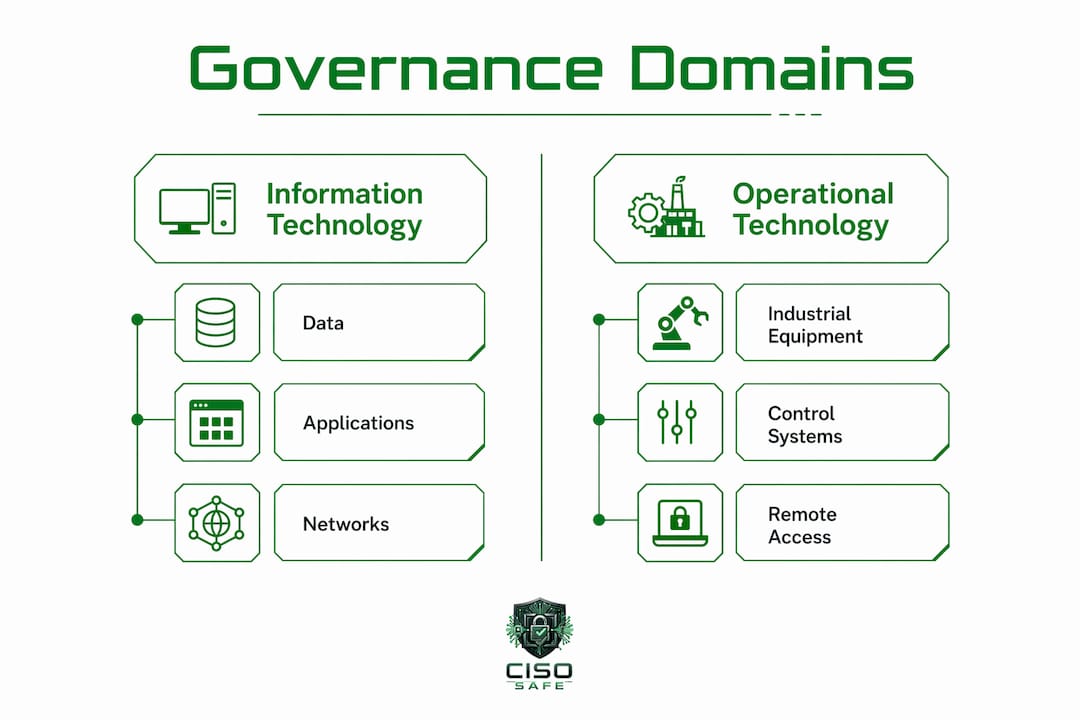
Operational technology (OT) and information technology (IT) security have historically operated as separate disciplines in energy companies. IT security protects data confidentiality and system availability. OT security protects the physical processes that generate, transmit, and distribute power. The priorities differ, the equipment differs, and until recently, the teams rarely spoke to each other.

That separation is now a liability. Fragmented IT and OT governance is a central hurdle for energy organizations trying to meet modern regulatory standards. A unified governance structure must provide oversight of both domains, because an attacker who compromises an IT network can pivot to OT systems and cause physical damage.
The table below compares the two environments and what governance must address in each:
| Domain | Primary Asset | Key Risk | Governance Priority |
|---|---|---|---|
| IT | Data, applications, networks | Confidentiality breach, ransomware | Access control, patch cadence, incident response |
| OT | SCADA, PLCs, sensors | Physical disruption, safety failure | Availability, change management, vendor risk |
| Unified | Both | Cross-domain lateral movement | Integrated risk register, shared reporting |
Distributed energy resources (DERs) such as wind farms and solar installations add a third layer of complexity. These assets typically receive less cybersecurity investment than central generation facilities, yet they carry extensive remote connectivity. A cyberattack on Poland's energy grid targeted over 30 wind and photovoltaic farms, demonstrating exactly how DER vulnerabilities can be weaponized at scale. CISA subsequently issued a warning to U.S. operators about the same attack vectors.
Pro Tip: Map every remote access point into your OT environment before you build governance policies. You cannot govern what you have not inventoried. A cybersecurity framework for industrial environments provides a solid starting template for that asset inventory process.
What threats and regulations are shaping energy governance right now?
The threat environment facing energy operators in 2026 is more sophisticated than at any prior point. APT groups are no longer just probing networks. They are pre-positioning for disruption.
"The energy and utilities sector appeared in 66.6% of APT campaigns over a three-month period in Q2 2026, compared to a 35% baseline over six months. That acceleration signals deliberate, sustained targeting." — Industrial Cyber
Three threat trends demand governance attention right now:
- Nation-state pre-positioning: Sandworm, Lazarus, and Mustang Panda are all active against energy infrastructure. Their goal is not always immediate disruption. Pre-positioning for future leverage is equally common.
- AI-assisted OT attacks: The first publicly observed AI-driven attack on energy OT infrastructure occurred in Mexico in 2026. It was unsuccessful, but it signals that attack automation is reaching operational technology environments.
- DER supply chain risk: Solar inverters and wind farm controllers sourced from high-risk vendors create persistent backdoor exposure. The EU has moved to address this directly.
On the regulatory side, the timeline is firm. By November 1, 2026, all EU-funded energy projects must comply with updated cybersecurity requirements, including the exclusion of high-risk suppliers. Chinese solar inverter manufacturers are the primary target of this policy. That requirement forces energy operators to audit their supply chains and update vendor risk governance policies before the deadline.
The NIS-2 directive reinforces this at the organizational level. Management bodies must approve cybersecurity risk measures and can be held personally liable for non-compliance. That is a direct governance mandate, not a technical requirement. It places cyber risk squarely on the board agenda.
How can energy organizations implement cybersecurity governance?
Building a governance program from scratch or maturing an existing one follows a logical sequence. The steps below reflect guidance from NIST CSF 2.0, the UK NCSC, and Ofgem, adapted for energy sector realities.
- Establish a governance body. Form a cross-functional cybersecurity committee that includes IT, OT, legal, compliance, and executive representation. This body owns the risk register and reports to the board quarterly.
- Define roles and accountability. Every system, process, and asset needs an owner. Ambiguity in ownership is the most common governance failure in energy companies. Assign a named individual, not a team, to each critical asset.
- Align with a recognized framework. NIST CSF 2.0 is the most widely adopted starting point for U.S. energy operators. Its Govern function maps directly to board-level accountability requirements. The UK NCSC and Ofgem publish sector-specific guidance that complements NIST for operators with international exposure.
- Set measurable reporting metrics. Track mean time to detect, mean time to respond, percentage of assets with current patches, and open critical findings from risk assessments. Report these to the board in plain language, not technical dashboards.
- Bridge IT and OT teams. Create shared incident response procedures that both IT and OT staff train on together. Separate playbooks for separate teams guarantee coordination failures during an actual incident.
- Conduct continuous risk assessment. Annual assessments are insufficient given the current threat pace. Quarterly reviews of the risk register, combined with continuous monitoring tools, keep governance current.
The UK government's energy cybersecurity strategy states explicitly that boards must treat cyber risk with the same seriousness as physical safety. That framing matters for compliance officers making the case for governance investment to leadership.
Key takeaways
Effective cybersecurity governance in energy requires unified oversight of IT and OT environments, board-level accountability, and continuous alignment with frameworks like NIST CSF 2.0 and NIS-2.
| Point | Details |
|---|---|
| Governance is not controls | Policies, roles, and oversight structures define governance; firewalls and patches are the outputs of governance decisions. |
| OT and IT must be unified | Fragmented governance between IT and OT teams creates exploitable gaps in energy infrastructure defense. |
| Board accountability is mandatory | Under NIS-2, management bodies can be held personally liable for cybersecurity non-compliance in energy organizations. |
| DERs expand the attack surface | Wind and solar assets with remote connectivity require dedicated governance coverage, not just perimeter defenses. |
| 2026 deadlines are real | EU-funded energy projects must exclude high-risk suppliers by November 1, 2026, requiring immediate supply chain governance action. |
The governance gap i see most often in energy organizations
After working with energy operators and oil and gas companies across the United States, the pattern I see most consistently is not a lack of technical controls. Most organizations have firewalls, endpoint protection, and some form of monitoring. What they lack is the governance layer that connects those controls to business decisions.
The IT team knows what the risks are. The OT team knows what the risks are. The board has no idea, because no one has built the reporting structure to translate technical findings into business language. That gap is where breaches become catastrophic. An incident that could have been contained becomes an operational shutdown because no one had authority to make a fast decision.
The AI-assisted attack on energy OT in Mexico is a signal worth taking seriously. Attackers are beginning to automate reconnaissance and exploitation in environments that governance programs have not yet caught up to. The organizations that will weather that shift are the ones that have already established clear ownership, practiced incident response across IT and OT teams together, and given their boards a real-time view of risk posture.
Cybersecurity governance is not a compliance checkbox. It is the operating model that determines whether your organization can respond effectively when something goes wrong. In energy, where a grid disruption affects public safety, that distinction is not abstract.
— vCISO
How CisoSafe helps energy companies build governance programs
Energy operators and oil and gas companies need governance programs that meet regulatory requirements without overwhelming internal teams. CisoSafe delivers virtual CISO services built specifically for regulated, high-stakes industries, including energy sector organizations navigating NIS-2, NIST CSF 2.0, and supply chain security requirements.
CisoSafe provides security assessments, risk roadmaps, policy development, and board-level reporting designed for energy sector realities. The AI-powered SaaS platform automates compliance intake and risk reporting, giving leadership clear visibility without requiring a full-time CISO. For energy companies facing the November 2026 regulatory deadline or building governance programs from the ground up, CisoSafe offers a practical, cost-effective path to enterprise-grade security oversight.
FAQ
What is cybersecurity governance in the energy sector?
Cybersecurity governance in energy is the framework of policies, roles, and oversight processes that align cyber risk management with business and operational objectives. It covers both IT and OT environments and assigns accountability from the board down to operational teams.
How does nis-2 affect energy company governance?
NIS-2 requires management bodies in energy companies to personally approve cybersecurity risk measures and accept liability for non-compliance. This makes cyber risk a direct board-level responsibility, not an IT department concern.
What is the difference between cybersecurity governance and cybersecurity controls?
Governance defines who is accountable, what the risk appetite is, and how security decisions get made. Controls are the technical tools and processes that execute those decisions. Governance without controls is policy on paper; controls without governance lack direction and accountability.
Why are distributed energy resources a governance priority?
DERs like wind and solar farms carry extensive remote connectivity but typically receive less security investment than central generation assets. The cyberattack on Poland's grid, which targeted over 30 wind and photovoltaic farms, confirmed that DERs are active targets requiring dedicated governance coverage.
What framework should u.s. energy operators use for cybersecurity governance?
NIST CSF 2.0 is the most widely adopted framework for U.S. energy operators. Its dedicated Govern function addresses board accountability, risk management integration, and organizational roles, making it directly applicable to energy sector governance requirements.