

ABA cybersecurity guidelines compliance is defined as the ongoing legal and ethical obligation of lawyers and law firms to implement reasonable security measures that protect client confidential information, grounded in ABA Model Rules including Rule 1.6 and the duty of technology competence. The ABA Cybersecurity Handbook provides the primary legal and ethical framework specific to legal practice, covering threat landscape analysis, applicable legal requirements, and professional responsibility. Compliance is not a one-time policy exercise. It is a continuous program that maps security controls to client information systems, satisfies jurisdiction-specific reasonable efforts standards, and integrates both technical safeguards and ethical duties into daily operations.
What are the core ABA cybersecurity compliance principles?
ABA cybersecurity compliance rests on six foundational principles that every compliance officer and legal team must understand before building a program.
- Technology competence. ABA Model Rule 1.1 requires lawyers to maintain competence in the technology they use to handle client matters. This means understanding how email, cloud storage, and collaboration platforms expose client data, and updating that knowledge as tools change.
- Confidentiality protection. ABA Rule 1.6 requires reasonable steps to prevent unauthorized disclosure of client information, and that duty continues even after representation ends. A single misconfigured cloud share can trigger a Rule 1.6 violation years after a matter closes.
- Risk-based security. The ABA does not prescribe a specific technical standard. Instead, it requires that security measures be proportionate to the sensitivity of the data and the realistic threat environment. A solo practitioner handling routine contracts faces a different risk profile than a 200-attorney firm managing M&A transactions.
- Breach response. Lawyers must have documented protocols for detecting, containing, and notifying affected parties when a security incident occurs. Notification obligations vary by state, so your incident response plan must account for jurisdiction-specific rules.
- Supervision. Model Rule 5.1 and 5.3 extend cybersecurity obligations to supervising attorneys and non-lawyer staff. If a paralegal uses an unsanctioned file-sharing app and client data is exposed, the supervising attorney carries ethical exposure.
- Client communication. Lawyers have a duty to inform clients about significant cybersecurity risks that could affect their matters, particularly when using electronic communications or cloud-based tools.
Pro Tip: Map each of these six principles to a specific written policy in your compliance program. When a bar complaint or malpractice claim arises, documented policies tied to ABA Model Rules are your first line of defense.
What prerequisites do you need to implement ABA compliance?
Building an ABA-aligned cybersecurity program requires foundational elements that many firms skip in their rush to deploy tools. The ABA's cybersecurity topic hub consolidates resources that support policy alignment and ongoing program maintenance. Start there before purchasing any technology.

The table below outlines the core prerequisites and what each one requires in practice.
| Prerequisite | What it requires in practice |
|---|---|
| Threat landscape awareness | Annual review of phishing, ransomware, and insider threat trends specific to legal practice |
| Formal cybersecurity policy | Written policies covering data classification, access control, acceptable use, and incident response |
| Technology competence training | Regular staff training on secure email, MFA setup, and phishing recognition |
| Vendor governance | Written agreements with cloud providers, e-discovery vendors, and IT contractors addressing data security |
| Risk assessment process | Documented risk assessments tied to client information systems, updated at least annually |
According to the ABA's 2024 Legal Technology Survey Report, 60% of law firms now have formal cybersecurity policies. That means 40% of firms are still operating without one, creating direct ethical exposure under Model Rule 1.6. Phishing and ransomware remain the dominant threat vectors, and multifactor authentication adoption is increasing but still uneven across firm sizes.
Technology competence is not a credential you earn once. It is an ongoing process. Deploying MFA across all firm systems, training staff to recognize spear-phishing attempts, and reviewing cloud vendor security posture annually are all part of meeting the competence standard. Firms that treat technology competence as a checkbox rather than a practice discipline consistently fall behind the threat curve.
Pro Tip: Before selecting any cybersecurity tool, document why it addresses a specific risk identified in your risk assessment. That documentation becomes evidence of "reasonable efforts" if your compliance program is ever scrutinized.
How to operationalize ABA cybersecurity compliance step by step
Implementation follows a logical sequence. Skipping steps creates gaps that surface during compliance audits or bar investigations.
-
Conduct a risk assessment and define your reasonable efforts standard. Identify every system that stores, transmits, or processes client information. Document the risk level for each system and the controls in place. The ABA compliance framework is a starting point, not a universal checklist. Your state bar's ethics rules drive the enforcement standard, so map your risk decisions to jurisdiction-specific guidance.
-
Develop and formalize cybersecurity policies. Written policies must cover data classification, access control, remote work security, acceptable use, and vendor management. Policies should reference the specific ABA Model Rules they satisfy. A policy that exists only as a downloaded template and has never been reviewed by firm leadership does not demonstrate reasonable efforts.
-
Deploy technical safeguards. Encryption for data at rest and in transit, role-based access controls, MFA on all client-facing systems, and endpoint detection tools are the minimum technical baseline for most law firms. Mapping every client information system to documented risk decisions prevents coverage gaps and addresses shadow IT risks, where staff use personal tools that bypass firm security controls entirely.
-
Train staff regularly and supervise adherence. Training must be documented, role-specific, and repeated at least annually. Attorneys need different training content than administrative staff. Supervision under Model Rules 5.1 and 5.3 means verifying that training was completed and that staff are actually following policies, not just acknowledging them.
-
Establish incident response and breach notification protocols. Your incident response plan must define roles, escalation paths, containment steps, and notification timelines. State breach notification laws vary significantly. Some require notification within 30 days; others allow 60 to 90 days. Your plan must account for every state where your clients reside.
-
Maintain compliance evidence and schedule continuous review. ABA cybersecurity compliance is a continuous process involving periodic risk reassessment combined with new technology adoption and vendor management. Maintain a compliance evidence file that includes risk assessments, training records, vendor agreements, policy acknowledgments, and incident logs. Review the entire program at least annually and after any significant technology change.
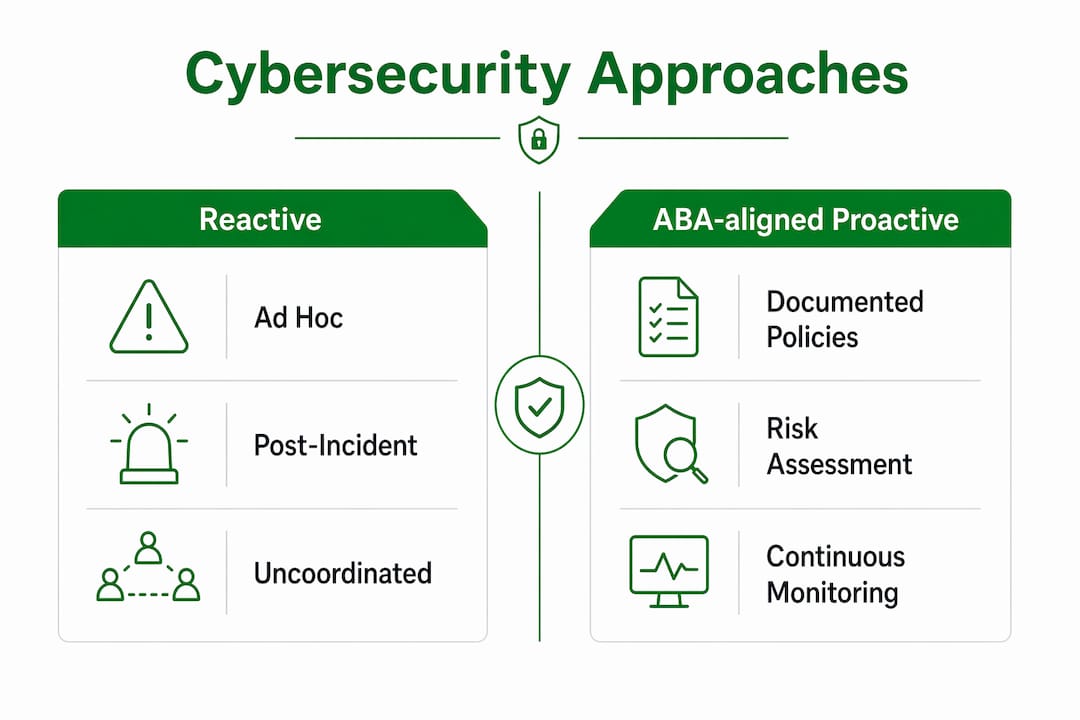
The table below compares a reactive approach to cybersecurity against a proactive, ABA-aligned compliance program.
| Approach | Reactive | ABA-aligned proactive |
|---|---|---|
| Policy development | Ad hoc, post-incident | Documented, pre-incident, tied to Model Rules |
| Risk assessment | Triggered by breach | Annual, system-mapped, jurisdiction-specific |
| Staff training | One-time onboarding | Annual, role-specific, documented |
| Vendor management | Informal relationships | Written agreements with security requirements |
| Incident response | Improvised | Tested, documented, state-law compliant |
What are the most common ABA compliance pitfalls?
Compliance officers who work with law firms repeatedly encounter the same failure patterns. Recognizing them early prevents costly remediation later.
- Treating compliance as a one-time policy download. Downloading an ABA model policy and filing it away does not constitute a compliance program. Compliance programs first formalize policies and then operationalize controls through training and vendor governance to demonstrate reasonable efforts. The policy is the starting point, not the finish line.
- Ignoring shadow IT. Attorneys frequently use personal Dropbox accounts, WhatsApp, or consumer-grade tools to share client files because they are convenient. Each unsanctioned tool is a gap in your security perimeter and a potential Rule 1.6 violation. Conduct periodic audits to identify tools in use that are not covered by your policies.
- Failing to update compliance programs as threats evolve. A program built in 2022 does not address the threat environment of 2026. Ransomware tactics, phishing sophistication, and AI-generated social engineering attacks have all changed materially. Your risk assessment must reflect current threats, not the threat landscape at the time your policy was written.
- Neglecting client communication obligations. Many firms focus entirely on internal security controls and overlook the duty to inform clients about cybersecurity risks relevant to their matters. If you use a cloud platform to share sensitive documents, clients should know what platform you use and what protections are in place.
"Cybersecurity compliance is not a destination. It is a discipline. The firms that treat it as a continuous professional responsibility rather than a periodic audit exercise are the ones that avoid both breaches and bar complaints."
Balancing technical security with ethical obligations requires genuine collaboration between legal, IT, and compliance functions. Compliance officers who operate in silos from their IT teams consistently miss the technical gaps that create ethical exposure. The reverse is equally true: IT teams that deploy security tools without understanding the ethical obligations they are meant to satisfy often build programs that look good on paper but fail the reasonable efforts standard.
Key takeaways
ABA cybersecurity guidelines compliance requires a continuous, documented program that maps technical security controls to ABA Model Rules, satisfies jurisdiction-specific reasonable efforts standards, and integrates staff training, vendor governance, and incident response into daily operations.
| Point | Details |
|---|---|
| Rule 1.6 is the foundation | Confidentiality obligations require reasonable security measures that persist after representation ends. |
| 40% of firms lack formal policies | The ABA's 2024 survey shows significant compliance gaps that create direct ethical exposure. |
| Jurisdiction-specific standards apply | ABA guidelines are a baseline; state bar ethics rules drive the actual enforcement standard. |
| Shadow IT is a primary gap | Unsanctioned tools used by staff create coverage gaps that documented risk assessments must address. |
| Compliance is a continuous cycle | Annual risk reassessment, updated training, and vendor reviews are required, not optional. |
Why compliance officers should rethink their ABA cybersecurity approach
After working with legal organizations across multiple regulated industries, the pattern I see most often is not a lack of intention. It is a lack of integration. Compliance officers build policies. IT teams deploy tools. Neither group consistently connects their work to the specific ABA ethical obligations that govern the firm's professional responsibility exposure.
The firms that handle this well treat their cybersecurity compliance program as a single, unified system with three interlocking components: legal governance tied to Model Rules, technical controls mapped to documented risk decisions, and operational practices enforced through training and supervision. When one component is missing, the other two cannot compensate.
The other observation worth sharing is that the "reasonable efforts" standard is more demanding than most compliance officers realize. It is not a static threshold. It shifts as the threat environment changes and as technology evolves. A firm that met the standard in 2023 may not meet it today if it has not updated its risk assessments, retrained staff on current phishing tactics, or reviewed vendor security posture since then. Continuous reassessment is not a best practice. It is the standard.
The most practical step any compliance officer can take right now is to schedule a full program review against current ABA guidance, map every gap to a specific remediation action, and document that process. That documentation is what demonstrates reasonable efforts when it matters most.
— APM
How Cisosafe supports ABA cybersecurity compliance for legal teams
Cisosafe delivers virtual CISO services purpose-built for law firms and regulated organizations that need to meet ABA cybersecurity guidelines without the overhead of a full-time security executive. The Cisosafe platform combines hands-on risk assessments, policy development tied directly to ABA Model Rules, and ongoing compliance monitoring through an AI-powered SaaS portal that gives compliance officers clear visibility into their security posture.
For legal teams managing jurisdiction-specific reasonable efforts standards, vendor governance obligations, and incident response requirements, Cisosafe provides the structured program architecture and expert advisory support to operationalize compliance at a cost that works for mid-market firms. If your current program was built from a template and has not been reviewed against current threats, Cisosafe can close those gaps efficiently and give your leadership documented evidence of a defensible cybersecurity program.
FAQ
What does ABA Rule 1.6 require for cybersecurity?
ABA Rule 1.6 requires lawyers to make reasonable efforts to prevent unauthorized access to or disclosure of client information, and that obligation continues even after the representation ends. The rule does not specify particular technical controls but sets a proportionality standard based on the sensitivity of the data and the realistic threat environment.
Are ABA cybersecurity guidelines legally binding?
ABA guidelines are not federal law, but they establish the professional responsibility standard that state bars use to evaluate attorney conduct. Each state adopts its own version of the Model Rules, so the enforceable standard varies by jurisdiction.
What is the "reasonable efforts" standard in ABA cybersecurity compliance?
The reasonable efforts standard requires that security measures be proportionate to the sensitivity of client information and the current threat environment. It is not a fixed technical benchmark. It shifts as threats evolve and as technology changes, which is why annual risk reassessment is required.
How often should a law firm update its cybersecurity compliance program?
A law firm should conduct a full program review at least annually and after any significant technology change, vendor transition, or security incident. The ABA Cybersecurity Handbook treats compliance as a continuous cycle, not a static checklist.
What is the biggest cybersecurity compliance gap in law firms today?
The most common gap is the absence of a formal cybersecurity policy. According to the ABA's 2024 survey, 40% of law firms still lack documented policies, creating direct ethical exposure under Model Rule 1.6 and leaving firms without a defensible record of reasonable efforts.