

Cyber risk is defined as a direct threat to firm reputation, not just a technical failure to contain. 67% of organizations now rank cyber attacks among their greatest reputational concerns, placing the role of cyber risk in firm reputation at the center of enterprise risk strategy. A single incident can trigger share price underperformance, client attrition, and regulatory scrutiny that outlasts the breach itself. For corporate leaders in regulated industries, including financial services, energy, and law, understanding how cyber threats affect reputation is no longer optional. It is a board-level obligation.
How does cyber risk affect firm reputation and financial performance?
Cyber incidents produce three categories of damage: financial loss, operational disruption, and trust erosion. Each one compounds the others, and trust erosion is the hardest to reverse.
The financial numbers are stark. Firms suffering cyber incidents underperform the stock market by nearly 5% on average for over 12 months after disclosure. That sustained underperformance reflects something deeper than a one-time shock. Investors reprice the firm's future earnings based on perceived governance failures and unresolved vulnerability.

Operational damage hits regulated industries especially hard. Production downtime costs exceed $500,000 per hour in manufacturing environments, and 25% of industrial firms report losses greater than $5 million from a single incident. Those figures do not include the downstream costs of contract penalties, regulatory fines, or lost client renewals.
The confidence gap makes this worse. 83% of U.S. executives believe they could fully recover financially from a cyber attack. Research consistently shows that disruptions last longer than executives expect, and the trust damage outlasts the financial recovery by months or years. Overconfidence in recovery is itself a reputational risk because it delays the urgency of preparation.
| Impact Category | Specific Consequence |
|---|---|
| Share price | Nearly 5% underperformance sustained for 12+ months post-incident |
| Operational downtime | Costs exceed $500,000 per hour in industrial environments |
| Single-incident losses | 25% of industrial firms lose more than $5 million per incident |
| Executive confidence gap | 83% believe full recovery is achievable, but trust damage persists longer |
Why is cyber risk fundamentally a reputation risk?
Cyber risk and reputational risk are the same problem viewed from different angles. The technical team sees a breach as a systems failure. Clients, partners, and regulators see it as a failure of trust.
Terakeet frames this directly: stakeholders interpret cyber incidents as trust failures, and the primary goal of cyber resilience is protecting the trust that drives enterprise value. That framing matters because it changes who owns the problem. Trust is not a communications department asset. It is built across every business unit, every vendor relationship, and every client interaction.
David Bennett, a reputation expert at Willis, reinforces this point. Effective reputation management requires routine trust-building across business processes, not surface-level public relations. Reputation is a daily-built asset. A cyber incident does not destroy reputation in isolation. It exposes the gaps in how trust was being maintained before the attack.
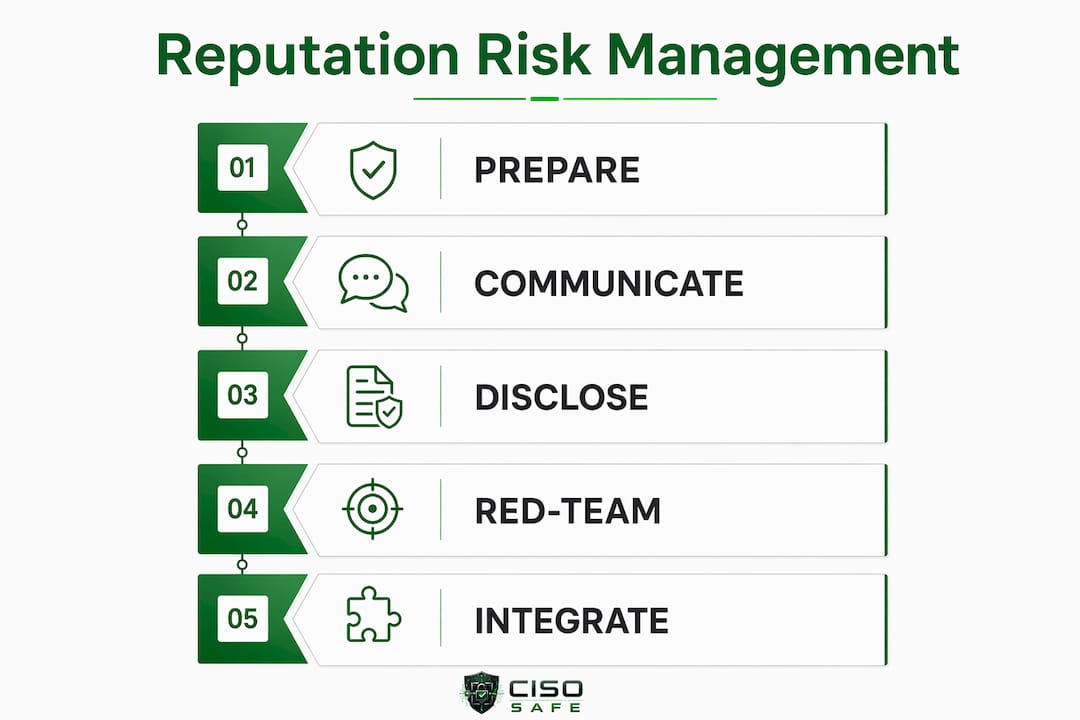
Leadership must treat cybersecurity and business reputation as a unified governance problem. The CISO cannot own reputation alone. The CEO, General Counsel, and Chief Risk Officer all carry accountability for how the firm is perceived when a breach occurs.
Pro Tip: Assign a named executive as the reputation lead in your incident response plan before a breach happens. Waiting until a crisis to decide who speaks publicly guarantees fragmented messaging.
What are the best strategies for managing cyber risk's impact on reputation?
Protecting reputation from cyber threats requires preparation that begins long before an incident. The following strategies reflect current best practice for regulated industries.
Build a unified communications protocol
Inconsistent communications after a breach cause more damage than the breach itself. A single source of truth, agreed upon before an incident, speeds recovery and stabilizes stakeholder confidence. Your incident response plan must include pre-approved messaging templates, a designated spokesperson, and a clear escalation path for approvals. Every statement issued externally must be verified internally first.
Trigger-event communications should be executed within seven days of a confirmed incident. That window is when you isolate claims, align leadership, deploy safeguards, and publish synchronized trust evidence. Missing that window allows speculation and disinformation to fill the void.
Practice proactive and calibrated disclosure
Proactive cyber incident disclosure can transform a crisis into a demonstration of integrity. Transparency builds resilience when it is accurate and timely. Publishing unverified information prematurely creates credibility gaps that are expensive to close. The standard is not speed alone. It is verified accuracy delivered promptly.
Fleishman Hillard's 2026 analysis confirms that reputation is now earned by demonstrating resilience and accountability through honest, timely communication about cyber incidents. Clients and regulators reward firms that communicate clearly under pressure.
Red-team your reputation before attackers do
Preston Golson at Brunswick Group warns that disinformation and reputational attacks must be integrated into standard risk management. These are not exotic threats. They are business-as-usual risks for any organization with a public profile.
Red-teaming reputation means stress-testing your narrative before a crisis. Identify the false stories that could circulate after a breach. Prepare rebuttals in advance. Brief key stakeholders on likely disinformation vectors. This practice, called prebunking, reduces the time it takes to counter false narratives when they appear.
Integrate reputation into enterprise risk governance
Reputational risk is increasingly integrated with cyber and operational risk, with insurers now developing actuarial models for forecasting reputation impact. That shift signals a market expectation: firms that treat reputation as a separate function from cyber governance are behind the curve. Your enterprise risk committee should review cyber risk and reputation risk on the same agenda, with shared metrics and shared accountability.
Pro Tip: Include a reputation impact score in every cyber risk assessment your team produces. Quantifying reputational exposure alongside financial exposure forces leadership to treat both with equal urgency.
How should regulated industries approach cyber risk management for reputation?
Regulated industries face a compounding challenge. Compliance requirements create a paper trail that regulators, plaintiffs, and journalists can examine after a breach. Meeting SOC 2, HIPAA, PCI DSS, or CMMC standards is not just a legal obligation. It is a reputation signal.
Clients in financial services, energy, and legal sectors make vendor and partner decisions based on perceived cyber maturity. A cybersecurity maturity assessment gives leadership a documented baseline that can be shared with clients and auditors as evidence of governance. That documentation becomes a trust asset during due diligence.
Stakeholder sentiment tracking is equally important. Regulated firms should monitor how clients, regulators, and media outlets discuss their cyber posture before and after any incident. Early signals of eroding confidence allow leadership to respond before sentiment hardens into lost contracts or regulatory action.
- Financial services: Clients expect real-time breach notification and documented recovery procedures. Delays trigger both regulatory penalties and client exits.
- Energy and oil and gas: Operational technology breaches carry physical safety implications. The reputational stakes extend beyond data loss to public safety credibility. Cybersecurity governance in energy requires integrating OT and IT risk into a single governance model.
- Legal: Law firms hold privileged client data. A breach signals a failure of confidentiality that clients cannot overlook. ABA cybersecurity guidelines set a minimum standard, but reputation-conscious firms exceed them.
Integrated cyber governance models treat compliance, incident response, and reputation management as one connected system. Firms that silo these functions discover the gaps only when a breach exposes them publicly.
Key Takeaways
Cyber risk is reputation risk. Firms that manage them separately will always be slower to respond and harder to trust after an incident.
| Point | Details |
|---|---|
| Cyber risk equals reputation risk | Stakeholders view every breach as a trust failure, not just a technical event. |
| Financial impact is sustained | Share price underperformance of nearly 5% persists for 12+ months post-incident. |
| Unified communications matter | Inconsistent messaging after a breach causes more damage than the breach itself. |
| Proactive disclosure builds resilience | Verified, timely transparency turns a crisis into a credibility demonstration. |
| Regulated industries face compounding risk | Compliance records become public evidence; cyber maturity signals client trustworthiness. |
What I've learned about cyber risk and reputation the hard way
Most organizations treat reputation recovery as a communications problem. It is not. It is a governance problem that shows up in communications.
I have worked with firms that had excellent PR teams and no incident response plan. When a breach hit, the communications team was ready to talk and had nothing credible to say. The technical team was working the problem in silence. Leadership was waiting for a full picture before approving any statement. That gap, measured in hours and days, is where reputation dies.
The firms that recover fastest share one trait: they decided how they would behave during a crisis before the crisis arrived. They had named executives, pre-approved messaging frameworks, and a clear definition of what "verified" meant before they would speak publicly. That preparation is not a communications strategy. It is a governance decision.
The other pattern I see consistently is underestimating disinformation. Regulated industries attract adversarial attention. Competitors, activists, and state actors all understand that a well-timed false narrative during a breach can amplify damage far beyond what the technical incident would cause alone. Red-teaming your reputation is not paranoia. It is the same logic as penetration testing your network. You find the vulnerabilities before someone else exploits them.
My recommendation to any corporate leader reading this: stop treating cyber risk and reputation risk as separate agenda items. Put them on the same slide in your next board presentation. Assign shared ownership. Measure them together. The firms that do this are not just better prepared for a breach. They are more trusted before one ever happens.
— vCISO
Protect your firm's reputation with CisoSafe
Reputation damage from a cyber attack is preventable with the right governance in place before an incident occurs. CisoSafe delivers virtual CISO services built specifically for regulated industries, including law firms, energy operators, and financial services organizations across the United States.
CisoSafe combines hands-on security assessments, incident response planning, and compliance support for frameworks including SOC 2, HIPAA, PCI DSS, and CMMC. Every engagement gives leadership clear visibility into cyber risk and its reputation implications, without the cost of a full-time CISO. If your firm needs to close the gap between cyber governance and reputation protection, CisoSafe is built for exactly that challenge.
FAQ
What is the role of cyber risk in firm reputation?
Cyber risk directly threatens firm reputation by exposing trust failures to clients, regulators, and investors. A single breach can trigger sustained share price underperformance, client attrition, and regulatory scrutiny that outlasts the technical incident.
How long does reputation damage from a cyber attack last?
Research shows firms underperform the stock market by nearly 5% for over 12 months after a cyber incident disclosure. Trust damage typically outlasts financial recovery by months or years.
What is the most important step in protecting reputation during a breach?
Establishing a unified communications protocol before a breach occurs is the most critical step. Inconsistent messaging after an incident causes more reputational damage than the breach itself.
How do regulated industries face different cyber reputation risks?
Regulated industries hold compliance records, privileged data, and public safety responsibilities that amplify reputational exposure after a breach. Clients and regulators in financial services, energy, and legal sectors treat cyber maturity as a direct signal of trustworthiness.
What is prebunking in the context of cyber reputation management?
Prebunking is the practice of identifying likely false narratives before a breach and preparing rebuttals in advance. Preston Golson at Brunswick Group recommends integrating disinformation scenarios into standard risk management to build crisis resilience.