

Cyber threat intelligence (CTI) is defined as the targeted process of gathering, analyzing, and applying threat data to protect law firms from extortion, data theft, and social engineering attacks. In the legal sector, CTI is not a generic security function. It is a compliance requirement shaped by real threat actors, specific attack vectors, and frameworks like NIST CSF 2.0 and ISO/IEC 27001. Law firms hold concentrated stores of client financial records, litigation strategy, and transaction data. That concentration makes them high-value targets. Integrating cyber threat intelligence into the legal sector means moving from passive monitoring to active, governance-aligned defense before an incident forces the issue.
What are the main cyber threats targeting the legal sector today?
Law firms face a specific and well-documented threat environment. The primary risks are data theft, extortion, ransomware, insider threats, and social engineering. Each of these is more dangerous in a legal context because the data at stake carries both financial and reputational consequences.
The most documented active threat actor targeting US law firms is UNC3753, also known as Silent Ransom Group. This group targets law firms via vishing and social engineering to exfiltrate sensitive client and financial data for extortion. The group does not deploy encryption ransomware. Instead, it convinces employees to host screen-sharing sessions and install remote monitoring tools, then steals data quietly. That approach bypasses most traditional endpoint defenses.

The physical dimension of this threat is equally serious. The FBI warns that Silent Ransom Group may impersonate IT support staff and physically visit law firm offices to access computers directly. This is not a theoretical risk. It is an active tactic that requires law firms to extend their CTI programs beyond digital indicators to include physical access controls and visitor verification protocols.
Key threat vectors law firms must monitor include:
- Vishing calls impersonating IT vendors or bar association representatives
- Remote access exploitation through screen-sharing tools like AnyDesk or remote desktop protocols
- In-person intrusion attempts by actors posing as support technicians
- Insider threats from staff with access to document management systems
- Third-party vendor compromise affecting shared legal technology platforms
"Legal and professional service firms are targeted because of their concentrated sensitive client data and regulatory exposure, making extortion highly effective." — Google Cloud Threat Intelligence
Law firms are not collateral targets. They are primary targets. Compliance officers who treat legal cybersecurity threats as a subset of general enterprise risk will consistently underestimate the actual exposure.
Which frameworks support CTI integration in legal cybersecurity programs?
Three frameworks define the governance structure for CTI programs in law firms: NIST CSF 2.0, ISO/IEC 27001 Annex A 5.7, and NIST IR 8374r1. Each addresses a different layer of the intelligence program.
| Framework | CTI Requirement | Legal Sector Application |
|---|---|---|
| NIST CSF 2.0 | Manage cybersecurity as enterprise risk; integrate CTI into governance and workforce planning | Aligns threat data with firm risk registers and leadership reporting |
| ISO/IEC 27001 Annex A 5.7 | Filter global threat feeds against asset inventories; document impact and remediation | Creates audit-ready intelligence records for compliance reviews |
| NIST IR 8374r1 | Define ransomware to include double-extortion without encryption; build tailored response playbooks | Covers UNC3753-style data theft extortion as a ransomware risk category |
NIST CSF 2.0 advocates managing cybersecurity as an enterprise risk function, emphasizing communication and workforce planning based on risk reality. For law firms, this means CTI findings must reach managing partners and compliance committees, not just IT staff. Intelligence that stays inside the security team does not change firm behavior.
ISO/IEC 27001 Annex A 5.7 requires threat intelligence processes that filter global threat feeds against asset inventories and document impact and remediation. The standard moves CTI from passive feed consumption to documented, risk-based decision-making. That documentation is what auditors check. Firms that cannot show a clear chain from threat identification to remediation closure will fail compliance reviews.
NIST IR 8374r1 defines ransomware to include double-extortion through data theft, which means law firms must include non-encryption extortion events in their CTI programs. The UNC3753 model fits this definition exactly. Firms that only track encryption-based ransomware will miss the most active threat currently targeting their sector.
Pro Tip: Map each framework control to a named owner inside the firm. NIST CSF 2.0 governance functions and ISO 27001 Annex A 5.7 both require accountability, not just documentation. Assign a compliance officer or vCISO as the designated intelligence owner for audit purposes.
How to operationalize CTI within law firm security and compliance workflows
Building a functional CTI program inside a law firm requires more than subscribing to threat feeds. The process must connect intelligence to the firm's actual assets, workflows, and decision-makers.
-
Map threat intelligence to your asset inventory. Start with document management systems, remote access tools, and communication platforms. Aligning threat cluster analysis to specific matter-data touchpoints creates audit-ready intelligence tailored for legal workflows. If UNC3753 exploits screen-sharing tools, your CTI program must flag any unauthorized screen-sharing session as a high-priority alert.
-
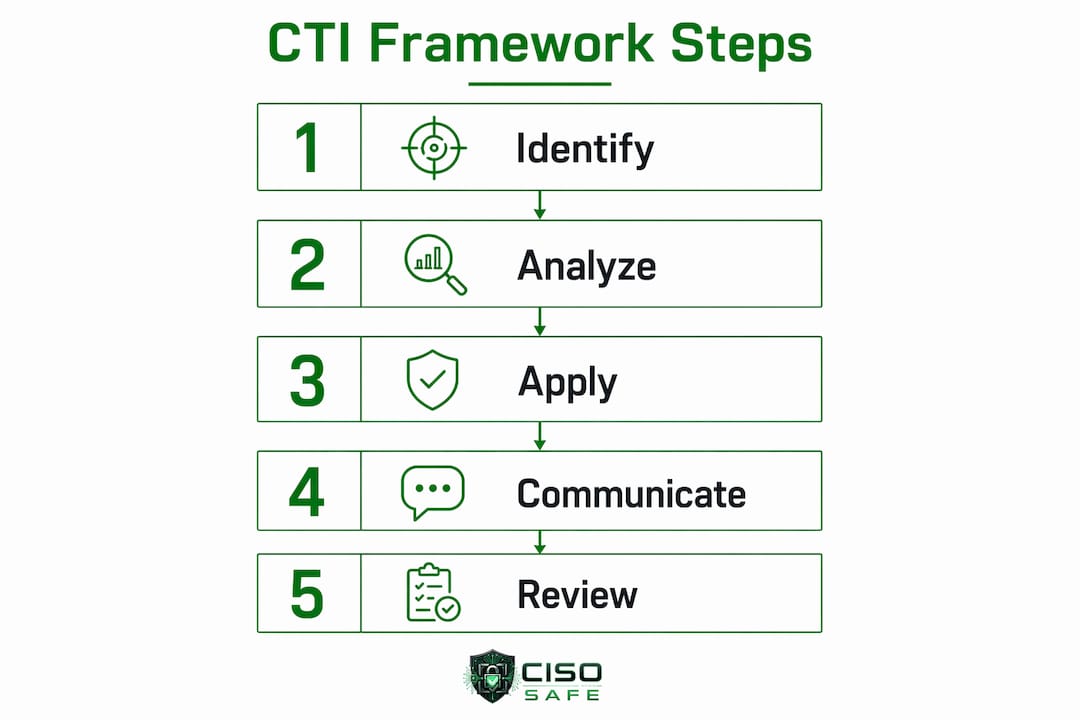
Build an intelligence filtering and analysis process. Not every threat feed item is relevant to a law firm. Filter incoming intelligence against your asset inventory and client data classification. Assign confidence levels to each finding using a three-tier model: tactical (specific indicators), operational (attack patterns), and strategic (actor intent and targeting trends). CTI reporting at tactical, operational, and strategic levels with calibrated confidence is the standard for compliance and audit-readiness.
-
Develop playbooks for social engineering and extortion scenarios. A UNC3753-style attack moves fast. Your playbook must define who authorizes emergency containment, what controls get enforced first, and how the firm communicates with affected clients. CTI programs must include a time-to-control assumption, enabling rapid enforcement of controls like blocking unauthorized screen-sharing or tightening remote access approvals within hours.
-
Integrate CTI findings into your risk register and governance reporting. Every intelligence finding with a confirmed business impact must enter the firm's risk register with an assigned owner and a remediation deadline. Compliance officers need this trail for SOC 2, ISO 27001, and ABA cybersecurity guideline reviews. For a detailed compliance mapping, the ABA cybersecurity guidelines provide a useful reference for legal teams.
-
Track remediation closure with documented evidence. Open findings without closure evidence are a compliance liability. Use a tracking table that records the threat source, the asset affected, the control applied, and the date the risk was closed.
| CTI Report Field | Purpose | Example Entry |
|---|---|---|
| Threat source | Identifies intelligence origin | FBI Flash Alert, Google Cloud Threat Intel |
| Asset affected | Links threat to firm infrastructure | Document management system, AnyDesk |
| Confidence level | Calibrates response priority | High, Medium, Low |
| Defensive implication | Defines required control action | Block remote tool installation |
| Remediation owner | Assigns accountability | IT Director or vCISO |
| Closure date | Confirms audit trail | Completed within 48 hours |
Pro Tip: Pre-authorize a named emergency containment decision-maker before an incident occurs. Extortion attackers use time pressure as a weapon. A firm that needs three approval layers to block a remote access tool will lose that race every time.
What are common challenges when implementing CTI in legal environments?
Most law firms that attempt CTI programs fail at the same points. Recognizing these failure patterns before they occur is the difference between a program that satisfies auditors and one that creates a false sense of security.
-
Passive feed consumption without filtering. Subscribing to threat intelligence feeds and forwarding alerts to an inbox is not a CTI program. Failure to document intelligence source selection, risk filtering, business impact, and remediation closure undermines compliance efforts and audit readiness. Every feed item must be evaluated against the firm's specific asset inventory before it generates an action.
-
Ignoring physical intrusion as a CTI concern. Most law firm security programs focus entirely on digital vectors. The FBI's warning about Silent Ransom Group's in-person tactics means threat intelligence for law firms must expand beyond malware indicators to include social engineering and physical intrusion risks. Visitor logs, badge access records, and front-desk verification protocols are now CTI data sources.
-
Alert fatigue from untargeted monitoring. Broad threat feeds generate noise. Targeted alerts from sources like FBI Flash Alerts, CISA advisories, and sector-specific intelligence sharing groups produce signals that legal teams can act on. Prioritize quality over volume.
-
Failing to treat extortion without encryption as ransomware. CTI integration should treat extortion without encryption as ransomware risk to align with evolving threat realities and compliance documentation needs. Firms that only track encryption events will miss the UNC3753 model entirely.
-
Not updating CTI processes as threats evolve. A playbook written for 2024 threat actors may not address 2026 tactics. Schedule quarterly reviews of your CTI program against current threat actor reporting from sources like Google Cloud Threat Intelligence and CISA.
For law firms managing third-party risk alongside CTI, the law firm vendor risk management checklist provides a practical complement to internal intelligence programs.
Key takeaways
Law firms that integrate cyber threat intelligence into governance-aligned compliance programs are materially better positioned to detect, contain, and document extortion and data theft attacks before they cause irreversible harm.
| Point | Details |
|---|---|
| CTI is a compliance function | Intelligence findings must enter risk registers and reach firm leadership, not just IT teams. |
| UNC3753 is an active, specific threat | Silent Ransom Group targets US law firms with vishing, screen-sharing exploits, and in-person intrusion. |
| Three frameworks define the standard | NIST CSF 2.0, ISO/IEC 27001 Annex A 5.7, and NIST IR 8374r1 together govern legal sector CTI programs. |
| Rapid control enforcement is required | Pre-authorize emergency containment decisions to counter fast-moving extortion tactics. |
| Documentation closes the audit gap | Source selection, impact analysis, and remediation closure records are what auditors verify. |
What I've learned about CTI in law firms that most guides won't tell you
The hardest part of building a CTI program inside a law firm is not the technology. It is the governance gap between the security team and firm leadership. Partners want to know their client data is protected. They do not want to review threat actor profiles. That gap is where most programs fail.
What actually works is translating intelligence into business language before it reaches the governance layer. When I see a UNC3753 vishing campaign targeting firms in a specific practice area, the relevant message for a managing partner is not "threat actor UNC3753 is using vishing and remote access tools." The message is "a criminal group is calling your staff, impersonating IT support, and stealing client files. Here is what we are blocking today and what you need to tell your front desk."
The physical intrusion angle is the detail that consistently surprises legal leadership. Most partners assume cybersecurity is a digital problem. The FBI's documented cases of Silent Ransom Group actors walking into offices changes that assumption immediately. Use that fact in your governance briefings. It lands differently than any technical indicator.
Speed is the other variable that legal CTI programs consistently underestimate. Extortion actors do not give firms days to respond. A CTI program that requires committee approval to block a remote access tool is not a CTI program. It is a documentation exercise. Pre-authorized containment authority, assigned to a named individual, is the single most practical improvement most law firms can make today.
— vCISO
How CisoSafe helps law firms build audit-ready CTI programs
Law firms that need to move from reactive security to a documented, governance-integrated CTI program can work with CisoSafe's virtual CISO services to get there without the cost of a full-time hire. CisoSafe specializes in regulated industries, including legal sector clients who need NIST CSF 2.0 alignment, ISO 27001 compliance, and incident response playbooks built for real threat actors like UNC3753.
CisoSafe delivers security assessments, risk roadmaps, policy development, and ongoing advisory that connect directly to compliance reporting requirements. For law firms managing SOC 2 or ABA cybersecurity obligations, the SOC 2 compliance guide for law firms is a practical starting point. Contact CisoSafe to schedule a threat assessment and build a CTI program your auditors and clients can rely on.
FAQ
What is cyber threat intelligence in the legal sector?
Cyber threat intelligence in the legal sector is the process of collecting, analyzing, and applying threat data specific to law firm risks, including extortion, data theft, and social engineering. It connects threat findings to compliance frameworks like NIST CSF 2.0 and ISO/IEC 27001 to produce audit-ready security decisions.
Who is UNC3753 and why do law firms need to know?
UNC3753, also called Silent Ransom Group, is an active threat actor that targets US law firms through vishing, screen-sharing exploitation, and in-person office intrusions. The FBI has issued warnings about this group specifically because its tactics bypass traditional endpoint security tools.
How does ISO/IEC 27001 Annex A 5.7 apply to law firm CTI?
ISO/IEC 27001 Annex A 5.7 requires organizations to filter threat intelligence against their asset inventories and document impact and remediation for audit purposes. For law firms, this means every threat finding must be evaluated against specific systems like document management platforms and closed with documented evidence.
Does extortion without ransomware encryption count as a ransomware risk?
NIST IR 8374r1 defines ransomware to include double-extortion through data theft, even without encryption. Law firms must include UNC3753-style data exfiltration and extortion events in their ransomware risk management programs to meet current compliance standards.
How quickly should a law firm respond to a CTI alert?
CTI programs must enable rapid control enforcement within hours of identifying a credible threat. Pre-designated containment authorizers and pre-built playbooks for social engineering and remote access exploitation are the minimum requirements for an effective response timeline.