

SOC 2 compliance is a security and privacy auditing framework developed by the American Institute of Certified Public Accountants (AICPA) that law firms must meet to demonstrate they protect sensitive client data with verified, repeatable controls. For legal practices handling privileged communications, financial records, and personally identifiable information, SOC 2 certification is no longer optional. Clients and enterprise counterparts now demand it. A SOC 2 Type II report can reduce up to 90% of the custom security questionnaires your firm receives, accelerating deal cycles and building measurable trust. This soc 2 compliance law firm guide covers every phase from requirements to audit readiness.
What are the core SOC 2 compliance requirements for law firms?
SOC 2 is built on five Trust Services Criteria: Security, Availability, Processing Integrity, Confidentiality, and Privacy. Security is the only mandatory category. The other four are optional and selected based on your firm's services and client commitments.
The Security category contains 9 Common Criteria labeled CC1 through CC9, covering approximately 64 individual control points. That number surprises most managing partners. It means SOC 2 is not a checkbox exercise. It is a structured governance program.
Here is what each Common Criteria cluster addresses:
- CC1 (Control Environment): Organizational structure, ethics policies, and board-level oversight of security responsibilities.
- CC2 (Communication and Information): Internal and external communication of security policies and incident procedures.
- CC3 (Risk Assessment): Formal risk identification, analysis, and response planning tied to business objectives.
- CC4 (Monitoring Activities): Ongoing evaluation of controls through internal audits, log reviews, and performance metrics.
- CC5 (Control Activities): Policies and procedures that mitigate identified risks, including data classification and access governance.
- CC6 (Logical and Physical Access): Multi-factor authentication, role-based access controls, and physical security for systems holding client data.
- CC7 (System Operations): Threat detection, vulnerability management, and incident response procedures.
- CC8 (Change Management): Controlled processes for software updates, configuration changes, and system modifications.
- CC9 (Risk Mitigation): Vendor risk management and business continuity planning.
For law firms, CC6 and CC9 draw the most auditor scrutiny. Logical access controls and legal tech platforms that handle client data must demonstrate strict permission management. Vendor oversight is equally critical, as outside counsel software, cloud storage providers, and e-discovery platforms all fall within scope.
| Criteria | Status | Typical Controls |
|---|---|---|
| Security (CC1–CC9) | Mandatory | MFA, access reviews, incident response, risk assessments |
| Availability | Optional | Uptime monitoring, disaster recovery, SLA documentation |
| Confidentiality | Optional | Data classification, encryption, NDA enforcement |
| Processing Integrity | Optional | Data validation, error handling, processing logs |
| Privacy | Optional | Consent management, data subject rights, retention policies |

How long does SOC 2 compliance take for a law firm?
SOC 2 Type II compliance typically requires 6–18 months from start to report issuance. That range reflects real variation in firm size, existing control maturity, and how quickly leadership commits resources. Plan for the longer end if your firm has never undergone a formal security audit.
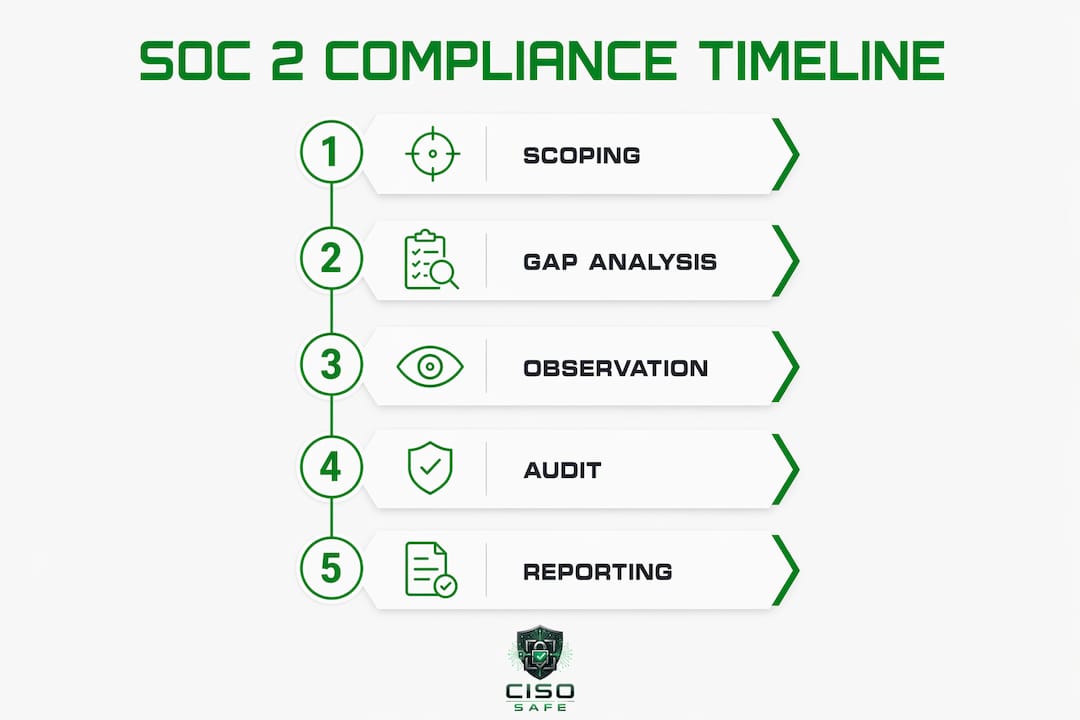
The process breaks into four distinct phases:
- Scoping and readiness assessment (2–4 weeks): Define which systems, services, and data types fall within the audit boundary. Identify gaps between current practices and SOC 2 requirements.
- Gap remediation (1–3 months): Implement missing controls, update policies, and document procedures. This phase often reveals that informal practices need to be formalized and assigned to specific owners.
- Observation window (3–12 months): The auditor evaluates whether controls operate consistently over time. This is the phase most firms underestimate. Evidence collection must be continuous, dated, and attributable to specific individuals or systems.
- Auditor fieldwork (4–6 weeks): The CPA firm conducts interviews, tests controls, and reviews collected evidence before issuing the final report.
Pro Tip: Automate evidence collection from day one of the observation window. Manual spreadsheets and email threads fail under auditor scrutiny. Use a compliance platform that timestamps access logs, policy acknowledgments, and vendor reviews automatically.
| Phase | Duration | Key Deliverable |
|---|---|---|
| Scoping and readiness | 2–4 weeks | Gap analysis report |
| Gap remediation | 1–3 months | Implemented controls and updated policies |
| Observation window | 3–12 months | Continuous, timestamped evidence artifacts |
| Auditor fieldwork | 4–6 weeks | SOC 2 Type II report |
A first-time Type 2 audit follows this exact phased structure. Firms that try to compress the observation window by starting remediation late consistently face audit delays or qualified opinions.
What tools and best practices help law firms prepare for SOC 2?
Selecting the right auditor is the first decision that shapes your entire compliance program. SOC 2 audits must be conducted by a licensed CPA firm with AICPA attestation credentials. Not every accounting firm qualifies. Verify that your auditor has specific SOC 2 experience with professional services or legal sector clients.
Beyond auditor selection, the following practices define firms that pass versus firms that struggle:
- Deploy a compliance automation platform. Tools that integrate with your existing systems to pull access logs, policy sign-offs, and vendor assessments reduce manual burden and produce the timestamped artifacts auditors require.
- Conduct quarterly access reviews. CC6 requires that user permissions are reviewed and revoked when roles change. Quarterly reviews with documented sign-off satisfy this requirement consistently.
- Build a vendor risk register. Documented vendor oversight is mandatory. Your register must include risk ratings, review schedules, and a process for reassessing vendors after service changes or security incidents.
- Document your incident response plan and test it. A written plan that has never been exercised does not satisfy CC7. Run at least one tabletop exercise per year and document the results.
- Assign control owners across departments. SOC 2 touches HR, IT, finance, and operations. Each control needs a named owner who is accountable for evidence collection and policy adherence.
Pro Tip: Involve your firm's managing partner or executive committee early. SOC 2 success depends on firm-wide governance, not just IT effort. Leadership sponsorship accelerates policy adoption and removes organizational resistance to new security controls.
Cross-department collaboration is not optional. Your HR team controls onboarding and offboarding procedures that directly affect CC6. Your finance team manages vendor contracts that affect CC9. Treating SOC 2 as an IT project is the single most common reason law firms stall during the observation window.
What are the most common SOC 2 audit pitfalls for law firms?
The most damaging misconception in legal SOC 2 programs is that compliance is a technical IT project. Security experts consistently emphasize that partner involvement and executive sponsorship are prerequisites for aligning controls with business objectives. Without that alignment, controls get implemented inconsistently and evidence collection breaks down.
Common pitfalls include:
- Insufficient or undated evidence. Auditors no longer accept policy documents as proof of compliance. They require timestamped, attributable records showing that controls operated consistently throughout the observation period.
- Weak vendor oversight. A simple list of third-party vendors does not satisfy CC9. Auditors expect documented risk ratings, defined review cycles, and evidence of reassessment when vendors change their services or experience incidents.
- Scope creep during remediation. Firms that expand their audit scope mid-cycle often cannot complete remediation before the observation window begins, forcing a restart.
- No incident response testing. Written plans without documented exercises are flagged as deficiencies. One tested, documented tabletop exercise per year is the minimum standard.
- Leadership disengagement after kickoff. Partner buy-in at the start of a SOC 2 program means nothing if leadership stops attending governance reviews three months in.
SOC 2 compliance success hinges on viewing it as a firm-wide governance initiative, not just an IT project, requiring strong executive sponsorship for cultural adoption.
The shift in audit methodology is significant. Modern SOC 2 audits demand ongoing evidence of process consistency with time-stamped records, moving away from static document review to dynamic process validation. That shift means your firm cannot sprint to compliance at the end of the observation window. The evidence must exist throughout.
Practical remediation steps when you identify gaps late in the process: prioritize CC6 and CC9 controls first, since access management and vendor oversight are the two areas most likely to generate audit findings. Document what you have, assign owners to what you are missing, and communicate the gap clearly to your auditor before fieldwork begins. Auditors respond better to transparency than to surprises.
Key takeaways
SOC 2 compliance for law firms requires treating security as a governance program, not a technical project, with consistent evidence collection across a 3–12 month observation period as the defining success factor.
| Point | Details |
|---|---|
| Security criteria is mandatory | CC1–CC9 covers ~64 control points; all other Trust Services Criteria are optional. |
| Timeline runs 6–18 months | Plan for the observation window to last up to 12 months before auditor fieldwork begins. |
| Evidence must be continuous | Timestamped, attributable artifacts throughout the observation period are required, not just at audit time. |
| Vendor oversight is audited | Maintain a risk register with ratings, review schedules, and reassessment triggers for all third-party vendors. |
| Leadership sponsorship is required | Partner-level involvement drives cross-department adoption and prevents control gaps from forming. |
Where law firm SOC 2 programs actually break down
After working through SOC 2 readiness with multiple professional services organizations, the pattern is consistent. Firms that fail their first Type 2 audit do not fail because of technical deficiencies. They fail because the program was never treated as a business priority at the partner level.
The observation window is where this becomes visible. When a managing partner is not personally accountable for quarterly governance reviews, those reviews get postponed. When HR is not looped in on access control requirements, terminated employees stay in systems for weeks. When vendor contracts are managed by individual attorneys without a centralized risk register, CC9 becomes impossible to satisfy.
The firms that pass on the first attempt share one trait: they assigned a named compliance lead with direct access to firm leadership, and that person had authority to enforce deadlines across departments. That is not an IT function. That is a governance function.
The 2026 audit environment has also raised the bar on vendor oversight specifically. Auditors are now asking for evidence of vendor reassessment after incidents, not just annual reviews. If a cloud storage provider your firm uses experiences a breach, your auditor will want to see that you reviewed the incident, assessed the impact on your data, and documented your response. Firms without a structured vendor risk program cannot produce that evidence.
SOC 2 done right becomes a competitive asset. Clients in regulated industries, including financial services, healthcare, and government contracting, increasingly require SOC 2 reports before engaging outside counsel. A Type II report positions your firm ahead of competitors who are still responding to custom security questionnaires one at a time.
— vCISO
How CisoSafe supports law firm SOC 2 readiness
Law firms pursuing SOC 2 certification need more than a checklist. They need a compliance partner who understands legal sector risk, executive governance, and the evidence requirements that determine audit outcomes.
CisoSafe delivers virtual CISO services built specifically for regulated industries, including law firms navigating SOC 2 for the first time or maintaining existing certifications. The CisoSafe platform automates evidence collection, manages vendor risk registers, and produces audit-ready documentation without burdening your internal teams. From scoping through fieldwork, CisoSafe provides the strategic advisory and technical execution that law firm partners need to reach compliance on schedule and on budget. Contact CisoSafe to assess your firm's current SOC 2 readiness and build a clear path to certification.
FAQ
What is SOC 2 compliance for law firms?
SOC 2 compliance is an AICPA auditing framework that verifies a law firm's security controls protect client data consistently over time. It results in a Type I or Type II report that clients and enterprise partners use to assess your firm's security posture.
How long does a SOC 2 type II audit take?
A SOC 2 Type II audit takes 6–18 months in total, including a 3–12 month observation period and 4–6 weeks of auditor fieldwork. First-time audits typically run closer to 12–18 months.
Which SOC 2 criteria are mandatory for law firms?
The Security criterion, covering Common Criteria CC1–CC9, is mandatory for all SOC 2 audits. Availability, Confidentiality, Processing Integrity, and Privacy are optional and selected based on the firm's services.
What is the biggest reason law firms fail SOC 2 audits?
Insufficient or undated evidence during the observation period is the most common audit failure point. Firms that rely on manual tracking often cannot produce the timestamped, attributable artifacts auditors require.
Do law firms need a SOC 2 report to win enterprise clients?
Many enterprise clients in financial services, healthcare, and government contracting now require a SOC 2 Type II report before engaging outside counsel. Providing one can reduce security questionnaires by up to 90%, accelerating the client intake process significantly.