

Supply chain cyber risk is defined as the potential for a cyberattack to reach your organization through vulnerabilities in your suppliers, vendors, or third-party partners rather than through a direct attack on your own systems. This is the formal industry term: cyber supply chain risk management, or C-SCRM. Supply chain threats account for 10.6% of all observed cyber threats in Europe, and regulators across frameworks like NIST CSF 2.0, SOC 2, and CMMC now treat vendor oversight as a core compliance requirement. For business leaders and compliance officers in regulated industries, understanding what is supply chain cyber risk is no longer optional. Your vendors are your largest attack surface.
What is supply chain cyber risk and why does it matter?
Supply chain cyber risk is the exposure your organization inherits from every vendor, software provider, and service partner you trust. Attackers do not need to breach your firewall directly. They compromise a supplier you already trust, then use that trusted relationship to reach you.
This is fundamentally different from a phishing attack aimed at your employees. Supply chain attacks exploit whitelisted software and trusted vendor tools, which means your perimeter defenses do not stop them. A malicious payload arrives through an authorized channel, and your security tools see it as legitimate traffic.

The business impact is severe. Regulated industries face operational shutdowns, data breaches affecting client records, and regulatory penalties when a vendor is compromised. Cyber supply chain risk is a business continuity and procurement challenge, not just an IT problem. That distinction matters because it changes who owns the risk and how it gets managed.
What are common supply chain cyber threats and attack methods?
Attackers use several proven methods to infiltrate organizations through their supply chains. Understanding these methods is the first step toward building an effective defense.
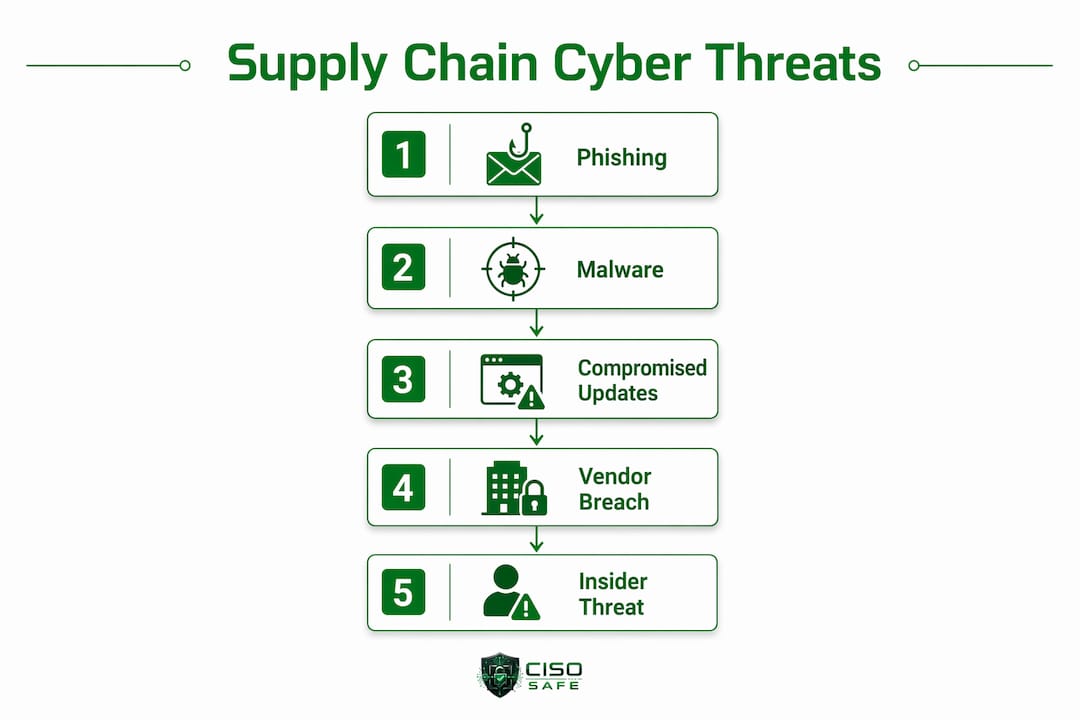
- Credential theft via cloud infrastructure. 67% of attacks on cloud infrastructure involve credential theft. Attackers steal a vendor employee's login credentials, then move laterally through connected partner networks.
- Malicious software updates. Attackers compromise a software maintainer's account and push a poisoned update to all downstream users. A june 2026 attack infected 141 packages within 45 minutes by exploiting one compromised maintainer account. That speed makes detection extremely difficult.
- Typosquatting. Attackers publish malicious packages with names nearly identical to legitimate ones, counting on developers to install them by mistake.
- Trusted vendor portal abuse. Attackers deliver malicious payloads through legitimate software update processes, bypassing traditional defenses entirely.
- Social engineering and insider risk. Attackers target vendor employees with phishing or bribery to gain access to systems your organization trusts.
The most dangerous supply chain attack is the one your security tools approve. When malicious code arrives through an authorized vendor channel, it looks identical to legitimate traffic. Detection requires behavioral monitoring, not just perimeter rules.
Pro Tip: Map every vendor that has direct or indirect access to your systems, data, or networks. That map is your true attack surface, and most organizations are surprised by how large it is.
How do supply chain risks affect operations and compliance in regulated industries?
Regulated industries face a compounding problem. A vendor breach does not just create a technical incident. It triggers compliance reporting obligations, client notification requirements, and potential regulatory penalties under frameworks like HIPAA, PCI DSS, and CMMC.
-
Business continuity exposure. If a critical vendor goes offline due to a cyberattack, your operations may stop with it. True business resilience requires evaluating suppliers on the potential business impact of their failure, not just the likelihood of a breach. A single-source supplier in a just-in-time operation is a high-impact risk even if its breach probability is low.
-
Regulatory transparency requirements. Frameworks like NIST CSF 2.0 and SOC 2 require organizations to demonstrate active vendor oversight. A static annual vendor checklist no longer satisfies auditors. You need documented, ongoing monitoring.
-
Dynamic risk reassessment triggers. Vendor cyber risk must be reassessed after material vendor relationship changes or security incidents. A vendor acquisition, a reported breach at your vendor, or a significant contract expansion all require a fresh risk review.
-
Shadow AI as an untracked supply chain risk. Unauthorized employee use of AI tools creates data leakage and compliance gaps that standard vendor risk programs miss entirely. When an employee uploads client data to an unauthorized AI tool, that tool becomes an unvetted third party with access to sensitive information.
-
The IT versus business resilience gap. IT teams focus on breach likelihood and technical controls. Business leaders need to focus on operational impact. These are different questions, and regulated industries need both answered.
Pro Tip: Ask your compliance team one question: "Which vendors, if breached or unavailable tomorrow, would stop our operations or trigger a regulatory notification?" That list is your priority vendor risk register.
What are best practices for assessing and managing supply chain cyber risk?
Effective supply chain vulnerability management requires a structured approach that goes beyond annual vendor questionnaires. NIST CSF 2.0 treats third-party risk as a continuous governance function, not a one-time checkbox. That shift in thinking is the foundation of a defensible program.
Key frameworks and techniques
| Approach | What it does | Best suited for |
|---|---|---|
| NIST CSF 2.0 Govern function | Embeds supplier oversight into ongoing governance cycles | All regulated industries |
| Software Bill of Materials (SBOM) | Catalogs every software component and its origin | Organizations using third-party software |
| Zero-trust architecture | Removes implicit trust from all vendor connections | Cloud-connected environments |
| Behavioral detection | Flags anomalous activity from trusted vendor accounts | Organizations with deep vendor integrations |
| Trigger-based reassessment | Reassesses vendor risk after incidents or relationship changes | Compliance-sensitive industries |
Integrating cyber risk into procurement is the most underused control in regulated industries. Most organizations assess vendors at onboarding and then forget them. The right model treats vendor risk as a living register, updated whenever a vendor's scope, ownership, or security posture changes.
A Software Bill of Materials gives your security team visibility into every component inside the software your vendors supply. Without an SBOM, you cannot know whether a vendor's product contains a vulnerable open-source library. That visibility gap is exactly what attackers exploited in the june 2026 package attack.
Zero-trust architecture applies the principle that no vendor connection is inherently safe. Every access request from a vendor system is verified, regardless of whether it comes through an approved channel. This directly counters the trust exploitation that makes supply chain attacks so effective.
Pro Tip: Build your vendor risk management checklist around three tiers: critical vendors with direct data access, important vendors with indirect access, and low-risk vendors with no access to sensitive systems. Apply your most rigorous controls to tier one.
What challenges complicate supply chain cyber risk management?
Managing cybersecurity in supply chains is harder than managing internal security because you control less of the environment. Several specific challenges make this especially difficult for regulated organizations.
- Short attack windows. The 45-minute window in the june 2026 package attack shows that detection must be near real-time. Traditional security reviews that run weekly or monthly cannot catch attacks that complete in under an hour.
- Multi-tier supply chain complexity. Your direct vendors have their own vendors. A breach four tiers deep in your supply chain can still reach your systems if the chain of trust connects. Most organizations have no visibility beyond their direct suppliers.
- AI-enabled attacks. Attackers now use AI to write more convincing phishing emails, generate malicious code faster, and identify vulnerable targets at scale. The attack surface grows as AI tools become more accessible to threat actors.
- Shadow AI inside your organization. Employees using unauthorized AI tools for productivity create an untracked third-party data exposure. This risk bypasses your vendor approval process entirely because it originates inside your own workforce.
- Evolving regulatory expectations. Regulators are raising the bar. What satisfied a SOC 2 auditor two years ago may not satisfy one today. Compliance officers must track regulatory updates alongside technical threats.
Pro Tip: Require vendors to notify you within 24 hours of any security incident affecting systems connected to your environment. Build this into your vendor contracts before you need it.
Key takeaways
Supply chain cyber risk is a continuous governance challenge that requires cross-functional ownership, dynamic vendor assessments, and controls that go well beyond perimeter security.
| Point | Details |
|---|---|
| Define the risk correctly | Supply chain cyber risk enters through trusted vendor relationships, not just direct attacks on your systems. |
| Prioritize by business impact | Assess vendors on the operational impact of their failure, not just breach likelihood. |
| Move beyond annual checklists | NIST CSF 2.0 requires continuous supplier monitoring with trigger-based reassessments after incidents or changes. |
| Address shadow AI | Unauthorized employee AI tool use creates untracked third-party data exposure that standard vendor programs miss. |
| Integrate risk into procurement | Vendor risk assessments must start at onboarding and update throughout the vendor relationship lifecycle. |
What I've learned about supply chain risk that most IT frameworks miss
The most common gap I see in regulated organizations is not a lack of security tools. It is a lack of ownership. IT teams manage the technical controls. Legal teams manage vendor contracts. Procurement teams manage supplier relationships. Nobody owns the intersection of all three, and that intersection is exactly where supply chain cyber risk lives.
The second gap is treating compliance as the finish line. Passing a SOC 2 audit or completing a CMMC assessment does not mean your supply chain is secure. It means you met a documented standard at a point in time. Attackers do not respect audit cycles.
The organizations that manage this well share one characteristic: they treat third-party cyber risk as a business governance issue, not a security team task. The CISO informs the risk. The executive team owns it. That accountability structure changes how seriously vendors take your security requirements and how quickly your organization responds when something goes wrong.
Cross-functional collaboration is not a soft recommendation. It is the only way to connect the technical signal from a vendor breach to the business decision about whether to continue that vendor relationship. If your security team cannot get a meeting with procurement, your supply chain risk program will always be reactive.
— vCISO
How CisoSafe supports supply chain cyber risk governance
Supply chain cyber risk management requires more than a policy document. It requires ongoing vendor oversight, compliance alignment, and the ability to respond quickly when a vendor incident occurs.
CisoSafe delivers virtual CISO services built specifically for regulated industries including law firms, oil and gas operators, and energy companies. The CisoSafe platform combines hands-on risk assessments, vendor risk program development, and AI-powered compliance reporting to give your leadership team clear visibility into supply chain exposure. CisoSafe helps organizations align with NIST CSF 2.0, SOC 2, HIPAA, PCI DSS, and CMMC without the cost of a full-time CISO. If your vendor risk program needs a structured foundation, CisoSafe provides the expertise and tools to build one.
FAQ
What is supply chain cyber risk in simple terms?
Supply chain cyber risk is the chance that an attacker reaches your organization through a vendor or third-party partner rather than attacking you directly. It exploits the trust your systems extend to approved suppliers.
How do supply chain attacks bypass traditional security controls?
Supply chain attacks deliver malicious code through authorized channels such as software updates or trusted vendor portals. Because the traffic appears legitimate, perimeter defenses and standard antivirus tools do not flag it.
What frameworks help manage supply chain cyber risk?
NIST CSF 2.0 is the leading framework, with its Govern function requiring continuous supplier monitoring. SOC 2, CMMC, and HIPAA also include third-party risk requirements that compliance officers must address.
How often should organizations reassess vendor cyber risk?
Vendor risk assessments should be trigger-based, not just annual. Reassess after a vendor acquisition, a reported security incident at the vendor, or any significant change in the vendor's access to your systems or data.
What is shadow AI and why is it a supply chain risk?
Shadow AI refers to unauthorized AI tools that employees use without IT or security approval. When employees upload sensitive data to these tools, an unvetted third party gains access to that data outside your vendor risk program.