

Third-party risk in energy companies is defined as the operational, cybersecurity, financial, and compliance exposure created by external vendors, contractors, and suppliers embedded in the energy supply chain. This is not a theoretical concern. 90% of large energy firms experienced at least one third-party cybersecurity breach in a single 12-month period. That figure means your vendor network is statistically your largest attack surface. Energy company third party risk explained properly goes beyond data breaches. It covers grid reliability, regulatory exposure, and the cascading failures that occur when a single supplier fails. Effective third party risk management requires due diligence, contract enforcement, continuous monitoring, and vendor lifecycle governance from day one.
What are the main types of third-party risks energy companies face?
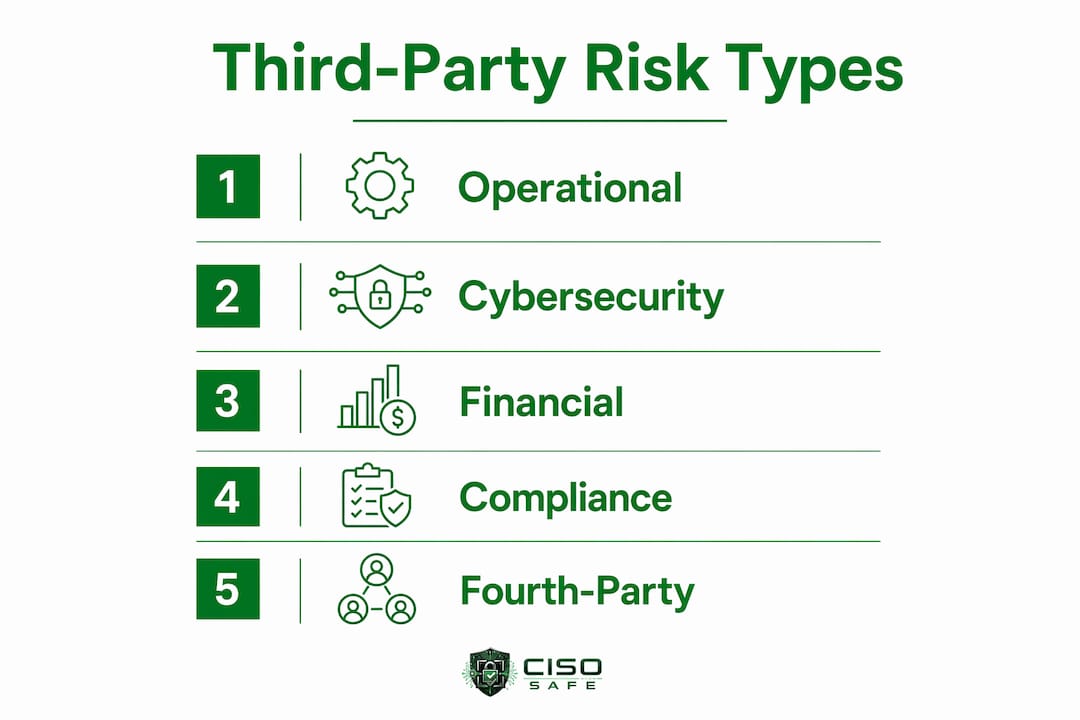
Energy companies carry five distinct categories of third-party risk. Each one operates independently, but they frequently compound each other when a vendor incident occurs.
Cybersecurity risk is the most visible category. Vendors with access to SCADA systems, energy management platforms, or billing infrastructure create direct pathways into critical operational technology. AI-driven attack methods now allow threat actors to probe vendor networks at scale, making even mid-tier suppliers a viable entry point.

Operational risk covers supply chain disruption and single points of failure. A single-source supplier for a critical grid component, for example a transformer manufacturer or a firmware provider for substation equipment, can halt operations if that vendor experiences a production failure, cyberattack, or financial collapse.
Here are the five core risk categories compliance officers must track:
- Cybersecurity risk: Data breaches, unauthorized access to OT systems, and AI-assisted intrusions via vendor networks
- Operational risk: Supply chain disruption, delivery failures, and vendor concentration in critical infrastructure components
- Financial risk: Vendor insolvency, fourth-party exposure, and unplanned costs from emergency sourcing
- Compliance and regulatory risk: Vendors failing to meet NERC CIP, IEC 62443, or contractual security requirements, creating audit liability for the energy company
- Reputational risk: 60% of organizations cite third-party service failures as the primary driver of their most significant reputational damage. That statistic means a vendor's failure becomes your headline.
Fourth-party risk deserves specific attention. Your vendor's vendors can be critical single points of failure that never appear on your standard vendor register. A software provider you trust may rely on a cloud subprocessor operating in a geopolitically sensitive region. That exposure is yours, even if you never contracted with that subprocessor directly.
How has third-party risk evolved in the energy sector?
The nature of third-party risk in energy has shifted from a compliance checkbox to a continuous operational discipline. Five years ago, most energy companies ran annual vendor questionnaires and called it due diligence. That model is no longer adequate.
Supplier risk is now an operational reality requiring multi-dimensional, continuous analysis. Moody's research on energy supply chains identifies financial stability, delivery capability, cyber and OT exposure, and geopolitical sensitivity as the four dimensions that must be assessed together. No single dimension tells the full story. A financially stable vendor operating in a sanctioned region still presents unacceptable risk.
Digital transformation has accelerated this complexity. Energy companies now connect with vendors through APIs, cloud platforms, and remote monitoring tools. Each integration point is a potential breach vector. The attack surface grows every time a new vendor is onboarded without a formal security review.
"The compliance paradox arises when firms rely on static questionnaires that overlook real-time geopolitical and operational shifts, creating zombie access and blind spots that persist for months."
AI adoption adds another layer. AI-related risks expand TPRM scope to include data exposure, model integrity, automation risk, and fourth-party AI dependencies. A vendor using an AI-driven grid optimization tool may be feeding your operational data into a model you have never reviewed. That model's outputs could influence decisions affecting grid reliability without any human validation step.
Geopolitical pressure is reshaping vendor rosters at the same time. Tariffs, export controls, and sanctions have forced energy companies to qualify new suppliers faster than their risk programs can keep pace. Speed-to-qualification creates gaps. Vendors approved under emergency timelines often receive less scrutiny than the risk warrants.
Pro Tip: Map your top 20 critical vendors against geopolitical risk zones annually. A vendor headquartered in a stable country may still manufacture components in a high-risk region, and that distinction matters for your risk register.
What are the best practices for managing third-party risk in energy?
Effective third party risk management in energy follows a structured vendor lifecycle. TPRM programs mandate four lifecycle stages: pre-engagement due diligence, contract security enforcement, ongoing monitoring, and secure offboarding. Skipping any stage creates the gaps that attackers and auditors both find.
Here is how to execute each stage:
- Pre-engagement due diligence: Assess the vendor's cybersecurity posture, financial health, regulatory compliance history, and fourth-party dependencies before signing any contract. Use cybersecurity rating platforms to get an objective baseline.
- Contract security enforcement: Require service level agreements (SLAs), audit rights, incident notification timelines, and specific cybersecurity controls as contractual obligations. Review SLA structures in IT outsourcing to understand which clauses carry the most enforcement weight.
- Continuous monitoring: Track vendor cybersecurity posture, financial signals, and operational performance in real time. Tiered risk-based monitoring focuses resources on critical vendors rather than applying the same scrutiny to every supplier equally.
- Secure offboarding: Revoke all access, recover assets, and confirm data deletion when a vendor relationship ends. Zombie access, where former vendors retain system credentials, is one of the most common and preventable breach vectors.
The comparison table below summarizes the key controls at each stage:
| Program Stage | Key Controls |
|---|---|
| Pre-engagement due diligence | Cybersecurity ratings, financial review, fourth-party mapping |
| Contract enforcement | SLAs, audit rights, incident notification clauses, OT security requirements |
| Continuous monitoring | Real-time cyber posture tracking, financial health signals, tiered criticality scoring |
| Secure offboarding | Access revocation, data deletion confirmation, asset recovery |
Extending oversight to fourth parties is no longer optional for energy companies. Conduct business continuity tests that include your critical vendors' own recovery capabilities. A vendor with a strong security posture but no tested incident response plan is still a liability during a grid emergency.
Pro Tip: Segment your vendor register into three tiers: critical, significant, and standard. Apply continuous monitoring to Tier 1, quarterly reviews to Tier 2, and annual assessments to Tier 3. This approach cuts resource waste without creating blind spots.
What role does technology play in reshaping vendor risk management?
Technology is both the solution and the source of new risk in energy sector vendor management. AI-driven continuous monitoring platforms now process vendor risk signals in real time, flagging changes in cybersecurity posture, financial ratings, and regulatory status before they become incidents. That capability replaces the annual questionnaire model with a live risk feed.
The risks introduced by AI are equally significant. Fortress InfoSec identifies four AI-specific risk categories that energy companies must now assess in their vendor programs:
- Data exposure: Vendors feeding operational data into AI models without adequate data governance controls
- Model integrity: AI systems making recommendations based on corrupted or manipulated training data
- Automation risk: Vendor AI acting autonomously on grid systems without human validation checkpoints
- Fourth-party AI dependencies: Your vendor's AI tools relying on subprocessors or model providers you have never assessed
The IT versus OT gap is the most critical technology challenge in energy TPRM. Traditional IT risk management solutions miss OT-specific security needs that are critical to grid reliability and safety. Standard IT certifications like SOC 2 do not address industrial control system security. Energy companies must require evidence of OT-specific controls, including compliance with IEC 62443, from any vendor with access to operational technology environments.
Vendor management strategies that integrate both IT and OT risk signals give compliance officers a complete picture of vendor exposure. Software-level supply chain analysis, which examines the components and libraries embedded in vendor products, adds another layer of visibility that product-level assessments alone cannot provide.
Key takeaways
Third-party risk management in energy companies requires continuous, tiered oversight across cybersecurity, operational, financial, and compliance dimensions, not periodic vendor questionnaires.
| Point | Details |
|---|---|
| Breach exposure is vendor-driven | 90% of large energy firms experienced a third-party breach in 12 months, making vendor networks the primary attack surface. |
| Four lifecycle stages are non-negotiable | Due diligence, contract enforcement, continuous monitoring, and secure offboarding each close distinct risk gaps. |
| Fourth-party risk is underestimated | Your vendor's vendors can be single points of failure that never appear on your standard risk register. |
| OT security requires separate controls | IT certifications like SOC 2 do not cover industrial control systems; require IEC 62443 compliance from OT-adjacent vendors. |
| Tiered monitoring preserves resources | Segment vendors by criticality and apply continuous monitoring only where the risk warrants it. |
The compliance paradox nobody talks about enough
After working with energy operators and oil and gas companies across the United States, the pattern I see most often is not a lack of vendor contracts or missing questionnaires. The problem is false confidence. A compliance officer sends out an annual vendor assessment, receives completed forms back, and files them. The box is checked. The risk is not managed.
Static assessments create what I call zombie risk. A vendor's security posture can deteriorate significantly between your annual review cycles. A key engineer leaves. A patch goes undeployed. A subprocessor gets acquired by a firm operating under sanctions. None of that shows up in last year's questionnaire. Your audit file looks clean while your actual exposure grows.
The energy sector has a specific version of this problem that other industries do not face at the same scale. OT environments run on long asset lifecycles. A substation component installed in 2014 may still be running firmware that a vendor stopped supporting in 2019. The vendor relationship is technically active, but the security controls are not. Requiring IEC 62443 compliance evidence from OT-adjacent vendors is not bureaucratic overhead. It is the only way to know whether the vendor's product is still defensible in your environment.
My honest recommendation: treat your top 10 critical vendors the way you treat your own internal systems. Monitor them continuously, test their incident response plans alongside yours, and audit their fourth-party dependencies at least once a year. The energy grid does not tolerate the kind of blind spots that a static compliance program leaves open.
— vCISO
How CisoSafe helps energy companies manage vendor risk
Energy companies operating with lean security teams face a real challenge: the scope of third-party risk management has grown faster than most internal programs can keep pace with.
CisoSafe delivers virtual CISO services built specifically for regulated, high-stakes industries including oil and gas operators, energy companies, and infrastructure providers. The CisoSafe platform combines hands-on risk assessments, vendor lifecycle governance, and AI-powered compliance reporting to give your leadership team clear visibility into third-party exposure without requiring a full-time CISO hire. From contract security requirements to continuous monitoring workflows and OT risk integration, CisoSafe aligns your vendor program with the frameworks that regulators and auditors expect. Contact CisoSafe to build a vendor risk program that holds up under scrutiny.
FAQ
What is third-party risk in energy companies?
Third-party risk in energy companies is the operational, cybersecurity, financial, and compliance exposure created by external vendors and suppliers embedded in the energy supply chain. It includes direct vendor risks and fourth-party risks from your vendors' own suppliers.
Why is third-party risk so high in the energy sector?
Energy companies rely on vendors for critical infrastructure components, OT systems, and digital platforms, creating a large and complex attack surface. 90% of large energy firms experienced a third-party breach in a single 12-month period, reflecting how deeply vendor exposure affects the sector.
What is fourth-party risk and why does it matter?
Fourth-party risk refers to the exposure created by your vendor's own suppliers and subprocessors. These entities can be critical single points of failure that never appear on your direct vendor register, making them one of the most overlooked sources of supply chain vulnerability.
How often should energy companies assess their vendors?
Critical vendors require continuous monitoring, not annual assessments. A tiered approach applies real-time tracking to high-criticality vendors and quarterly or annual reviews to lower-risk suppliers, reducing blind spots without overwhelming compliance teams.
What is the difference between IT and OT risk in vendor management?
IT risk covers data systems, software, and networks. OT risk covers industrial control systems, SCADA platforms, and physical grid components. Standard IT certifications do not address OT-specific security needs, so energy companies must require separate evidence of OT controls such as IEC 62443 compliance from vendors with access to operational technology environments.