

Offshore facility cybersecurity risk management is the structured practice of identifying, assessing, and controlling cyber threats to critical IT and operational technology (OT) systems in remote maritime environments. The US Coast Guard's Maritime Transportation Security Act (MTSA) 2026 rules now mandate formal cybersecurity programs for all regulated offshore facilities, with a compliance deadline of july 2027. IEC 62443 sets the technical baseline for industrial control system security, and the Bureau of Safety and Environmental Enforcement (BSEE) requires 12-hour incident reporting for Outer Continental Shelf facilities. The convergence of IT and OT networks in offshore settings creates attack surfaces that standard enterprise security programs are not designed to address.
What are the core prerequisites for offshore facility cybersecurity risk management?
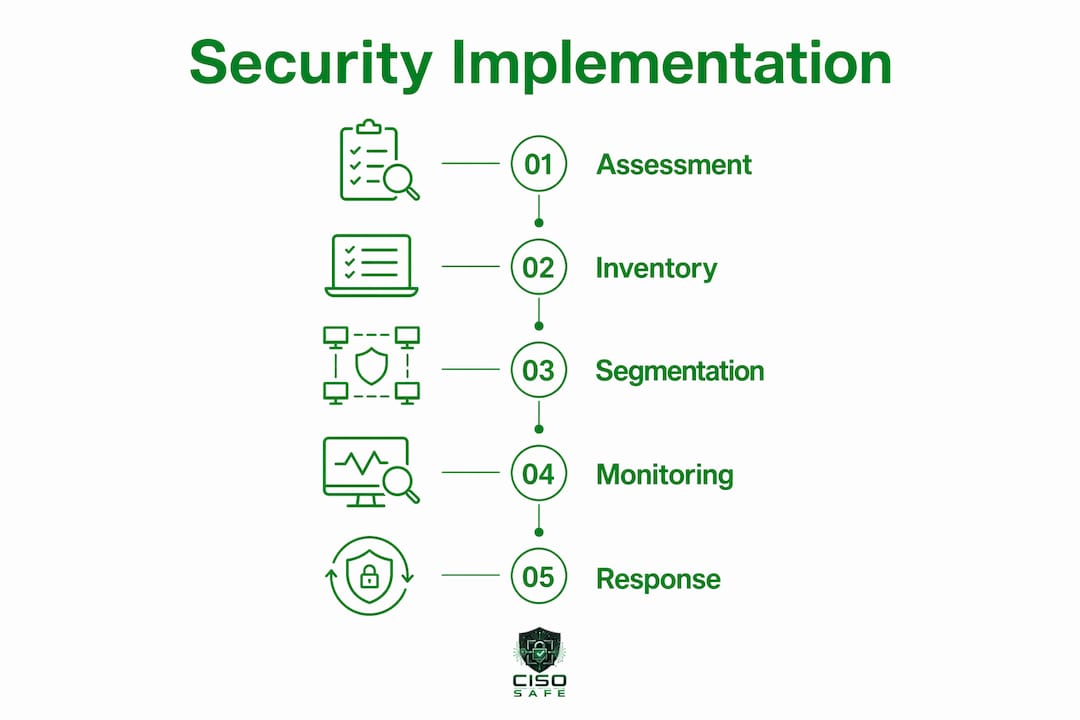
Effective offshore cybersecurity risk management starts with a formal assessment, not a technology purchase. The MTSA 2026 framework requires operators to complete documented cybersecurity assessments, develop written plans, and designate a Cybersecurity Officer (CySO) responsible for both IT and OT security governance. That dual responsibility is significant. Most enterprise security programs treat OT as someone else's problem, and offshore facilities pay the price.
Before any controls go in, you need a complete asset inventory. This means cataloging every IT endpoint, every OT device including programmable logic controllers and distributed control systems, and every third-party connection. Vendors with remote access to drilling control systems represent a supply chain risk that many operators underestimate until an incident occurs.

Offshore connectivity adds a layer of complexity that onshore programs ignore. Satellite links introduce latency and bandwidth constraints that affect how security tools perform. Your governance policies and tool selections must account for this from the start.
Key prerequisites before executing any risk management activities:
- Complete a formal cybersecurity risk assessment covering all IT and OT assets
- Designate a CySO with documented authority over both IT and OT security decisions
- Build a comprehensive asset register including all remote access connections and third-party integrations
- Establish written policies aligned with IEC 62443 and maritime cybersecurity guidelines
- Evaluate satellite connectivity constraints and their effect on monitoring and response capabilities
Pro Tip: Map your OT asset inventory separately from your IT inventory. OT devices have different patching cycles, communication protocols, and failure modes. Merging them into a single register without distinguishing these differences produces a document that looks complete but misses the real risk.
How to implement technical security controls for offshore IT/OT environments
Network segmentation is the single most impactful technical control for offshore cyber defense. The IEC 62443 zone-and-conduit model assigns Security Levels 1 through 4 to assets based on risk, then enforces communication boundaries between zones using conduits. MTSA mandates this segmentation for all regulated facilities by july 2027. A survey cited in MTSA guidance found that 94% of organizations face segmentation challenges, which explains why the regulation includes a phased deadline rather than immediate enforcement.
Implementing technical controls follows a logical sequence:
- Deploy zone-and-conduit segmentation. Isolate OT networks from IT networks using firewalls, data diodes, and dedicated conduit rules. No direct communication path should exist between a corporate workstation and a safety instrumented system.
- Establish a demilitarized zone (DMZ). Place jump servers and application proxies in the DMZ to mediate all traffic between IT and OT zones. This forces every session through a controlled inspection point.
- Control all remote vendor access. Privileged access management (PAM) tools limit vendor sessions to specific assets, specific time windows, and specific protocols. Every session should be logged and recorded.
- Deploy passive OT monitoring. Legacy OT systems are fragile. Active scanning can crash programmable logic controllers and disrupt live processes. Passive tools analyze industrial protocol traffic without sending interrogation packets, enabling anomaly detection without operational risk.
- Adopt edge computing for satellite-constrained environments. Satellite links carry 500–900 ms of latency, which makes real-time security monitoring impractical if all traffic routes to shore. Edge computing processes data locally and sends only metadata or alert signals to onshore security operations centers.
- Encrypt all data in transit. VPNs with strong cipher configurations and strict TLS settings protect data moving between the facility and shore-based systems.
The table below maps each control to its primary risk and the relevant standard:
| Technical control | Primary risk addressed | Relevant standard |
|---|---|---|
| Zone-and-conduit segmentation | Lateral movement from IT to OT | IEC 62443 |
| DMZ with jump servers | Unauthorized direct OT access | MTSA / IEC 62443 |
| Privileged access management | Malicious or compromised vendor access | MTSA |
| Passive OT monitoring | Undetected anomalies in industrial protocols | IEC 62443 |
| Edge computing | Satellite latency defeating real-time detection | BSEE guidance |
| VPN / TLS encryption | Data interception in transit | MTSA / IEC 62443 |
Pro Tip: Before deploying any new monitoring tool in an OT environment, test it in a lab replica of your control system architecture. A tool that works perfectly on IT networks can generate enough broadcast traffic to degrade OT network performance.
Which organizational factors reduce cybersecurity risk offshore?
The human dimension is the leading source of cybersecurity incidents offshore. Social engineering and phishing are the primary attack vectors, and offshore crews rotate frequently, which means security awareness degrades faster than in a stable office environment. MTSA requires annual cybersecurity training for both IT and OT workers, with completion deadlines tied to the july 2027 compliance date.
Building a security-aware offshore culture requires treating cyber hygiene with the same seriousness as physical safety. Offshore workers accept that bypassing a safety procedure can cause physical harm. The same logic applies to plugging in an unauthorized USB drive or clicking a phishing link on a control system workstation. That behavioral shift does not happen through annual slide decks. It requires repeated, scenario-based training tied to real offshore incidents.
Key organizational actions for reducing cyber risk offshore:
- Deliver annual cybersecurity training for all personnel, covering phishing recognition, device policies, and OT-specific threats
- Enforce a strict USB and removable media policy with technical controls, not just written rules
- Develop an incident response plan specifically for OT compromises, including communication protocols and decision authority
- Practice incident response through tabletop and simulated drills, the same way crews practice blowout response
- Assign the CySO clear authority to coordinate regulatory reporting and manage cross-functional response teams
Pro Tip: Run your first incident response drill before you finish writing the plan. The gaps you discover in a 90-minute tabletop exercise will improve the written plan more than any additional review cycle.
How to comply with mandatory reporting and regulatory standards
Regulatory compliance for offshore cybersecurity is not optional, and the timelines are firm. BSEE requires operators to report cybersecurity incidents affecting Outer Continental Shelf facilities within 12 hours of detection. That window is shorter than most corporate incident response plans assume. Your detection, triage, and notification workflows must be designed to meet that deadline, not adapted after the fact.
The International Maritime Organization (IMO) Resolution MSC-FAL.1/Circ.3 requires cybersecurity to be integrated into a vessel or facility's Safety Management System (SMS). This means cyber risk does not sit in a separate IT compliance silo. It appears in the same documentation structure as fire safety and emergency response. Operators who treat cybersecurity as a standalone IT function will fail this requirement.
Cyber seaworthiness has emerged as a legal standard that integrates cyber risk readiness into traditional maritime seaworthiness doctrine. Courts and insurers now assess whether a facility's cyber posture was adequate at the time of an incident. Data residency laws add another layer, particularly for facilities operating in international waters or under multiple national jurisdictions. Data tokenization at the source allows operational telemetry to move globally while keeping regulated data elements compliant with local residency requirements.
Audit readiness requires maintaining documented evidence of assessments, training completions, incident reports, and corrective actions. ISO 31000 provides a continuous improvement framework for risk management that maps well to the post-incident analysis cycle required by both BSEE and MTSA. The energy sector compliance frameworks that apply to offshore operations now overlap significantly, and managing them as separate programs creates gaps and redundant effort.
Key Takeaways
Offshore facility cybersecurity risk management requires integrating IEC 62443 technical controls, MTSA governance requirements, BSEE reporting obligations, and workforce training into a single coordinated program.
| Point | Details |
|---|---|
| Designate a CySO immediately | MTSA requires a Cybersecurity Officer with authority over both IT and OT security before july 2027. |
| Segment IT and OT networks | IEC 62443 zone-and-conduit architecture prevents lateral movement from corporate systems to industrial controls. |
| Meet the 12-hour reporting window | BSEE requires incident notification within 12 hours; detection and triage workflows must support this deadline. |
| Train all personnel annually | Social engineering is the top attack vector offshore; MTSA mandates annual training for IT and OT workers. |
| Use passive OT monitoring | Active scanning can crash legacy control systems; passive protocol analysis detects anomalies without disrupting operations. |
What I've learned working with offshore cybersecurity programs
The most persistent mistake I see in offshore cybersecurity programs is treating IT/OT convergence as a technical problem with a technical solution. It is not. The IT/OT convergence challenge is fundamentally a governance problem. Someone has to own the boundary between the corporate network and the control system network, and that person needs authority over both sides. Without that, every technical control you deploy gets undermined by a vendor who needs "just one exception" to finish a maintenance job.
Satellite connectivity constraints are underestimated in almost every offshore security architecture I review. Security teams design monitoring programs assuming they have the same bandwidth and latency as an onshore data center. They do not. When the monitoring system stops sending alerts because the satellite link is saturated, the team onshore assumes everything is fine. Edge computing is not a nice-to-have in this environment. It is the only architecture that actually works.
The workforce training issue is where I push back hardest against conventional thinking. Most operators run annual compliance training and consider the box checked. The offshore workforce rotates every few weeks. By the time a crew member completes their annual training, they may not return to that facility for months. Frequency matters more than duration. Short, scenario-based sessions delivered at crew change are more effective than a two-hour annual module.
Physical security and cyber security must be managed together. Advanced access controls and CCTV systems that feed into a unified security picture are not separate from the cyber program. They are part of it. An attacker who gains physical access to an OT network cabinet bypasses every logical control you have deployed.
— vCISO
CisoSafe supports offshore cybersecurity risk management programs
Regulated offshore operators need cybersecurity leadership that understands both maritime compliance and industrial control system security. CisoSafe delivers virtual CISO services built for exactly this environment, covering MTSA compliance planning, IEC 62443 implementation, workforce training programs, and incident response preparation.
CisoSafe's vCISO team helps offshore operators build governance frameworks that address IT/OT convergence, meet BSEE reporting requirements, and prepare for MTSA audits. The AI-powered compliance portal automates assessment documentation and tracks corrective actions, giving your leadership team clear visibility into risk without adding administrative burden to your operations team. For operators who need cybersecurity governance built for regulated, high-stakes environments, CisoSafe provides the expertise without the cost of a full-time CISO.
FAQ
What does MTSA require for offshore cybersecurity?
The US Coast Guard's MTSA 2026 rules require formal cybersecurity assessments, written plans, and designation of a Cybersecurity Officer responsible for both IT and OT security. All regulated offshore facilities must complete these requirements by july 2027.
How does IEC 62443 apply to offshore facilities?
IEC 62443 defines a zone-and-conduit segmentation model that assigns Security Levels 1 through 4 to assets based on risk and enforces communication boundaries between OT and IT networks. It is now the baseline technical standard written into new offshore control system contracts.
What is the BSEE incident reporting requirement?
BSEE requires cybersecurity incidents affecting Outer Continental Shelf facilities to be reported within 12 hours of detection. Operators must design their detection and triage workflows to meet this deadline.
Why can't standard IT security tools be used on offshore OT systems?
Legacy OT systems are fragile and cannot tolerate active scanning without risk of process disruption or device failure. Passive monitoring tools analyze industrial protocol traffic without sending interrogation packets, making them the correct approach for offshore control environments.
What is cyber seaworthiness?
Cyber seaworthiness is a legal standard that integrates cyber risk readiness into traditional maritime seaworthiness doctrine. Courts and insurers assess whether a facility's cyber posture was adequate at the time of an incident, creating direct legal liability for inadequate cybersecurity programs.