

Supply chain security in the energy sector is defined as the practice of identifying, assessing, and controlling cybersecurity risks introduced through hardware, software, services, and third-party relationships across the full energy delivery lifecycle. Nearly 95% of energy firms experienced a supply chain loss in the past year. That figure confirms what compliance officers already sense: the threat is not theoretical, and the cost of inaction is measurable. The industry term for this discipline is cyber supply chain risk management, or C-SCRM. Both the U.S. Department of Energy and the UK government have issued formal frameworks in 2026 to address it, making this the most active regulatory period the sector has seen in a decade.
What are the unique cybersecurity risks in the energy supply chain?
Energy supply chains carry a category of cyber risk that most other industries do not face. A compromised component in a financial services firm disrupts transactions. A compromised component in a power grid or pipeline can disable physical infrastructure serving millions of people.
The risk surface spans four distinct layers:
- Hardware: Sensors, programmable logic controllers, and field devices often arrive with factory-installed firmware that has never been audited. Substituting or tampering with hardware at any point in the procurement chain can introduce persistent backdoors.
- Firmware and software: DOE CESER's Energy Cyber Sense program targets identifying and engineering out vulnerabilities across hardware, firmware, and software lifecycle stages. This signals that patching software alone is no longer sufficient.
- Services and managed providers: Third-party maintenance contractors, cloud service providers, and remote monitoring vendors each represent a potential entry point. A single vendor with privileged access to operational technology (OT) systems can become the weakest link.
- Digital integration from renewables: The rapid addition of distributed energy resources, including solar inverters and wind turbine controllers, has introduced thousands of new network endpoints. Many of these devices run consumer-grade firmware with limited security controls.
The cascading effect of a compromised component is what makes energy supply chain vulnerabilities particularly dangerous. A manipulated sensor reading in a natural gas compressor station can trigger automated shutdowns across an entire pipeline segment. The failure does not announce itself as a cyberattack. It looks like equipment malfunction.
Pro Tip: Map your third-party vendors by their level of access to operational technology systems, not just IT systems. Vendors with OT access require a separate, more rigorous vetting process.

Which cybersecurity frameworks should energy professionals apply?
Principle-based frameworks give energy operators a structured way to manage supply chain cyber risk without prescribing a single technical solution. Two major frameworks now define the regulatory baseline.
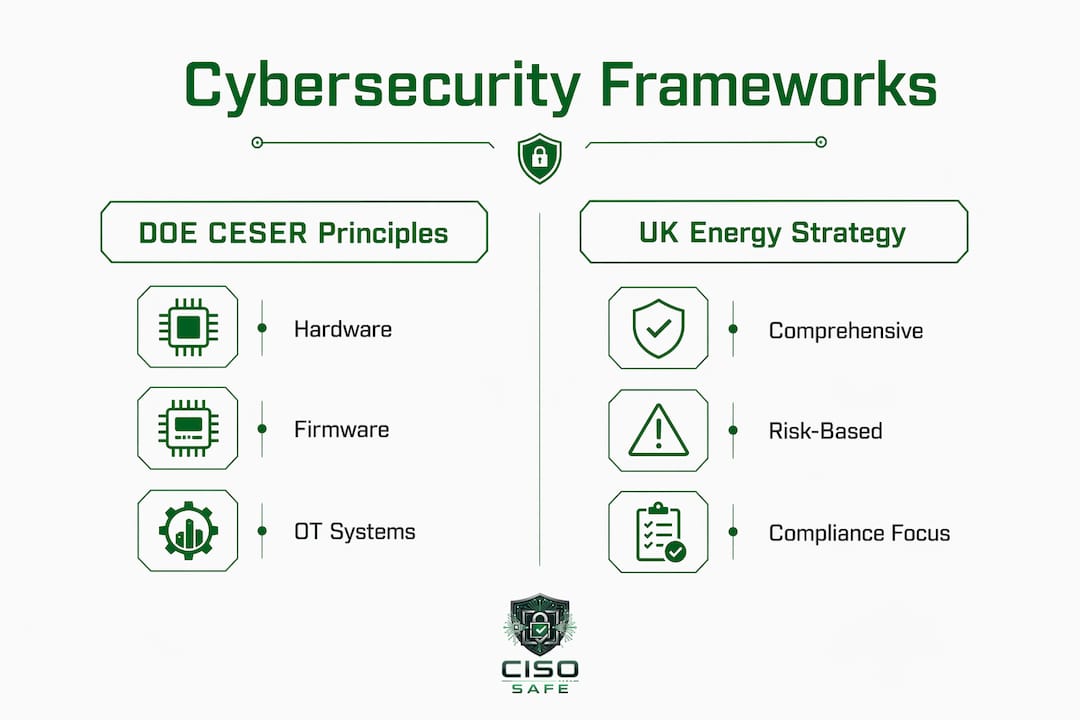
The DOE Supply Chain Cybersecurity Principles, launched in june 2026, outline foundational actions for energy sector organizations. These principles cover supplier vetting, component integrity verification, incident response coordination, and lifecycle risk management from procurement through decommissioning. They are designed to be proportionate, meaning a rural electric cooperative applies them differently than a multinational oil and gas operator.
The UK government has published a parallel framework through its energy sector cyber security strategy. Key regulatory milestones include:
- End of 2026: Preliminary supply chain security principles published for industry consultation.
- End of 2027: Full regulatory capability in place, with enforceable standards for energy sector supply chain cybersecurity.
- Ongoing: Alignment with baseline resilience standards, including Cyber Essentials, which addresses vulnerabilities across physical, network, and application layers.
The table below summarizes how these two frameworks compare across key dimensions.
| Dimension | DOE CESER Principles (U.S.) | UK Energy Cyber Strategy |
|---|---|---|
| Scope | Hardware, firmware, software, services | Full supply chain, including logistics partners |
| Risk approach | Impact-driven, lifecycle-based | Baseline standards plus proportionate controls |
| Regulatory timeline | Active since june 2026 | Full capability by end of 2027 |
| Baseline standard | NIST CSF alignment | Cyber Essentials |
| Enforcement | Guidance-based, voluntary adoption | Moving toward enforceable regulation |
The critical insight from both frameworks is that impact-driven risk management takes priority over checkbox compliance. Operators must understand which supply chain components, if compromised, would cause the greatest operational harm. That impact assessment drives where controls are applied most intensively.
For a detailed breakdown of the compliance frameworks shaping the sector right now, the 2026 compliance framework overview from CisoSafe covers the regulatory landscape in full.
How to implement an effective supply chain risk management strategy
Building a C-SCRM program for an energy organization requires more than a policy document. It requires operational integration across procurement, IT, OT, and legal functions. The following steps reflect current best practice.
-
Conduct a supplier risk assessment. Classify every supplier by the criticality of what they provide and their level of system access. 65% of energy firms have already implemented supplier risk assessments. That means a third of the sector is still operating without this baseline visibility.
-
Extend risk management to hardware and firmware lifecycles. Cyber supply chain risk management must evolve beyond patches to address the full lifecycle from installation through maintenance and decommissioning. Require suppliers to provide a software bill of materials (SBOM) and firmware version history for all critical components.
-
Deploy digital monitoring and AI-based forecasting. Over 70% of energy firms now use AI and digital tools for real-time supply chain monitoring. These tools detect anomalies in supplier behavior, flag unusual procurement patterns, and provide early warning of component shortages that could force the use of unvetted substitutes.
-
Build contractual safeguards. Every supplier contract should include cybersecurity requirements, incident notification timelines, and the right to audit. Vague language around "reasonable security measures" is not enforceable. Specify the standards you require.
-
Diversify your supplier base. Single-source dependencies create both operational and security risk. Two-thirds of energy firms balance stockpiling with agility and insurance solutions to protect against supply chain volatility. Supplier diversification is the structural version of that same principle.
-
Integrate insurance as a risk transfer tool. Cyber insurance for supply chain events is now a standard component of energy sector risk programs. Policies should specifically cover third-party-induced outages, not just direct breaches.
Pro Tip: Treat resilience as a performance metric alongside cost and delivery speed. A supplier who is 10% cheaper but has no incident response plan is not actually cheaper when you factor in breach costs.
For a practical starting point, a cyber risk assessment gives energy firms the baseline visibility needed before any of these steps can be prioritized effectively.
What common pitfalls should you avoid when securing energy supply chains?
The most common failure in protecting energy sector logistics is treating cybersecurity as an IT problem rather than an operational one. When security decisions stop at the IT perimeter, OT systems, field devices, and physical logistics networks remain unprotected.
Watch for these specific pitfalls:
- Siloed IT and OT programs. Separate security teams for information technology and operational technology create blind spots at the integration points. Attackers exploit exactly those gaps. Integrated, principle-based risk management aligned with baseline standards is the only approach that closes them.
- Framework adoption without context. Applying NIST CSF or Cyber Essentials without mapping controls to your specific operational risk profile produces compliance theater, not actual security. Every framework must be tailored to the operator's risk context.
- Underinsurance and vague contracts. Many energy firms carry cyber insurance that excludes supply chain events or contains ambiguous trigger language. Review policy terms annually and align contract language with your insurance requirements.
- Static security postures. A supplier assessment conducted once at onboarding becomes outdated within months. Continuous monitoring and annual reassessments are the minimum standard for third-party risk management in the energy sector.
"Energy supply chains now function as strategic infrastructure. Cyber resilience must be integrated into logistics and operational models from the design stage, not added as an afterthought after a breach." Source: Industry analyst commentary on evolving energy supply chain strategy
The most dangerous assumption in this space is that a high-level framework adoption is sufficient. Frameworks define what to do. Your organization must determine how, at what depth, and with what verification.
Key Takeaways
Effective C-SCRM in the energy sector requires lifecycle-based controls, integrated IT/OT governance, and continuous supplier monitoring aligned with DOE and UK regulatory frameworks.
| Point | Details |
|---|---|
| Define your risk surface | Map all suppliers by system access level and component criticality before applying controls. |
| Apply lifecycle-based controls | Manage hardware and firmware risk from procurement through decommissioning, not just at installation. |
| Align with 2026 frameworks | DOE CESER Principles and the UK energy cyber strategy set the current regulatory baseline for C-SCRM. |
| Integrate IT and OT governance | Siloed security programs leave OT systems exposed; unified governance closes the gap. |
| Monitor continuously | Annual supplier assessments are the minimum; real-time digital monitoring is now standard practice for 70%+ of energy firms. |
The shift I keep seeing energy operators get wrong
After working with energy operators across oil and gas, renewables, and utilities, the pattern I see most often is this: organizations invest heavily in perimeter security and then treat their supply chain as a procurement problem rather than a security problem. They negotiate price, delivery timelines, and quality standards. They do not negotiate cybersecurity requirements.
The DOE's june 2026 principles changed the conversation at the federal level. But regulatory guidance does not automatically change internal culture. Supply chain managers and compliance officers are often working in separate lanes, and neither group has full visibility into the other's risk picture.
What actually works is treating cyber-resilience as infrastructure design. That means security requirements are written into supplier qualification criteria before a contract is ever signed. It means firmware version control is a procurement specification, not an afterthought. It means your incident response plan names specific suppliers and defines exactly what notification you expect from them within 24 hours of a breach.
The energy firms that are ahead of this are not necessarily the largest ones. They are the ones where the CISO has a seat at the supply chain table. If that is not the case at your organization, that is the first structural change worth making.
— vCISO
How CisoSafe supports energy sector supply chain security
Energy operators managing C-SCRM compliance face a real resource problem. The regulatory requirements from DOE CESER and the UK energy cyber strategy are detailed, evolving, and operationally demanding.
CisoSafe provides virtual CISO services built specifically for regulated industries, including oil and gas, utilities, and energy operators. The CisoSafe team delivers supplier risk assessments, security policy development, incident response planning, and ongoing compliance advisory aligned with DOE, NIST CSF, and CMMC frameworks. For energy firms that need enterprise-grade expertise without the cost of a full-time CISO, CisoSafe offers a direct path from risk exposure to documented compliance. Contact CisoSafe to schedule a supply chain risk assessment.
FAQ
What is supply chain security in the energy sector?
Supply chain security in the energy sector is the practice of managing cybersecurity risks introduced through hardware, software, services, and third-party vendors across the full energy delivery lifecycle. The formal term is cyber supply chain risk management, or C-SCRM.
What cybersecurity framework applies to U.S. energy supply chains?
The DOE Supply Chain Cybersecurity Principles, launched in june 2026, provide the current foundational framework for U.S. energy sector C-SCRM, covering supplier vetting, component integrity, and lifecycle risk management.
How common are supply chain cyber incidents in the energy sector?
Nearly 95% of energy firms experienced a supply chain loss in the past year, making supply chain disruption one of the most frequent operational risks in the sector.
What is the difference between IT and OT risk in energy supply chains?
IT risk covers data systems and business networks, while OT risk covers physical control systems like pipeline controllers and grid sensors. Siloed management of these two domains leaves critical integration points unprotected.
How often should energy firms reassess their suppliers?
Continuous digital monitoring is now standard for over 70% of energy firms, with formal supplier reassessments conducted at minimum annually. High-risk suppliers with OT access warrant more frequent review.