

Offshore oil and gas platforms need cyber protection because a successful attack on their operational technology (OT) systems can trigger consequences comparable to a major industrial disaster. The GAO has warned that a cyberattack on offshore infrastructure could produce effects resembling the 2010 Deepwater Horizon catastrophe, including physical destruction, environmental damage, and severe economic disruption. These are not theoretical scenarios. Threat actors, ranging from state-sponsored groups to financially motivated cybercriminals, are actively targeting offshore assets because of their economic and strategic value.
Key reasons cyber protection is critical for offshore platforms:
- OT and IT systems are now deeply interconnected, eliminating the air gaps that once provided passive protection
- Safety Instrumented Systems (SIS) that prevent blowouts and fires are reachable through the same networks used for business operations
- Remote access capabilities, required for efficiency, also create entry points for attackers
- Legacy equipment with minimal built-in security remains in active service across many platforms
- Physical isolation in deep water slows incident response, turning a contained breach into a prolonged crisis
Why offshore platforms face growing cyber vulnerabilities
The convergence of OT and IT networks has fundamentally changed the attack surface on offshore platforms. Systems that once ran on proprietary protocols in physically isolated environments now communicate over standardized networks accessible from onshore control centers. That connectivity is operationally necessary, and it is also your largest attack surface.
Specific technical weaknesses compound the exposure. OT systems on offshore platforms commonly suffer from poor encryption, weak authentication controls, inconsistent patch management, and misconfigured systems. Once an attacker gains initial access, the MITRE ATT&CK for ICS framework documents how they use execution, evasion, and lateral movement to reach their target, whether that is a valve controller, a pressure monitor, or a dynamic positioning system.
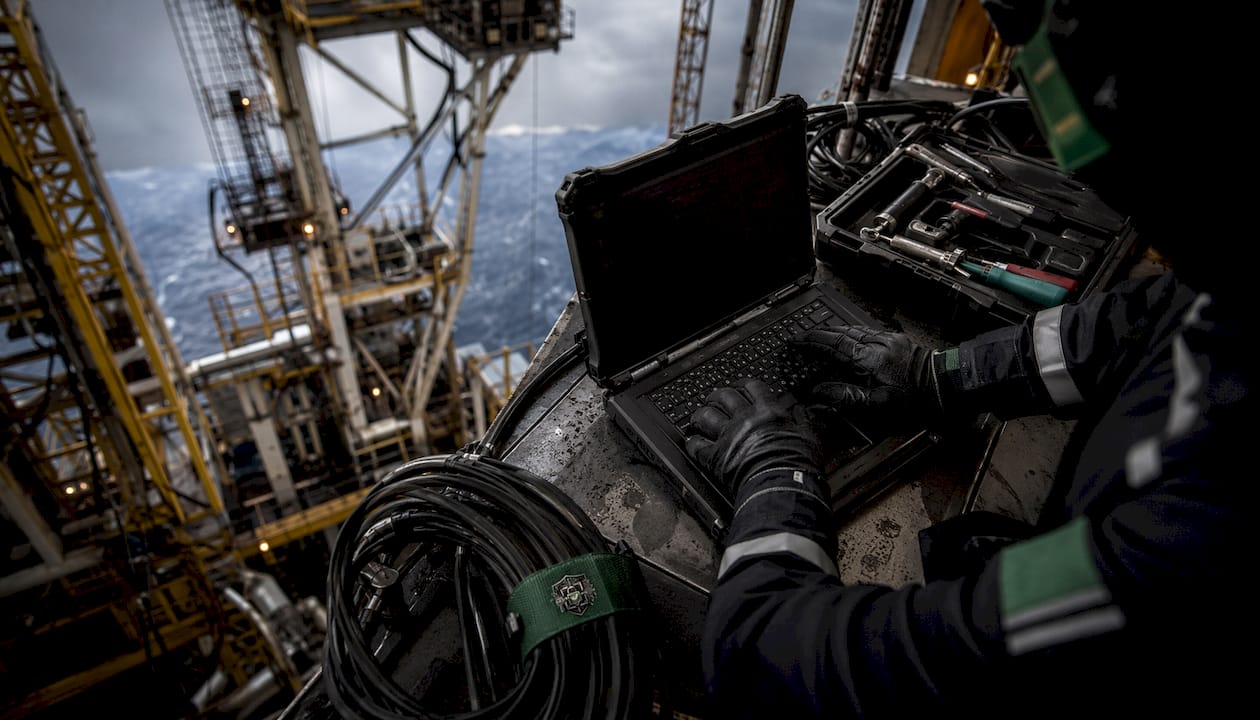
Real incidents confirm the risk. At a U.S. Gulf of Mexico drilling unit, workers plugged personal devices into the same system used to control navigational thrusters. Malware from infected music and adult content sites crossed into the rig's control network, disabled the dynamic positioning thrusters, and forced the well to shut down. In a separate incident, malware kept an oil rig offline for 19 days, with financial losses exceeding $10 million, partly because no one on board fully understood the computer systems they were operating.
Common offshore cyber vulnerabilities include:
- Lack of network segmentation between crew entertainment networks and mission-critical OT
- SCADA systems running outdated Linux-based Ethernet modules in Programmable Logic Controllers (PLCs)
- Vendor and contractor systems integrated directly with production networks during drilling campaigns
- Stuxnet variants confirmed on PLCs in oil rigs in Angola and Indonesia before the worm became publicly known
- Subsea control systems operating hundreds of kilometers underwater with limited physical access for emergency response
What are the real consequences of a cyberattack on an offshore platform?
The consequences of a successful attack extend well beyond a temporary production halt. Cyberattacks on offshore assets can cause cascading physical damage, environmental harm, financial losses, and broader market disruption through oil and gas supply interruption. Safety system failures specifically can lead to uncontrolled leaks that endanger both personnel and the surrounding marine environment.
Key risk: Offshore production accounts for approximately 30% of global oil and gas output. A coordinated attack on multiple platforms could create measurable supply shocks with downstream market effects.
The financial exposure is direct and severe. The 19-day malware incident referenced above cost operators more than $10 million in operational losses alone, and that figure does not account for regulatory penalties, remediation costs, or reputational damage. Regulatory compliance status is also at risk: the Bureau of Safety and Environmental Enforcement (BSEE) has identified cybersecurity as an area of increasing oversight, and operators who cannot demonstrate adequate controls face growing liability.
Consequences security professionals must account for:
- Equipment damage from manipulated valve or pressure controls
- Worker safety incidents caused by disabled safety interlocks or positioning systems
- Environmental violations from uncontrolled releases triggered by compromised shutdown systems
- Supply disruption affecting energy markets and downstream customers
- Loss of stakeholder confidence and potential regulatory action from BSEE or the Coast Guard
How to reduce cyber risk on offshore platforms
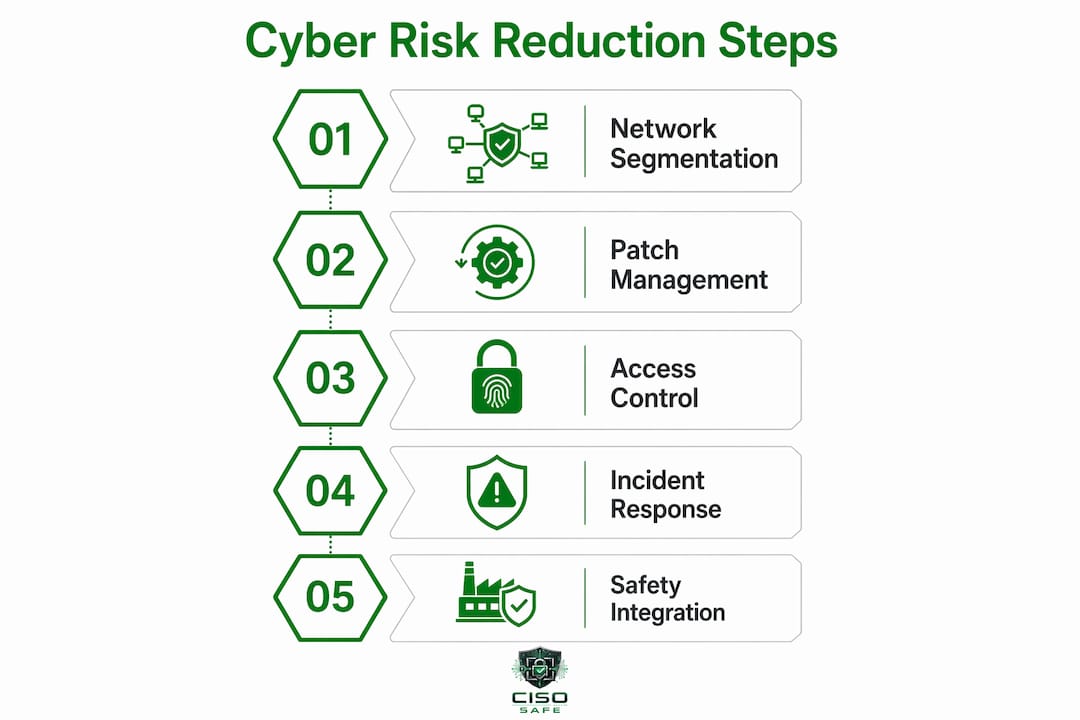
Effective offshore facility cybersecurity starts with network architecture. Modern industry standards require OT-DMZ zones that enforce strict separation between corporate IT, operational networks, and safety systems. Boundary protections such as firewalls and data diodes should permit only explicitly authorized traffic between zones, reducing the pathways an attacker can use to move laterally.

Patching in OT environments requires a different approach than standard IT patch cycles. Applying patches without testing against safety instrumented systems can itself introduce failures. Industrial-grade security controls, validated for OT reliability, are the correct standard, not general IT tools applied without adaptation.
Pro Tip: Build vendor and contractor access into your segmentation model from day one. Every drilling campaign that integrates a service company's systems into your production network is a potential entry point. Require contractors to meet or exceed your cyber hygiene standards as a condition of access.
A practical mitigation framework for offshore platforms:
- Deploy OT-DMZ architecture with data diodes or unidirectional gateways between safety and business networks
- Conduct regular cyber risk assessments using methodologies specific to industrial control environments
- Enforce multi-factor authentication on all remote access connections to OT systems
- Implement anomaly detection tuned to OT protocols such as Modbus-TCP and DNP3
- Develop and test an incident response plan that accounts for the remote location and limited on-site expertise
- Maintain an asset inventory of all OT components, including firmware versions and known vulnerabilities
- Address training gaps in maritime cybersecurity with OT-specific programs, not generic IT security awareness courses
Why cybersecurity and functional safety must work together
Treating cybersecurity as a separate IT concern, isolated from functional safety management, is one of the most persistent and dangerous gaps in offshore security programs. Effective cyber resilience requires integrating organizational, operational, and technical security directly into safety management systems, not running them in parallel silos. A compromised SIS does not just create a cyber incident; it creates a process safety incident.
The ABS CyberSafety framework and similar standards from the American Bureau of Shipping explicitly recognize this interdependence, providing certification benchmarks that treat cybersecurity as integral to overall safety management. Offshore Norge guidelines similarly require continuous updates to risk assessment methodologies as new threats and incident learnings emerge.
Pro Tip: A virtual CISO with offshore energy experience can align your cybersecurity program with IEC 61511 functional safety requirements and applicable ABS or BSEE standards simultaneously, without the cost of maintaining separate safety and security advisory teams.
Building integrated resilience requires:
- Joint governance structures that include IT, OT, safety, and physical security stakeholders
- Cyber-informed safety system designs that account for remote access requirements and harsh offshore conditions
- Continuous cybersecurity governance reviews tied to the safety management system lifecycle
- Incident response procedures that trigger both cybersecurity and safety response protocols simultaneously
- Regular tabletop exercises that simulate cyber-physical attack scenarios specific to offshore operations
CisoSafe brings offshore-grade cybersecurity leadership to your team
Offshore platforms carry risks that generic IT security programs were never designed to address. CisoSafe is a Houston-based virtual CISO firm built specifically for high-stakes, regulated industries, including oil and gas operators who need OT-aware security leadership without the cost of a full-time CISO or a large consultancy engagement.
CisoSafe delivers security assessments, risk roadmaps, policy development, and incident response planning through a combination of hands-on vCISO advisory and an AI-powered compliance platform. For offshore security professionals, that means getting a program aligned to BSEE expectations, ABS CyberSafety standards, and OT-specific frameworks, with clear reporting for leadership and no internal team overwhelmed in the process. The cost barrier is lower than traditional options, and the expertise is specific to the environments where the stakes are highest.
Ready to close the gap between your current posture and where it needs to be? Contact CisoSafe to schedule a security assessment tailored to your offshore operations.
Key Takeaways
Offshore platforms require cyber protection because OT-IT convergence has created direct pathways from business networks to safety-critical systems, and a successful attack can cause physical, environmental, and financial damage on the scale of a major industrial disaster.
| Point | Details |
|---|---|
| OT-IT convergence expands risk | Connecting OT to business networks eliminates the isolation that once protected safety-critical systems from external threats. |
| Real incidents confirm the threat | One malware attack kept a rig offline for 19 days with losses exceeding $10 million; another disabled dynamic positioning thrusters in the Gulf of Mexico. |
| Consequences go beyond downtime | Compromised safety systems can trigger uncontrolled leaks, equipment damage, regulatory action, and supply market disruption. |
| Segmentation and OT-specific controls | OT-DMZ architecture and industrial-grade security controls, not standard IT tools, are the correct baseline for offshore environments. |
| CisoSafe for offshore security | CisoSafe provides vCISO services and compliance support aligned to OT environments, ABS standards, and BSEE requirements for offshore operators. |