

vCISO services for oilfield operations are expert virtual cybersecurity leadership solutions designed to protect complex energy infrastructure without disrupting production. The industry term is "virtual Chief Information Security Officer" (vCISO), and in the oilfield context, this role covers both IT and operational technology (OT) environments. Regulatory frameworks including NERC CIP, NIST CSF, and ISO 27001 define the compliance baseline for energy operators, but meeting those standards while keeping wells and pipelines running requires a production-first security strategy. CisoSafe delivers exactly that: vCISO consulting services built for the operational realities of oil and gas, not adapted from generic enterprise IT playbooks.
What unique cybersecurity challenges do oilfield operations face?
Oilfield environments carry cybersecurity risks that standard IT security programs are not built to handle. The core problem is the convergence of aging OT infrastructure with modern network connectivity, creating attack surfaces that conventional tools miss entirely.
- Legacy control systems. Oilfield OT systems often run legacy DCS and PLC platforms that are 20–30 years old and lack encryption or multi-factor authentication. These systems were designed for air-gapped environments, so adding network connectivity without a tailored security layer creates serious exposure.
- Remote site vulnerabilities. Wellheads, pump stations, and pipeline monitoring points sit in geographically isolated locations. Securing remote connectivity for these sites requires purpose-built solutions, not standard VPN configurations designed for office workers.
- SCADA and ICS attack surfaces. Supervisory Control and Data Acquisition (SCADA) systems and Industrial Control Systems (ICS) manage physical processes. A breach here does not just mean data loss. It can trigger equipment failure, environmental incidents, or worker safety events.
- False Data Injection attacks. These attacks bypass network-level monitoring by sending commands that appear normal at the packet level. Detection requires visibility into Level 0 physical signals, meaning raw data from sensors and actuators, not just network traffic.
- Flat OT network architecture. OT networks in energy sectors are often flat, which means a single compromised device can give an attacker lateral access across the entire operational environment.
The production pressure compounds every one of these risks. Patching a PLC or taking a SCADA node offline for security updates requires coordination with maintenance windows and production schedules. A vCISO who does not understand that operational reality will create security plans that never get implemented.
Pro Tip: Before engaging any cybersecurity program, map every OT asset to its maintenance window schedule. Security controls that require downtime must align with planned outages, not force unplanned ones.

What components form the foundation of effective vCISO services for oilfield cybersecurity?
Effective vCISO services for oilfield environments combine governance, technical monitoring, and executive communication into one coordinated program. Each component addresses a specific gap that generic IT security programs leave open.
| Component | Purpose | Key Standard or Tool |
|---|---|---|
| OT/IT risk assessment | Identify exposure across legacy and modern systems | NIST CSF, NERC CIP |
| Physical process monitoring | Detect Level 0 anomalies beyond network packets | Sensor and actuator signal analysis |
| Incident response planning | Define response actions tied to production constraints | ISO 27001, site-specific playbooks |
| Executive risk reporting | Translate technical findings into financial and operational impact | Board-ready dashboards |
| Compliance program management | Align security controls with regulatory audit requirements | NERC CIP, NIST SP 800-82 |
| Secure remote connectivity | Protect access to remote wellheads and field devices | Zero-trust architecture, segmented VPNs |
Board-ready security reporting is the component most energy operators underestimate. A vCISO translates findings like "unpatched legacy PLC firmware" into business language: production downtime risk, regulatory fine exposure, and insurance implications. Executives make better decisions when they understand risk in those terms.
Physical process monitoring deserves equal attention. Effective monitoring extends beyond network packets to raw electrical signals from critical field devices. This is the only reliable way to detect False Data Injection attacks, which are specifically designed to look normal at the network layer.
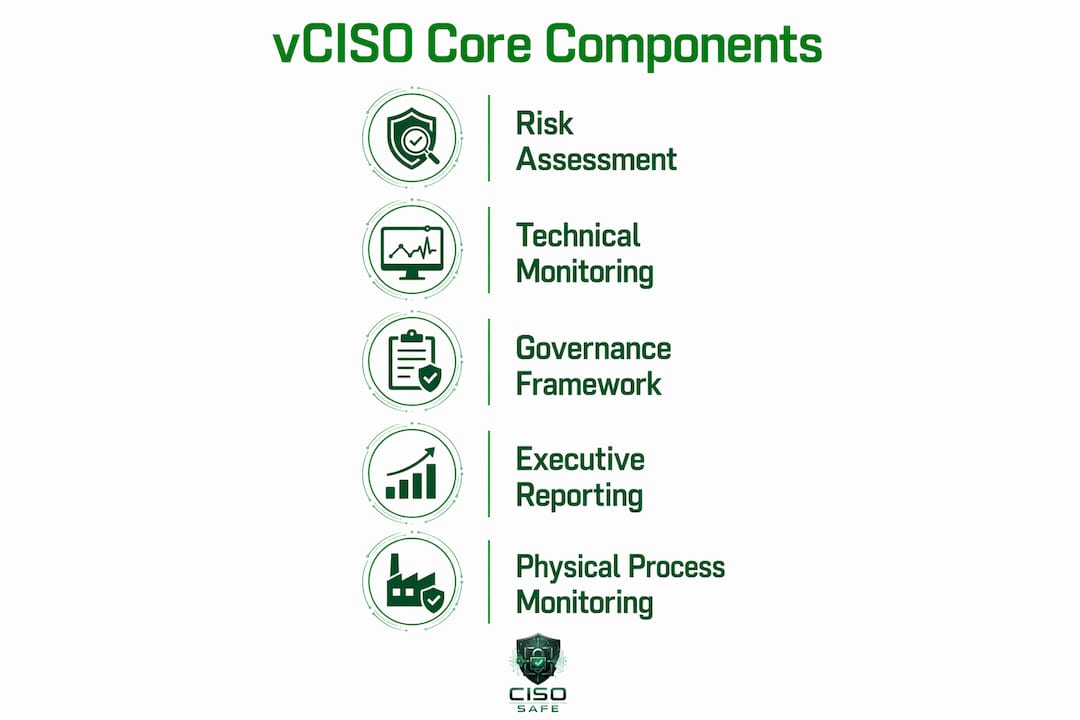
Governance frameworks tie everything together. NIST CSF provides a flexible structure for identifying, protecting, detecting, responding to, and recovering from threats. NERC CIP sets mandatory requirements for bulk electric systems. A vCISO builds a program that satisfies both without creating redundant compliance work. For a detailed look at how these frameworks apply to energy operators, the energy sector compliance frameworks guide covers the 2026 regulatory picture in full.
How to implement vCISO services in oilfield operations
A successful implementation follows a defined sequence. Skipping steps, particularly the asset inventory and stakeholder alignment phases, produces security plans that conflict with operational realities.
-
Conduct a full IT/OT asset inventory. Document every device, control system, and network connection across all sites. Include firmware versions, communication protocols, and physical locations. This baseline drives every subsequent decision.
-
Assess current security posture against NIST CSF and NERC CIP. Identify gaps between existing controls and regulatory requirements. Prioritize gaps by operational impact, not just technical severity. A vulnerability on a production-critical PLC ranks higher than the same vulnerability on an administrative workstation.
-
Align the security roadmap with maintenance windows. Successful vCISO implementation requires alignment with operational realities including maintenance windows, remote site constraints, and legacy system limitations. Work with plant engineers to schedule security changes during planned outages.
-
Develop tailored incident response plans. Generic incident response playbooks do not account for SCADA environments or production safety requirements. Write site-specific plans that define who has authority to isolate a compromised OT segment and how production continues during an active incident.
-
Build executive reporting cadence. Establish monthly or quarterly reporting cycles that present risk in financial and operational terms. Executives need to understand the cost of inaction, not just the technical details of each vulnerability.
-
Integrate compliance tracking and audit preparation. Map security controls to specific NERC CIP or NIST requirements. Maintain evidence continuously so that audit preparation does not become a crisis. For operators managing supply chain security risks, this step also covers third-party vendor access controls.
-
Establish cross-functional communication protocols. Security decisions in oilfield environments affect engineering, operations, IT, and executive leadership simultaneously. A vCISO creates the communication structure that keeps all four groups aligned without creating bottlenecks.
Pro Tip: Run a tabletop exercise within 90 days of implementation. Simulate a SCADA compromise scenario with your operations and IT teams present. The gaps that surface will be more valuable than any written assessment.
Common pitfalls in vCISO deployment for oilfield settings
The most expensive mistakes in oilfield cybersecurity programs share a common root: treating OT as an extension of IT. Treating OT simply as an extension of IT leads to ineffective security programs. A vCISO must build production-grounded strategies that account for legacy constraints and maintenance cycles, not apply IT security templates to industrial environments.
- Applying IT patch cycles to OT systems. Monthly patching schedules work for office computers. They do not work for PLCs running continuous production processes. Forcing IT patch timelines onto OT systems creates either unplanned downtime or unpatched systems because operators refuse to comply.
- Ignoring physical layer signals. Network monitoring tools catch most IT threats. They miss False Data Injection attacks entirely. Standard network security tools often fail to detect these attacks because the malicious commands look identical to legitimate ones at the packet level.
- Fragmented monitoring without unified governance. Fragmented monitoring and unclear governance lead to overlooked vulnerabilities. When IT security tools, OT monitoring systems, and physical access controls report to different teams with no shared oversight, critical signals get missed.
- Communication gaps between operations and security. Cybersecurity teams that do not speak the language of production engineers will not get cooperation on security controls. A vCISO who can translate between both worlds is the difference between a security program that gets implemented and one that sits in a document.
Unified oversight from a vCISO consolidates risk insights across IT, OT, and physical systems, giving boards and regulators a single, accurate picture of organizational risk. Without that unified view, energy operators are managing cybersecurity blind in the most critical parts of their infrastructure.
Regulatory complexity adds another layer. NERC CIP, NIST SP 800-82, and state-level energy regulations each carry different requirements and audit timelines. A vCISO manages that complexity without forcing operators to choose between compliance and production continuity. The cybersecurity governance in energy framework guide provides a practical breakdown of how to structure governance across multiple regulatory obligations.
Key Takeaways
vCISO services for oilfield operations protect production-critical infrastructure by integrating OT-aware security governance, physical process monitoring, and executive-level risk reporting into a single coordinated program.
| Point | Details |
|---|---|
| Production-first security | All security controls must align with maintenance windows and operational uptime requirements. |
| Legacy OT is the primary risk | DCS and PLC systems 20–30 years old lack encryption and MFA, making them the highest-priority targets. |
| Physical monitoring is non-negotiable | Network tools alone cannot detect False Data Injection attacks; Level 0 signal monitoring is required. |
| Unified governance closes gaps | Fragmented tools without shared oversight allow critical vulnerabilities to go undetected across IT and OT. |
| Executive reporting drives decisions | Translating technical risk into financial and operational impact gives leadership the information they need to act. |
What I have learned leading OT cybersecurity programs in energy
After working through vCISO engagements across oilfield and energy environments, the pattern I see most often is this: operators know they have a cybersecurity problem, but they underestimate how different the solution needs to be from what their IT team already does.
The production-first model is not a compromise. It is the only approach that actually gets implemented. Security controls that conflict with production schedules get bypassed. Controls that fit within maintenance windows get followed. That distinction determines whether a security program exists on paper or in practice.
Board reporting is where I see the most immediate impact. When an executive understands that an unpatched SCADA system represents a quantifiable production downtime risk and a potential regulatory fine, the conversation about security investment changes completely. Technical findings alone rarely move budgets. Financial and operational framing always does.
The technology evolution in oilfield environments is accelerating. Remote monitoring, cloud-connected sensors, and digital twin platforms are adding new attack surfaces faster than most operators realize. Legacy systems are not going away, but they are being connected to modern networks at an increasing rate. That combination, old systems with new connectivity, is exactly where the most serious risks live. Future-proofing means addressing that boundary now, not after an incident forces the issue.
— vCISO
CisoSafe brings vCISO expertise to oilfield operations
CisoSafe is a Houston-based vCISO firm built for regulated, high-stakes industries including oil and gas. The team combines hands-on security assessments, risk roadmaps, incident response planning, and compliance program management with an AI-powered platform that automates reporting and audit preparation.
For energy operators managing legacy OT infrastructure, remote site connectivity, and NERC CIP or NIST compliance obligations, CisoSafe delivers virtual CISO services calibrated to production realities. The goal is not just compliance on paper. It is a security program your operations team will actually follow. Contact CisoSafe to schedule an initial assessment and see where your current program stands.
FAQ
What are vCISO services for oilfield operations?
vCISO services for oilfield operations provide virtual cybersecurity leadership covering both IT and OT environments, including SCADA security, legacy infrastructure protection, and regulatory compliance. The vCISO role integrates security governance with production schedules and operational constraints specific to oil and gas.
How do vCISO services differ from standard IT security consulting?
Standard IT security consulting focuses on enterprise networks and data systems. vCISO services for oilfield environments extend to industrial control systems, physical process monitoring, and OT-specific threats like False Data Injection attacks that network tools cannot detect.
Which compliance frameworks apply to oilfield cybersecurity?
NERC CIP applies to bulk electric systems, NIST CSF and NIST SP 800-82 provide risk management structure for industrial environments, and ISO 27001 covers information security management. A vCISO maps controls across all applicable frameworks to avoid duplicate compliance work.
How does a vCISO handle legacy OT systems that cannot be patched?
A vCISO applies compensating controls to legacy systems that cannot be patched, including network segmentation, physical access restrictions, and enhanced monitoring at the process level. These controls reduce exposure without requiring system replacement or unplanned downtime.
What does board-ready reporting look like for oilfield cybersecurity?
Board-ready reporting translates technical findings into production downtime risk, regulatory fine exposure, and financial impact estimates. Executives receive a clear picture of which vulnerabilities pose the greatest operational and business risk, enabling informed investment decisions.