

A virtual CISO (vCISO) is a part-time, outsourced cybersecurity executive who delivers senior security leadership and governance without the cost of a full-time hire. The industry term is "virtual Chief Information Security Officer," and the role covers every strategic security function a traditional CISO performs. Organizations typically engage a vCISO when compliance requirements, cyber insurance mandates, or a serious security incident force the question of security leadership to the surface. For mid-sized companies without the budget or need for a $300,000 executive, the vCISO model delivers the same governance at a fraction of the cost.
What does a virtual CISO do?
A vCISO provides the same strategic oversight as a full-time CISO, including policy development, risk management, regulatory compliance, incident response planning, and security awareness training. The difference is delivery. The engagement is flexible, retainer-based, and scoped to your organization's actual needs rather than a fixed executive salary.
The core responsibilities of a vCISO include:
- Security policy development: Writing and maintaining information security policies, acceptable use standards, and data classification frameworks aligned to your industry.
- Risk assessment and management: Identifying your highest-priority threats, scoring them against business impact, and building a risk roadmap your board can act on.
- Regulatory compliance: Managing your obligations under frameworks like SOC 2, HIPAA, PCI DSS, CMMC, ISO 27001, and GDPR, including audit readiness and regulator engagement.
- Incident response planning: Building and testing a documented response plan so your team knows exactly what to do when a breach occurs.
- Executive and board reporting: Translating technical risk into business language for leadership, investors, and insurers.
- Vendor risk management: Reviewing third-party security posture through structured vendor cybersecurity assessments to reduce supply chain exposure.
- Security awareness training: Designing and overseeing employee training programs that reduce human error, which remains the leading cause of breaches.
Pro Tip: Ask any vCISO candidate to show you a sample risk roadmap and a board-level security report. If they cannot produce both, they are not operating at the strategic level you need.
A vCISO is not a hands-on technical resource who patches servers or monitors your firewall. The role is governance and strategy. Your internal IT team or a managed security service provider handles day-to-day operations. The vCISO sets direction, owns the security program, and holds accountability for outcomes.

How does a virtual CISO differ from an in-house CISO?
The most direct distinction is financial commitment. A vCISO monthly retainer typically runs $1,500 to $8,000, compared to a fully loaded in-house CISO cost of $250,000 to $350,000 per year including salary, benefits, and equity. That gap is significant for any organization with fewer than 500 employees.
| Factor | Virtual CISO | In-house CISO |
|---|---|---|
| Cost | $1,500–$8,000 per month retainer | $250,000–$350,000 per year fully loaded |
| Availability | Part-time, scoped to engagement | Full-time, dedicated |
| Time to deploy | Days to weeks | 3–6 months to hire and onboard |
| Scalability | Adjust scope as needs change | Fixed headcount and cost |
| Breadth of experience | Cross-industry exposure from multiple clients | Deep knowledge of one organization |
The in-house CISO model makes sense when your organization has a large, complex security program requiring daily executive presence. A vCISO best fits organizations with fewer than 500 employees or those in an early stage of building a formal security program. The vCISO also deploys faster. Hiring a full-time CISO typically takes three to six months. A vCISO engagement can start within days.
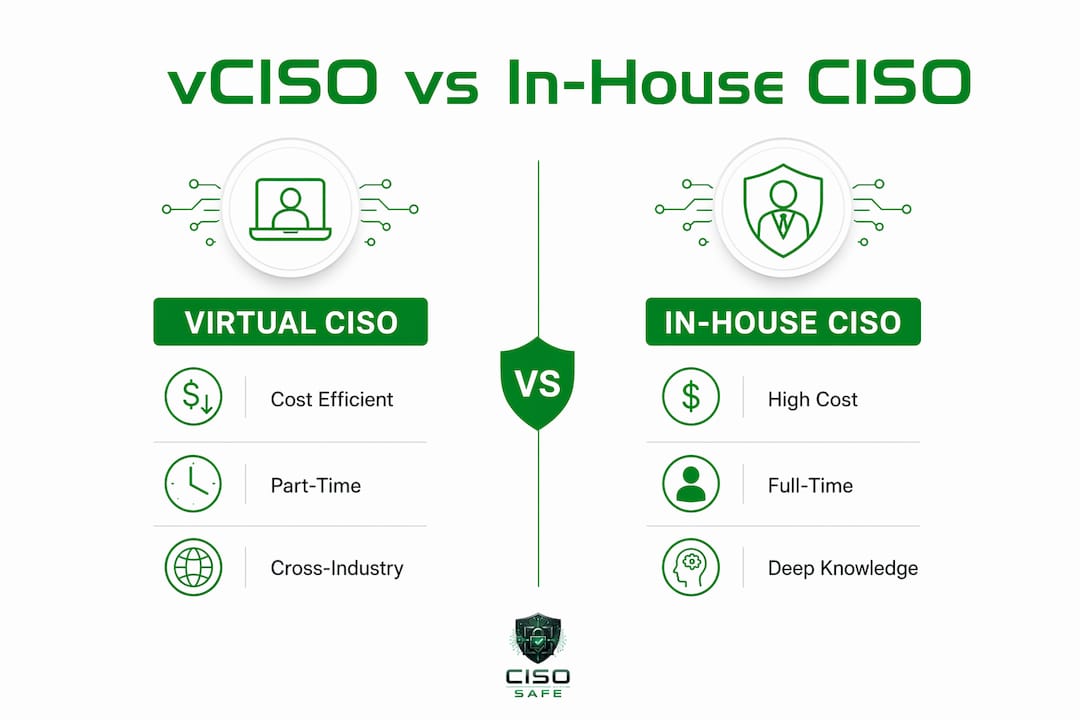
One underappreciated advantage is cross-industry exposure. An in-house CISO knows your organization deeply. A vCISO working across multiple clients brings pattern recognition from dozens of environments, which means they have likely seen your specific compliance challenge or threat scenario before.
What are the main benefits of a virtual CISO for mid-sized organizations?
The primary benefit is access to senior security expertise at a cost mid-sized organizations can actually afford. Virtual CISOs fill leadership gaps during IT restructuring, post-breach recovery, and growth stages when a full-time hire is not yet justified.
The concrete benefits break down as follows:
- Cost control without sacrificing expertise. You get a seasoned security executive for a monthly fee that fits a realistic budget. The savings versus a full-time hire are immediate and substantial.
- Faster compliance achievement. A vCISO who has guided dozens of SOC 2 compliance engagements moves faster than an internal team learning the framework for the first time. Speed matters when a customer or regulator is waiting.
- Cyber insurance readiness. Insurers increasingly require documented security programs, incident response plans, and evidence of ongoing risk management. A vCISO produces exactly that documentation.
- Multi-framework compliance management. vCISOs support compliance across ISO 27001, SOC 2, HIPAA, GDPR, DORA, and Cyber Essentials simultaneously, managing the overlap efficiently rather than treating each framework as a separate project.
- Continuity and accountability. A layered vCISO engagement provides ongoing risk committee leadership and security roadmap ownership. This is a sustained partnership, not a one-time assessment.
- Support for internal IT teams. Your IT staff gains a senior resource who can prioritize their security workload, justify budget requests to leadership, and escalate risk decisions that should not sit with a systems administrator.
Pro Tip: If your organization is pursuing SOC 2 Type II, HIPAA, or CMMC certification, engage a vCISO before the audit process begins. Starting with governance in place cuts remediation time significantly.
Cybersecurity leadership delivered as a managed service also aligns security investment with business growth. When your organization expands into a new market or acquires a company, the vCISO scales the security program to match without requiring a new hire.
How does the virtual CISO model work in practice?
The operational model in 2026 combines a software platform with a human strategist. Credible vCISOs use automation to handle control mapping, audit evidence collection, and vendor risk monitoring. The human expert focuses on governance, risk prioritization, and board-level reporting. Neither component works as well without the other.
Here is how a typical engagement operates:
| Phase | Platform role | Human vCISO role |
|---|---|---|
| Onboarding | Compliance intake, asset inventory, baseline gap analysis | Scoping, stakeholder interviews, risk appetite definition |
| Ongoing operations | Continuous control monitoring, evidence collection, alert triage | Risk committee leadership, policy decisions, vendor reviews |
| Audit preparation | Automated evidence packaging, control status reporting | Auditor communication, remediation prioritization |
| Board reporting | Data aggregation and dashboard generation | Narrative framing, risk translation, executive presentation |
A vCISO using security platforms to continuously monitor control status frees leadership time for the decisions that actually require human judgment. This is the core efficiency argument for the hybrid model. Automation handles the repeatable work. The strategist handles the judgment calls.
Engagement structures vary. Some organizations retain a vCISO for a fixed number of hours per month. Others engage on a project basis for a specific compliance initiative, then transition to a lighter ongoing advisory retainer. The right structure depends on your current security maturity, the compliance frameworks you are targeting, and how much internal IT capacity you already have.
Integration with your existing IT team is straightforward when expectations are set clearly at the start. The vCISO owns the security program and sets priorities. Your IT team executes. That division of responsibility prevents the overlap and confusion that can arise when security governance is undefined.
Key Takeaways
A virtual CISO delivers executive-level security governance at a fraction of the cost of a full-time hire, making it the most practical security leadership model for mid-sized organizations with compliance obligations and limited budgets.
| Point | Details |
|---|---|
| vCISO definition | An outsourced cybersecurity executive providing strategic governance on a retainer basis. |
| Cost advantage | Monthly retainers of $1,500–$8,000 versus $250,000–$350,000 for a full-time in-house CISO. |
| Core responsibilities | Policy development, risk management, compliance, incident response, and board reporting. |
| Operational model | Automation platforms handle evidence and monitoring; the human strategist handles governance and decisions. |
| Best fit | Organizations with fewer than 500 employees, active compliance requirements, or emerging security programs. |
Why the vCISO model is more than a cost-cutting measure
The framing I see most often is wrong. Executives evaluate a vCISO purely as a cheaper version of a full-time CISO. That misses the actual value proposition.
A vCISO brings cross-client pattern recognition that a single in-house hire simply cannot replicate. When I work with a law firm navigating CMMC requirements and an energy operator managing SOC 2 simultaneously, the overlap in control frameworks means both clients benefit from solutions I have already tested elsewhere. That knowledge transfer does not happen inside a single organization.
The pitfall I see most often is engaging a vCISO for compliance theater. The organization wants a certificate or a clean audit report, not an actual security program. That approach fails. Regulators, insurers, and sophisticated clients now probe beyond documentation. They want evidence of ongoing risk management, tested incident response, and leadership accountability. A vCISO who only produces paperwork will not protect you when it matters.
My recommendation for executives evaluating this model: prioritize vCISOs who combine a technology platform with genuine governance experience. The platform handles the volume of compliance work that would otherwise consume all available hours. The strategist applies judgment where automation cannot. Organizations that get this combination right end up with a security program that actually reduces risk, not just one that looks good on paper.
The future of security leadership for mid-sized organizations is not a choice between a full-time CISO and no CISO. It is a hybrid model that delivers the right expertise at the right time, backed by technology that keeps the program running continuously.
— vCISO
CisoSafe delivers vCISO services built for regulated industries
Mid-sized organizations in law, energy, and other compliance-sensitive sectors face security demands that generic IT support cannot meet. CisoSafe combines hands-on virtual CISO services with an AI-powered compliance platform purpose-built for SOC 2, HIPAA, PCI DSS, and CMMC requirements.
CisoSafe's Houston-based team delivers security assessments, risk roadmaps, policy development, and incident response planning at a cost structure designed for mid-market organizations. The platform automates penetration testing, compliance intake, and professional reporting, so your leadership gets clear risk visibility without burdening your internal team. For organizations managing SOC 2 compliance for law firms or energy sector regulatory requirements, CisoSafe provides the expertise and technology to get there efficiently.
FAQ
What is a virtual CISO in simple terms?
A virtual CISO is an outsourced cybersecurity executive who manages your organization's security program on a part-time, retainer basis. The role covers the same strategic functions as a full-time CISO, including risk management, compliance, and board reporting.
How much does a virtual CISO cost?
A vCISO monthly retainer typically ranges from $1,500 to $8,000, compared to $250,000 to $350,000 per year for a fully loaded in-house CISO. The exact cost depends on engagement scope, organization size, and compliance requirements.
When does an organization need a virtual CISO?
Organizations typically need a vCISO when facing compliance mandates such as SOC 2 or HIPAA, cyber insurance requirements, post-breach recovery, or a leadership gap in their security program. Companies with fewer than 500 employees are the most common fit.
What is the difference between a vCISO and a managed security service provider?
A vCISO provides executive-level governance, strategy, and compliance leadership. A managed security service provider handles operational security monitoring and technical response. The two roles are complementary, not interchangeable.
Can a virtual CISO handle multiple compliance frameworks at once?
Yes. vCISOs regularly manage multi-framework compliance portfolios covering ISO 27001, SOC 2, HIPAA, GDPR, and CMMC simultaneously. They identify control overlaps across frameworks to reduce duplication and accelerate audit readiness.