

SOC 2 compliance is an auditing framework developed by the American Institute of Certified Public Accountants (AICPA) that evaluates whether a service organization's controls adequately protect customer data across five Trust Services Criteria. Unlike HIPAA or PCI DSS, SOC 2 is not a government regulation. It is market-enforced, meaning enterprise clients, investors, and procurement teams demand it before signing contracts. For law firms, energy operators, SaaS providers, and other regulated businesses, a SOC 2 report is increasingly the price of entry into high-value deals.
What is SOC 2 compliance and why does it matter?
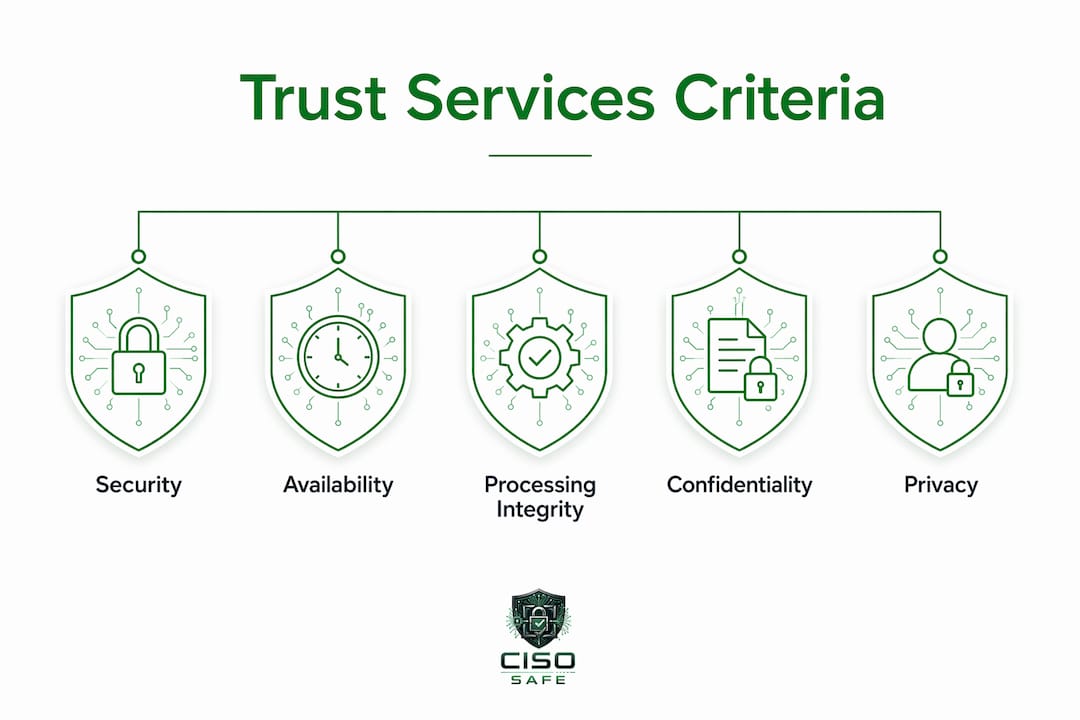
SOC 2 compliance is the process of designing, implementing, and having an independent CPA firm attest to the effectiveness of your organization's data security controls. The framework centers on five Trust Services Criteria: Security, Availability, Processing Integrity, Confidentiality, and Privacy. Security is the only mandatory criterion. The other four are selected based on your business model, contractual obligations, and client expectations.
The importance of SOC 2 compliance is clearest in B2B sales cycles. Without a SOC 2 report, companies face repeated security questionnaires, stalled procurement reviews, and lost enterprise deals. That friction has a real cost. For regulated industries like oil and gas, legal services, and healthcare technology, the report also signals to regulators and insurers that your security posture meets a recognized standard.

SOC 2 is not a certification. No government body issues it, and no organization "passes" or "fails." A licensed CPA firm conducts an attestation engagement and issues an opinion letter. That distinction matters because it shapes how you prepare, what you submit, and how you interpret the final report.
What are the five trust services criteria?
The five Trust Services Criteria form the structural backbone of every SOC 2 audit. Security, the mandatory criterion, contains 9 Common Criteria covering approximately 64 individual controls. These address logical access, change management, risk assessment, incident response, and system monitoring. Every organization pursuing SOC 2 must satisfy all 9 Common Criteria under Security before any optional criteria are added.
The four optional criteria each address a distinct operational concern:
- Availability: Controls that verify systems are operational and accessible as committed to clients
- Processing Integrity: Controls confirming that data processing is complete, accurate, timely, and authorized
- Confidentiality: Controls protecting information designated as confidential from unauthorized disclosure
- Privacy: Controls governing the collection, use, retention, and disposal of personal information
The table below summarizes each criterion and its typical audit focus:
| Criterion | Required | Primary Focus |
|---|---|---|
| Security | Yes | Logical access, threat monitoring, incident response |
| Availability | No | Uptime commitments, disaster recovery, redundancy |
| Processing Integrity | No | Data accuracy, completeness, authorized processing |
| Confidentiality | No | Data classification, encryption, access restrictions |
| Privacy | No | Personal data collection, consent, retention policies |
SOC 2 controls are principles-based, which means organizations have flexibility in how they satisfy each criterion. One organization may use data loss prevention (DLP) tools to meet a confidentiality control. Another may rely on encryption policies. Both approaches can satisfy the same criterion, provided the auditor agrees the control is designed and operating effectively.
Pro Tip: Select your optional criteria based on what your clients contractually require, not on what seems easiest to implement. Adding Availability to your scope when your clients have uptime SLAs is far more defensible than leaving it out.
How do SOC 2 audit types and timelines work?
SOC 2 report types fall into two categories: Type 1 and Type 2. Understanding the difference is critical before you commit to an audit timeline or budget.
A Type 1 report evaluates whether your controls are designed appropriately at a single point in time. The auditor reviews your policies, system descriptions, and control documentation. Type 1 engagements typically take 3–8 months from readiness assessment to report issuance. They are useful for organizations new to SOC 2 that need to demonstrate baseline security posture quickly.
A Type 2 report evaluates both the design and the operating effectiveness of controls over an observation period, typically 3–12 months. This is the report most enterprise clients require. Type 2 engagements run 6–18 months from start to final report. The extended timeline reflects the need to collect continuous evidence throughout the observation window.
| Report Type | Evaluation Scope | Typical Timeline | Enterprise Acceptance |
|---|---|---|---|
| Type 1 | Control design at a point in time | 3–8 months | Limited; often a stepping stone |
| Type 2 | Design and operating effectiveness | 6–18 months | Standard requirement |
The observation period is where most organizations struggle. Auditors expect ongoing evidence collection throughout the entire period, not a batch submission at the end. Timestamped access logs, incident tickets, change management records, and vendor review documentation must accumulate continuously. Organizations that treat evidence collection as a last-minute task routinely face audit delays and findings.
Pro Tip: Select your auditor early, ideally before you begin control implementation. Different CPA firms have different risk tolerances and interpretations of the criteria. Aligning on expectations upfront prevents costly redesigns after controls are already deployed.
What are common misconceptions about SOC 2 reports?
The most persistent misconception is that SOC 2 is a government-mandated certification with a pass/fail outcome. It is neither. SOC 2 is a voluntary, market-driven attestation that produces an auditor's opinion letter, not a certificate you hang on a wall.
A second misconception is that any exceptions or gaps in a SOC 2 report indicate failure. In practice, exceptions provide transparency. A clean, or "unqualified," opinion means the auditor found controls to be effective. A qualified opinion with noted exceptions still has value in due diligence because it shows the organization understands its gaps and is working to address them. As A-Lign, one of the leading SOC 2 audit firms, frames it:
"SOC 2 reports are independent opinions, not pass/fail certifications. Exceptions in a report provide transparency for due diligence rather than disqualifying a vendor."
A third misconception is that SOC 2 compliance is a one-time event. Every SOC 2 report covers a specific organization, a specific audit period, and a specific scope. When your systems change, your vendors change, or your client contracts expand, your audit scope must be reassessed. Compliance is a continuous operating state, not a project with a finish line.
How to achieve SOC 2 compliance: a practical roadmap
Achieving SOC 2 compliance follows four distinct phases. Each phase builds on the last, and skipping any one of them creates gaps that surface during audit fieldwork.
- Scoping: Define which Trust Services Criteria apply, identify the systems and services in scope, and document your system description. This phase sets the boundaries for everything that follows.
- Remediation: Identify control gaps through a readiness assessment, then implement missing controls. Common areas requiring attention include multi-factor authentication (MFA) enforcement, data loss prevention (DLP), incident response planning, and formal vendor management policies.
- Observation: For Type 2 audits, operate your controls consistently throughout the observation period. Collect timestamped evidence continuously. This phase is where ongoing evidence collection becomes operationally critical.
- Audit Fieldwork: The CPA firm reviews your evidence, interviews personnel, and tests control effectiveness. Gaps discovered here are expensive to remediate mid-audit.
Common pitfalls to avoid during implementation:
- Failing to document informal processes before the audit begins
- Treating vendor contracts as sufficient oversight without periodic reassessments
- Relying on manual evidence collection instead of automated logging tools
- Scoping too broadly in the first audit, which increases cost and timeline without proportional benefit
- Neglecting to train staff on security policies before the observation period starts
Compliance automation platforms can reduce the manual burden of evidence collection significantly. Tools that integrate with your cloud infrastructure, identity providers, and ticketing systems pull continuous evidence automatically. This approach reduces audit preparation time and lowers the risk of gaps in your evidence trail.
How does SOC 2 affect vendor management?
Vendor management is one of the most underestimated components of a SOC 2 audit. Auditors now expect documented, ongoing vendor reassessments rather than a one-time contract review. A signed agreement with a cloud provider or managed service provider does not satisfy the vendor management criterion on its own.
For organizations relying on AWS, Microsoft Azure, Google Cloud, or third-party SaaS tools within their audit scope, the expectation is clear. You must document how each vendor is assessed, how often reviews occur, and what happens when a vendor experiences a security incident or changes their service terms.
Effective vendor management under SOC 2 requires:
- Maintaining a vendor inventory with risk ratings for each provider
- Conducting documented annual reviews for high-risk vendors
- Reassessing vendors after significant service changes or security incidents
- Reviewing vendor SOC 2 reports or equivalent attestations as part of due diligence
- Establishing contractual security requirements and verifying compliance periodically
The vendor management strategies that work best treat third-party oversight as an ongoing program, not a checklist item. For technology companies pursuing SOC 2 to close enterprise deals or raise capital, demonstrating mature vendor oversight is a competitive signal. Enterprise procurement teams review vendor management sections closely because your vendors are part of your attack surface.
Key takeaways
SOC 2 compliance is a continuous, principles-based attestation framework that requires documented controls, ongoing evidence collection, and periodic vendor oversight to satisfy enterprise and regulatory expectations.
| Point | Details |
|---|---|
| SOC 2 is not a certification | It is an auditor's opinion letter issued by a licensed CPA firm, not a government-issued credential. |
| Security is the only mandatory criterion | The remaining four Trust Services Criteria are selected based on business and contractual needs. |
| Type 2 reports are the enterprise standard | They evaluate operating effectiveness over 3–12 months and are required by most enterprise clients. |
| Evidence collection must be continuous | Timestamped logs and incident records must accumulate throughout the observation period, not at the end. |
| Vendor management requires ongoing oversight | Auditors expect documented, periodic vendor reviews, not one-time contract checks. |
What SOC 2 actually teaches you about your security program
After working through SOC 2 engagements with regulated organizations across energy, legal, and technology sectors, the most consistent finding is this: most organizations discover their security program is less documented than they believed. Controls exist informally. Processes run on institutional knowledge. Policies are outdated or missing entirely. SOC 2 forces that documentation into the open, which is genuinely useful regardless of whether a client ever asks to see the report.
The comparison between SOC 2 vs ISO 27001 comes up frequently. ISO 27001 is a certification with a formal pass/fail outcome issued by an accreditation body. SOC 2 is an attestation with a nuanced opinion. For U.S.-based organizations selling to enterprise clients domestically, SOC 2 is the more recognized standard. For organizations with international clients or those pursuing formal certification, ISO 27001 may be worth pursuing in parallel.
The organizations that get the most value from SOC 2 treat it as a security program audit, not a compliance checkbox. They use the readiness assessment to prioritize remediation. They use the observation period to build evidence collection habits that persist year-round. And they use the final report as a sales tool, a board communication, and a baseline for the next audit cycle. That mindset shift, from compliance burden to security investment, is what separates organizations that struggle through annual audits from those that maintain readiness continuously.
— vCISO
Ready to build your SOC 2 program with confidence?
CisoSafe provides virtual CISO services and an AI-powered compliance platform built specifically for regulated industries, including law firms, energy operators, and technology companies. From scoping your first SOC 2 audit to maintaining continuous evidence collection and vendor oversight, CisoSafe delivers the expertise and tooling your team needs without the cost of a full-time CISO.
If your organization is preparing for a SOC 2 audit or needs to close the gap between your current security posture and audit readiness, CisoSafe can help you move from assessment to report efficiently. Explore vCISO and compliance services designed for organizations that cannot afford to get compliance wrong.
FAQ
What is SOC 2 compliance in simple terms?
SOC 2 compliance is the process of having an independent CPA firm verify that your organization's security controls adequately protect customer data according to the AICPA's Trust Services Criteria. It is a voluntary, market-driven standard, not a government regulation.
What are the SOC 2 audit requirements?
A SOC 2 audit requires organizations to implement controls across the Security criterion at minimum, maintain continuous evidence throughout the observation period, and engage a licensed CPA firm to conduct the attestation engagement.
How long does it take to achieve SOC 2 compliance?
A Type 1 report typically takes 3–8 months from readiness assessment to issuance. A Type 2 report takes 6–18 months because it requires an observation period of 3–12 months to evaluate operating effectiveness.
What is the difference between SOC 2 type 1 and type 2?
A Type 1 report evaluates whether controls are properly designed at a single point in time. A Type 2 report evaluates both design and operating effectiveness over an extended observation period, which is why enterprise clients typically require Type 2.
How does SOC 2 compare to ISO 27001?
SOC 2 is an attestation engagement producing an auditor's opinion letter, while ISO 27001 is a formal certification issued by an accreditation body. U.S.-based organizations selling to domestic enterprise clients generally prioritize SOC 2, while those with international clients may pursue both frameworks.