

Security awareness for energy workers is the process of building role-specific knowledge, attitudes, and behaviors that reduce human-factor risk across both IT and operational technology (OT) environments. The industry term is "security awareness and training," and it goes well beyond annual compliance content. The goal is measurable behavior change: field operators, plant staff, corporate users, and contractors each understanding the threats relevant to their daily tasks and knowing exactly what to do when something looks wrong. For a security or training manager, the immediate next step is a stakeholder brief with operations, EHS, and HR, followed by a scoped pilot plan targeting your highest-risk role group.
Table of Contents
- Why security awareness is critical in energy operations
- How awareness differs from training and competency, and what to aim for
- What a tailored security awareness program for energy workers includes
- U.S. regulations and standards to align your program with
- How to design and roll out a tailored security awareness program for energy workers
- How to measure effectiveness and show ROI
- Practical challenges when training energy workers and how to mitigate them
- Evidence and a concise case example from the energy sector
- How a vCISO or managed security awareness program can accelerate results
- Key Takeaways
- The case for building awareness programs that outlast their launch
- CisoSafe builds energy security awareness programs that hold up at audit
- Authoritative sources and further reading
Why security awareness is critical in energy operations
Energy organizations face a threat profile unlike most industries. A successful phishing attack on a corporate user is damaging. The same attack reaching a plant operator with access to a distributed control system (DCS) or SCADA network can trigger physical consequences: equipment damage, environmental release, or grid disruption. That physical-digital convergence is what makes energy sector cyber threats categorically different from threats in other sectors.
The consequences of a human-factor failure in energy are severe across several dimensions:
- Physical safety: A compromised OT system can disable safety instrumentation, expose workers to hazardous conditions, or trigger emergency shutdowns.
- Grid and supply disruption: Electricity operators face potential cascading outages when control systems are manipulated or taken offline.
- Environmental harm: Oil and gas operators risk spills, flaring events, or pipeline failures if process controls are interfered with.
- Regulatory fines and enforcement: NERC CIP violations carry civil penalties, and DOE contractor programs operate under 10 CFR 851, which mandates documented safety and training programs with management accountability.
The threat vectors that most frequently exploit human factors in energy include:
- Phishing and spear-phishing: Targeted emails impersonating vendors, regulators, or internal IT remain the most common initial access method.
- Supply-chain social engineering: Attackers impersonate trusted third-party vendors to gain credentials or physical access. Supply chain security is a persistent gap in most energy awareness programs.
- OT access exploitation: Field engineers and operators are targeted specifically because they hold credentials or physical access to control systems.
- Insider risk: Insider threat guidelines for energy critical infrastructure recommend integrating physical access logs with digital telemetry to detect behavioral anomalies early, particularly around "compelling events" such as disciplinary actions or sudden financial stress.
- Contractor and third-party vectors: Contractors often receive the least security orientation yet carry the most access risk during maintenance windows.
Research confirms that human-factor vulnerabilities remain the most frequently exploited elements in attacks against power and energy systems. Field staff, plant operators, and contractors should be prioritized in any awareness program precisely because they interact with the systems where a mistake has the highest consequence.
How awareness differs from training and competency, and what to aim for
The distinction matters practically, not just theoretically. NIST SP 800-12 defines three distinct activities: awareness changes attitudes and primes employees to care about security; training builds specific job skills and teaches people how to act; and education develops deep expertise for security professionals. Programs that collapse all three into a single annual module tend to produce neither lasting attitude change nor measurable skill gains.
For energy workers, the practical balance looks like this:
- Awareness: Short, frequent touchpoints (monthly micro-modules, posters in control rooms, toolbox talks) that keep threats visible and relevant. Frequency matters more than depth here.
- Training: Role-specific skill modules delivered at onboarding and at meaningful intervals, covering tasks like recognizing a suspicious USB device, reporting an anomaly in a SCADA interface, or escalating a social engineering attempt across the OT/IT boundary.
- Competency assessment: A scored evaluation that confirms a worker can actually perform the skill, not just recall a definition. The DOE's competency and functional framework for cyber workforce development provides a useful reference for mapping roles to required competencies.
The NIST framing is practical: awareness changes what people notice; training changes what people do. Programs that collapse the two often miss measurable competency gains.
Pro Tip: Run a short knowledge-attitude-behavior (KAB) baseline survey before launching any new module. It takes under ten minutes per respondent and gives you a pre-intervention benchmark that makes your post-training measurement credible to leadership and auditors alike.
What a tailored security awareness program for energy workers includes
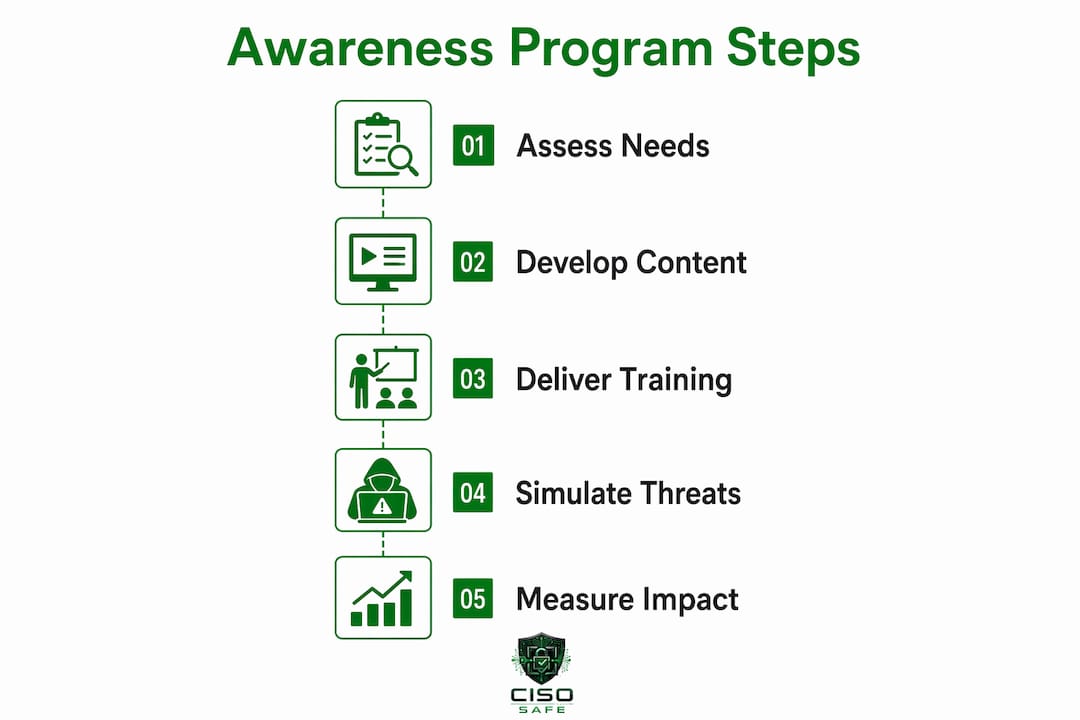
Generic, role-agnostic annual training consistently fails to reduce phishing susceptibility or address OT-specific risks for field and offshore workers. A program built for energy workers needs distinct tracks—not a single course pushed to everyone.
Role matrix: who needs what
| Role Group | Primary Threat Focus | Key Learning Topics |
|---|---|---|
| Corporate / administrative | Phishing, credential theft, data handling | Email security, MFA, password hygiene, data classification |
| Field engineers / technicians | Removable media, physical-digital convergence | USB/removable media policy, physical access controls, vendor impersonation |
| Plant operators / control-room staff | OT social engineering, SCADA anomaly recognition | Control-room social engineering, anomaly escalation, safe HMI use |
| Contractors / third parties | Onboarding gaps, supply-chain vectors | Site access rules, credential handling, incident reporting channels |
Core program elements every energy awareness program should include:
- Role-based content modules: Designed around daily tasks. A plant operator track should focus on physical-digital convergence threats, control-room social engineering, and safe use of removable media so the content is immediately relevant.
- Short just-in-time modules: Five-to-ten-minute micro-learning units that fit shift schedules and low-attention windows better than hour-long courses.
- OT-aware social engineering scenarios: Phishing simulations and scenario exercises that reflect energy-sector lures (vendor invoices, regulatory notices, maintenance requests) rather than generic retail phishing templates.
- Incident reporting channels: Workers need to know exactly how to report a suspicious event, and the channel must be frictionless. Awareness of incident response procedures should be embedded in every role track.
- Contractor and onboarding tracks: A dedicated short-form track for contractors that covers site-specific rules, credential handling, and reporting expectations before they touch any system.
Technology enablers
A learning management system (LMS) such as Absorb LMS or TalentLMS handles content delivery, completion tracking, and audit reporting. Phishing simulation platforms like KnowBe4 or Proofpoint Security Awareness Training deliver adaptive, role-relevant simulations and track click rates over time. For OT environments, avoid simulations that interact with live control systems; use tabletop exercises and scenario-based discussions instead. Integration with HR and onboarding systems automates enrollment and reduces administrative overhead significantly.
Continuous, adaptive simulations with role-relevant templates produce stronger engagement and lower phishing susceptibility than annual, generic campaigns, and modern platforms handle most of the scheduling and reporting automatically.

Pro Tip: Use your LMS's API to pull completion data directly into your compliance reporting dashboard. Automating that data flow cuts reporting time and gives auditors a clean evidence trail without manual spreadsheet work.
U.S. regulations and standards to align your program with
Three frameworks define the compliance floor for security awareness in U.S. energy organizations. Aligning your program to all three is both good practice and good audit hygiene.
-
NERC CIP (North American Electric Reliability Corporation Critical Infrastructure Protection): Applicable to bulk electric system operators, NERC CIP standards including CIP-004 require documented personnel risk assessment, security awareness programs, and training for all personnel with access to BES cyber systems. CIP-004-6 specifically mandates a security awareness program that reinforces security practices at least quarterly. Awareness activities, delivery dates, and participant records must be retained as audit evidence. Cyber frameworks help map awareness activities to specific CIP controls.
-
DOE cybersecurity awareness and training guidance: The DOE's competency and functional framework for cyber workforce development maps roles to required knowledge, skills, and abilities. The DOE's 10 CFR 851 Worker Safety and Health Rule requires contractors to provide training and information to all workers exposed to hazards, including periodic refreshers when conditions change. Awareness program documentation, training records, and competency assessments all serve as evidence under DOE contractor oversight.
-
NIST SP 800-series guidance: NIST SP 800-12 and NIST SP 800-50 (Building an Information Technology Security Awareness and Training Program) provide the definitional and structural framework most U.S. organizations use. The NIST Cybersecurity Framework (CSF) maps awareness and training activities to the "Protect" function under PR.AT controls. NIST guidance is the most widely accepted reference for demonstrating that your program design is methodologically sound.
For audit evidence, save the following: awareness delivery records (dates, topics, delivery method), training completion records by role, competency assessment scores, phishing simulation results, and any policy acknowledgment logs. Map each activity to the specific NERC CIP standard, DOE requirement, or NIST CSF control it satisfies. That mapping document is what an auditor will ask for first.
How to design and roll out a tailored security awareness program for energy workers
The recommended approach is phased: stakeholder alignment, role mapping, pilot, then scaled rollout. Trying to deploy enterprise-wide before validating content and logistics with a small cohort wastes resources and risks low adoption.
Phase 1: Stakeholder alignment (weeks 1–3)
- Convene a working group with representatives from security, operations, HR, EHS, procurement, and an executive sponsor.
- Document the regulatory obligations (NERC CIP, DOE, NIST) the program must satisfy.
- Agree on scope: which roles, which sites, which contractors are in scope for the pilot.
- Assign ownership: who approves content, who manages the LMS, who reviews simulation results.
Phase 2: Role mapping and content development (weeks 4–8)
- Conduct a role inventory: list every job function with system access and map it to a threat profile.
- Develop or source content for each role track. Separate corporate and plant/operator tracks and build escalation modules that address the OT/IT boundary.
- Build the contractor onboarding track as a standalone short-form module.
- Configure phishing simulation templates using energy-sector-relevant lures.
Phase 3: Pilot (weeks 9–14)
Run the pilot with one high-risk role group (plant operators or field engineers are the best starting cohort). The pilot checklist should include:
- Defined success metrics: target phish susceptibility rate, completion rate, time-to-report baseline.
- Pre-pilot KAB survey to establish a behavioral baseline.
- At least one simulated phishing campaign during the pilot window.
- A debrief session with pilot participants to collect qualitative feedback.
- A post-pilot report for the executive sponsor covering metrics against targets.
Phase 4: Scaled rollout (months 4–12)
- Incorporate pilot feedback into content and delivery adjustments.
- Roll out remaining role tracks in priority order (highest-risk roles first).
- Establish a quarterly awareness touchpoint cadence to satisfy NERC CIP-004 requirements.
- Schedule annual competency assessments for roles with OT access.
Operational constraints to address explicitly:
- Shift workers: Deliver modules asynchronously; never require live attendance for awareness content.
- Low-connectivity sites: Pre-load content on offline-capable devices or use printed scenario cards for toolbox talks.
- Contractors: Trigger the contractor track automatically via HR/onboarding system integration on day one of site access.
How to measure effectiveness and show ROI
Completion rates alone tell you nothing about risk reduction. The right measurement approach combines engagement, behavior, and outcome metrics, then baselines each before the program launches so you can show directional change.
| KPI | What It Measures | Measurement Method |
|---|---|---|
| Phish susceptibility rate | Percentage of users who click a simulated phishing link | Phishing simulation platform; track monthly or quarterly by role group |
| Time-to-report | Average time between a suspicious event and a formal report | Ticketing system or IR platform timestamps; compare pre- and post-training cohorts |
| Human-factor incident count | Security incidents attributable to user behavior (credential misuse, malware execution) | IR case tagging; compare rolling 12-month periods |
| Competency pass rate | Percentage of role-specific assessments passed on first attempt | LMS assessment module; track by role and site |
| Near-miss reporting volume | Number of self-reported near-miss events | Incident reporting channel; an increase signals improved reporting culture, not more incidents |
Align measurement to the Kirkpatrick model: Level 1 (reaction, via post-module surveys), Level 2 (learning, via competency assessments), Level 3 (behavior, via phishing simulation and incident data), and Level 4 (results, via incident count trends and audit outcomes). Collect a cyber risk baseline before the program launches so your Level 4 data has a credible comparison point.
For executive reporting, present three numbers: phish susceptibility rate trend, time-to-report improvement, and human-factor incident count. Those three metrics translate risk reduction into language a leadership team understands without requiring a cybersecurity background.
Practical challenges when training energy workers and how to mitigate them
Energy organizations face operational barriers that most corporate security training programs are not designed for. Recognizing them early prevents low adoption and wasted budget.
-
Dispersed and offshore workforce: Workers at remote or offshore sites often lack reliable internet access and may not interact with corporate IT systems regularly. Mitigation: develop offline-capable micro-learning kits and integrate awareness content into existing safety toolbox talks that already reach these workers. Offshore facility cybersecurity programs require purpose-built delivery methods, not adapted corporate content.
-
Contractor churn: High contractor turnover means the onboarding track must be short, self-contained, and automatically triggered. Mitigation: integrate contractor enrollment with your vendor management or HR onboarding system so no manual step is required. Pair with a brief site-access acknowledgment that doubles as a policy record.
-
Low digital literacy among field staff: Some field and plant workers have limited experience with LMS platforms or online training tools. Mitigation: use video-first content with minimal reading, keep modules under eight minutes, and supplement with printed scenario cards for toolbox talks.
-
Cultural resistance and the "check-the-box" mindset: Workers who have completed the same generic annual training for years are conditioned to click through without engaging. Mitigation: frame security in terms of mission success and personal safety rather than compliance. Research confirms that linking security hygiene to outcomes workers care about produces more sustained behavior change than compliance-framed content.
-
Insider risk detection gaps: Physical and digital monitoring are often siloed in energy organizations. Integrating badge access logs with digital telemetry and monitoring for compelling events (disciplinary actions, sudden financial stress, role changes) gives security teams a much earlier signal of emerging insider risk than badge monitoring alone.
Pro Tip: Partner with your EHS team to co-brand awareness content. When field workers see safety messaging delivered through the same channel as their OSHA and hazard training, adoption rates improve and the security program gains operational credibility it cannot build on its own.
Evidence and a concise case example from the energy sector
The research base on human factors in energy security is consistent: people remain the most exploited element in attacks on power and energy systems. A study evaluating security awareness and competency gaps across energy organizations found that role-specific knowledge deficits, particularly among operational staff, were the primary driver of vulnerability. Generic programs that treat all employees the same fail to close those gaps.
A representative program flow from a mid-size U.S. utility illustrates what a well-designed pilot produces:
- Situation: A regional utility with approximately 800 employees had completed annual compliance training for three years. Phishing simulation data showed no meaningful improvement in click rates, and incident reporting was sporadic.
- Intervention: The security team, working with an external program designer, separated content into three role tracks (corporate, control-room operators, field technicians), replaced the annual module with quarterly micro-learning units, and launched monthly adaptive phishing simulations using energy-sector lures. Contractor onboarding was automated through the HR system.
- Observed outcomes after one pilot cycle (approximately six months):
- Phishing susceptibility rate dropped measurably across all three role groups, with the sharpest improvement in the control-room operator cohort.
- Time-to-report improved as workers became familiar with the reporting channel and understood what to flag.
- Near-miss reporting volume increased, indicating a shift in reporting culture rather than an increase in actual incidents.
- The program generated documented quarterly awareness records that satisfied NERC CIP-004 audit requirements without additional manual effort.
The pattern holds across the sector: role-specific content, adaptive simulations, and a frictionless reporting channel consistently outperform generic annual training on every behavioral metric that matters.
How a vCISO or managed security awareness program can accelerate results
A vCISO accelerates program setup, aligns activities to NERC CIP, NIST, and DOE requirements from day one, and reduces the burden on internal security and HR teams who are already stretched. For energy organizations without a dedicated security awareness function, a vCISO-led program is often the fastest path from zero to a defensible, audit-ready program.
What a vCISO-managed awareness engagement typically delivers:
- Pilot design and role mapping: Structured stakeholder workshops, role inventory, threat profile mapping, and content sourcing or development for each track.
- LMS and phishing simulation integration: Platform selection or configuration, template development using energy-sector-relevant lures, and automated enrollment tied to HR systems.
- KPI setup and baseline collection: Pre-program KAB survey, phishing baseline campaign, and a measurement dashboard configured before the pilot launches.
- Compliance mapping: Each awareness activity mapped to the specific NERC CIP standard, DOE requirement, or NIST CSF control it satisfies, with documentation formatted for audit evidence.
- Reporting templates: Executive-ready monthly and quarterly reports covering phish susceptibility rate, time-to-report, and competency pass rates.
- Ongoing advisory: Quarterly program reviews, content refresh recommendations, and regulatory update briefings as NERC CIP standards or DOE guidance evolves.
A typical vCISO-led awareness program reaches a defensible pilot state within 8–12 weeks and full scaled rollout within six to nine months, depending on workforce size and site complexity. vCISO services for oilfield operations follow a similar phased model and can be adapted for utilities, renewables, and midstream operators.
The compliance support dimension is particularly valuable at audit time. When a NERC CIP auditor requests evidence of a quarterly security awareness program, a vCISO-managed program produces that documentation automatically, with the control mapping already in place.
Key Takeaways
A security awareness program for energy workers reduces human-factor risk only when it is role-specific, continuously measured, and aligned to NERC CIP, NIST, and DOE requirements from the start.
| Point | Details |
|---|---|
| Role-specific content is non-negotiable | Generic annual training fails to reduce phishing susceptibility or OT risk for field and plant workers. |
| NIST, NERC CIP, and DOE set the compliance floor | Align every awareness activity to these three frameworks and document the mapping for audit evidence. |
| Measure behavior, not just completion | Track phish susceptibility rate, time-to-report, and human-factor incident counts, not module completion alone. |
| Operational barriers require purpose-built solutions | Shift workers, offshore crews, and contractors need offline-capable, automated, and short-form delivery methods. |
| CisoSafe accelerates implementation | CisoSafe's vCISO-led awareness programs deliver role mapping, compliance documentation, and KPI dashboards within weeks. |
The case for building awareness programs that outlast their launch
The most common failure mode in energy security awareness is not a bad program. It is a good program that launches well and then quietly degrades. Quarterly touchpoints become annual. Phishing simulations stop because no one owns the scheduling. Role tracks go stale as job functions change. Within eighteen months, the organization is back to checking a box.
The programs that hold up share one structural feature: they are owned by a named function with a budget line, not delegated to whoever has time. In energy organizations, that usually means security owns the program architecture, operations owns the delivery logistics, and EHS owns the field-worker channel. When those three functions share accountability, the program survives personnel changes and budget cycles.
The tactical advice that matters most: map every awareness activity to a daily task, not an abstract threat. A control-room operator who understands why they should not plug in an unknown USB device, framed in terms of what it could do to the system they are responsible for, retains that behavior far longer than one who sat through a slide about malware. Specificity is what converts awareness into habit.
For organizations that need hands-on help building that structure, a vCISO engagement is the fastest way to get there without pulling internal teams off their primary responsibilities.
CisoSafe builds energy security awareness programs that hold up at audit
Energy organizations that need a defensible, role-specific awareness program without hiring a full-time security awareness manager have a practical option. CisoSafe's vCISO services cover the full program lifecycle: stakeholder workshops, role mapping, LMS and phishing simulation configuration, NERC CIP and NIST compliance mapping, and executive-ready KPI reporting.
The concrete advantage over building internally: CisoSafe brings an energy-sector-specific threat library, pre-built role track templates, and compliance documentation frameworks that would take an internal team month to develop from scratch. Programs reach pilot-ready state in weeks, not quarters, and every activity is documented for audit evidence from day one.
If your organization needs to satisfy NERC CIP-004, meet DOE contractor training requirements, or simply reduce the human-factor risk that generic annual training has not addressed, request a vCISO consultation to scope a pilot program for your workforce.
Authoritative sources and further reading
The sources below are the primary references for program design, measurement methodology, and compliance alignment. Each one belongs in your internal governance pack and audit evidence file.
| Source | What It Covers | How to Use It |
|---|---|---|
| NIST SP 800-12 | Defines awareness, training, and education as distinct activities; specifies techniques for each | Used to justify program structure and the separation of awareness from competency training in audit documentation |
| NIST SP 800-50 | Provides a full framework for building an IT security awareness and training program | Use as the primary design reference; map your program elements to its recommended components |
| NIST Cybersecurity Framework (CSF), PR.AT controls | Maps awareness and training activities to the Protect function | Use to align program activities to CSF controls and generate compliance evidence |
| DOE Competency and Functional Framework for Cyber Workforce Development | Maps roles to required knowledge, skills, and abilities for cyber workforce | Use to design role-specific competency assessments and justify track separation |
| DOE 10 CFR 851 Worker Safety and Health Rule | Mandates training and information programs for all workers exposed to hazards | Use to document contractor and field worker training obligations and periodic refresher requirements |
| NERC CIP-004-6 | Requires documented security awareness programs with at least quarterly reinforcement for BES cyber system personnel | Use to set your awareness cadence, document delivery records, and prepare for CIP audit evidence requests |
| Security Industry Association Insider Threat Guidelines for Energy Critical Infrastructure | Recommends integrating physical access logs with digital telemetry and monitoring for compelling events | Use to design insider risk components of your awareness program and cross-functional monitoring protocols |
| PMC: "Security Awareness Training for the Workforce: Moving Beyond Check-the-Box Compliance" | Academic review of behavior change approaches; recommends moving beyond compliance to advocacy and intrinsic motivation | Use to justify adaptive simulation and KAB measurement methodology to leadership and auditors |