

Incident response in energy operations is defined as the coordinated process of detecting, containing, and recovering from cybersecurity and operational incidents across critical energy infrastructure, including oil and gas systems, power grids, and pipelines. The role of incident response in energy operations goes far beyond IT security. It directly determines whether a pipeline stays pressurized, whether a grid stays stable, and whether your organization avoids regulatory penalties under frameworks like the NIS2 Directive. Energy operators face a distinct challenge: their operational technology (OT) environments, including SCADA systems, distributed control systems (DCS), and field devices, carry physical consequences when compromised. Compliance officers and operations teams must treat incident response as a core operational discipline, not a documentation exercise.
What are the key components of incident response in energy operations?
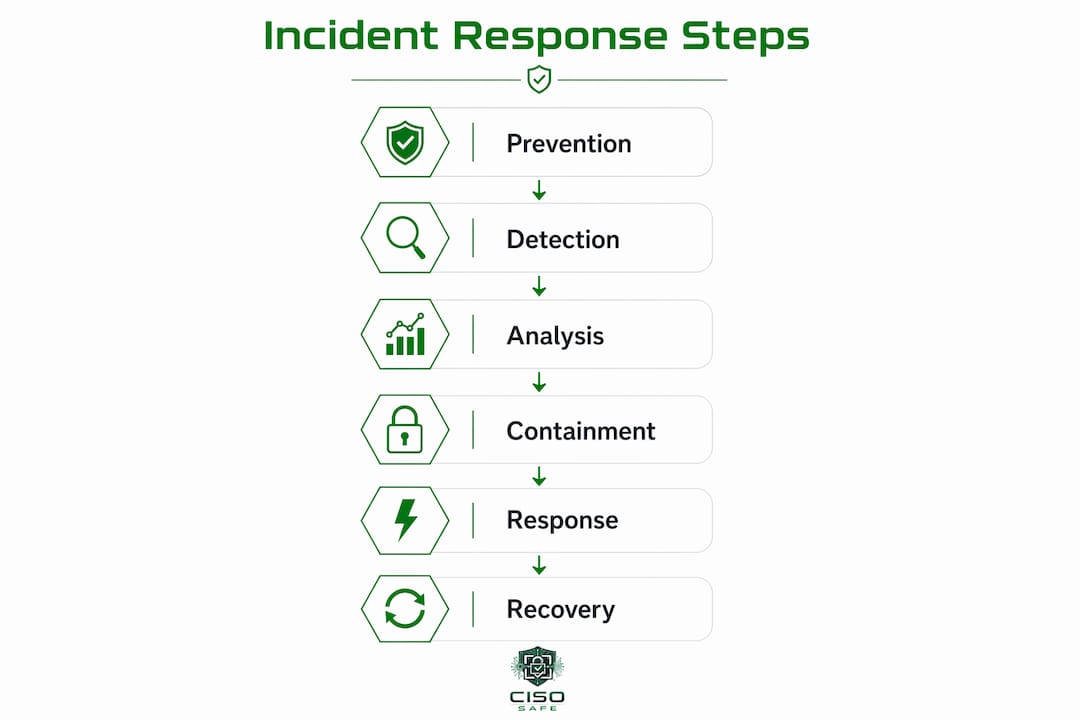
Incident response in energy operations follows six core components: prevention, detection, analysis, containment, response, and recovery. Each component carries specific requirements when applied to OT environments, where a wrong move can disrupt physical supply rather than just data flow.
Prevention covers asset hardening, access controls, and security-by-design practices across both IT and OT networks. Energy operators must maintain an accurate asset inventory covering SCADA controllers, DCS nodes, and field instrumentation. Without that inventory, you cannot protect what you cannot see.
Detection requires coverage across all system layers. Comprehensive SOC coverage spanning IT and OT is necessary to detect incident significance within 24-hour reporting windows. A detection gap in a single field device layer can delay the entire response chain.
Analysis determines the scope, severity, and likely origin of an incident. In energy environments, this step must also assess whether physical processes are at risk. An analyst who only examines network logs without checking SCADA process states will miss the most dangerous consequences.
Containment in OT environments requires a fundamentally different approach than in IT. Isolating SCADA controllers without coordination can cause cascading failures across interconnected grid segments. Every containment action must follow a documented coordination protocol that accounts for physical process impacts.
Response covers the active mitigation steps: patching, credential resets, vendor notifications, and regulatory filings. This phase runs in parallel with containment and requires clear role assignments to avoid duplication or gaps.
Recovery must be prioritized by system criticality. Recovery Time Objectives vary from near zero for safety-critical systems to over 72 hours for non-essential IT. That tiered approach prevents teams from spending recovery resources on low-priority systems while critical infrastructure remains offline.
| Component | Energy OT Application |
|---|---|
| Prevention | Asset inventory across SCADA, DCS, and field devices |
| Detection | SOC coverage spanning IT and OT within 24-hour windows |
| Analysis | Assess network and physical process state simultaneously |
| Containment | Coordinated isolation to prevent cascading physical failures |
| Response | Parallel mitigation with defined roles and regulatory filings |
| Recovery | Tiered RTOs from near zero to 72+ hours by system criticality |
Pro Tip: Build your containment playbooks before an incident occurs. A playbook that requires approval from three departments during a live SCADA compromise will fail every time.
How do regulatory reporting requirements shape incident response practices in energy?
Regulatory timelines directly dictate how your incident response workflow must be structured. Under the NIS2 Directive, energy operators must report incidents with three distinct deadlines: an initial notification, a substantive update within 72 hours, and a final report within 30 days. Missing any of these deadlines creates both regulatory liability and reputational damage.
These timelines force a specific operational discipline. Your detection and analysis phases must complete fast enough to support the initial notification. Your containment and response phases must generate documented evidence for the 72-hour update. Your full recovery and root cause analysis must close within 30 days. That sequence is not optional.
The practical challenge for most energy operators is asset visibility. You cannot file an accurate initial notification if you do not know which systems were affected. Many operators discover during an incident that their OT asset inventory is incomplete, which delays every subsequent reporting step. Addressing that gap before an incident is one of the highest-value investments a compliance officer can make. A cyber risk assessment conducted before an incident gives you the baseline inventory and risk profile that reporting requires.
Electricity transmission system operators (TSOs) face an additional layer of complexity. They carry dual-filing obligations under both NIS2 and national critical infrastructure protection regulations. That means two separate reporting chains, two sets of documentation standards, and two agencies that may ask conflicting questions. Your incident response plan must explicitly map which team files which report to which authority.
- Assign a dedicated compliance liaison before any incident occurs.
- Pre-build notification templates for each reporting deadline.
- Map dual-filing obligations for TSOs to specific named individuals.
- Conduct a quarterly asset inventory review to keep OT records current.
- Run a tabletop exercise that simulates the full 30-day reporting chain.
Pro Tip: Pre-draft your 72-hour update template with blank fields for incident-specific data. Under pressure, teams that start from a blank page consistently miss required fields and file incomplete reports.
What unique challenges does OT incident response face in energy environments?
OT environments in energy operations present physical risks that have no equivalent in standard IT incident response. A compromised SCADA system is not just a data breach. It is a potential loss of control over high-voltage equipment, pressurized pipelines, or rotating machinery. That physical dimension changes every decision in the response process.
Manual reversion capabilities, specifically the physical operation of breakers and valves, are necessary during SCADA compromises to maintain safety and supply continuity. Operators who have never practiced manual reversion under pressure will struggle to execute it correctly during an active incident. This is a training gap that shows up repeatedly in post-incident reviews.
Cross-vendor coordination is another persistent challenge. Energy operations involve multiple asset managers and technology providers, each with their own access credentials, maintenance windows, and communication protocols. When an incident spans systems from three different vendors, the response team must coordinate across all three simultaneously. Without pre-established coordination agreements, that process stalls.
Operational inefficiencies compound the technical challenge. Logistics delays and limited data access drive economic risk in energy operations as much as technical failures do. During an incident, those same inefficiencies slow the response. A technician who cannot access a remote substation because of a logistics failure extends the outage window just as surely as an unpatched vulnerability.
Key practices for OT incident response readiness:
- Maintain documented manual reversion procedures for every critical control point.
- Establish pre-incident coordination agreements with all major OT vendors.
- Conduct joint training exercises that include both IT security staff and OT operators.
- Keep a current contact list for every asset manager and vendor with 24/7 access.
- Test physical failover procedures at least twice per year under realistic conditions.
How does accountability define effective incident response for energy operators?
Clear accountability is the single most important structural element in energy incident response. Without it, every other component degrades under pressure. Failing to define an Incident Commander responsible for both OT and IT decisions causes delays and operational failures during active incidents. That single role must carry authority to make containment decisions without waiting for committee approval.
A single accountable focal point improves oversight of interface risks in hybrid and complex energy projects. In practice, this means one person who owns the incident timeline, coordinates vendor communications, and signs off on regulatory filings. That person must be named in the plan before an incident occurs, not assigned during one.
Board-level engagement is not optional under NIS2 Article 20. Directors carry personal liability for cybersecurity governance failures. That liability extends to incident response preparedness. Boards that treat incident response as a purely technical matter and delegate it entirely to IT teams expose themselves to regulatory and legal consequences. Your cybersecurity governance structure must connect the Incident Commander directly to executive leadership.
Role clarity must extend across four functional areas:
- IT security: Network isolation, log preservation, and forensic analysis.
- OT operations: Physical process monitoring, manual reversion, and vendor coordination.
- Legal and compliance: Regulatory filing, documentation control, and liability management.
- Communications: Internal notifications, customer advisories, and media response.
Each function needs a named lead and a named backup. A plan that lists job titles without named individuals fails the moment the primary contact is unavailable.
Key Takeaways
Effective incident response in energy operations requires OT-specific playbooks, regulatory-aligned reporting workflows, and named accountability at every level of the organization.
| Point | Details |
|---|---|
| OT containment requires coordination | Isolating SCADA systems without physical process coordination causes cascading failures. |
| Reporting deadlines are fixed | NIS2 mandates an initial notice, a 72-hour update, and a 30-day final report. |
| Manual reversion is non-negotiable | Physical breaker operation must be practiced before a SCADA compromise occurs. |
| Incident Commander must be pre-assigned | Defining this role during an incident causes delays and coordination failures. |
| Asset inventory drives compliance | Incomplete OT asset records delay every regulatory filing and response decision. |
What I have learned from watching energy incident response plans fail
The most common failure I see is not a technical gap. It is a governance gap. Energy operators invest in detection tools, write detailed playbooks, and train their IT teams. Then an incident hits the OT side, and no one in the room has authority to isolate the affected SCADA segment without calling three managers first.
Incident response plans must be tested and tailored to the operational OT environment to be effective. That means tabletop exercises that simulate real OT scenarios, not just IT breach scenarios. It means testing whether your manual reversion procedures actually work on the specific equipment in your facilities. A plan that has never been tested is a document, not a capability.
The second failure I see consistently is treating the 30-day reporting window as a deadline rather than a discipline. Operators who build their documentation practices around the reporting timeline, capturing evidence and decisions in real time, produce far more accurate final reports than those who reconstruct events from memory after recovery. That accuracy matters when regulators review your response.
My practical recommendation: run a full incident simulation that includes a regulatory filing drill. Have your compliance officer actually draft the 72-hour update using only the information your team would realistically have at that point. The gaps that exercise reveals will be more valuable than any gap analysis report.
— vCISO
CisoSafe supports energy operators with incident response planning
Energy operators and compliance officers who need to close the gap between a written incident response plan and a tested, compliant capability have a direct path forward with CisoSafe.
CisoSafe is a Houston-based virtual CISO firm built for regulated industries including oil and gas. The team provides incident response planning and validation services that cover OT-specific playbooks, NIS2 reporting workflows, and Incident Commander role definition. CisoSafe also supports board-level governance reviews and compliance framework alignment across NIS2, CMMC, and related standards. For energy operators who need enterprise-grade security expertise without the cost of a full-time CISO, CisoSafe delivers practical, tested outcomes. Visit cisosafe.com to schedule a consultation.
FAQ
What is the role of incident response in energy operations?
Incident response in energy operations is the structured process of detecting, containing, and recovering from cybersecurity and operational incidents across critical infrastructure, including SCADA systems, pipelines, and power grids. Its primary role is to protect physical safety, maintain supply continuity, and meet regulatory reporting obligations under frameworks like NIS2.
What are the NIS2 reporting deadlines for energy operators?
NIS2 requires an initial notification, a substantive update within 72 hours, and a final report within 30 days of a significant incident. Missing any deadline creates regulatory liability for the operator and its board.
Why is OT incident response different from IT incident response?
OT incident response carries physical consequences. Isolating a SCADA controller without coordination can cause cascading grid failures, which means containment decisions require documented physical process coordination that IT responses do not.
What is an Incident Commander in energy incident response?
An Incident Commander is the single accountable person responsible for all OT and IT decisions during an active incident. Failing to pre-assign this role is one of the most common causes of delayed and failed incident responses in energy operations.
How often should energy operators test their incident response plans?
Energy operators should conduct tabletop exercises at least twice per year, including scenarios that test manual reversion procedures and regulatory filing drills. Testing reveals execution gaps that written plans cannot.