

A virtual Chief Information Security Officer, or vCISO, owns strategy, risk management, compliance readiness, and incident command for organizations that need executive-level security leadership without a full-time hire, often on a part-time or retainer basis. The role works on a fractional or retainer basis, mapping cleanly to frameworks like the NIST Cybersecurity Framework (CSF) 2.0 and SOC 2 audit expectations. Firms such as CISO Safe deliver this leadership as a service rather than a payroll line.
TL;DR:
- vCISOs primarily focus on strategic security governance, including risk management, policy development, and compliance, without handling day-to-day security operations.
- They engage with the board and executive leadership through regular reporting on risk posture, progress, and material issues, while working with internal teams on policy enforcement.
- The scope and costs of a vCISO depend on workload, regulatory complexity, deliverable frequency, and whether rapid incident response services are included.
- Transitioning from a vCISO to a full-time CISO becomes justifiable when organizational size, regulatory requirements, or board expectations increase significantly.
- Clear scope, defined success metrics, and a documented handoff plan are essential to avoid mismatched expectations and scope creep in vCISO engagements.
Table of Contents
- What a vCISO's Job Actually Involves Day to Day
- vCISO vs. Full-Time CISO vs. Short-Term Consultant
- Core vCISO Responsibilities: A Detailed Breakdown
- Deliverables, Cadence, and the Governance Paper Trail
- When to Hire a vCISO and How Engagements Are Structured
- Mapping vCISO Work to NIST and SEC Governance Expectations
- What Drives the Cost of a vCISO Engagement
- Where Vciso Engagements Go Wrong
- How CISO Safe Structures a vCISO Engagement
- Where to Go for Primary Guidance and Templates
- Sources
- FAQ
What a vCISO's Job Actually Involves Day to Day
The vCISO's remit is executive, not operational. That distinction matters because it defines what a hiring organization should expect and where the boundaries sit between leadership and hands-on defense.
A vCISO translates technical risk into decisions a board or CEO can act on. They own the direction of the security program: setting priorities, providing budget recommendations, and advising on which risks get remediated first and which get formally accepted. This work sits closer to governance than to engineering.
What a vCISO typically does not do is triage alerts at 2 a.m. or run a 24/7 security operations center. Those are execution tasks, usually handled by internal IT staff, a managed security provider, or a SOC team, unless the engagement specifically contracts for that coverage.
The reporting relationship usually runs upward and sideways at the same time.
- Board and CEO engagement: regular briefings on risk posture, program progress, and material issues that need executive sign-off.
- IT collaboration: working with internal IT or managed service providers to translate policy into configuration and enforcement.
- Security operations coordination: setting the playbook and priorities that operational teams execute against.
This structure lets an organization keep strategic security leadership consistent even as day-to-day technical staff rotate or scale.
vCISO vs. Full-Time CISO vs. Short-Term Consultant
Choosing between these three models comes down to how much continuity, authority, and hands-on time your organization actually needs.
- Time commitment. A full-time CISO is present daily and embedded in operational meetings; a vCISO typically allocates set hours per week or month; a consultant engages for a defined project and then exits.
- Continuity. vCISOs are built for ongoing relationships, often spanning years, while consultants are brought in for a specific audit, incident, or assessment and rarely stay involved afterward.
- Authority and escalation. A full-time CISO usually holds direct hire and fire authority over a security team; a vCISO's decision rights are defined in the engagement contract and generally cover strategy and risk acceptance rather than personnel management.
- When to transition. Organizations often move from vCISO to full-time CISO once headcount, regulatory complexity, or board expectations grow enough to justify a dedicated executive. A good vCISO engagement should include a transition plan: documented policies, a risk register, and vendor relationships handed off cleanly rather than lost.
A short-term consultant fits a narrow need, like preparing for a single SOC 2 audit. A vCISO fits organizations that need sustained governance without committing to a six-figure executive salary. Our guide to virtual CISO roles covers this comparison in more depth for mid-sized companies weighing the decision.
Core vCISO Responsibilities: A Detailed Breakdown
The scope of a vCISO engagement can look broad from the outside, but it breaks down into a manageable set of ownership areas. Each one produces its own artifacts, which matters when you are writing a scope of work or evaluating a proposal.
- Strategy and roadmap: a multi-quarter plan with milestones and rough budget guidance tied to business priorities, not just technical wish lists.
- Risk assessment and register: identifying threats, ranking them by likelihood and impact, and maintaining a plan of action and milestones (POA&M) for remediation.
- Compliance program ownership: coordinating with auditors across frameworks like SOC 2, HIPAA, PCI DSS, and CMMC, and keeping evidence organized ahead of assessment windows.
- Policy and controls: drafting policy, assigning control owners, and confirming enforcement actually happens rather than sitting in a shared drive.
- Incident command: building playbooks, running tabletop exercises, and making the executive-level calls during a real incident (when to notify customers, regulators, or the board).
- Third-party and supply chain risk: vetting vendor security postures and monitoring ongoing exposure, a process detailed in our vendor cybersecurity assessment guide.
- Board and executive reporting: translating risk into KPIs and narratives that connect to business materiality, not just technical severity scores.
- Team enablement: mentoring internal staff and building the documentation trail that supports a future transition to a full-time hire.
Each of these areas has sub-tasks that vary by industry. A law firm's compliance program looks different from an oil and gas operator's, even though both may need supply chain risk oversight mapped to the same governance framework.
Pro Tip: When evaluating a vCISO proposal, ask for a sample risk register and a sample board deck. If a candidate cannot produce either, they are likely selling advisory time without a delivery process.
The prioritization sequence generally matters more than the checklist itself. Strategy and risk assessment come first because they inform everything downstream: compliance work is easier once risks are ranked, policy is easier to write once controls are scoped, and incident playbooks are stronger once the organization understands its actual exposure. Rushing straight to policy documents without a risk assessment behind them tends to produce paperwork that does not hold up under audit scrutiny.
Deliverables, Cadence, and the Governance Paper Trail
A vCISO engagement should produce a consistent set of artifacts, on a predictable schedule, that an auditor or board member can actually review.
- Risk register: updated continuously, reviewed monthly.
- Strategic roadmap: set quarterly, revisited as priorities shift.
- Policy library: reviewed and re-approved annually, or sooner after a material change.
- Incident response playbook: tested through tabletop exercises, typically annually or semi-annually.
- Board decks: presented quarterly, summarizing posture, progress, and material risks.
- Vendor risk scorecards: updated at each vendor renewal or contract review cycle.
Weekly touchpoints tend to cover operational check-ins and open remediation items. Monthly cadence is where the risk register gets real attention. Quarterly reviews are where strategy and board reporting happen. Annual cycles cover policy refresh, tabletop testing, and audit preparation.
This rhythm is not just administrative. The SEC's 2023 final rule on cybersecurity disclosure requires public companies to describe governance and management's role in cybersecurity risk oversight, and to report material incidents promptly. Even for private companies not directly subject to SEC rules, board members increasingly expect the same kind of documented evidence trail before they will sign off on risk acceptance. A vCISO who produces these artifacts on schedule gives the organization something to point to when a regulator, acquirer, or insurer asks how security decisions actually get made.
When to Hire a vCISO and How Engagements Are Structured
Certain triggers tend to push organizations toward hiring a vCISO rather than continuing to handle security informally.
- A looming compliance deadline, such as a SOC 2 audit or a client contract requiring HIPAA or PCI DSS attestation.
- Enterprise sales requirements, where prospective customers demand a documented security program before signing.
- Board or investor pressure following a funding round, acquisition, or governance review.
- A recent incident that exposed the absence of an incident response plan or clear decision authority.
Engagement shapes vary to match these triggers. An advisory retainer works well for ongoing governance and steady compliance maintenance. An embedded part-time model fits organizations that need the vCISO close to internal teams for a defined stretch, often during a compliance push. Project-based engagements suit a single certification effort, like CMMC readiness. Emergency response add-ons cover incident-driven engagements where speed matters more than routine cadence.
Whatever the shape, the contract should spell out a few specifics clearly: allocated hours per week or month, who holds escalation authority during an incident, the exact list of deliverables, who owns the resulting evidence (the organization, not the vCISO firm), and any conflict-of-interest rules if the same firm also sells security tools or managed services.
Mapping vCISO Work to NIST and SEC Governance Expectations
Most vCISO responsibilities map directly onto the GOVERN function of the NIST Cybersecurity Framework (CSF) 2.0, which defines governance outcomes covering roles, policy, oversight, and supply chain risk management. A risk register entry that assigns ownership and review dates lines up with GV.RR (roles, responsibilities, and authorities), while a documented vendor risk matrix supports the GOVERN function's supply chain risk expectations.

Detect, Respond, and Recover functions are typically shared responsibilities. NIST SP 1299 explains how these functions should be coordinated with governance, with the vCISO handling leadership, planning, and playbook design while operational teams execute detection tooling and incident containment.
Registrants must describe the board's oversight of cybersecurity risk and management's role in assessing and managing material risks, and must disclose material cybersecurity incidents promptly after determining materiality.
That standard comes from the SEC's final rule on cybersecurity disclosure, and it explains why board-ready reporting has become a core vCISO deliverable rather than a nice-to-have.
The SEC's cybersecurity disclosure rule requires registrants to describe governance and management's role in cybersecurity risk management and to disclose material incidents promptly. For mid-market companies without a dedicated internal security executive, that requirement is a direct driver of vCISO demand.
Our NIST IT security guide and SEC disclosure guide walk through these mappings in more detail for security leaders building out documentation.
What Drives the Cost of a vCISO Engagement
Pricing for vCISO services varies by scope, and a handful of factors consistently drive that variation.
- Allocated hours: a light monthly advisory retainer costs far less than an embedded part-time arrangement running dozens of hours a week.
- Scope depth: a narrow engagement focused on one compliance framework costs less than a full program build spanning strategy, policy, and incident response.
- Regulatory complexity: highly regulated sectors like healthcare, finance, or defense contracting (CMMC) typically require more documentation and auditor coordination.
- Deliverable frequency: monthly board reporting and continuous risk register updates cost more than quarterly check-ins.
- Incident response SLA: guaranteed rapid response availability during a breach adds to the retainer.
The better way to judge value is not the hourly rate but the outcome: how quickly the organization reaches compliance, how many audit findings shrink year over year, and whether customers and partners trust the security posture enough to close deals faster. Our vCISO cost guide breaks down representative pricing shapes for regulated organizations budgeting for 2026.
Where Vciso Engagements Go Wrong
The biggest pitfall is not a lack of expertise, it is mismatched expectations. Organizations sometimes assume a vCISO will handle SOC triage or write every configuration change themselves. They then feel underserved when that work sits with internal IT instead.
The fix is setting success metrics up front: time-to-remediation, audit findings closed, and a defined handoff plan if the organization later hires a full-time CISO. Clear scope prevents scope creep on both sides.
— vCISO
How CISO Safe Structures a vCISO Engagement
A firm combines hands-on vCISO leadership, including security risk assessments, policy and controls development, and compliance program management, with an AI-powered SaaS platform that automates compliance intake and reporting across regulated industries such as legal and energy. Engagements typically start with an assessment, move into a prioritized risk roadmap, and settle into an ongoing retainer that produces board-ready evidence on a predictable schedule.
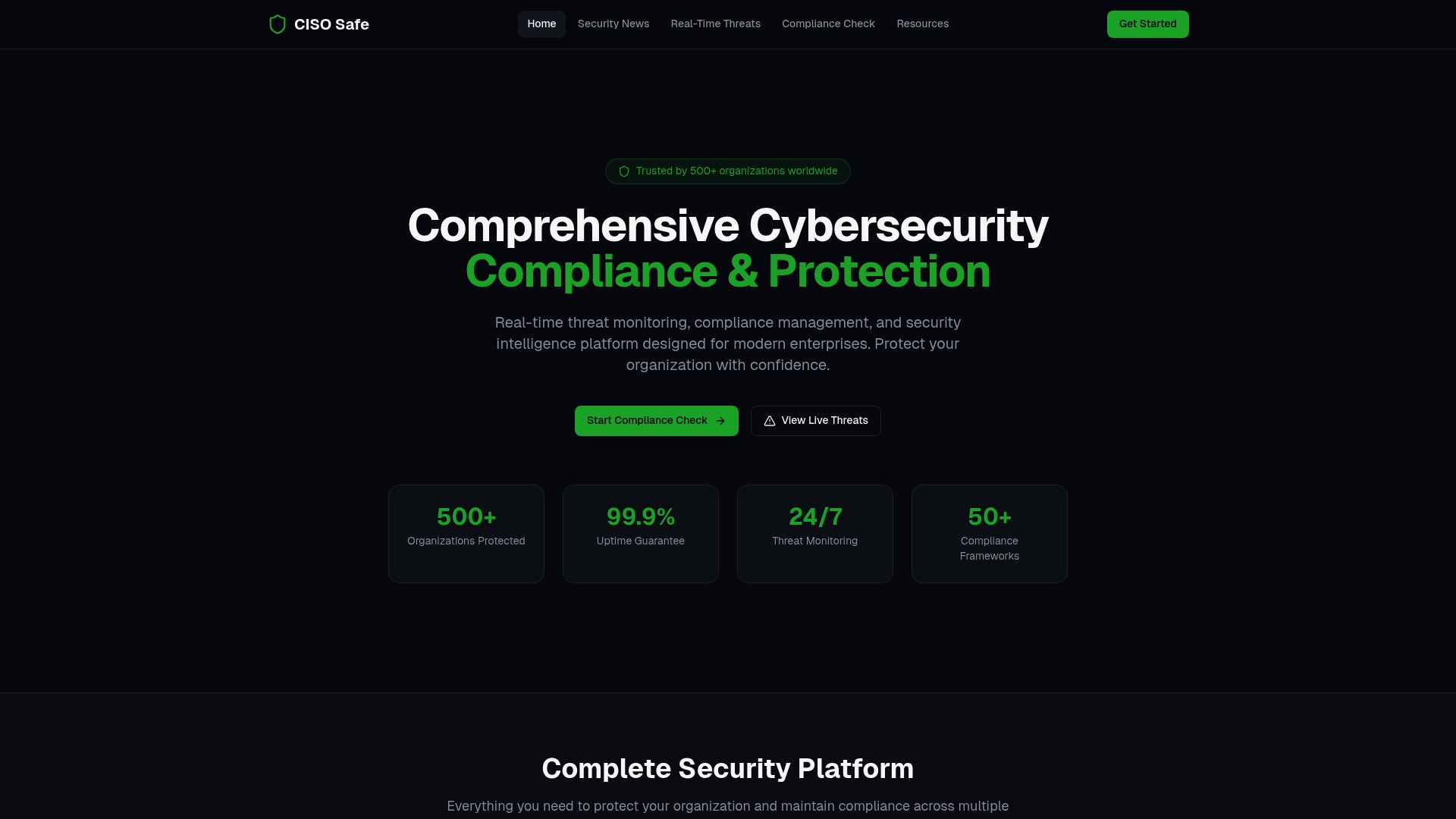
For organizations that need SOC 2, HIPAA, PCI DSS, or CMMC readiness without the cost of a full-time executive hire, CISO Safe's vCISO and compliance services are built to deliver that leadership at a lower cost than a full-time CISO or a traditional consultancy. Visit CISO Safe to review service scope and start a conversation.
Where to Go for Primary Guidance and Templates
For hands-on implementation, consult the NIST CSF 2.0 resource guide, the SEC's small-business compliance guide, and the CIS/NIST-aligned policy template guide for sample policies and role matrices.
Sources
- The NIST Cybersecurity Framework (CSF) 2.0
- NIST CSF 2.0: Resource & Overview Guide (NIST SP 1299)
- SEC final rule: Cybersecurity risk management, strategy, governance, and incident disclosure (2023)
- Policy template guide (CIS/NIST-aligned)
FAQ
What is the difference between a CISO and a vCISO?
A CISO is a full-time, in-house executive dedicated to one organization, while a vCISO delivers the same strategic leadership on a fractional or retainer basis, often serving multiple clients at once. The core responsibilities, strategy, risk management, and compliance oversight, are similar, but the vCISO model trades daily presence for lower cost and flexible scope.
What are the main responsibilities of a CISO?
A CISO owns security strategy, risk management, compliance readiness, policy governance, incident response leadership, third-party risk oversight, and board-level reporting. These responsibilities apply whether the role is filled full-time or through a vCISO arrangement.
How much does a vCISO cost?
Published pricing varies by scope, allocated hours, and regulatory complexity, and is generally available on request from providers rather than listed as a fixed rate. Our vCISO cost guide breaks down the pricing shapes and factors that most affect the final quote.
What is a typical CISO salary?
CISO salaries are not tracked as part of this article's sourced data, and figures vary widely by industry, company size, and region, so no single number applies broadly. Organizations comparing costs should weigh a full-time salary against the lower, scoped cost of a fractional vCISO retainer.
When should a company move from a vCISO to a full-time CISO?
Companies typically transition once headcount, regulatory complexity, or board expectations grow enough to justify a dedicated executive presence. A well-run vCISO engagement should include a transition plan with documented policies, an active risk register, and vendor relationships ready to hand off.