

For most mid-sized, regulated U.S. organizations, a fractional vCISO retainer runs at an operational engagement level in a range typical for mid-market retainers, with incident surge terms layered on top. That single model, a recurring retainer with defined incident coverage, delivers the best cost-to-outcome ratio for companies carrying SOC 2, HIPAA, CMMC, or PCI DSS obligations. According to BD Emerson's pricing analysis shows monthly retainers varying widely depending on days per month and scope, while project-scoped engagements have a broad price range.
Here is where the numbers land across all common engagement types:
- Hourly advisory engagements typically involve paid hourly rates for guidance
- Advisory retainers for limited monthly days are a common engagement
- Operational retainers involve more committed days with corresponding fees
- Embedded retainers reflect highest commitment and pricing in the market
- Project-scoped work varies substantially by scope and complexity
- Incident surge engagements are priced at a premium compared to standard hours
A fractional retainer is often more cost-effective than a full-time hire for mid-market firms, as it delivers senior-level security leadership at a significantly lower fully loaded annual cost compared to employing a full-time CISO when you factor in salary, benefits, recruiter fees, and ramp time.
Table of Contents
- How much does vCISO cost? A breakdown of pricing models
- What drives vCISO pricing up or down?
- What should you expect to pay by company size and industry?
- What do you actually get at each price point?
- How do you evaluate vCISO proposals and build a budget?
- How CisoSafe structures vCISO engagements for regulated mid-market clients
- Key Takeaways
- The real cost of buying hours instead of outcomes
- CisoSafe helps regulated firms get security leadership right
- Useful sources
How much does vCISO cost? A breakdown of pricing models
The vCISO market offers four primary engagement structures, and the one you choose will shape both your total spend and what you actually receive. Understanding each model before you issue an RFP prevents scope creep and budget surprises.
| Engagement Model | Typical U.S. Range | Best Fit |
|---|---|---|
| Hourly / advisory | — | One-off questions, board prep, short audits |
| Advisory retainer (1–2 days/month) | $3,000–$6,000/month | Early-stage firms needing governance direction |
| Operational retainer (4–6 days/month) | $8,000–$16,000/month | Mid-market firms with active compliance programs |
| Embedded retainer (8–12 days/month) | $15,000–$25,000+/month | Regulated industries with OT, M&A, or heavy audit loads |
| Project-scoped | $25,000–$75,000/project | SOC 2 readiness, CMMC gap, incident response plan |
| Hybrid (retainer + projects) | Retainer base + project add-ons | Firms needing both ongoing program and periodic deep work |
| Incident surge | — | Active breach, regulatory notification, crisis response |
SideChannel's pricing guide shows a broad range of mid-market retainers, aligning with other market data on monthly costs.
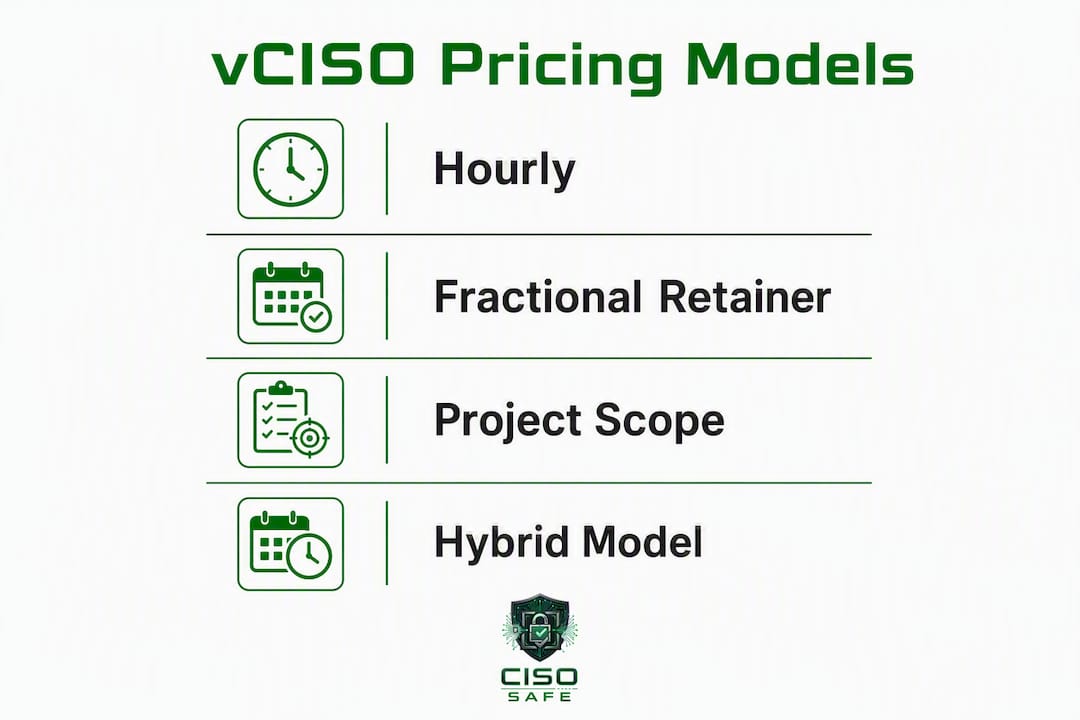
Hourly engagements work well for a law firm that needs a security expert to review a vendor contract or prepare a board presentation. The problem is unpredictability: hourly buckets without a cap can balloon fast when a compliance question turns into a two-week policy rewrite.
Fractional retainers are the workhorse model. A mid-sized healthcare vendor running a HIPAA compliance program with 4–6 days per month of vCISO support typically receives key program ownership and management within a predictable monthly fee. The retainer structure also means your vCISO is available for quick calls and email guidance without the clock running.

Project-scoped engagements suit firms with a defined, time-bounded need: a CMMC Level 2 gap assessment before a DoD contract bid, or a SOC 2 Type II readiness sprint ahead of a customer audit. These are clean to budget but leave a gap once the project closes unless a retainer follows.
Hybrid models are increasingly common for energy operators and mid-market SaaS companies. A base retainer of $8,000–$12,000/month covers ongoing program management, with project add-ons for penetration testing, third-party risk reviews, or M&A security due diligence billed separately.
What drives vCISO pricing up or down?
Price quotes for the same company can vary by 40–60% depending on how a vendor interprets scope. Knowing which variables move the needle lets you anticipate proposals and negotiate from a position of clarity.
Core cost drivers:
- Days per month committed: The single largest lever. Moving from 2 days to 6 days roughly doubles the retainer cost.
- Regulatory load: Carrying two or more frameworks simultaneously (HIPAA + SOC 2, or CMMC + PCI DSS) adds meaningful scope. Each framework requires its own controls mapping, evidence collection, and audit-readiness activity.
- Third-party ecosystem complexity: A firm with 50+ vendors in scope for a SOC 2 audit needs active vendor security review management, which adds hours every month.
- Cloud footprint and architecture: Multi-cloud environments with AWS, Azure, and GCP each require separate security configuration reviews. A single-cloud, well-documented environment costs less to manage.
- Incident coverage and SLA terms: A retainer that includes a named incident commander with a 2-hour response SLA carries a premium over one that simply offers "best efforts" support. Binding incident terms are worth paying for.
- Vendor experience and credentials: A vCISO with CISSP, CISM, or direct experience in your specific regulatory framework (CMMC Registered Practitioner, for example) commands higher day rates than a generalist.
- Bench depth: Firms with a team behind the named vCISO, covering OT security, cloud architecture, or legal/regulatory liaison, price higher but deliver more when complex issues arise.
How vendors build the quote: Most providers start with a blended day rate ($1,500–$3,000/day is common for experienced practitioners) and multiply by committed days per month. Incident surge rates are then priced separately, often at 1.5–2x the standard day rate, because they require immediate availability and displace other client work.
Pro Tip: Bundling recurring program work (risk register maintenance, vendor reviews, policy updates) into a retainer almost always costs less than buying those activities à la carte. The hidden cost of hourly engagements is coordination overhead: every call, email, and document review runs the clock. A retainer absorbs that friction.
What should you expect to pay by company size and industry?
Typical organizational profiles correspond to ranges of monthly vCISO spend with various common add-ons reflecting company size, compliance frameworks, and industry complexity. |

Law firms often underestimate their exposure. ABA Formal Opinion 477R makes clear that attorneys have an ethical duty to protect client data, and a breach affecting privileged communications carries reputational risk well beyond the regulatory fine. A mid-sized firm typically lands in the $5,000–$12,000/month range, with incident response planning as the most common add-on.
Healthcare vendors carrying both HIPAA and SOC 2 obligations face the highest baseline scope among non-OT clients. Dual-framework management, business associate agreement reviews, and breach notification planning push retainers toward the upper end of the $8,000–$16,000 band.
Energy and oilfield operators represent the most complex engagements. OT environments in oilfield operations introduce industrial control system security requirements that most generalist vCISOs cannot cover without specialist support. Expect embedded retainer pricing ($15,000–$25,000+/month) for any engagement that includes SCADA, DCS, or NERC CIP scope.
Outliers that push costs higher: Very cloud-intensive startups with microservices architectures, companies with large vendor ecosystems (100+ third parties), and organizations undergoing active M&A all require more hours per month than a standard retainer assumes. Budget for project add-ons in these cases rather than trying to absorb everything into a base retainer.
What do you actually get at each price point?
Price bands mean little without knowing what deliverables come with them. The matrix below maps common retainer tiers to representative outputs and measurable outcomes.
| Price Band | Representative Deliverables | Measurable Outcomes |
|---|---|---|
| $3,000–$6,000/month | Security policy review, risk register setup, quarterly security briefing, basic vendor questionnaire template | Documented risk register, board-ready quarterly report |
| $8,000–$12,000/month | Active risk register management, vendor security reviews (up to 10/month), incident response plan, compliance gap assessment, monthly security reporting | Audit-ready evidence folder, mapped controls for 1–2 frameworks |
| $12,000–$18,000/month | Full program ownership (policies, controls, vendor risk), penetration test coordination, security awareness training, audit liaison, named incident commander | SOC 2 / HIPAA readiness, incident response tested annually |
| $18,000–$25,000+/month | Embedded presence, OT/cloud security oversight, M&A security due diligence, regulatory liaison, board-level reporting, continuous monitoring oversight | Multi-framework certification support, real-time risk visibility |
A 3–6 month program at the $8,000–$12,000/month tier typically looks like this: Month 1 covers a baseline security assessment and gap analysis against your primary framework. Months 2–3 focus on policy development, controls implementation, and vendor risk program setup. Months 4–6 shift to evidence collection, audit preparation, and incident response tabletop exercises. By month 6, most mid-market firms have a documented, defensible security program.
Deliverables vendors sometimes omit that you should always require:
- A named incident commander with defined response SLAs (not just "available for incidents")
- Ownership of vendor security reviews, not just a template you run yourself
- Board-ready reports in plain language, not raw technical findings
- Knowledge transfer documentation so your internal team retains program context if the engagement ends
- Framework-specific evidence mapping tied to your actual audit requirements, not a generic controls list
Security framework mapping at the operational retainer tier should include explicit coverage of which NIST SP 800-53 controls, HIPAA safeguards, or PCI DSS requirements the vCISO owns versus which remain with your internal team.
How do you evaluate vCISO proposals and build a budget?
A well-structured evaluation process protects you from scope creep, hidden costs, and vendors who sell hours instead of outcomes. Work through the checklist below before signing any statement of work.
Must-ask questions for every vCISO proposal:
- What specific deliverables are committed each month, and how are they measured?
- Who is the named vCISO, and what is their availability if they leave the firm?
- What are the incident response terms: response time SLA, escalation path, and hourly rate during active incidents?
- Does the firm subcontract any work, and if so, to whom?
- What is the bench depth: who covers OT, cloud, legal/regulatory, and forensics if needed?
- Can you provide references from clients in our industry and regulatory environment?
- Who owns the work product (policies, risk register, documentation) at engagement end?
- How is knowledge transferred if we terminate or transition to a full-time hire?
Red flags in SOWs and pricing:
- Open-ended hourly buckets with no monthly cap or not-to-exceed clause
- No defined incident response terms or SLA language
- Vague deliverables ("security consulting" with no named outputs)
- A single named vCISO with no backup or bench
- No knowledge-transfer or IP-ownership clause
- Pricing that bundles everything into one line item with no scope breakdown
Breakeven example vs. a full-time CISO hire:
ZipRecruiter's salary data shows wide variation in virtual CISO compensation, but the fully loaded cost of a full-time CISO hire consistently exceeds the base salary figure. Add employer-side payroll taxes, benefits, 401(k) match, recruiter fees (typically 20–25% of first-year salary), a 60–90 day ramp period, and the ongoing cost of keeping a single person current across all relevant frameworks, and the true annual cost of a full-time CISO for a mid-market firm lands well above $350,000. A fractional retainer at $12,000/month runs $144,000 annually, covers a team with multiple specializations, and carries no vacancy or recruiter risk. The Cloud Security Alliance frames this clearly: organizations that do not need or cannot yet justify a full-time CISO get the same strategic coordination, risk management, and incident response leadership through a fractional engagement at a fraction of the cost.
How CisoSafe structures vCISO engagements for regulated mid-market clients
CisoSafe combines a fractional vCISO retainer with an AI-powered compliance platform, delivering security program management, automated penetration testing, compliance intake, and audit-ready reporting as a bundled engagement. The model is built for regulated mid-market organizations in legal, energy, healthcare, and financial services that need enterprise-grade security leadership without the overhead of a full internal security team.
CisoSafe's three engagement tiers map directly to the retainer bands above:
- Advisory (1–2 days/month, $3,000–$6,000/month): Governance direction, quarterly security briefings, policy review, and access to the compliance platform for self-service framework tracking. Best for early-stage firms establishing their first security program.
- Operational (4–6 days/month, $8,000–$16,000/month): Active risk register ownership, vendor security reviews, incident response plan development, compliance gap assessments across SOC 2, HIPAA, PCI DSS, or CMMC, and monthly board-ready reporting. This tier covers the full program management cycle for most mid-market regulated firms.
- Embedded (8–12 days/month, $15,000–$25,000+/month): Full security program ownership including OT security oversight, M&A due diligence support, regulatory liaison, continuous monitoring via the SaaS platform, and a named incident commander with defined SLAs. Designed for energy operators, healthcare systems, and firms with complex third-party or multi-framework obligations.
What adds 20–50% to a CisoSafe proposal:
- Deep OT or industrial control system security work (SCADA, DCS, NERC CIP)
- Continuous monitoring with real-time alerting and monthly threat intelligence briefings
- Accelerated audit timelines requiring compressed evidence collection sprints
- Large vendor ecosystems (50+ third parties requiring active security reviews)
- Additional SLA tiers for incident response (sub-1-hour escalation vs. standard 4-hour)
CisoSafe bundles these efficiently through its platform: automated penetration testing, compliance intake, and professional reporting reduce the manual hours required for evidence collection and audit preparation, which keeps the overall engagement cost lower than a purely consulting-based model at the same scope. For energy and oilfield clients, CisoSafe's OT-specific engagement framework addresses the industrial control system requirements that push generalist vCISO engagements to their limits.
Key Takeaways
A fractional vCISO retainer at the operational tier generally offers a strong cost-to-outcome value for many mid-sized, regulated U.S. organizations, providing comprehensive security program management at significantly less than the fully loaded cost of a full-time CISO hire.
| Point | Details |
|---|---|
| Core monthly range | Most mid-market regulated firms budget $8,000–$16,000/month for an operational retainer covering active program management. |
| Full-time CISO comparison | A fractional retainer at a common market rate typically costs substantially less than the fully loaded annual cost of a full-time CISO hire. |
| Key cost drivers | Days per month, regulatory framework count, OT scope, and incident SLA terms are the primary variables that move a quote up or down. |
| Deliverables to require | Always confirm a named incident commander, board-ready reports, vendor review ownership, and knowledge-transfer documentation before signing. |
| CisoSafe option | CisoSafe's bundled retainer and compliance platform covers advisory through embedded tiers ($3,000–$25,000+/month) for regulated mid-market clients across the U.S. |
The real cost of buying hours instead of outcomes
The conventional wisdom in vCISO procurement is to compare hourly rates and pick the lowest one. That framing gets organizations into trouble consistently, and the pattern is worth naming directly.
A vCISO engagement priced at $175/hour sounds cheaper than a $10,000/month retainer until you realize that a single incident response event, a SOC 2 audit preparation sprint, or a board presentation cycle can consume 60–80 hours in a month. The hourly model also creates a perverse incentive: the vendor earns more when problems are complex and time-consuming, not when your security program runs efficiently.
The better frame is outcomes per dollar. What does your organization need to be able to demonstrate at the end of a 12-month engagement? A defensible risk register, audit-ready evidence for your primary framework, a tested incident response plan, and a board that understands your risk posture. A retainer-based engagement with defined deliverables is the only structure that holds a vendor accountable to those outcomes.
There is also a procurement mistake that shows up repeatedly in mid-market engagements: organizations sign a retainer without incident response terms, then discover during an actual breach that their vCISO's availability is "best efforts" and surge rates are uncapped. Binding incident terms, a defined escalation path, and a not-to-exceed clause for surge hours are not negotiating extras. They are table stakes.
One more observation worth making: the firms that get the best ROI from fractional vCISO engagements treat the relationship as a quarterly-driven security program, not a reactive resource. Quarterly planning cycles, defined milestones, and regular board reporting create accountability on both sides. Organizations that call their vCISO only when something breaks pay more per outcome and build less durable security programs.
The sign that you have outgrown a fractional model is not the cost. It is when your vCISO is consistently at capacity, when you need daily security decisions made by someone with organizational authority, or when a regulatory body expects a named, full-time security officer. At that point, the transition from embedded retainer to a full-time hire makes sense, and a well-structured engagement will have built the documentation and program maturity to make that hire productive from day one.
CisoSafe helps regulated firms get security leadership right
Mid-market organizations in legal, energy, and healthcare face a specific problem: they carry enterprise-level compliance obligations but cannot justify the cost or risk of a full-time CISO hire. CisoSafe is built for exactly that gap. The combination of a fractional vCISO retainer and an AI-powered compliance platform means your organization gets active security program management, automated penetration testing, and audit-ready reporting at a cost that fits a mid-market budget.
Where most vCISO engagements deliver a named consultant and a monthly report, CisoSafe delivers a complete security operating model: risk assessments, policy ownership, vendor security reviews, incident response planning, and real-time compliance tracking across SOC 2, HIPAA, PCI DSS, CMMC, and 50+ additional frameworks. Engagements start with a scoping assessment that maps your regulatory obligations, current security posture, and the right retainer tier for your organization's size and risk profile.
The next step is straightforward: schedule a scoping assessment with CisoSafe to receive a scope-to-price recommendation tailored to your industry, framework obligations, and team structure. No open-ended hourly commitments, no vague deliverables. Just a clear engagement model with defined outcomes.
Useful sources
The following references support the pricing ranges, framework guidance, and engagement model analysis in this article. Consult vendor statements of work for exact quotes specific to your scope.
- How Much Does a vCISO Cost in 2026? (BD Emerson) — Primary source for U.S. monthly retainer bands, day-rate examples, and project pricing ranges used throughout this article.
- vCISO Pricing in 2026: What You'll Actually Pay (SideChannel) — Market summary supporting mid-market monthly ranges of $3,000–$20,000.
- What Are the Benefits of Hiring a vCISO? (Cloud Security Alliance) — Authoritative framing of the vCISO role and the strategic benefits that justify fractional engagements over full-time hires.
- Virtual CISO Salary Data (ZipRecruiter) — Salary aggregator data used for the full-time CISO breakeven comparison.
- NIST SP 800-53 Rev. 5 (NIST CSRC) — The foundational U.S. federal security controls framework referenced in deliverables mapping and framework scope discussions.
- CisoSafe: Virtual CISO and Cybersecurity Compliance Services — CisoSafe's primary platform and service description, covering retainer tiers, compliance frameworks, and the AI-powered SaaS portal.
- What Is a Virtual CISO? A Guide for Mid-Sized Companies (CisoSafe) — CisoSafe's operational guidance on vCISO roles and scope for mid-sized organizations.
- vCISO Services for Oilfield Operations: 2026 Guide (CisoSafe) — Sector-specific guidance on OT security scope and why energy clients typically land at higher retainer tiers.
- Security Frameworks for SMB Firms: A Practical Guide (CisoSafe) — Framework-to-scope mapping showing which control activities are typical at different retainer levels.
This article provides general pricing and procurement guidance for informational purposes. Actual vCISO fees vary by vendor, scope, and market conditions. Consult qualified cybersecurity professionals and review vendor statements of work before making procurement decisions.