

Security frameworks give SMBs a repeatable, risk-focused operating model for managing cyber threats, meeting compliance expectations, and demonstrating trust to customers and insurers. This guide covers the core functions every small team should understand, how to choose among NIST CSF, CIS Controls, ISO 27001, SOC 2, PCI DSS, and HIPAA, a pragmatic adoption roadmap, and a practical outsourcing path that fits resource-constrained organizations.
Table of Contents
- What security frameworks actually do for your business
- Why adopting a framework pays off for SMBs
- Which framework fits your SMB's situation?
- A step-by-step adoption roadmap for resource-constrained SMBs
- Common mistakes SMBs make when implementing frameworks
- How outsourced vCISO services and automation accelerate framework adoption
- Key Takeaways
- The vCISO perspective on what actually moves the needle
- CisoSafe helps SMBs build and maintain a security framework program
- Sources and further reading
What security frameworks actually do for your business
A security framework is a structured set of standards, policies, and controls that converts ad hoc security activity into a measurable operating model. Instead of reacting to incidents one at a time, your team works from a defined set of priorities tied directly to business risk. The NIST CSF 2.0 organizes that model around six core functions, each one answering a specific operational question for a small team:
- Govern: Define who owns cybersecurity decisions and what your risk tolerance is. For an SMB, this means a written policy and a named owner, even if that person wears multiple hats.
- Identify: Catalog the assets, data, and systems your business depends on. A spreadsheet of devices, cloud accounts, and sensitive data files is a legitimate starting point.
- Protect: Apply safeguards that reduce the likelihood of a breach. Multi-factor authentication (MFA), patching, and least-privilege access are the highest-return controls for most small teams.
- Detect: Put logging and alerting in place so you know when something goes wrong. Basic endpoint detection or cloud-native logging covers most SMB environments.
- Respond: Document what your team does when an incident occurs. A one-page incident response plan beats no plan every time.
- Recover: Define how you restore operations after a disruption. Tested backups and a recovery time objective are the minimum.
The distinction between a framework and a security strategy matters. A framework is the scaffolding, the structure that organizes your controls and policies. Your strategy is the outcome you are working toward: reduced business risk, regulatory compliance, and operational continuity. Confusing the two is where most SMBs go wrong. As Google Cloud's guidance puts it, the framework is a tool for stopping attackers and reducing business risk, not the goal itself.
Pro Tip: Use the six functions as conversation starters with your leadership team, not as a compliance checklist. Ask "What would a breach in this area cost us?" for each function. That question converts abstract controls into business-priority decisions.
Why adopting a framework pays off for SMBs
Frameworks convert fragmented tools and ad hoc processes into measurable governance that reduces business risk and supports growth. Palo Alto Networks describes this shift precisely: frameworks provide standards, policies, and best practices that make security measurable and defensible to insurers and regulators. For an SMB owner, that defensibility has direct financial value.
The concrete business outcomes of framework adoption include:
- Cyber insurance: Insurers increasingly require documented controls before issuing or renewing policies. A framework gives you the evidence trail they ask for.
- Compliance readiness: Regulated industries face fines and contract losses when controls are undocumented. A framework maps your controls to regulatory requirements before an audit arrives.
- Customer and vendor trust: Enterprise buyers and government contractors routinely ask for security attestations. A documented program answers those requests without a scramble.
- Operational resilience: Defined incident response and recovery procedures reduce downtime costs when something goes wrong.
- Budget prioritization: A risk-ranked control list tells you where to spend first, which prevents over-investing in low-risk areas while leaving critical gaps open.
According to the U.S. Small Business Administration, small businesses can use free government tools including the Cyber Resilience Review (CRR) and the Small Biz Cyber Planner to begin building a documented security program at minimal cost.
Consider a practical example: an SMB that suffers a ransomware incident without documented controls may face an insurance coverage denial on the grounds that reasonable security practices were not in place. A firm with a framework-aligned program, written policies, and evidence of regular patching is in a fundamentally different position with the same insurer. The documentation is the defense.
Which framework fits your SMB's situation?
Different frameworks serve different jobs. The right choice depends on your industry, the data you handle, and whether you need a risk-management baseline, a technical control set, or a formal certification. Cybersecurity frameworks are most effective when selected by purpose and maturity, not by popularity.
| Framework | Scope | Complexity | Compliance fit | Cost/staffing | Maturity required |
|---|---|---|---|---|---|
| NIST CSF 2.0 | Risk management and governance | Low to moderate | Broad; maps to most regulations | Low; no certification fee | Any level |
| CIS Controls | Technical control baseline | Low | Strong for general IT hygiene | Low; free resources | Beginner to intermediate |
| ISO 27001 | Organizational information security management | High | Strong for international/enterprise contracts | Moderate to high; audit fees required | Intermediate to advanced |
| SOC 2 | Service organization trust criteria | High | Strong for SaaS and service providers | Moderate to high; auditor fees | Intermediate |
| PCI DSS | Payment card data security | Moderate to high | Required for card processing | Varies by merchant level | Any; required by contract |
| HIPAA | Protected health information | Moderate | Required for healthcare and business associates | Low to moderate; no certification | Any; required by law |
When to favor each framework:
- NIST CSF 2.0: The right starting point for any SMB building a risk-driven program from scratch. It is voluntary, flexible, and scalable, which makes it practical for teams with limited security staff.
- CIS Controls: Best for SMBs that need a fast, technical baseline. Implementation Group 1 (IG1) covers the 56 safeguards most relevant to small organizations and can be completed without a dedicated security team.
- ISO 27001: Pursue this when enterprise customers or international partners require a formal certification. The documentation burden is significant, so it suits firms with at least one dedicated compliance resource.
- SOC 2: The standard expectation for SaaS companies and managed service providers selling to mid-market or enterprise buyers. A Type II report demonstrates sustained controls over time.
- PCI DSS: Non-negotiable if you store, process, or transmit payment card data. Scope reduction through tokenization or a payment processor that handles card data on your behalf can dramatically lower your compliance burden.
- HIPAA: Required for healthcare providers, health plans, and their business associates. There is no formal certification, but documented policies, risk assessments, and workforce training are auditable requirements.
For a startup with minimal IT infrastructure, start with NIST CSF 2.0 and CIS IG1 simultaneously. For a regulated firm in healthcare or finance, layer the applicable regulatory framework (HIPAA or PCI DSS) on top of a NIST CSF baseline. For a technology vendor seeking enterprise contracts, SOC 2 is typically the first certification customers will ask for.
A step-by-step adoption roadmap for resource-constrained SMBs
This is a low-friction, prioritized roadmap designed for SMBs that cannot dedicate a full-time security team to framework implementation. Each step builds on the last, and the timeline is realistic for a firm with one part-time owner and a small IT vendor relationship.

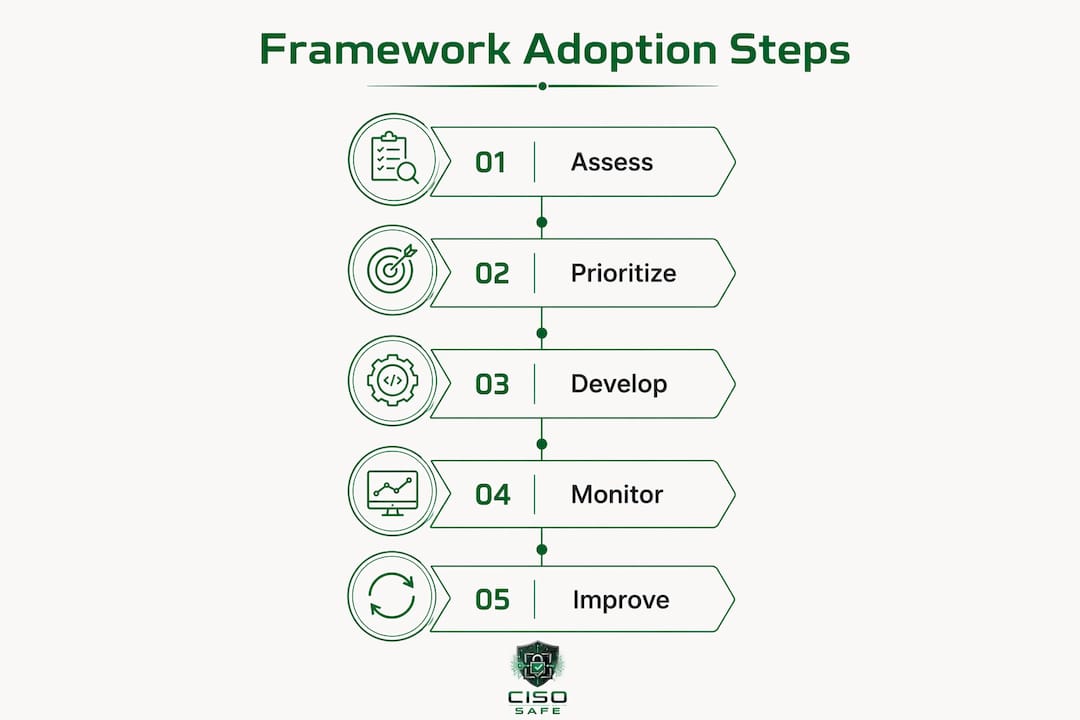
Step 1: Assess (Days 1–30)
Run a basic risk inventory before buying any tools. Use the SBA's Cyber Planner and the CISA Cyber Resilience Review to identify your most critical assets and your most obvious gaps. Map every device, cloud account, and data type your business depends on. This does not need to be sophisticated. A spreadsheet with asset names, owners, and data sensitivity levels is enough to start.
Step 2: Prioritize (Days 30–60)
Map your gaps to business impact. Focus on the controls that reduce the most risk first. CIS Controls IG1 is a proven shortlist: 56 safeguards that address the highest-frequency attack vectors for small organizations. Rank your gaps by likelihood and financial impact, not by how easy they are to fix.
Step 3: Implement (Days 60–120)
Execute the highest-priority controls first. For most SMBs, that means:
- MFA on all accounts, starting with email and cloud services
- Automated patching for operating systems and third-party software
- Encrypted, tested backups stored off-site or in a separate cloud account
- Least-privilege access: no one has admin rights they do not actively need
- Basic endpoint protection on every device that touches business data
CISA recommends assigning a Security Program Manager, even if that role is part-time, to coordinate these efforts across leadership and IT.
Step 4: Monitor (Days 120–180)
Set up logging and a basic alerting cadence. Cloud-native logging in Microsoft 365 or Google Workspace is free and captures most of what a small team needs. Schedule a monthly review of alerts and a quarterly executive summary that tracks open risks against closed ones.

Step 5: Improve (Ongoing)
Run a tabletop exercise at least once a year. Test your backups quarterly. Revisit your risk inventory when you add a new vendor, move to a new cloud service, or hire significantly. Frameworks are living programs, not one-time projects.
Primary cost drivers: external assessment fees, staff time for documentation and training, remediation tools (endpoint protection, backup software), and optional third-party testing.
Pro Tip: Migrating critical services to a reputable cloud provider often reduces your patching and monitoring burden more than any single security tool. CISA's guidance explicitly recommends considering cloud migration as a cost-effective way to reduce on-premises maintenance risk.
Common mistakes SMBs make when implementing frameworks
The most common mistake is treating a framework as a compliance checklist rather than a risk-management tool. An SMB that completes every line item in a framework audit without understanding why those controls exist is not more secure. It is just more documented. Academic research on SME framework adoption confirms that one-size-fits-all approaches raise costs and reduce effectiveness without tailoring to the organization's actual risk profile.
Common pitfalls to avoid:
- Checkbox compliance: Marking controls complete without testing whether they actually work. A backup policy that has never been restored is not a control.
- Overprotecting low-value assets: Spending significant resources securing data that would cause minimal harm if compromised, while leaving customer records or financial systems underprotected.
- Underinvesting in detection: Most SMBs spend on prevention but skip logging and alerting. You cannot respond to an incident you do not know about.
- Skipping tabletop exercises: A written incident response plan that has never been practiced will fail under pressure. Annual tabletops are low-cost and high-value.
- Mis-scoped third-party risk: Vendors and cloud providers that touch your data are part of your risk surface. Frameworks require you to assess them, not just your internal systems.
What to avoid during implementation: do not purchase expensive security tools before you have scoped your environment. Do not attempt to implement every control in a framework simultaneously. Both approaches waste budget and create implementation fatigue that stalls programs entirely.
Pro Tip: Calibrate effort to business value. If a control costs more to implement than the asset it protects is worth, deprioritize it. When the program grows beyond what internal staff can manage, a part-time outsourced vCISO or managed IT support relationship is often more cost-effective than hiring a full-time security employee.
How outsourced vCISO services and automation accelerate framework adoption
Outsourcing a vCISO combined with targeted automation is often the fastest, most cost-effective path for SMBs to operationalize a security framework. A vCISO provides the strategic layer: risk prioritization, vendor oversight, policy development, and board-level reporting. Automation handles the recurring operational burden: evidence collection, scheduled vulnerability scans, and compliance reporting that would otherwise consume staff hours every week.
What a vCISO does for an SMB in practice:
- Translates framework requirements into a prioritized, business-specific roadmap
- Manages vendor and third-party risk assessments on your behalf
- Prepares documentation and evidence packages for customer audits or regulatory reviews
- Provides executive-level reporting that gives leadership clear visibility into risk posture without requiring technical expertise
Automation reduces the gap between strategy and execution. Instead of manually gathering screenshots and policy documents for a SOC 2 audit, an automated compliance platform collects evidence continuously and generates audit-ready reports on demand. For law firms and other regulated SMBs, that capability directly reduces the cost and disruption of annual compliance reviews.
Expected outcomes from a vCISO plus automation model:
- Faster time to compliance baseline, typically measured in weeks rather than months for initial controls
- Predictable monthly cost versus the variable expense of incident-driven remediation
- Measurable reporting that tracks risk reduction over time
- Fewer incidents resulting from unpatched systems or misconfigured cloud services
- Audit-ready evidence packages that satisfy customer and regulatory requests without emergency effort
When to seek a consultation: if your firm handles regulated data (health records, payment cards, legal files), has received a customer security questionnaire you cannot answer, or is approaching a renewal of cyber insurance, those are the right triggers for an initial assessment.
Pro Tip: When evaluating an outsourced security partner, prioritize industry experience and automation capabilities over headcount. A vCISO who has worked with firms in your sector already understands your regulatory exposure and can skip the learning curve that a generalist firm would need.
Key Takeaways
Security frameworks give SMBs a structured, risk-based operating model that converts fragmented tools and policies into measurable governance, compliance readiness, and demonstrable customer trust.
| Point | Details |
|---|---|
| Start with NIST CSF or CIS Controls | Both are free, scalable, and designed for organizations at any maturity level. |
| Match the framework to your regulatory exposure | HIPAA, PCI DSS, and SOC 2 are required or expected in specific industries, not optional enhancements. |
| Prioritize the 30-day quick wins | MFA, tested backups, and patching address the majority of common attack vectors immediately. |
| Avoid the checklist trap | Frameworks are decision-making tools for managing business risk, not pass/fail audits to complete once. |
| CisoSafe accelerates the process | CisoSafe's vCISO services and compliance automation reduce time-to-baseline and produce audit-ready evidence without adding internal headcount. |
Starter plan examples include enabling MFA on all accounts, verifying backups are encrypted and tested, assigning a named security owner; establishing a patching cadence, deploying basic endpoint logging, completing a gap assessment against CIS IG1 or NIST CSF; completing a risk-prioritized roadmap, running a tabletop exercise, and evaluating whether a vCISO or managed service fits your growth trajectory over time.
Frameworks are tools that support risk-based decisions. They are not the destination.
The vCISO perspective on what actually moves the needle
The first 90 days with a new SMB client follow a consistent pattern. The top three priorities are always the same: close the authentication gap (MFA everywhere, no exceptions), establish a tested backup and recovery process, and document who owns what. Everything else is secondary until those three are in place. Not because the other controls do not matter, but because those three address the attack vectors that cause the most business damage for small organizations.
Success in a framework program is measured by reduction in high-risk exposures, not by the number of policies written. A client who starts with 14 critical gaps and closes 11 of them in six months has made real progress. A client who has written 40 policies but tested none of them has not. The documentation matters, but only when it reflects what the organization actually does. Audit readiness follows from operational discipline, not the other way around.
CisoSafe helps SMBs build and maintain a security framework program
For SMBs that need enterprise-grade security expertise without the cost of a full-time CISO, CisoSafe delivers exactly that. CisoSafe is a Houston-based vCISO firm and AI-powered compliance platform built for regulated, high-stakes industries, including law firms, energy operators, and healthcare-adjacent businesses across the United States.
The practical difference: CisoSafe combines hands-on strategic advisory with automated evidence collection, penetration testing, and compliance reporting, so your team gets a complete framework program without hiring additional staff. Whether you are working toward SOC 2, HIPAA, PCI DSS, or a NIST CSF baseline, CisoSafe builds the roadmap, manages the evidence, and prepares you for customer and regulatory audits. For SMBs that have received a security questionnaire they cannot answer or are approaching a cyber insurance renewal, a security assessment is the right first step. Request your assessment at cisosafe.com and get a clear picture of where your program stands.
Sources and further reading
The following primary references informed this article and provide authoritative guidance for SMBs building or maturing a security framework program.
- NIST Cybersecurity Framework 2.0 (CSF 2.0): The foundational framework document; covers all six functions and organizational profile methodology.
- NIST SMB Quick Start Guide for CSF 2.0: A one-page-per-function guide designed specifically for small and medium-sized businesses beginning their cybersecurity program.
- NIST IR 7621 Rev. 2 (Initial Public Draft): Tailored guidance for non-employer firms and solopreneurs using CSF 2.0 to build a foundational security program.
- CISA Cyber Guidance for Small Businesses: Role-based action guidance covering MFA, patching, cloud migration, and program management for small organizations.
- SBA Strengthen Your Cybersecurity: Practical starting tools including the Cyber Resilience Review and Small Biz Cyber Planner, available at no cost.
- FTC Cybersecurity for Small Businesses: Plain-language guidance on security basics and the NIST CSF functions for non-technical business owners.
- FCC Cybersecurity for Small Businesses: Covers foundational controls including firewalls, backups, access controls, and payment security practices.
- Palo Alto Networks: What Is a Security Framework?: Clear explanation of how frameworks convert fragmented tools into a governance model defensible to insurers and regulators.
- Google Cloud: Why Leaders Should Avoid Security Framework Traps: Authoritative caution against treating frameworks as goals rather than tools for reducing business risk.
- MDPI: Risk-Management Framework and Information-Security Systems for SMEs: Peer-reviewed meta-analysis on why established frameworks require adaptation for SMEs to avoid cost overruns and misapplied controls.