

Legal industry cybersecurity frameworks are structured sets of standards and controls that law firms use to protect client data and meet regulatory obligations. The four frameworks that define this space are the NIST Cybersecurity Framework, ISO/IEC 27001, SOC 2, and the ABA Model Rules. Phishing and ransomware are the leading cyber threats against law firms, and only 60% of firms have formal cybersecurity policies in place. That gap creates direct professional liability. For compliance officers and firm leadership, choosing and implementing the right framework is not optional. It is a professional duty.
What are the primary legal industry cybersecurity frameworks for law firms?
The core frameworks for law firms are the NIST Cybersecurity Framework, ISO/IEC 27001, SOC 2, and the ABA ethical standards. Each differs in scope, certification requirements, and regulatory alignment. Understanding those differences is the first step toward selecting the right one for your firm.
NIST Cybersecurity Framework
The NIST Cybersecurity Framework (NIST CSF) organizes security activities into five functions: Identify, Protect, Detect, Respond, and Recover. Regulators and auditors widely use NIST CSF as the baseline for security assessments across industries, including legal. It does not require formal certification, which makes it accessible for firms of any size. Law firms use NIST CSF to build risk management programs and demonstrate due diligence to clients and regulators.

ISO/IEC 27001
ISO/IEC 27001 is an international standard for information security management systems. It requires formal certification through an accredited third-party auditor. The certification process involves a documented risk assessment, a statement of applicability, and an ongoing audit cycle. Large law firms and those serving multinational clients often pursue ISO/IEC 27001 to signal a high level of security maturity.
SOC 2
SOC 2 is an audit framework developed by the American Institute of Certified Public Accountants (AICPA). It evaluates controls across five Trust Service Criteria: security, availability, processing integrity, confidentiality, and privacy. Law firms that handle client data on cloud platforms or provide legal technology services frequently face client demands for a SOC 2 compliance report. A Type II report, which covers a period of six to twelve months, carries the most weight in client due diligence reviews.
ABA Model Rules
The ABA Model Rules of Professional Conduct are not a technical framework, but they set the ethical floor for cybersecurity in legal practice. Model Rule 1.1 requires competence, which includes technology competence. Model Rule 1.6(c) requires reasonable efforts to prevent unauthorized disclosure of client information. These rules translate directly into technical controls: encryption, access management, and incident response planning.
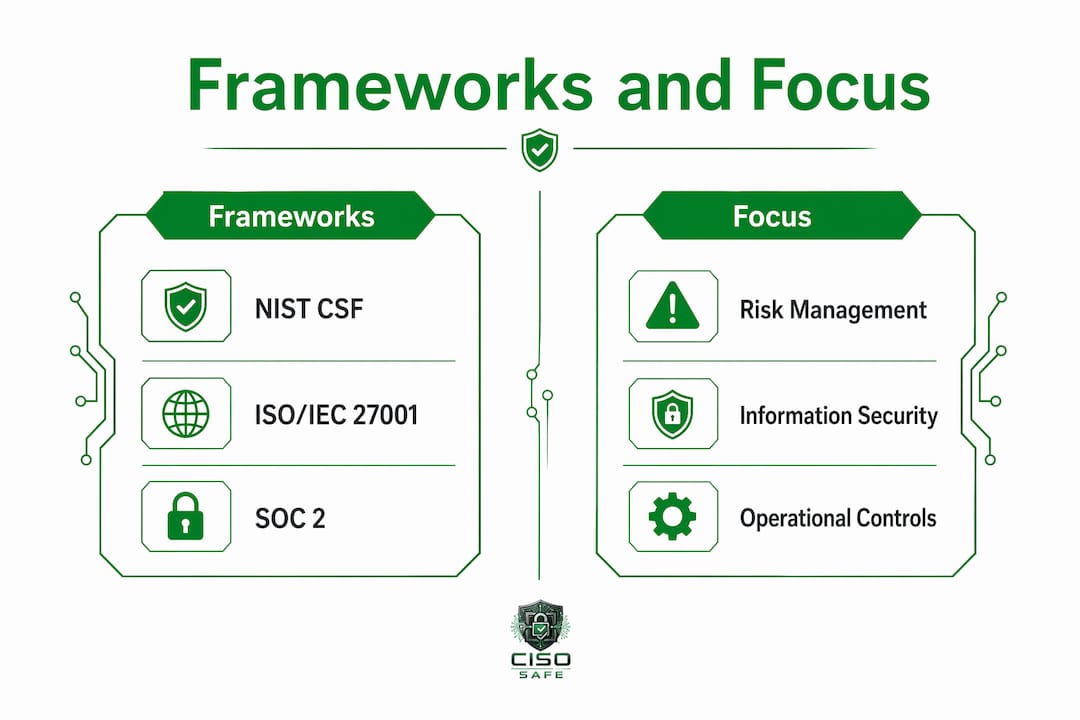
| Framework | Certification required | Primary focus | Best suited for |
|---|---|---|---|
| NIST CSF | No | Risk management | All firm sizes |
| ISO/IEC 27001 | Yes | Information security management | Large or multinational firms |
| SOC 2 | Yes (audit report) | Trust and data controls | Firms with cloud or tech services |
| ABA Model Rules | No | Ethical and professional duty | All U.S. law firms |
How do regulatory and ethical obligations shape framework adoption?
Regulatory and ethical mandates directly determine which controls a law firm must implement, regardless of which framework it selects. As of 2026, 40 states have adopted ABA Model Rule 1.1 Comment 18, which requires attorneys to make reasonable efforts to protect client data. That adoption rate means most U.S. attorneys are already under a formal technology competence obligation.
The specific controls that satisfy these obligations include:
- Multi-factor authentication (MFA): MFA blocks 99.9% of credential theft attacks and is explicitly referenced in state bar guidance as a baseline control.
- Email encryption: ABA Formal Opinion 477R requires encryption for sensitive communications involving social security numbers, trade secrets, or privileged legal strategy. TLS transport encryption and secure client portals are the minimum standard.
- Incident response plans: Firms must have a documented plan for detecting, containing, and reporting breaches. ABA Formal Opinion 483 addresses post-breach obligations to clients.
- Written Information Security Policies (WISP): State bars and frameworks alike require documented policies that govern data handling, access, and acceptable use.
Firms handling health information also fall under HIPAA. Those serving California residents must address CCPA requirements. Firms with European clients face GDPR obligations. Each of these regulations maps to controls already present in NIST CSF and ISO/IEC 27001, which is why adopting a recognized framework simplifies multi-regulation compliance.
Pro Tip: Review your state bar's cybersecurity ethics opinions annually. Several states, including New York, California, and Florida, have issued guidance that goes beyond the ABA baseline and specifies controls by name.
What are best practices for implementing cybersecurity frameworks in law firms?
Implementation is where most firms stall. A framework on paper does nothing. The following steps translate framework requirements into operating practice.
-
Conduct a baseline risk assessment. Identify every system that stores or transmits client data. Map the data flows. A cybersecurity maturity assessment gives you a scored baseline and identifies the highest-priority gaps before you spend a dollar on controls.
-
Draft and adopt a Written Information Security Policy. The WISP is the foundation of legal compliance cybersecurity. It defines who can access what data, how devices are managed, and what happens when a breach occurs. A 90-day implementation roadmap that begins with the WISP and incident response plan is the standard approach for meeting professional standards efficiently.
-
Deploy MFA across all firm systems. This includes email, practice management software, document management systems, and remote access tools. MFA is the single highest-return control available to law firms. Configure it actively. Cloud providers secure their infrastructure, but MFA configuration remains the firm's responsibility.
-
Implement Endpoint Detection and Response (EDR) software. Traditional antivirus does not detect behavioral threats. EDR software monitors devices in real time, isolates compromised endpoints, and speeds breach containment. Every device that accesses firm data requires EDR coverage.
-
Test encrypted backups quarterly. Backing up data is not enough. Untested backups provide false confidence against ransomware. Quarterly restore tests confirm that backups are complete, isolated, and recoverable.
-
Manage nonlawyer staff access formally. Nonlawyer staff represent the highest insider security risk in most firms. Written data handling agreements, role-based access controls, and regular access reviews are required under ABA compliance standards.
-
Assess vendor risk before granting data access. Every vendor with access to client data extends your attack surface. A vendor risk management checklist should cover data handling practices, breach notification terms, and security certifications before any contract is signed.
Pro Tip: Integrate security policies into the tools your staff already uses. A mandatory MFA prompt inside your practice management system gets more consistent compliance than a 40-page policy document that staff read once during onboarding.
What challenges and misconceptions do law firms face with cybersecurity compliance?
The most damaging misconceptions in legal data security are the ones that feel reasonable on the surface.
Misconception 1: Small firms have lighter compliance obligations. ABA Model Rule 1.6(c) applies the same reasonableness standard to a solo practitioner as to a 500-attorney firm. Compliance is determined by data sensitivity, not firm size or revenue. A solo family law attorney handling custody disputes and financial records carries the same duty to protect client communications as any large firm.
Misconception 2: Cloud providers handle security for you. Cloud legal software vendors secure their infrastructure. They do not configure your MFA settings, manage your user access lists, or test your backups. Those responsibilities stay with the firm. Firms that assume otherwise leave critical gaps in their legal industry data security posture.
Misconception 3: Backing up data is the same as protecting it. Untested backups are a liability, not an asset. Ransomware frequently targets backup systems first. Quarterly testing of encrypted, isolated backups is the only way to confirm recoverability.
"The question is not whether your firm will face a cyber incident. The question is whether your firm will be able to respond, recover, and demonstrate that it met its duty of care when it does."
Misconception 4: Cybersecurity frameworks are too complex for smaller legal teams. NIST CSF is designed to scale. A small firm does not need to implement every control at once. A risk-tiered approach, starting with the highest-sensitivity data and highest-probability threats, makes framework adoption practical for teams without dedicated IT staff.
Key takeaways
Law firms that align their security controls with recognized frameworks and ABA ethical standards meet both their professional duty and their clients' expectations for data protection.
| Point | Details |
|---|---|
| Framework selection matters | NIST CSF suits all firm sizes; ISO/IEC 27001 and SOC 2 serve firms with audit or client demands. |
| ABA rules set the ethical floor | Model Rules 1.1 and 1.6(c) require active security controls, not just written policies. |
| MFA is non-negotiable | Multi-factor authentication blocks the majority of credential attacks and is a baseline bar requirement. |
| Backup testing is required | Quarterly restore tests confirm recoverability and satisfy professional standards for ransomware defense. |
| Compliance scales by data, not firm size | Solo practitioners carry the same duty to protect sensitive client data as large firms. |
What I have learned from working with law firms on cybersecurity
Law firms are not short on policies. They are short on policies that people actually follow. The firms I have seen handle incidents well share one trait: their security controls are built into daily workflows, not stored in a compliance binder. When MFA is mandatory at login, staff do not debate it. When the incident response plan is rehearsed twice a year, attorneys know what to do when a phishing email lands.
The other pattern I have observed is that firms consistently underestimate the risk from within. External attackers get the attention, but a paralegal with access to every client file and no formal data handling agreement is a larger exposure than most firms acknowledge. The ABA compliance guidance on nonlawyer staff is specific for a reason.
My honest recommendation: do not start with the framework. Start with your data. Map where your most sensitive client information lives, who can reach it, and what happens if it is compromised. The right framework will become obvious once you understand your actual risk profile. Proportionality matters. A firm handling routine contract work has a different risk profile than one managing mergers and acquisitions or criminal defense. Build your program to match your exposure, then use a recognized framework to structure and document it.
— vCISO
How CisoSafe helps law firms build and maintain cybersecurity compliance
Law firms need more than a framework checklist. They need experienced guidance to translate standards like NIST CSF, ISO/IEC 27001, and SOC 2 into working security programs.
CisoSafe delivers virtual CISO services built specifically for regulated industries, including law firms. The CisoSafe team conducts security assessments, builds risk roadmaps, develops Written Information Security Policies, and designs incident response plans aligned with ABA Formal Opinions. The AI-powered SaaS portal automates compliance intake, penetration testing, and reporting, giving firm leadership clear visibility into their security posture without requiring a full-time internal security hire. For law firms that need enterprise-grade expertise at a practical cost, CisoSafe provides the structure and ongoing support to stay compliant and protected.
FAQ
What are the main cybersecurity frameworks for law firms?
The four core frameworks are the NIST Cybersecurity Framework, ISO/IEC 27001, SOC 2, and the ABA Model Rules of Professional Conduct. NIST CSF is the most widely used baseline for legal sector risk management.
Does ABA Model Rule 1.6 require specific technical controls?
Yes. ABA Model Rule 1.6(c) requires reasonable efforts to prevent unauthorized client data disclosure, which courts and state bars interpret to include MFA, encryption, and documented incident response plans.
Are small law firms subject to the same cybersecurity obligations as large firms?
Yes. ABA Model Rule 1.6(c) applies the same reasonableness standard regardless of firm size. Compliance obligations are determined by data sensitivity, not headcount or revenue.
What is the difference between SOC 2 Type I and Type II for law firms?
SOC 2 Type I reports on controls at a single point in time. Type II covers a period of six to twelve months and carries significantly more weight in client due diligence and vendor qualification reviews.
How often should law firms test their data backups?
Quarterly testing of encrypted, isolated backups is the standard recommended by legal IT compliance guidance. Untested backups do not provide reliable protection against ransomware attacks.