

A critical infrastructure security framework is a structured approach that enables organizations to identify, protect, detect, respond to, and recover from threats targeting vital systems that underpin national security, economic stability, and public safety. Regulatory bodies including NIST, CISA, and FERC govern how these frameworks are designed and enforced across 16 critical sectors. For security professionals and compliance officers in regulated industries, understanding this framework is not optional. It is the foundation of every defensible risk management strategy, from energy operators subject to NERC CIP to federal contractors navigating CMMC requirements.
What is a critical infrastructure security framework?
A critical infrastructure security framework is a formal, structured system of policies, controls, and processes that organizations use to manage risk to essential assets. The term is often used interchangeably with "cybersecurity framework," but the scope is broader. It covers physical systems, operational technology, and digital infrastructure together. CISA coordinates protection efforts across all 16 critical infrastructure sectors, deploying frameworks to facilitate risk management and continuity planning. That coordination matters because a failure in one sector, such as energy, can cascade into water, transportation, and financial systems.
The NIST Cybersecurity Framework (CSF) is the most widely adopted strategic foundation for these programs in the United States. It gives organizations a common language for describing their security posture and a repeatable process for improving it. Industry-specific standards like NERC CIP, HIPAA, and PCI DSS then layer mandatory controls on top of that foundation.

What are the core functions of NIST CSF 2.0?
NIST CSF 2.0 introduced the "Govern" function, shifting cybersecurity from an IT responsibility into enterprise risk management and board-level strategy. That single addition changed how security programs are funded, prioritized, and sustained. The full framework now operates across six core functions:
- Govern: Establishes organizational context, risk tolerance, and cybersecurity policy. This function ensures leadership owns security decisions, not just IT.
- Identify: Catalogs assets, systems, data, and risks. You cannot protect what you have not mapped.
- Protect: Implements safeguards including access controls, data security, and awareness training to limit the impact of an incident.
- Detect: Deploys continuous monitoring and anomaly detection to identify cybersecurity events in real time.
- Respond: Defines incident response plans, communication protocols, and mitigation procedures.
- Recover: Restores systems and services after an incident and incorporates lessons learned into future planning.
These six functions form a continuous lifecycle, not a one-time project. Each function feeds the next, and the cycle repeats as threats evolve. The 2026 version of NIST CSF also addresses supply chain risk and community-based risk profiles, with updated resources for ransomware response and incident management.
Pro Tip: Map your existing controls to each of the six NIST CSF 2.0 functions before starting a gap analysis. This gives leadership a visual of where the program is mature and where investment is needed, which makes budget conversations far more productive.
How do NERC CIP-003-11 and NSM-22 complement broader frameworks?
Strategic frameworks like NIST CSF 2.0 set the direction. Mandatory standards like NERC CIP-003-11 and NSM-22 set the floor. Understanding the difference between the two is what separates a compliance officer who passes audits from one who actually reduces risk.
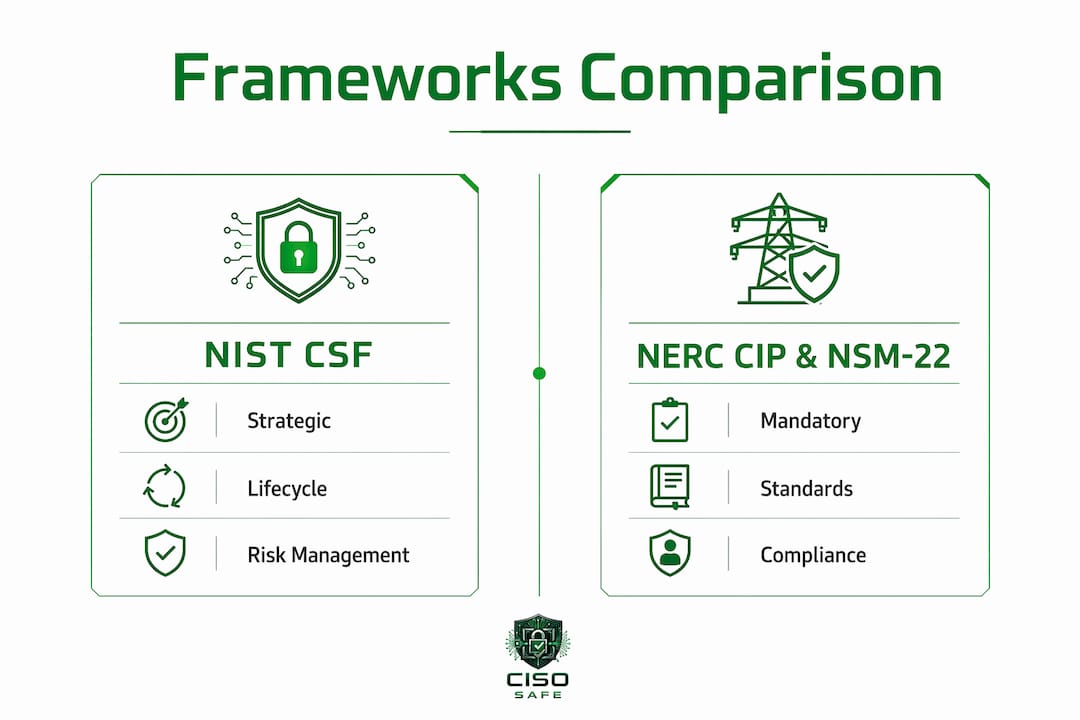
The Federal Energy Regulatory Commission approved CIP-003-11 in march 2026, requiring new security management controls for low-impact Bulk Electric System (BES) Cyber Systems. These controls specifically address remote user authentication and protection of authentication data in transit. The update targets distributed assets that were previously underprotected, precisely the type of systems adversaries exploit in coordinated attacks on the grid.
NSM-22, issued in april 2024, introduced the concept of Systemically Important Entities. These are organizations whose disruption would cause cascading national security impacts, requiring asset-level risk management and direct collaboration with sector risk management agencies. The designation forces organizations to think beyond their own perimeter and consider how their failure affects the broader ecosystem.
"Differentiating between frameworks as strategic guidance and compliance requirements as mandatory controls enables more adaptive and sustainable security programs. Organizations that treat NERC CIP or NSM-22 as the ceiling of their security program will always be one threat evolution behind."
| Standard | Scope | Key Requirement | Effective Date |
|---|---|---|---|
| NERC CIP-003-11 | Low-impact BES Cyber Systems | Remote authentication, data-in-transit protection | March 2026 |
| NSM-22 | Systemically Important Entities | Asset-level risk management, sector agency collaboration | April 2024 |
| NIST CSF 2.0 | All critical infrastructure sectors | Six-function risk lifecycle including Govern | February 2024 |
What prerequisites are needed to implement a security framework?
Governance alignment comes first. Without executive buy-in and a defined risk tolerance, a security framework becomes a documentation exercise rather than an operational program. The "Govern" function in NIST CSF 2.0 exists precisely because cybersecurity programs fail when leadership treats them as IT projects rather than enterprise risk decisions.
Before deploying any framework, security teams need the following in place:
- Asset inventory: A complete catalog of hardware, software, operational technology, and data assets. You cannot prioritize protection without knowing what exists.
- Risk assessment process: A repeatable method for evaluating threats, vulnerabilities, and business impact across asset categories.
- Defined roles and responsibilities: Clear ownership for security decisions at the operational, management, and executive levels.
- Baseline compliance mapping: An understanding of which mandatory standards apply, whether NERC CIP, HIPAA, CMMC, or others, before selecting framework controls.
- Technology controls: Endpoint detection, network monitoring, identity and access management, and logging capabilities as a minimum technical baseline.
For mid-market organizations that lack mature security programs, CIS Critical Security Controls offer a practical starting point. They prioritize 18 actions organized into implementation groups based on real-world attack data. Starting with CIS Controls builds the technical foundation that NIST CSF 2.0 then governs at the enterprise level. A vendor cybersecurity assessment should also be part of early-stage prerequisites, since third-party risk is one of the most common gaps in regulated industries.
How do you implement a security framework step by step?
Implementing a critical systems defense program in a regulated industry requires a structured sequence. Skipping steps creates gaps that auditors and adversaries both find.
- Conduct an asset and risk inventory. Identify every system, data flow, and third-party connection. Classify assets by criticality and regulatory scope. This step feeds every subsequent decision.
- Perform a gap analysis against your applicable framework. Map current controls to NIST CSF 2.0 functions and your mandatory standards. Document what is missing, what is partial, and what is compliant.
- Establish governance and policy documentation. Define your risk tolerance, assign ownership, and create or update security policies. The Govern function requires this before controls are deployed.
- Implement prioritized controls. Address the highest-risk gaps first. For energy operators, remote access controls under NERC CIP-003-11 are a current priority. For federal contractors, CMMC Level 2 controls take precedence.
- Deploy continuous monitoring. Implement security information and event management (SIEM), endpoint detection, and network monitoring. Detection without response capability is incomplete.
- Develop and test incident response and recovery plans. Document procedures for each threat scenario relevant to your sector. Test them through tabletop exercises at least annually.
- Integrate with enterprise risk management (ERM). Present cybersecurity risk in the same language as financial and operational risk. This is the mechanism that sustains leadership support and long-term investment.
- Review and update continuously. Threat landscapes shift. NERC CIP-003-11 and NSM-22 both arrived within the past two years. Schedule quarterly reviews and annual framework reassessments.
Pro Tip: When presenting framework implementation to leadership, translate technical risk into business impact. "An unpatched remote access vulnerability in our BES Cyber Systems could trigger a NERC CIP violation and a grid disruption" lands differently than "we have a patch gap."
What are the common challenges in framework implementation?
The most common failure mode is treating compliance as the goal rather than the outcome. Security professionals consistently note that organizations using NIST CSF as a checklist rather than a strategic blueprint end up with documentation that satisfies auditors but does not reduce actual risk exposure.
Several recurring challenges affect regulated organizations:
- Siloed teams: Security, IT, legal, and operations often work from different risk registers. Framework implementation requires a single, unified view of risk that crosses departmental lines.
- Resource constraints: Mid-market organizations frequently lack the internal headcount to manage a full framework program. This is where virtual CISO services provide a cost-effective alternative to full-time hires.
- Compliance versus security confusion: Mandatory standards like NERC CIP define the minimum. They do not define what is sufficient. Organizations that stop at the minimum leave exploitable gaps.
- Keeping frameworks current: The 2026 NIST CSF updates added supply chain risk management and ransomware-specific guidance. Organizations that adopted CSF 1.1 and never revisited it are operating on outdated assumptions.
- Sustaining executive engagement: Cybersecurity investment competes with every other capital priority. Embedding security metrics into ERM reporting is the most reliable method for maintaining budget and leadership attention over time.
Key Takeaways
A critical infrastructure security framework succeeds only when it functions as a living enterprise risk program, not a static compliance document built around NIST CSF 2.0, NERC CIP-003-11, and NSM-22.
| Point | Details |
|---|---|
| NIST CSF 2.0 is the strategic foundation | Use its six functions as the enterprise risk lifecycle, not a documentation checklist. |
| NERC CIP-003-11 raises the floor for energy operators | New remote authentication controls for low-impact BES systems are mandatory as of march 2026. |
| NSM-22 redefines asset prioritization | Systemically Important Entities must manage risk at the asset level with direct sector agency coordination. |
| Governance alignment precedes control deployment | Executive buy-in and defined risk tolerance are prerequisites, not afterthoughts. |
| Compliance is the floor, not the ceiling | Organizations that stop at mandatory minimums leave exploitable gaps that adversaries actively target. |
The compliance trap most security teams fall into
The most dangerous assumption I see in regulated industries is that passing an audit means the organization is secure. It does not. Compliance frameworks define what regulators require. They do not define what adversaries need to find a way in.
NIST CSF 2.0 is the right strategic tool precisely because it forces organizations to ask harder questions than any audit checklist does. The Govern function, in particular, changes the conversation. When cybersecurity risk sits inside the enterprise risk register alongside financial and operational risk, leadership cannot ignore it. That visibility is what drives sustained investment and real program maturity.
The organizations I have seen build genuinely resilient programs share one characteristic: they treat the framework as a continuous improvement engine, not a project with an end date. They review their risk profiles quarterly, update their threat assessments when new standards like NSM-22 emerge, and test their incident response plans before they need them. That discipline is what separates organizations that recover quickly from those that spend months rebuilding after an incident.
Cross-functional collaboration is the other factor that separates strong programs from weak ones. Security cannot own critical infrastructure protection alone. Legal, operations, finance, and executive leadership all have roles in the Govern function. The security team's job is to make the risk legible to each of those stakeholders, not to carry the entire program internally.
— vCISO
How CisoSafe supports critical infrastructure security programs
Regulated organizations face a real challenge: the frameworks and standards governing critical infrastructure protection are complex, frequently updated, and resource-intensive to implement without dedicated expertise.
CisoSafe delivers virtual CISO services specifically built for regulated, high-stakes industries including energy operators, oil and gas companies, and law firms. The CisoSafe team helps organizations build and maintain security programs aligned to NIST CSF 2.0, NERC CIP, CMMC, and NSM-22 requirements, without the cost of a full-time CISO. Services include security assessments, risk roadmaps, policy development, incident response planning, and continuous compliance monitoring through an AI-powered SaaS portal. If your organization needs enterprise-grade security expertise delivered at a pace and price that works for a mid-market team, CisoSafe is built for exactly that.
FAQ
What is a critical infrastructure security framework?
A critical infrastructure security framework is a structured set of policies, controls, and processes that organizations use to protect essential systems from physical and cyber threats. NIST CSF 2.0 is the most widely adopted framework in the United States, covering six core functions: Govern, Identify, Protect, Detect, Respond, and Recover.
How does NIST CSF 2.0 differ from version 1.1?
NIST CSF 2.0 added the "Govern" function, which embeds cybersecurity into enterprise risk management rather than treating it as a standalone IT responsibility. It also expanded guidance on supply chain risk management and ransomware response.
Is NERC CIP-003-11 mandatory for all energy companies?
NERC CIP-003-11 applies specifically to organizations that own or operate low-impact Bulk Electric System Cyber Systems. The Federal Energy Regulatory Commission approved it in march 2026, requiring remote user authentication controls and protection of authentication data in transit.
What is the difference between a framework and a compliance standard?
A framework like NIST CSF 2.0 provides strategic guidance and a risk management lifecycle. A compliance standard like NERC CIP or HIPAA mandates specific controls with legal or regulatory consequences for non-compliance. Effective programs use frameworks as the foundation and layer mandatory standards on top.
How long does it take to implement a security framework?
Implementation timelines vary by organization size, existing control maturity, and applicable standards. Most regulated mid-market organizations complete an initial gap analysis and priority control deployment within six to twelve months, with continuous improvement ongoing after that.