

A security assessment is a systematic evaluation of an organization's cybersecurity controls, policies, and technical infrastructure to identify vulnerabilities and prioritize risk mitigation. For mid-market companies, this process is the foundation of any credible cybersecurity program. Unlike enterprise firms with dedicated security teams or small businesses with minimal compliance obligations, mid-sized organizations face a distinct challenge: significant regulatory exposure combined with limited internal security resources. A structured mid-market security evaluation closes that gap by delivering a clear, prioritized picture of where your organization is most at risk and what to fix first.
What is security assessment for mid-market companies?
A security assessment, formally known as a cybersecurity risk assessment, evaluates technical controls alongside organizational policies and compliance posture. Think of it as a health checkup for your entire security program. It surfaces latent risks that quietly erode your defenses before they trigger a breach or a regulatory penalty.
Mid-market firms typically operate with 100 to 2,500 employees and face compliance requirements under frameworks such as SOC 2, HIPAA, PCI DSS, or CMMC. A security assessment for medium businesses maps your current controls against those requirements and identifies the gaps. The output is a scored risk profile that leadership can act on, not a technical report that sits unread on a server.

The scope of a thorough assessment covers four domains: external attack surface, internal network controls, application security, and compliance alignment. Each domain produces findings that feed into a remediation roadmap. That roadmap is what separates a useful assessment from a checkbox exercise.
What are the key types and components of security assessments?
Mid-market leaders must clearly distinguish between assessment types before committing budget and time. Each type answers a different question and carries a different cost profile.
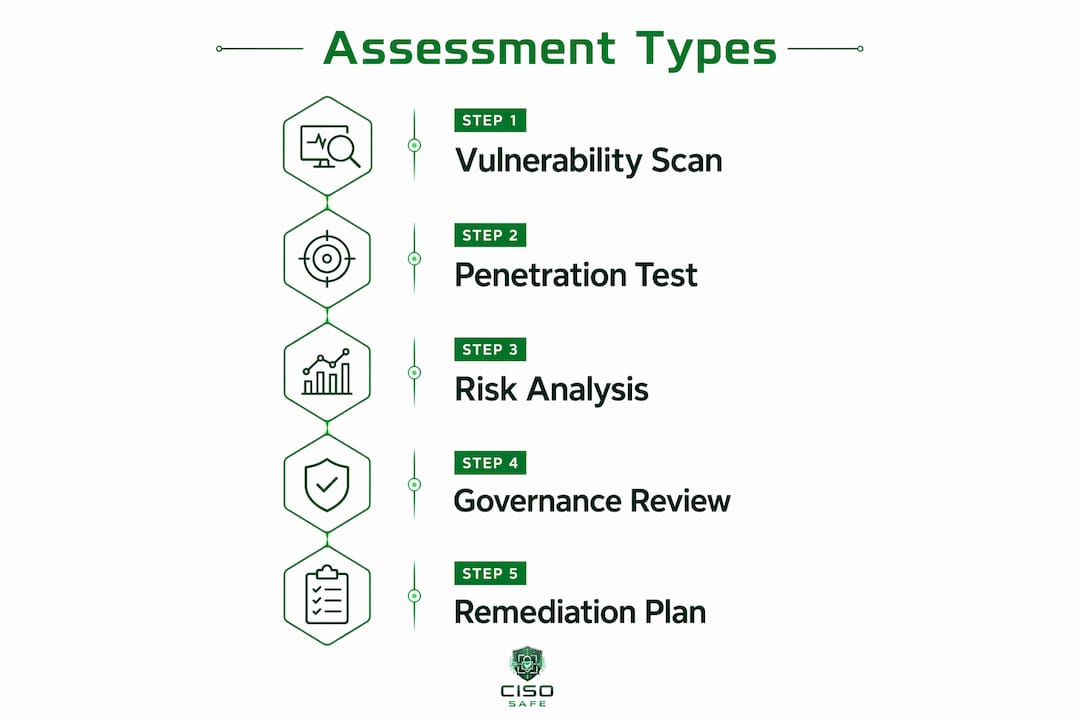
Vulnerability assessments provide a broad list of security gaps across your environment. They use automated scanning tools to catalog known weaknesses in systems, software, and configurations. Penetration testing goes further: it simulates real attacks to validate whether those gaps are actually exploitable. A vulnerability assessment tells you what is broken. A penetration test tells you what an attacker can do with what is broken.
A full security assessment combines both methods with a compliance review and governance evaluation. It is the most complete picture of your risk posture. Mid-market organizations benefit most from this combined approach because their environments are complex enough to have exploitable gaps but often lack the internal expertise to find them without outside help.
The core components of a mid-market security evaluation include:
- External assessment: Scans internet-facing assets, including web applications, email systems, and remote access points, for exploitable vulnerabilities.
- Internal assessment: Evaluates network segmentation, identity and access management, endpoint controls, and patch management practices.
- Application security review: Tests custom or third-party applications for injection flaws, authentication weaknesses, and data exposure risks.
- Compliance gap analysis: Maps existing controls against applicable regulatory frameworks such as NIST CSF 2.0, HIPAA, or PCI DSS.
- Governance review: Examines policies, procedures, and security ownership to identify structural weaknesses in how security decisions are made.
A self-serve security assessment can cover 47 controls across 5 domains and deliver a scored risk profile in about 5 minutes. That speed is useful for a quick baseline, but it does not replace expert validation. Automated tools miss context that a skilled analyst catches during manual review.
How do recognized frameworks guide security assessments?
NIST CSF 2.0 is the most widely adopted framework for structuring mid-market security assessments in the United States. It organizes cybersecurity activities into six core functions: Govern, Identify, Protect, Detect, Respond, and Recover. The Govern function is new in version 2.0 and is now central to the entire framework. It establishes accountability, risk tolerance, and security policy at the leadership level.
Mid-market firms frequently lack formal governance, which means the Govern and Identify functions are often the weakest starting points. Addressing those two functions first produces the greatest improvement in both security posture and cyber insurance premiums. Jumping to technical tools before governance is mature produces diminishing returns.
| NIST CSF 2.0 Function | Core Focus | Mid-Market Priority |
|---|---|---|
| Govern | Risk tolerance, policies, accountability | High: often absent in mid-market |
| Identify | Asset inventory, risk assessment | High: foundation for all other functions |
| Protect | Access control, data security, training | High: direct breach prevention |
| Detect | Continuous monitoring, anomaly detection | Medium: requires tooling investment |
| Respond | Incident response planning and execution | Medium: often underdeveloped |
| Recover | Business continuity, restoration | Lower: build after core functions mature |
NIST CSF 2.0 also uses Tier levels to describe cybersecurity maturity. Most mid-market firms operate at Tier 1 or low Tier 2 when they begin a formal assessment program. Tier 3 maturity is achievable within six months through a phased rollout. Tier 4 requires multiple years of sustained investment and is not a realistic near-term target for most mid-sized organizations.
Pro Tip: Before purchasing any new security tool, complete your Govern and Identify function assessments first. Organizations that mature governance before deploying technology consistently report better outcomes on both security audits and insurance applications.
Supply chain risk is another area NIST CSF 2.0 addresses explicitly. Mid-market companies often have dozens of third-party vendors with access to sensitive systems or data. A thorough assessment maps those relationships and scores the risk each vendor introduces. Ignoring third-party risk is one of the most common gaps CisoSafe identifies during initial client assessments.
What should you expect in scope, duration, and cost?
A comprehensive mid-market security assessment requires 40–60 hours of expert analysis, with an additional 8–16 hours for sector-specific overlays. Those overlays matter. A healthcare organization needs HIPAA-specific control testing. An oil and gas operator needs OT (operational technology) security evaluation. Skipping the overlay produces inaccurate risk reporting and a remediation plan that misses your most critical exposures.
The financial investment for a comprehensive IT security assessment for mid-market firms ranges from $50,000 to $150,000. Physical security assessments carry a separate cost range of $3,600 to $15,000. The gap between those two figures reflects the depth of technical analysis required for IT environments versus physical site reviews.
| Assessment Type | Typical Duration | Estimated Cost |
|---|---|---|
| Vulnerability assessment only | 1–2 weeks | $5,000–$20,000 |
| Penetration test (scoped) | 2–3 weeks | $15,000–$40,000 |
| Comprehensive IT assessment | 3–4 weeks | $50,000–$150,000 |
| Physical security assessment | 1–2 weeks | $3,600–$15,000 |
| Sector overlay (healthcare, OT) | Add 1–2 weeks | Additional $10,000–$30,000 |
A confirmatory or follow-up assessment, used to verify that remediation actions were completed correctly, typically runs 3–4 weeks. Organizations undergoing M&A due diligence or regulatory audits often need this phase to satisfy investor or regulator requirements.
Pro Tip: Request a phased assessment if budget is a constraint. Complete the governance and vulnerability assessment first, then schedule penetration testing and sector overlays in a second phase. You get actionable findings immediately without delaying the entire program.
How can you apply assessment findings to improve security posture?
Assessment findings are only valuable if they drive action. The first step after receiving results is risk scoring and prioritization. The Common Vulnerability Scoring System (CVSS) provides a standardized scale for rating individual vulnerabilities. Findings rated 7.0 or above on the CVSS scale require immediate remediation. Lower-rated findings feed into a 90-day or 180-day remediation roadmap.
Technical discovery consistently reveals 65–75% more findings than document review alone, particularly in infrastructure and identity management. That gap is significant. Organizations that rely only on policy documentation to assess their security posture are systematically underestimating their actual risk.
Practical next steps after completing a mid-market risk assessment:
- Patch critical vulnerabilities first: Address all CVSS 7.0+ findings within 30 days. Schedule medium-severity patches within 90 days.
- Strengthen identity and access management: Implement multi-factor authentication across all remote access points and privileged accounts.
- Update incident response plans: Revise your incident response playbook based on the attack scenarios identified during the assessment.
- Remediate compliance gaps: Address any control deficiencies that create direct regulatory exposure under SOC 2, HIPAA, PCI DSS, or CMMC.
- Share results with your cyber insurer: Many insurers reduce premiums or expand coverage for organizations that demonstrate a formal assessment and remediation program.
Ongoing vulnerability scanning, conducted quarterly or monthly for high-risk assets, sustains the improvements made after the initial assessment. A one-time evaluation produces a snapshot. A continuous improvement cycle, structured around the Plan-Do-Check-Act (PDCA) model, produces a maturing security program. You can learn more about building that maturity through a cybersecurity maturity assessment framework.
For organizations in regulated industries, the benefits of security assessments extend directly to compliance reporting. A documented assessment with a remediation log is the most credible evidence you can present to an auditor or regulator. It demonstrates that your organization identifies risks systematically and addresses them with accountability.
Key Takeaways
A mid-market security assessment is the most direct path from unknown risk to a prioritized, budget-aligned remediation plan grounded in NIST CSF 2.0 and regulatory requirements.
| Point | Details |
|---|---|
| Define scope before starting | Cover external, internal, application, and compliance domains to avoid blind spots. |
| Prioritize Govern and Identify first | Maturing governance before deploying tools produces better security and insurance outcomes. |
| Budget realistically | Comprehensive IT assessments for mid-market firms cost $50,000–$150,000 and take 3–4 weeks. |
| Act on CVSS scores | Remediate all findings rated 7.0 or above within 30 days of receiving results. |
| Assess continuously | Quarterly vulnerability scanning sustains improvements and satisfies regulatory expectations. |
What I've learned from mid-market assessments that most guides won't tell you
The most common mistake I see mid-market organizations make is treating a security assessment as a one-time compliance deliverable. They complete it, file the report, and move on. Twelve months later, the environment has changed significantly, new vendors have been onboarded, new applications have been deployed, and the original findings are only partially remediated. The assessment is now a historical document, not a living risk picture.
The second pattern I see consistently is what the industry calls security debt. Stretched IT teams defer patching, skip access reviews, and delay policy updates for months or years. When an assessment finally surfaces that accumulated debt, the remediation cost shocks leadership. The fix is not to avoid assessments. The fix is to assess earlier and more often so that debt never reaches a critical level.
I also see organizations chase tools before they have mature governance. They purchase a SIEM or an endpoint detection platform before they have a clear asset inventory or a defined risk tolerance. Those tools then generate alerts that no one has the process or authority to act on. The NIST CSF 2.0 Govern function exists precisely to prevent that pattern. Get governance right first, then invest in technology.
One metric I recommend tracking from day one: your cyber insurance application score. Insurers now ask detailed questions about assessment frequency, patch management, and incident response readiness. Your assessment findings, and your remediation progress, directly affect your premium and your coverage limits. Treat your insurer's requirements as a minimum baseline, not a ceiling.
— vCISO
How CisoSafe helps mid-market organizations assess and improve security
Mid-market organizations need expert guidance that fits their budget and their regulatory environment. CisoSafe delivers virtual CISO services that include structured security assessments, risk roadmaps, and compliance support for frameworks including SOC 2, HIPAA, PCI DSS, and CMMC.
CisoSafe combines hands-on vCISO expertise with an AI-powered SaaS platform that automates penetration testing, compliance intake, and professional reporting. The result is enterprise-grade security assessment capability without the cost of a full-time CISO or a large consultancy engagement. Organizations in law, energy, oil and gas, and other regulated industries use CisoSafe to move from an unknown risk posture to a documented, auditable security program. If your organization is ready to start a security gap analysis or a full mid-market assessment, CisoSafe provides the expertise to do it right.
FAQ
What is a security assessment for mid-market companies?
A security assessment for mid-market companies is a structured evaluation of cybersecurity controls, policies, and compliance posture designed to identify vulnerabilities and prioritize remediation. It covers technical, organizational, and regulatory dimensions tailored to the size and risk profile of mid-sized organizations.
How long does a mid-market security assessment take?
A comprehensive mid-market security assessment typically takes 3–4 weeks, requiring 40–60 hours of expert analysis plus an additional 8–16 hours for sector-specific overlays in industries such as healthcare or operational technology.
What does a mid-market security assessment cost?
Comprehensive IT security assessments for mid-market firms range from $50,000 to $150,000 depending on scope, industry overlays, and assessment depth. Physical security assessments carry a separate cost range of $3,600 to $15,000.
How does NIST CSF 2.0 apply to mid-market security assessments?
NIST CSF 2.0 provides the framework structure for mid-market assessments through six functions: Govern, Identify, Protect, Detect, Respond, and Recover. Most mid-market firms start at Tier 1 or Tier 2 maturity and can realistically reach Tier 3 within six months through a phased improvement program.
How often should mid-market companies conduct security assessments?
Mid-market companies should conduct a full security assessment annually and perform vulnerability scanning quarterly, or monthly for high-risk assets. Continuous assessment cycles, structured around the PDCA model, produce sustained improvements rather than point-in-time snapshots.