

A security gap analysis is defined as a structured comparison of an organization's existing cybersecurity controls against a recognized target state, such as NIST CSF, ISO 27001, HIPAA, or PCI-DSS, to identify specific deficiencies and prioritize remediation. The output is not a vague scorecard. It is a detailed inventory of control gaps annotated with risk levels, remediation effort, and sequencing. For compliance officers managing regulatory deadlines, business leaders allocating security budgets, and cybersecurity professionals building program roadmaps, understanding what is security gap analysis is the first step toward measurable risk reduction.
What is the standard methodology for a security gap analysis?
A gap analysis methodology follows a defined sequence of steps. Skipping any one of them produces incomplete findings and unreliable remediation plans.
-
Define scope and objectives. Set SMART goals before collecting a single data point. Specify which systems, business units, and regulatory frameworks are in scope. Undefined scope leads to scope creep and project delays of 2–4 weeks, which is a cost no compliance timeline can absorb.
-
Gather objective evidence of current controls. Pull configuration files, access logs, policy documents, and audit trails. Do not accept verbal confirmations as evidence. Relying on verbal confirmations causes teams to underestimate gap size by 30–50%, which directly distorts remediation budgets.
-
Identify the target state. Select the framework or regulatory requirement that defines your destination. Recognized frameworks like NIST CSF, ISO 27001, CIS Controls v8, SOC 2, HIPAA, and PCI-DSS provide authoritative benchmarks that make gap measurement objective rather than subjective.
-
Quantify and annotate gaps. Classify each control as "missing," "partial," or "ineffective." Assign a risk level and estimate the effort required to close the gap. This specificity is what separates a gap analysis from a broader cybersecurity maturity assessment, which yields qualitative insights rather than control-level findings.
-
Build a prioritized remediation roadmap. Sequence remediation by risk severity, regulatory milestones, and business dependencies. Documenting this roadmap is what secures budget and executive buy-in. Without it, gap findings sit in a report and nothing changes.
-
Validate and reassess. Confirm that remediation actions closed the gaps with evidence, not assumptions. Schedule the next assessment cycle based on organizational change triggers.
Pro Tip: Never start a gap analysis without a written scope statement signed off by a business owner. Scope creep is the single most common reason gap analysis projects run over time and budget.
How does security gap analysis differ from risk assessments and audits?

These three assessment types serve distinct purposes. Treating them as interchangeable wastes resources and leaves real vulnerabilities unaddressed.
Gap assessments, audits, and risk assessments each fill a different role in a security program. The table below clarifies those roles.
| Assessment type | Primary focus | Output |
|---|---|---|
| Security gap analysis | Control maturity and compliance gaps | Inventory of missing, partial, or ineffective controls |
| Risk assessment | Threat likelihood and business impact | Risk register with prioritized threats |
| Compliance audit | Adherence to regulatory requirements | Pass/fail findings against specific standards |
The practical difference matters when allocating resources. A gap analysis tells you what controls you are missing relative to a framework. A risk assessment tells you which threats are most likely to harm your business and what the financial impact would be. An audit tells you whether you currently meet a specific regulatory requirement.
Consider a law firm preparing for a SOC 2 audit. A gap analysis against the SOC 2 Trust Services Criteria reveals which controls are absent or partial. A risk assessment then evaluates which of those gaps expose the firm to the highest probability of a data breach. The audit, conducted by an external auditor, verifies whether the firm has closed enough gaps to receive certification. All three are necessary. None replaces the others.
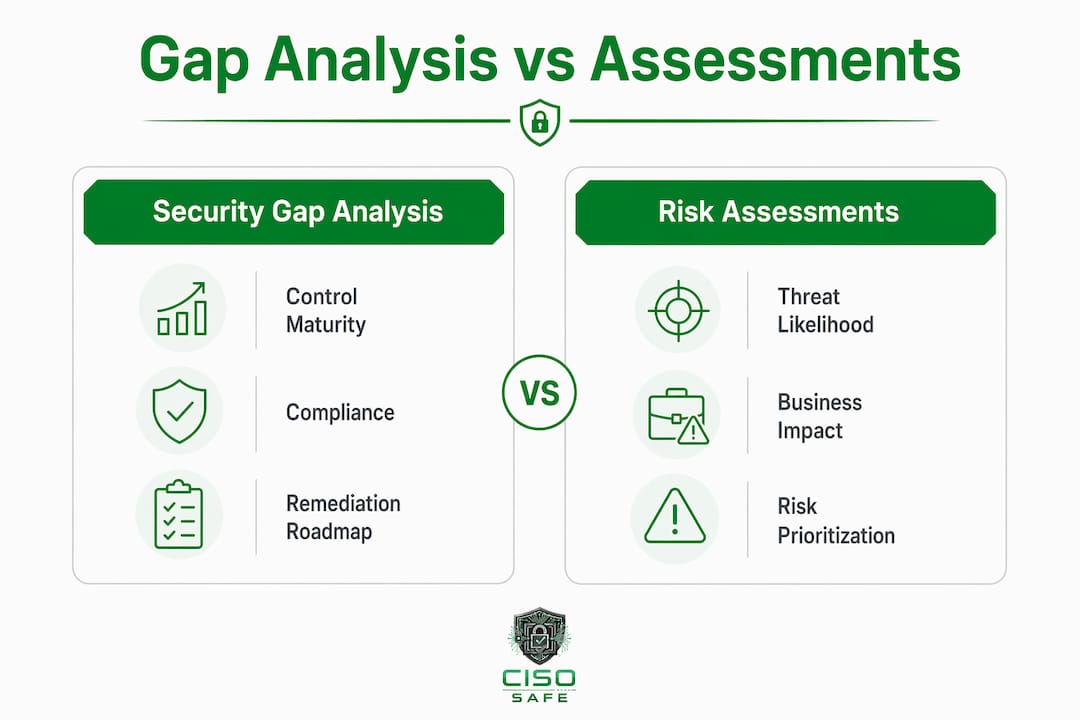
The key distinction for compliance officers is this: misunderstanding these differences leads to wasted resources. Organizations that run only audits discover failures too late. Organizations that run only risk assessments may miss specific control deficiencies that regulators require.
What techniques improve gap identification and root cause analysis?
Identifying a gap is only half the work. Understanding why the gap exists determines whether remediation actually sticks.
The most effective analytical techniques for root cause discovery include:
- 5 Whys analysis. Ask "why" five times in sequence to trace a control failure back to its origin. A missing multi-factor authentication policy may trace back to an underfunded IT team, not a lack of awareness. Using 5 Whys and SWOT analysis during gap quantification uncovers root causes, so remediation addresses fundamental problems rather than surface symptoms.
- SWOT analysis applied to security controls. Map internal strengths and weaknesses against external threats and opportunities. This technique is particularly useful when evaluating whether existing controls are ineffective due to design flaws or implementation failures.
- Evidence collection protocols. Require logs, configuration screenshots, and signed policy documents for every control being evaluated. Verbal confirmation is not evidence. Teams that enforce this standard produce gap inventories that hold up under regulatory scrutiny.
- Control classification. Label every control as "missing," "partial," or "ineffective." This classification drives remediation sequencing more accurately than a simple yes/no checklist.
Pro Tip: Build a standard evidence request template before the assessment begins. Send it to system owners two weeks in advance. Teams that receive the request early return complete evidence packages, which cuts assessment time significantly.
Continuous reassessment is equally important. A gap analysis conducted after a major system migration or a new regulatory requirement takes effect is not optional. It is the only way to keep your gap inventory current. Treating gap analysis as a one-time annual event produces a false sense of security within months of completion.
How do organizations apply gap analysis to improve security posture?
The gap inventory is the starting point, not the finish line. The real value comes from translating findings into a funded, sequenced remediation roadmap that leadership can act on.
Effective remediation prioritization does not simply rank gaps by raw risk score. Remediation roadmaps should weigh business priorities alongside risk scores, because some low-risk gaps are prerequisites for certifications and therefore more urgent than higher-risk gaps. A missing asset inventory control may carry a moderate risk score, but without it, an organization cannot complete a CMMC or SOC 2 assessment. That dependency makes it a first-priority item regardless of its standalone risk rating.
Organizations that align gap analysis findings with security frameworks gain a second advantage: they can demonstrate measurable progress to regulators, clients, and boards. A gap inventory from six months ago compared to a current inventory shows exactly which controls moved from "missing" to "implemented." That evidence satisfies auditors and builds internal confidence in the security program.
The table below shows how gap analysis findings map to common compliance frameworks and their remediation implications.
| Framework | Common gap categories | Remediation priority driver |
|---|---|---|
| NIST CSF | Identify, Protect, Detect functions | Risk exposure and asset criticality |
| HIPAA | Access controls, audit logs, encryption | Regulatory deadline and breach liability |
| PCI-DSS | Network segmentation, cardholder data controls | Certification requirement and merchant agreement |
| SOC 2 | Availability, confidentiality, change management | Client contract and audit timeline |
| CMMC | Access control, incident response, configuration management | Federal contract eligibility |
Gap analysis also prepares organizations for evolving cyber threats. Threat actors adapt faster than annual assessment cycles. Organizations in oil and gas, energy, and legal services face sector-specific attack patterns that require gap inventories updated at least quarterly or after any significant infrastructure change.
Key Takeaways
A security gap analysis is the most direct method for identifying specific control deficiencies and building a funded remediation roadmap that closes them before regulators or attackers do.
| Point | Details |
|---|---|
| Define scope first | Set written SMART objectives before collecting evidence to prevent scope creep and delays. |
| Use objective evidence | Collect logs, configs, and policy documents; verbal confirmations underestimate gaps by 30–50%. |
| Distinguish assessment types | Gap analysis finds control deficiencies; risk assessments evaluate threat impact; audits verify compliance. |
| Prioritize by business dependency | Some low-risk gaps are certification prerequisites and must be remediated before higher-risk items. |
| Treat it as continuous | Reassess after major system changes, new regulations, or significant organizational shifts. |
The check-box trap: why most gap analyses fail to deliver
The most common mistake I see organizations make is treating a gap analysis as a compliance deliverable rather than a decision-making tool. The report gets filed, the findings get acknowledged, and nothing moves. Six months later, the same gaps appear in the next assessment.
The problem is not the methodology. It is the absence of a remediation roadmap with owners, deadlines, and budget. A gap inventory without those three elements is just a list of problems. The organizations that extract real value from gap analysis are the ones that connect every finding to a specific person, a specific timeline, and a specific dollar amount. That connection is what turns a compliance exercise into a security improvement.
I have also seen teams over-index on raw risk scores when sequencing remediation. A control gap rated "critical" may be technically complex and take six months to close. A gap rated "medium" may be a two-week fix that unlocks a certification worth a major client contract. Business context always overrides the risk score in a well-run program.
The other pattern worth calling out is the annual-only assessment cycle. One-time gap analyses are insufficient for organizations operating in regulated industries with dynamic infrastructure. A law firm that adds a cloud-based document management system in march has a materially different attack surface by april. The gap inventory from january is already outdated. Continuous assessment, triggered by organizational change, is the standard that regulated industries require and that effective security programs practice.
— vCISO
CisoSafe brings expert gap analysis leadership to your security program
Security gap analysis produces results only when the methodology is sound, the evidence is objective, and the remediation roadmap has executive backing. That combination requires experienced security leadership, which most SMBs and mid-market organizations do not have in-house.
CisoSafe delivers virtual CISO services that include structured gap analysis, framework-aligned remediation roadmaps, and ongoing compliance advisory for law firms, energy operators, oil and gas companies, and other regulated organizations across the United States. The CisoSafe platform automates compliance intake and reporting, so your leadership team gets clear visibility into risk without the overhead of a full-time CISO. If your organization needs a gap analysis that produces a funded, sequenced remediation plan rather than a report that collects dust, CisoSafe is built for that outcome.
FAQ
What is security gap analysis in simple terms?
A security gap analysis compares your current cybersecurity controls against a target framework, such as NIST CSF or HIPAA, and identifies which controls are missing, partial, or ineffective. The output is a prioritized list of deficiencies with remediation guidance.
How long does a security gap analysis take?
The timeline depends on scope and organizational size, but most gap analyses for SMBs and mid-market organizations take two to six weeks from scoping to final report. Undefined scope is the leading cause of delays.
What is the difference between a gap analysis and a risk assessment?
A gap analysis measures control maturity against a defined framework. A risk assessment evaluates the likelihood and business impact of specific threats. Both are necessary but serve different purposes in a security program.
Which frameworks are used as benchmarks in a security gap analysis?
Common benchmarks include NIST CSF, ISO 27001, CIS Controls v8, SOC 2 Trust Services Criteria, HIPAA Security Rule, PCI-DSS, and CMMC. The right framework depends on your industry, regulatory obligations, and client requirements.
How often should organizations conduct a security gap analysis?
Organizations should conduct a formal gap analysis at least annually and reassess after major changes such as new systems, acquisitions, or updated regulatory requirements. Continuous assessment is the standard for regulated industries.