

A security policy is defined as a formally approved management document that declares an organization's rules, responsibilities, and commitments for protecting its information assets and technology environment. The industry standard term is "information security policy," as established under ISO 27001 Clause 5.2, though "security policy" is widely used across compliance frameworks including SOC 2, HIPAA, PCI DSS, and CMMC. Every regulated organization needs one. Without a formal policy, security decisions default to individual judgment, and human factors contribute to approximately 60% of all security breaches. That statistic makes the case for documented, enforceable rules better than any argument can.
What is a security policy and what does it include?
A security policy sets management's intent for how the organization protects its information systems, data, and physical assets. It is not a technical manual. It is an authoritative statement that defines what is required, who is responsible, and what happens when rules are violated.
Every effective security policy contains five core components:
- Purpose: Why the policy exists and what risk it addresses
- Scope: Which systems, people, locations, and data the policy covers
- Roles and responsibilities: Who owns, enforces, and complies with the policy
- Rules and requirements: The specific controls and behaviors the policy mandates
- Enforcement: Consequences for non-compliance and the process for handling violations
Security policies also fall into three distinct types. Program-level policies cover the entire organization's security posture. Issue-specific policies address a single topic, such as remote access or data classification. System-specific policies govern a particular technology, such as a cloud platform or database environment.
One distinction that trips up many compliance officers is the difference between policies, standards, procedures, and guidelines. Policies set the "what" by declaring management intent. Standards define the minimum controls required to meet that intent. Procedures explain the "how" with step-by-step instructions. Guidelines offer recommended but non-mandatory practices. Treating these as interchangeable creates audit liabilities and enforcement gaps.

A well-structured policy library typically contains between 15 and 25 core policies to cover the controls required by frameworks like ISO 27001. That range is large enough to address the major risk domains and small enough to remain manageable. Organizations that exceed 40 policies without clear ownership often find that most documents go unread and unenforced.
Why security policies are critical for compliance and risk management
Security policies are the accountability backbone of any compliance program. Without them, there is no authoritative basis for enforcing controls, training employees, or demonstrating due diligence to auditors.
ISO 27001 requires a formal information security policy under Clause 5.2, along with supporting policies for applicable controls. SOC 2 auditors expect documented policies that align with the Trust Services Criteria. GDPR, NIS2, and DORA each require organizations to demonstrate that security governance is formalized, not improvised. A missing or outdated policy is not just a documentation gap. It is a compliance violation with financial and legal consequences.
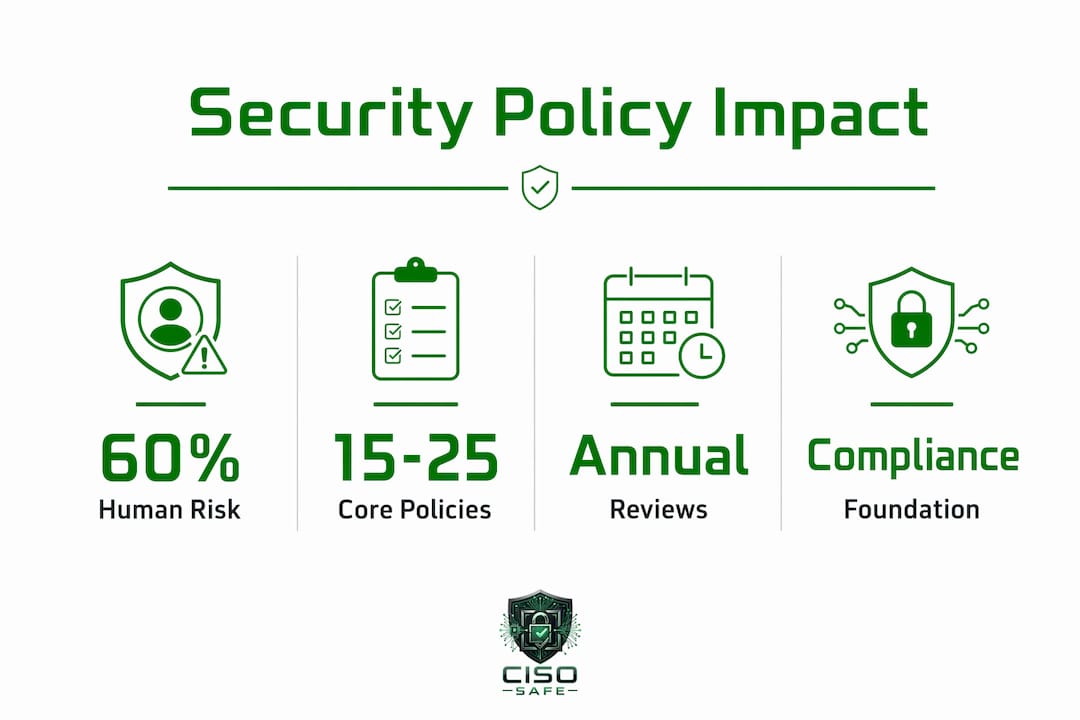
The human risk dimension is equally significant. Human-driven breaches represent roughly 60% of total incidents. This includes phishing clicks, misconfigured systems, weak passwords, and unauthorized data sharing. Policies reduce this risk by replacing individual judgment with clear, enforceable rules. An employee who knows the organization's acceptable use policy is far less likely to connect a personal device to a corporate network than one who has never seen a written rule.
Pro Tip: Review your policy library against your current compliance framework requirements at least once per year. Policies written before your organization adopted cloud services or remote work almost certainly contain gaps that auditors will find before you do.
Without a formal policy framework, security decisions become inconsistent and reactive across teams. One department enforces multi-factor authentication. Another does not. One vendor receives a security questionnaire. Another does not. Policies eliminate that inconsistency by creating a single, authoritative standard that applies across the organization. That consistency is what makes security programs defensible, repeatable, and auditable. You can read more about how evolving cyber threats make this consistency even more critical in 2026.
How to create and maintain effective security policies
Creating a security policy that actually works requires more than drafting a document. It requires management approval, operational alignment, and a plan for keeping the policy current.
Follow these steps to build policies that hold up under audit and in practice:
-
Identify the risk or compliance driver. Every policy should address a specific threat, regulatory requirement, or operational need. Start with your risk assessment results and your compliance framework's control requirements.
-
Draft with operational input. Involve the teams who will live under the policy. IT, legal, HR, and operations each bring context that prevents policies from conflicting with how work actually gets done.
-
Obtain formal management approval. Policies must be management-approved to carry legal and organizational authority. A policy signed by the CISO alone carries less weight than one approved by the executive team or board.
-
Write for clarity, not length. A policy no one reads provides zero security value. Use plain language. Keep each policy focused on one topic. Aim for two to four pages per policy document.
-
Communicate and train. Distribute policies to all affected employees and vendors. Require acknowledgment. Integrate key requirements into onboarding and annual security training.
-
Trigger reviews on environmental changes. Policies must be updated whenever relevant changes occur in the computing environment. Cloud adoption, remote work expansion, a merger, or a new regulatory requirement each warrants a policy review.
-
Assign ownership. Every policy needs a named owner responsible for its accuracy, communication, and review cycle. Without ownership, policies drift out of date.
Pro Tip: Never copy-paste a generic policy template without customizing it to your organization's actual operations and risk profile. Generic templates often fail to reflect true organizational risks and introduce audit liabilities when auditors find that documented controls do not match how your team actually works.
What are common security policy examples in organizations?
Most organizations build their policy library around a set of core issue-specific policies that address the highest-risk areas. Each policy targets a specific threat category and maps to one or more compliance controls.
Common security policy examples include the following categories:
- Access control policy: Defines who can access which systems and data, and under what conditions. Supports least-privilege principles required by ISO 27001, SOC 2, and HIPAA.
- Password policy: Sets minimum password length, complexity, rotation, and multi-factor authentication requirements. Directly reduces credential-based breach risk.
- Network security policy: Governs firewall rules, network segmentation, remote access, and wireless usage. Critical for organizations with distributed or hybrid environments.
- Data classification policy: Establishes categories for data sensitivity and the handling rules for each category. Required under GDPR and most data protection frameworks.
- Physical security policy: Covers access to facilities, server rooms, and hardware. Often overlooked but required under PCI DSS and ISO 27001.
- Disaster recovery and business continuity policy: Defines recovery time objectives, backup requirements, and response procedures for system failures or cyberattacks.
- Acceptable use policy: Sets rules for employee use of company systems, devices, and internet access. Reduces insider threat and legal liability.
The table below summarizes how these policies map to common compliance frameworks:
| Policy category | Primary compliance frameworks |
|---|---|
| Access control | ISO 27001, SOC 2, HIPAA, CMMC |
| Password management | ISO 27001, PCI DSS, NIST 800-53 |
| Network security | PCI DSS, CMMC, NIS2 |
| Data classification | GDPR, ISO 27001, HIPAA |
| Physical security | PCI DSS, ISO 27001 |
| Disaster recovery | SOC 2, HIPAA, DORA |
| Acceptable use | ISO 27001, SOC 2, general employment law |
Each policy in this library reinforces the others. An access control policy without a supporting password policy leaves a gap. A disaster recovery policy without a tested business continuity plan creates a false sense of preparedness. The library works as a system, not as a collection of standalone documents. Understanding cyber risk and reputation helps leaders see why each policy category carries real business consequences when missing.
Key Takeaways
A security policy is the formal, management-approved foundation that makes every other security control enforceable, auditable, and consistent across your organization.
| Point | Details |
|---|---|
| Security policy definition | A formally approved document declaring rules and responsibilities for protecting information assets. |
| Policy library size | ISO 27001 guidance supports 15–25 core policies as a sufficient documented foundation. |
| Human risk reduction | Documented policies directly address the human factors behind roughly 60% of all breaches. |
| Compliance requirement | ISO 27001, SOC 2, GDPR, HIPAA, and CMMC all require formal, current security policies. |
| Policy maintenance | Policies must be reviewed and updated after any significant change to the environment or regulatory requirements. |
Why most security policies fail before they are ever enforced
After working with law firms, energy operators, and compliance-sensitive organizations across the United States, I have seen the same failure pattern repeat itself. The policy exists. It was approved two years ago. Nobody has read it since. And the organization is running on cloud infrastructure that the policy does not mention.
The uncomfortable truth is that a policy no one reads provides zero security value. It is worse than zero, actually, because it creates the illusion of governance while leaving real gaps open. Auditors find these gaps. Regulators find them. Attackers exploit them.
The organizations that get this right treat their policy library as a living program, not a documentation project. They assign owners. They tie policies to actual controls. They train employees on the rules that matter most, not just the ones that are easiest to explain. And they update policies when the business changes, not when the next audit arrives.
The shift from reactive to repeatable security governance does not happen through technology alone. It happens when leadership commits to a policy framework that reflects how the organization actually operates. That is the difference between a security program that holds up under scrutiny and one that collapses the moment an auditor asks for evidence.
— vCISO
How CisoSafe helps organizations build and manage security policies
Building a policy library that satisfies ISO 27001, SOC 2, HIPAA, or CMMC requirements takes more than templates. It takes expert judgment about which policies your specific risk profile demands and how to write them so they hold up under audit.
CisoSafe provides virtual CISO services that include policy development, review, and ongoing management as part of a complete security program. The CisoSafe team works directly with law firms, oil and gas companies, energy operators, and other regulated organizations to build policy libraries tailored to their actual operations and compliance obligations. From initial risk assessment through regulatory alignment and annual policy reviews, CisoSafe gives leadership the expert support needed to maintain a defensible, current security program without the cost of a full-time CISO.
FAQ
What is a security policy in simple terms?
A security policy is a formal document approved by management that defines the rules employees and systems must follow to protect the organization's data and technology. It sets accountability and provides the basis for enforcing security controls.
What should a security policy include?
Every security policy should include a purpose statement, scope, defined roles and responsibilities, specific rules or requirements, and an enforcement mechanism. These five components make a policy enforceable and auditable.
How many security policies does an organization need?
ISO 27001 guidance supports a library of 15–25 core policies as a sufficient foundation for most organizations. The exact number depends on the organization's size, industry, and applicable compliance frameworks.
How often should security policies be reviewed?
Policies must be reviewed and updated whenever significant changes occur in the computing environment, such as cloud adoption, remote work expansion, or new regulatory requirements. An annual review cycle is the minimum standard for most compliance frameworks.
What is the difference between a security policy and a security procedure?
A security policy declares management's intent and sets the rules. A security procedure explains the step-by-step process for carrying out those rules. Policies answer "what is required." Procedures answer "how to do it."