

Managed security services are defined as outsourced cybersecurity programs in which an external provider continuously monitors, detects, and responds to threats on behalf of an organization. For law firms, energy operators, and other compliance-sensitive businesses, this model delivers enterprise-grade protection without the cost of building an internal Security Operations Center. Leading managed security service providers (MSSPs) like CrowdStrike deploy Security Operations Centers staffed with expert analysts, AI-driven SIEM platforms, and endpoint detection and response tools to protect client environments around the clock. The role of managed security services extends beyond simple monitoring. It covers incident response, vulnerability management, and regulatory compliance oversight, making MSSPs a core component of any serious cybersecurity strategy.
What roles do managed security service providers actually fulfill?
MSSPs perform a defined set of security functions that most internal IT teams cannot replicate at the same depth or scale. Their scope covers the full threat lifecycle, from initial detection through containment and recovery.
Core MSSP responsibilities include:
- 24/7 threat monitoring: Analysts and automated tools watch network traffic, endpoints, and logs continuously. Hackers strike mostly during off-hours, making round-the-clock coverage a non-negotiable defense requirement.
- Incident response: When a breach occurs, MSSPs contain the threat, investigate the root cause, and guide remediation. Speed here directly determines financial impact.
- Firewall and endpoint management: MSSPs configure, monitor, and update firewalls, intrusion detection systems, and endpoint protection platforms on behalf of clients.
- Vulnerability assessments: Regular scans identify weaknesses before attackers do, prioritizing remediation based on risk level.
- Compliance oversight: MSSPs track adherence to frameworks like SOC 2, HIPAA, PCI DSS, and CMMC, generating audit-ready documentation.
- AI and automation: AI and automation reduce breach lifecycles by 80 days and save organizations approximately $1.76 million to $1.9 million per breach. That figure reflects the compounding value of faster detection and containment.
MSSPs increasingly offer Managed Detection and Response (MDR) services to address sophisticated attacks that standard signature-based tools miss entirely. MDR combines behavioral analytics with human analyst review to catch threats that automated systems flag incorrectly or overlook.
Pro Tip: Ask any MSSP candidate how they handle false positives. The answer reveals the maturity of their analyst team and their triage process. A provider that cannot explain their alert review workflow is not ready to protect your organization.

Mssps vs. msps: what is the real difference?
Many business leaders conflate managed IT services (MSPs) with managed security services, and that confusion creates real risk. MSSPs focus exclusively on threat detection, incident response, and compliance, whereas MSPs focus on operational IT uptime and help desk support. These are fundamentally different disciplines.
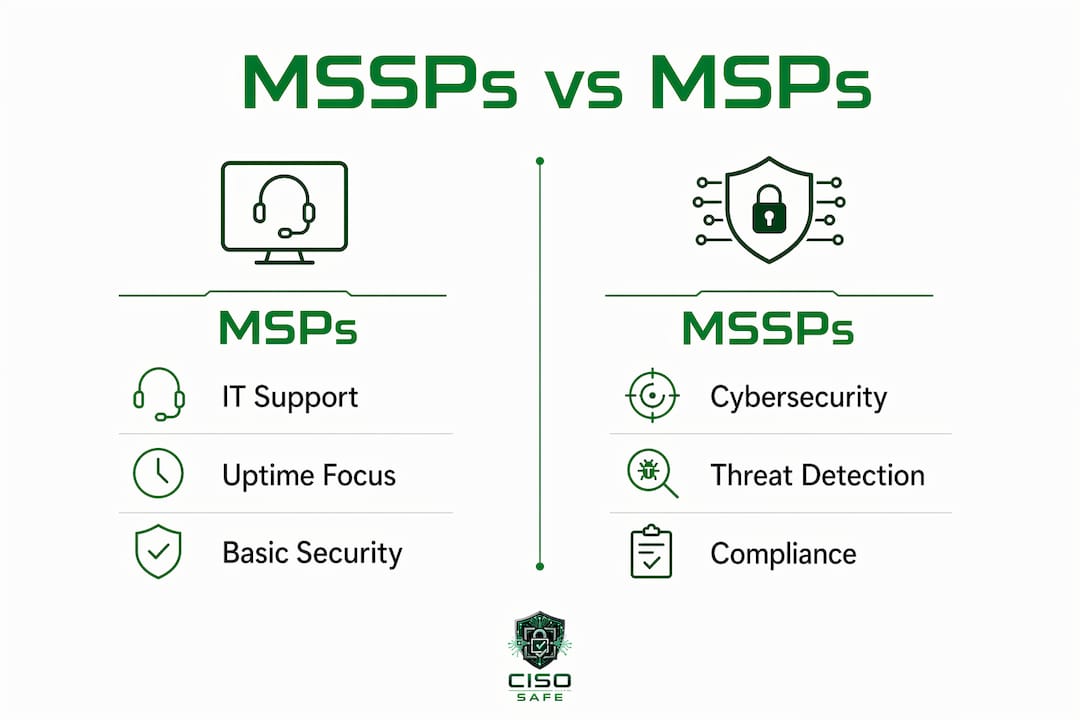
| Capability | MSP | MSSP |
|---|---|---|
| Primary focus | IT uptime and support | Cybersecurity and threat defense |
| Security Operations Center | Rarely included | Core service component |
| Incident response | Limited or none | Defined and practiced workflows |
| Compliance management | Incidental | Structured and ongoing |
| Threat hunting | Not standard | Active and continuous |
Business leaders often mistakenly rely on MSPs for security needs, leaving critical defense gaps that MSSPs specialize in closing. An MSP can keep your servers running and your email flowing. It cannot investigate a lateral movement attack or contain a ransomware deployment at 2 a.m. on a Sunday.
The distinction matters most in regulated industries. A law firm handling client data under state bar ethics rules or an energy company subject to NERC CIP standards needs a provider whose entire operation is built around security, not one that treats it as an add-on service.
Pro Tip: Review your current IT service agreement and search for the words "incident response." If you find a vague clause or nothing at all, you are relying on an MSP for security work that requires an MSSP.
What are the key benefits of partnering with an MSSP?
The benefits of security services delivered through an MSSP are measurable, not theoretical. For compliance-sensitive organizations, the value shows up in four concrete areas.
-
Faster breach detection and lower costs. Breaches detected internally cost nearly $1 million less on average than those discovered externally. An MSSP's continuous monitoring makes internal detection the default, not the exception.
-
Access to specialized expertise. Outsourcing security provides immediate access to experienced security teams and enterprise-grade tools at a fraction of the cost of building those capabilities in-house. Hiring a full-time CISO plus a SOC team in a major market costs well over $500,000 annually before benefits and tooling.
-
Elimination of off-hours vulnerability windows. Most cyberattacks occur outside standard business hours. An MSSP's 24/7 coverage closes that window entirely, which is particularly critical for organizations that cannot staff overnight security shifts.
-
Compliance assurance. MSSPs maintain continuous oversight of security controls mapped to specific regulatory frameworks. For a healthcare organization under HIPAA or a defense contractor under CMMC, this ongoing oversight reduces audit preparation time and lowers the risk of non-compliance findings.
-
Predictable cost structure. Mid-sized organizations typically pay between $5,000 and $25,000 monthly for managed security engagements, depending on scope and compliance requirements. That range is substantially lower than the capital and operational cost of an equivalent internal program.
The cost-effectiveness argument is especially strong for organizations that need enterprise-grade protection but cannot justify a full internal security team. MSSPs provide the depth of a mature security program at a fraction of the build cost.
How do managed security services work in practice?
Understanding how managed security works operationally helps leaders set realistic expectations and ask better questions during vendor evaluation.
The operational process follows a defined sequence:
- Data ingestion: The MSSP deploys agents and integrations across the client's environment, feeding logs from firewalls, endpoints, cloud services, and identity platforms into a centralized SIEM platform. Tools like Microsoft Sentinel, Splunk, and IBM QRadar are commonly used at this layer.
- AI-driven analysis: Machine learning models analyze ingested data in real time, flagging anomalies based on behavioral baselines. This layer catches threats that rule-based detection misses, including insider threats and novel malware variants.
- Human analyst triage: Human analysts triage alerts to avoid the alert fatigue that overwhelms internal teams, separating genuine threats from false positives before escalation. This step is where MSSP quality varies most significantly between providers.
- Escalation and response: Confirmed threats trigger a defined incident response workflow. The MSSP contacts the client's designated point of contact, initiates containment actions, and begins forensic investigation.
- Remediation and reporting: After containment, the MSSP documents the incident, identifies root causes, and recommends control improvements. This documentation also supports compliance reporting requirements.
MSSPs also collaborate directly with internal IT teams, providing context and guidance without displacing existing staff. The relationship works best when the client's IT team handles day-to-day operations and the MSSP owns security monitoring and response. Scalability is built into the model. As an organization grows or its threat profile changes, the MSSP adjusts coverage and tooling without requiring the client to hire additional headcount.
How should business leaders select and integrate an MSSP?
Selecting the right MSSP is a strategic decision, not a procurement exercise. The following steps give decision-makers a structured approach to evaluation and integration.
-
Define your security and compliance requirements first. Identify which regulatory frameworks apply to your organization, SOC 2, HIPAA, PCI DSS, CMMC, or others, and document your current security gaps. This baseline determines what capabilities your MSSP must provide.
-
Evaluate service level agreements with precision. Review mean time to detect and mean time to respond commitments. Ask for historical performance data, not just contractual promises. A credible MSSP will share actual metrics from comparable client environments.
-
Assess the depth of the analyst team. Ask how many analysts cover your account, what certifications they hold, and how they handle escalations. Certifications like CISSP, CISM, and GIAC credentials indicate genuine expertise.
-
Plan for ongoing collaboration. Successful managed security depends on collaborative engagement between clients and MSSPs, with regular posture reviews and strategy updates. Avoid the set-it-and-forget-it mindset. Schedule quarterly security reviews and require transparent reporting on threat trends and control effectiveness.
-
Calculate total cost of ownership. Compare the MSSP's monthly fee against the fully loaded cost of internal alternatives, including salaries, benefits, tooling licenses, and training. For most mid-market organizations, the MSSP model wins on cost and capability simultaneously.
-
Start with a defined scope. Begin with the highest-risk areas of your environment, such as endpoints, email, and identity, then expand coverage as the relationship matures. This phased approach reduces integration complexity and builds trust between your team and the MSSP.
Pro Tip: Request a tabletop exercise during the evaluation process. Ask the MSSP to walk through how they would respond to a ransomware incident in your specific environment. Their response reveals the quality of their playbooks and the depth of their preparation.
Key takeaways
Managed security services deliver measurable protection by combining continuous monitoring, expert human analysis, and defined incident response workflows that most internal teams cannot replicate at equivalent cost or scale.
| Point | Details |
|---|---|
| MSSPs vs. MSPs | MSSPs specialize in threat detection and compliance; MSPs focus on IT uptime and support. |
| Cost savings from detection speed | Internally detected breaches cost nearly $1 million less on average than externally discovered ones. |
| AI and human analysts together | AI reduces breach lifecycles by 80 days; human analysts prevent alert fatigue and improve precision. |
| Compliance coverage | MSSPs provide continuous oversight mapped to SOC 2, HIPAA, PCI DSS, CMMC, and similar frameworks. |
| Ongoing collaboration is required | Regular posture reviews and strategy updates are necessary for MSSP partnerships to deliver full value. |
What most leaders get wrong about outsourcing security
After working with compliance-sensitive organizations across law, energy, and financial services, I have seen one mistake repeat itself more than any other. Leaders treat managed security as a transfer of responsibility rather than a transfer of execution. They sign an MSSP contract and assume the security problem is solved. It is not.
The true value of MSSPs lies in specialized human analysts who review alerts and differentiate genuine threats from false positives. That value only materializes when the client stays engaged. You still own the risk. The MSSP manages the program. That distinction matters enormously when a breach occurs and leadership has to explain to regulators, clients, or a board what happened and why.
I also push back on the assumption that automation makes human analysts optional. AI tools are exceptional at processing volume and catching behavioral anomalies. They are poor at understanding business context. An analyst who knows your organization's normal patterns, your peak transaction periods, your third-party integrations, will catch things no algorithm flags. That contextual knowledge is built through proactive leadership involvement and regular engagement with your MSSP team.
My recommendation: treat your MSSP as a strategic partner, not a vendor. Bring them into your risk conversations. Share your business roadmap. The more context they have, the better they protect you.
— vCISO
How CisoSafe delivers managed security for regulated industries
Organizations in compliance-sensitive industries need more than a monitoring contract. They need a security partner who understands their regulatory obligations and builds protection around them.
CisoSafe provides virtual CISO services and AI-powered managed security solutions built specifically for law firms, oil and gas companies, energy operators, and other high-stakes businesses. The CisoSafe platform combines hands-on security advisory with automated compliance intake, penetration testing, and professional reporting, giving leadership clear visibility into risk without overwhelming internal teams. Whether your organization needs to meet SOC 2, HIPAA, PCI DSS, or CMMC requirements, CisoSafe delivers enterprise-grade expertise at a cost structure designed for mid-market organizations. Contact CisoSafe to evaluate your current security posture and identify the gaps that matter most.
FAQ
What is the primary role of managed security services?
The primary role of managed security services is to provide continuous threat monitoring, detection, and incident response on behalf of an organization. MSSPs use Security Operations Centers, SIEM platforms, and expert analysts to protect client environments around the clock.
How do mssps differ from standard IT support providers?
MSSPs focus exclusively on cybersecurity, including threat detection, incident response, and compliance management, while standard MSPs focus on IT uptime and help desk support. Relying on an MSP for security leaves critical defense gaps that only an MSSP is equipped to close.
What does managed security cost for a mid-sized business?
Mid-sized organizations typically pay between $5,000 and $25,000 monthly for managed security engagements, depending on scope and compliance requirements. This range is significantly lower than the cost of building an equivalent internal security program.
Why is 24/7 monitoring critical for compliance-sensitive organizations?
Most cyberattacks occur outside standard business hours, making continuous monitoring the only reliable defense against off-hours intrusions. For organizations subject to HIPAA, CMMC, or PCI DSS, a breach during unmonitored hours can trigger regulatory penalties on top of direct financial losses.
Can an MSSP help with regulatory compliance reporting?
MSSPs provide continuous oversight of security controls mapped to specific regulatory frameworks and generate audit-ready documentation. This ongoing compliance management reduces preparation time and lowers the risk of findings during formal audits.