

Law firms are prime targets for cyberattacks. Privileged client data, confidential communications, and high-stakes financial transactions make legal practices one of the most attractive environments for ransomware operators and business email compromise schemes. A virtual Chief Information Security Officer, or vCISO, gives your firm executive-level security leadership on a fractional basis. For most law firms, a vCISO retainer averages $7,500 per month (about $90,000 per year)—compared to $200,000–$350,000+ annually for a full-time CISO.
The core vCISO services law firm benefits include:
- Executive-level security leadership without the high cost of a full-time executive salary commitment
- Compliance facilitation across ABA guidelines, HIPAA, SOC 2, PCI DSS, and GDPR for international clients
- Objective risk management that prioritizes real threats over vendor-driven tool purchases
- Flexible engagement models scaled to firm size, from boutique practices to mid-market firms
- Client trust and competitive positioning by demonstrating a documented, mature security program
Table of Contents
- Key benefits of hiring a vCISO for your law firm
- What services does a vCISO typically deliver to legal practices?
- How does a vCISO build your cybersecurity program over time?
- What does a fractional vCISO cost, and what is the return on investment?
- How does a vCISO balance security with attorney productivity?
- How does a vCISO work alongside your existing IT team?
- How do vCISOs communicate security risk to law firm leadership?
- How does a vCISO handle incident response for legal data breaches?
- Key Takeaways
- CisoSafe brings vCISO expertise built for law firms
Key benefits of hiring a vCISO for your law firm
1. Access to CISSP-grade expertise on demand
A qualified vCISO holds the same credentials as an in-house counterpart, including the Certified Information Systems Security Professional (CISSP) or CISM designation. Your firm gets that expertise without recruiting, onboarding, or retaining a full-time executive. The vCISO role covers risk management, compliance ownership, incident response planning, and board-level reporting.
2. Compliance with legal industry regulatory frameworks
vCISOs develop security policies and compliance programs aligned with ABA cybersecurity guidelines, HIPAA, SOC 2, and PCI DSS, ensuring your firm meets both regulatory obligations and client security requirements. For firms serving international clients, GDPR obligations add another layer that a vCISO can address systematically.
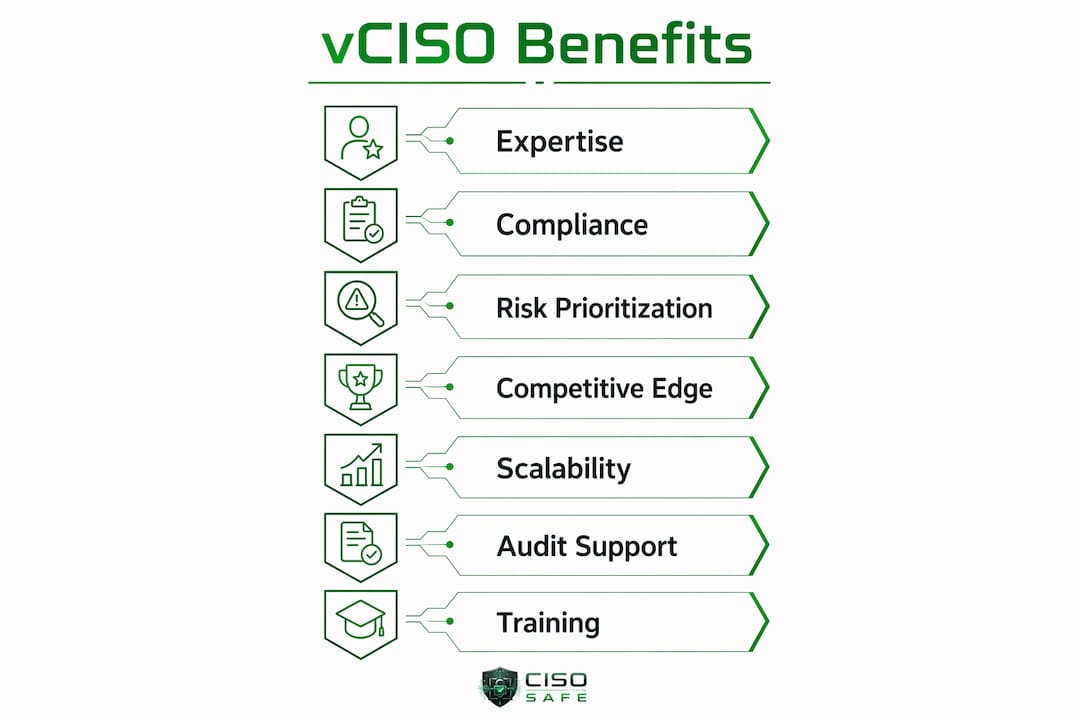
3. Objective, data-driven risk prioritization
A vCISO removes internal bias from security investment decisions. Rather than defaulting to popular tools or vendor pitches, they prioritize based on actual risk to privileged data, ensuring every dollar spent targets a real vulnerability.
4. Security as a competitive differentiator
Corporate clients now evaluate law firm security the same way they evaluate conflicts and competence. A vCISO converts security from a cost center into a trust asset that wins and retains business from security-conscious clients.
5. Scalable engagement matched to firm size
Most vCISO engagements run a flexible number of hours per month on a monthly retainer, covering risk management, compliance, incident response planning, and policy development. Firms can scale hours up during an audit or incident and reduce them during quieter periods.
6. Support for audits and vendor risk management
vCISOs lead audit preparation, review vendor contracts for data-sharing risks, and evaluate third-party security postures. Law firms relying on cloud document management, e-discovery platforms, or outside counsel portals carry third-party risk that needs active oversight. A vendor risk management program is a standard vCISO deliverable.
7. Security awareness training tailored to legal staff
Attorneys are high-value targets and, statistically, the hardest accounts to lock down without friction. A vCISO designs training that fits legal workflows rather than generic IT security modules, reducing phishing susceptibility without slowing case work.
What services does a vCISO typically deliver to legal practices?
The deliverables a vCISO provides go well beyond policy documents. For law firms specifically, the service set addresses the intersection of attorney productivity, client confidentiality, and regulatory compliance.
- Security program development: Building a documented security program aligned with NIST CSF or ISO 27001, customized to the firm's practice areas and client base
- Cybersecurity risk reviews: Structured assessments that identify gaps in access controls, email security, and endpoint protection across attorney and staff devices
- Compliance facilitation: Mapping controls to ABA guidelines, HIPAA, SOC 2, and PCI DSS, with documentation ready for client or regulatory review
- Incident response planning: Written response plans covering ransomware, business email compromise, and insider exposure, with defined escalation paths for bar notification and client communication
- Staff training programs: Phishing simulations and security awareness sessions designed around legal workflows, not generic corporate scenarios
- Vendor and third-party risk reviews: Evaluation of contracts and data-sharing agreements with cloud providers, e-discovery vendors, and co-counsel portals
- Executive reporting: Clear, plain-language risk reports for managing partners, covering current posture, open risks, and remediation progress
Pro Tip: Ask your vCISO to produce a one-page risk summary for managing partners alongside the full technical report. Partners who understand risk in business terms make faster, better-informed security budget decisions.
How does a vCISO build your cybersecurity program over time?
Law firms working with a vCISO for the first time typically move through four phases. The timeline varies by firm size and existing controls, but the sequence is consistent.
- Baseline assessment (weeks 1–4): The vCISO conducts a structured review of current security controls, policies, and compliance gaps. The output is a documented risk register and a prioritized remediation roadmap.
- Policy and procedure development (months 2–3): Core policies are written or updated, covering acceptable use, data classification, access control, and incident response. These align with the frameworks your clients and regulators expect.
- Technical and procedural control implementation (months 3–6): The vCISO directs your IT team or managed service provider to implement prioritized controls, such as multi-factor authentication, endpoint detection, and email security hardening.
- Staff training and awareness (ongoing from month 2): Training is introduced early and runs continuously, with phishing simulations and periodic refreshers tied to real threat trends affecting legal sector targets.
- Continuous monitoring and improvement (month 6 onward): The vCISO reviews metrics monthly, adjusts the risk roadmap as threats evolve, and prepares the firm for compliance audits or client security questionnaires.
What does a fractional vCISO cost, and what is the return on investment?
The financial case for a fractional vCISO is direct. A full-time CISO commands a high annual compensation with benefits and equity. A mid-market vCISO retainer is offered at substantially lower monthly cost, without benefits, equity, or onboarding expenses.
- Cost reduction: The retainer model runs at approximately one-third the cost of a full-time hire for firms under 200 employees
- Compliance cost avoidance: A documented security program reduces exposure to regulatory fines, bar complaints, and malpractice claims tied to data breaches
- Cyber insurance alignment: Insurers increasingly require evidence of a security program; a vCISO produces that documentation and can reduce premium exposure
- Reduced downtime: Proactive incident response planning shortens recovery time after a breach, limiting the productivity and reputational damage that follows
- Scalable spend: Firms can start with a lighter engagement and increase hours during audits, M&A due diligence, or post-incident remediation
Fractional vCISO services provide a faster path to compliance and incident readiness than a full-time hire, with case studies showing law firms avoiding fines and preserving client trust through proactive risk mitigation.
How does a vCISO balance security with attorney productivity?
Law firm cybersecurity has a constraint that most industries do not face at the same intensity: attorneys work on tight deadlines, share confidential files across multiple parties, and depend on document management and communication tools that must stay available. Locking those systems down too aggressively creates its own risk, because attorneys route around controls that slow them down.

A vCISO addresses this by designing controls that protect privileged data without adding friction to legitimate legal work. Access controls are tiered by role and matter sensitivity. Email security is configured to catch compromise attempts without blocking co-counsel communications. Security training is built around the actual threats law firms face, including business email compromise and ransomware, rather than generic awareness modules.
Pro Tip: When evaluating security controls, have your vCISO run a productivity impact assessment before rollout. Controls that attorneys find disruptive get disabled or bypassed. Controls that fit the workflow get followed.
Metrics matter here. A vCISO tracks security posture through quantifiable indicators: phishing click rates, patch compliance percentages, mean time to detect, and open risk items by severity. Those numbers give managing partners a clear picture of where the firm stands without requiring them to interpret technical logs.
How does a vCISO work alongside your existing IT team?
A vCISO does not replace your IT staff or managed service provider. The division is clear: IT handles technical maintenance, helpdesk support, and system administration. The vCISO provides strategic governance and compliance oversight, directing what IT implements rather than doing it themselves.

In practice, this means the vCISO sets the security roadmap and priorities, and your IT team executes the technical work. For firms using a managed service provider, the vCISO evaluates that provider's security capabilities and holds them accountable to defined standards. This model also extends to legal compliance teams: the vCISO aligns security controls with the firm's existing data governance and confidentiality obligations, so security and legal compliance reinforce each other rather than creating conflicting requirements. Professional services firms in adjacent industries, such as accounting practices managing sensitive financial data, follow a similar integration model when building data protection programs.
How do vCISOs communicate security risk to law firm leadership?
Managing partners are not security professionals. A vCISO's communication role is to translate technical risk into business impact language that partners can act on. That means framing a vulnerability not as a CVSS score but as a potential breach scenario with a dollar cost, a client notification obligation, and a bar complaint risk attached.
Reporting typically follows a monthly cadence. The vCISO delivers a risk summary covering the current security posture, completed remediation items, open risks ranked by business impact, and upcoming compliance milestones. Quarterly, the vCISO may present to the full partnership or executive committee, connecting security investments to client retention and malpractice risk reduction. This approach, translating technical exposure into business-impact terms, is what drives informed security budgeting at the partner level.
How does a vCISO handle incident response for legal data breaches?
Law firm breaches carry consequences that most industries do not face simultaneously: client notification obligations, bar reporting requirements, potential malpractice exposure, and opposing counsel scrutiny. A vCISO prepares the firm for all of these before an incident occurs.
The incident response plan a vCISO develops covers the specific threat vectors law firms face most: ransomware encrypting active matter files, business email compromise targeting wire transfers, and unauthorized access to privileged communications. Response procedures define who is notified first, how the firm communicates with affected clients, what evidence is preserved for forensic review, and how the firm documents its response for the bar and its insurance carrier. When an incident does occur, the vCISO coordinates the response, manages outside forensic vendors, and ensures the firm's actions are defensible. Cyber compliance built before a breach is what separates firms that recover cleanly from those that face secondary liability.
Key Takeaways
vCISO services give law firms executive-level security leadership, documented compliance programs, and incident readiness at a fraction of the cost of a full-time CISO hire.
| Point | Details |
|---|---|
| Cost advantage | A vCISO retainer averages $7,500/month (about $90,000/year) versus $200,000–$350,000+ annually for a full-time CISO. |
| Compliance coverage | vCISOs align law firm security programs with ABA guidelines, HIPAA, SOC 2, and PCI DSS. |
| Productivity balance | Security controls are designed to protect privileged data without disrupting attorney workflows or deadlines. |
| Engagement scale | Most engagements run 15–40 hours per month, scalable up during audits or incidents. |
| CisoSafe fit | CisoSafe delivers hands-on vCISO services and AI-powered compliance reporting built specifically for law firms across the United States. |
CisoSafe brings vCISO expertise built for law firms
Law firms need more than a generic security consultant. They need a partner who understands privilege, bar obligations, client confidentiality standards, and the specific threat vectors that target legal practices. CisoSafe is a Houston-based vCISO firm built for exactly this environment.
CisoSafe combines hands-on vCISO advisory, including security assessments, risk roadmaps, policy development, and incident response planning, with an AI-powered compliance portal that automates penetration testing, compliance intake, and professional reporting. Law firms get clear visibility into their security posture without overwhelming their IT staff or managing partners. The engagement model is fractional and flexible, sized to your firm's budget and compliance obligations, with no long-term commitment required to get started.
If your firm is ready to move from reactive security to a documented, defensible program, schedule a consultation with CisoSafe today.