

Cybersecurity compliance is defined as the practice of implementing documented security controls that meet recognized regulatory standards, and it directly reduces malpractice risk by preventing the data breaches and operational failures that trigger liability claims. For law firm partners and compliance officers, this connection is not theoretical. Noncompliance costs 2.71 times more than compliance when you factor in breach costs, fines, lost productivity, and litigation. That ratio means every dollar your firm invests in a structured compliance program saves more than two dollars in downstream exposure. Frameworks like SOC 2, NIST CSF, and the ABA Cybersecurity Guidelines give legal practices the specific controls needed to protect client confidentiality and demonstrate due diligence when a claim arises.
Why cyber compliance reduces malpractice risk in legal practices
Cybersecurity compliance reduces malpractice risk through a specific mechanism: it forces law firms to document, test, and maintain the security controls that prevent the incidents most likely to generate liability. A data breach exposing client communications, a ransomware attack that delays court filings, or an unauthorized disclosure of privileged information can each form the basis of a malpractice claim. Compliance frameworks address all three categories.

The ABA Cybersecurity Guidelines require firms to conduct regular risk assessments, maintain written security policies, and train staff on data handling. NIST CSF adds continuous monitoring and incident response requirements. SOC 2 Type 2 audits verify that controls are not just written down but actually operating over time. Each layer of documentation creates a verifiable record that your firm took reasonable precautions, which is the core defense in any malpractice proceeding.
Key controls that directly reduce malpractice exposure include:
- Access controls and multi-factor authentication (MFA): Limit who can reach client files and create an audit trail showing who accessed what and when.
- Encryption at rest and in transit: Protects privileged communications from interception, satisfying both ABA and HIPAA requirements for firms handling health-related matters.
- Incident response plans: Define exactly how your firm detects, contains, and reports a breach, reducing the window of harm and demonstrating proactive governance.
- Vendor risk management: Requires third-party service providers to meet your security standards, closing a common gap where breaches originate outside the firm but liability lands inside it.
- Continuous control monitoring: Catches configuration drift before it becomes a vulnerability, keeping your compliance posture current rather than point-in-time.
Pro Tip: Map each compliance control directly to a malpractice risk scenario. When a claim arises, your legal team needs to show that the control existed, was tested, and was functioning. A control that lives only in a policy document provides far weaker protection than one with logged evidence of operation.
Regulators now scrutinize the quality of risk analysis, not just its completion. Failure to tie risk assessments to live asset inventories and actionable remediation timelines is cited as evidence of negligence. That standard applies directly to malpractice defenses: a static, outdated risk assessment signals that your firm did not take reasonable care.
How cyber compliance lowers insurance premiums and malpractice coverage
Standard professional malpractice liability policies typically exclude cyber losses. Malpractice policies often do not cover cyber incidents, requiring separate endorsements or standalone cyber policies backed by documented security risk assessments. This distinction matters because a breach that compromises client data can generate both a malpractice claim and a cyber loss simultaneously, and without the right coverage structure, your firm absorbs one of those costs entirely.
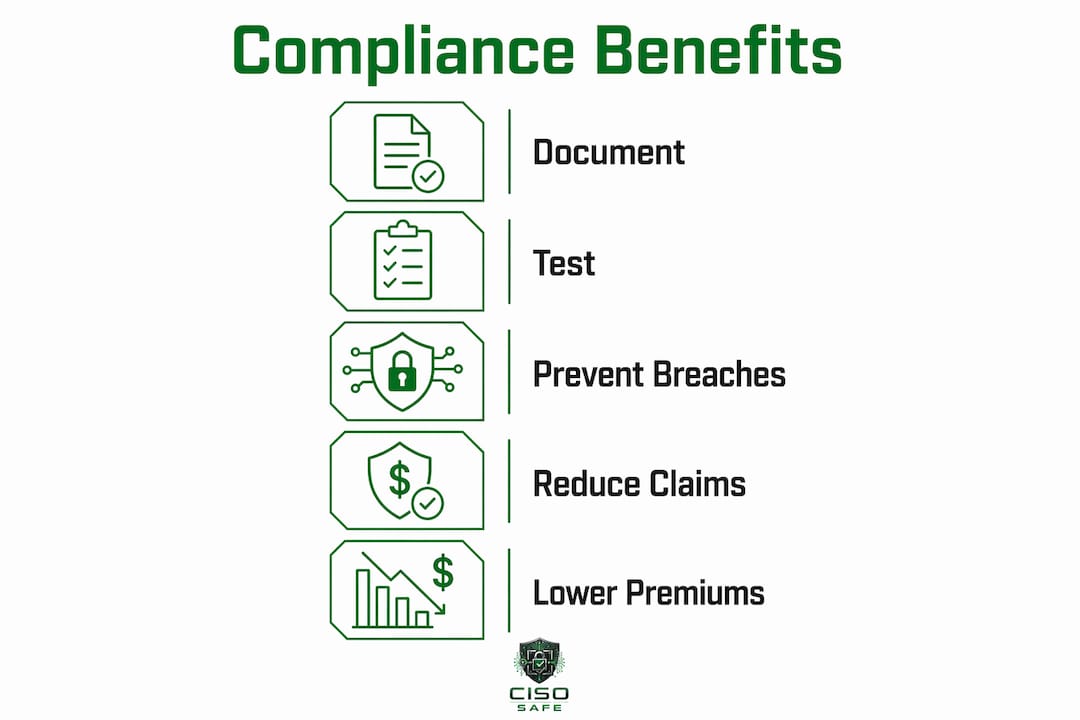
Documented cybersecurity compliance changes your firm's risk profile in the eyes of underwriters. Compliant organizations see premium reductions of 15–40% compared to non-compliant peers, while non-compliant firms face premium increases of 28–40%. That spread represents a significant annual cost difference for a mid-size law firm carrying both cyber and professional liability coverage.
Cyber insurers now treat specific controls as eligibility gates, not optional enhancements:
| Control category | Insurer treatment |
|---|---|
| MFA on all remote access | Required for coverage eligibility |
| Endpoint detection and response (EDR) | Required; absence triggers denial or surcharge |
| Immutable or offsite backups | Required; verifiable evidence needed |
| SOC 2 Type 2 certification | Reduces risk score, lowers premium |
| Documented incident response plan | Required for claim validity |
Cyber insurers require documented proof of these controls as eligibility gates. Missing any one of them can result in a denied claim at exactly the moment your firm needs coverage most.
Compliance frameworks also align your incident reporting timelines with insurer policy conditions. NIS2's 24-hour early warning and 72-hour notification requirements mirror what most cyber insurers demand before they will process a claim. Firms operating under a compliance framework that mandates these timelines are far less likely to miss a reporting window and trigger a denial.
Pro Tip: Start building your compliance documentation at least 90 days before your insurance renewal date. Organizations that begin documentation early gain measurably better negotiating leverage with underwriters. Waiting until renewal week leaves you with no evidence to present and no room to close gaps.
Common pitfalls: compliance illusion and checkbox audits
Compliance is not the same as security. Organizations can be technically compliant but still vulnerable to modern ransomware because their risk analyses are outdated and their controls have drifted from their documented state. This gap, often called "compliance drift," is one of the most common causes of malpractice exposure in firms that believe they are protected.
Checkbox compliance creates a false sense of security in several specific ways:
- Point-in-time audits: A SOC 2 Type 1 report or an annual penetration test captures a single moment. Threats evolve daily, and a control that passed in january may fail by june.
- Outdated asset inventories: Regulators and courts both look at whether your risk assessment covered your actual environment. A firm that added cloud storage or a new practice management platform without updating its asset inventory has a documented gap.
- Policies without evidence: A written incident response plan that was never tested provides minimal legal protection. Courts and insurers want logs, tabletop exercise records, and after-action reports.
- Vendor assumptions: Assuming that a cloud vendor's SOC 2 certification covers your firm's obligations is a common and costly mistake. Your firm's compliance program must address how you configure and use third-party platforms, not just whether those platforms are certified.
- Regulatory lag: Compliance frameworks update on multi-year cycles. The threat environment does not. Minimum compliance with a 2023 standard may leave your firm exposed to attack techniques that emerged in 2025.
Compliance programs must function as living documents that incorporate real-time asset inventories, continuous monitoring, and tested incident response to effectively reduce malpractice exposure. A firm that treats compliance as an annual event rather than an ongoing practice is building a legal defense on a foundation that will not hold under scrutiny.
Practical steps for law firms to reduce malpractice risk through compliance
Building a compliance program that actually reduces malpractice exposure requires more than purchasing a framework template. These steps produce verifiable, defensible results.
-
Conduct a gap analysis against a recognized framework. Use NIST CSF or the legal industry cybersecurity frameworks applicable to your firm's size and practice areas. Identify which controls are missing, which are partially implemented, and which have evidence gaps.
-
Build and maintain a live asset inventory. Every device, application, and data repository that touches client information must appear in your risk assessment. Update the inventory whenever your environment changes, not just at annual review.
-
Document controls with verifiable evidence. Logs, configuration screenshots, test results, and training completion records all serve as evidence. Store them in a format that survives a legal discovery request.
-
Align your incident response plan with insurer requirements. Confirm that your plan's reporting timelines match your cyber policy's notification conditions. Test the plan with a tabletop exercise at least once per year and document the results.
-
Assess and manage vendor risk. Require all third-party vendors with access to client data to provide their own compliance documentation. Review it annually and include vendor risk in your firm's overall risk register.
-
Integrate legal and compliance team oversight. Compliance officers and managing partners need shared visibility into the firm's risk posture. Cybersecurity governance belongs in the same conversation as legal risk management, not siloed in IT.
Pro Tip: Assign a named owner to every compliance control. When a control fails or drifts, accountability is immediate. Unnamed controls tend to be nobody's responsibility until a breach makes them everyone's problem.
Key Takeaways
Cybersecurity compliance reduces malpractice risk by creating documented, tested security controls that prevent the incidents most likely to generate liability and support your firm's legal defense when claims arise.
| Point | Details |
|---|---|
| Compliance prevents liability triggers | Documented controls stop the breaches and operational failures that generate malpractice claims. |
| Malpractice policies exclude cyber losses | Separate cyber coverage with documented risk assessments is required to close the gap. |
| Compliance lowers insurance premiums | Compliant firms see premium reductions of 15–40%; non-compliant firms face increases of 28–40%. |
| Checkbox compliance creates exposure | Outdated risk analyses and untested controls leave firms vulnerable despite formal compliance status. |
| Documentation timing matters | Starting evidence preparation 90 days before renewal improves coverage terms and negotiating position. |
What I've learned about compliance and malpractice risk after years in the field
The most dangerous belief I encounter in law firms is that passing an audit means the firm is protected. It does not. An audit confirms that controls existed on a specific date. Malpractice claims and insurance disputes are decided on what was happening at the time of the incident, not at the time of the last audit.
The firms that genuinely reduce their malpractice exposure share one characteristic: they treat compliance as a governance function, not an IT project. Managing partners are briefed on risk posture quarterly. Compliance officers have authority to pause vendor relationships that fail security reviews. Incident response plans are tested, not just filed.
The other pattern I see consistently is the documentation gap. A firm may have excellent security controls in place, but if those controls are not generating verifiable evidence, they provide almost no protection in a claim or a coverage dispute. Insurers and opposing counsel both know how to ask for logs, and "we had the control but didn't document it" is not a defense.
The shift from checkbox compliance to outcome-based security metrics is not just a philosophical improvement. It is the difference between a compliance program that holds up under legal scrutiny and one that collapses the moment it is tested. Law firms that make that shift now will be in a materially stronger position as regulatory enforcement and insurer requirements continue to tighten through 2026 and beyond.
— vCISO
How CisoSafe supports law firm compliance and malpractice protection
Law firms operating in regulated environments need more than a compliance checklist. They need a program that produces verifiable evidence, aligns with insurer requirements, and holds up under legal scrutiny.
CisoSafe delivers virtual CISO services built specifically for law firms and other compliance-sensitive organizations. The CisoSafe platform combines hands-on risk assessments, policy development, and incident response planning with AI-powered compliance reporting that generates the documentation your firm needs before renewal, before a claim, and before a regulator asks. For firms that need enterprise-grade security expertise without the cost of a full-time CISO, CisoSafe provides a practical, evidence-based path to reduced malpractice exposure and stronger insurance positioning.
FAQ
Does cybersecurity compliance directly prevent malpractice claims?
Compliance reduces the incidents that trigger malpractice claims and creates a documented defense when claims arise. It does not eliminate risk entirely, but it significantly narrows exposure.
What frameworks apply to law firm cybersecurity compliance?
The ABA Cybersecurity Guidelines, NIST CSF, and SOC 2 are the most widely applicable frameworks for law firms. Firms handling health data must also meet HIPAA requirements.
Why does cyber compliance lower insurance premiums?
Compliant organizations present lower risk to underwriters, qualifying for premium reductions of 15–40% compared to non-compliant peers who face increases of 28–40%.
Does malpractice insurance cover a data breach at a law firm?
Standard malpractice policies typically exclude cyber losses. Separate cyber coverage with documented security risk assessments is required to cover breach-related claims.
What is compliance drift and why does it matter for malpractice risk?
Compliance drift occurs when security controls fall out of their documented state between audits. Technically compliant firms can still face malpractice exposure if their controls are outdated or untested at the time of an incident.