

NIST IT security refers to the set of frameworks and publications the National Institute of Standards and Technology maintains to help organizations manage cybersecurity risk. The three that matter most are the Cybersecurity Framework (CSF) 2.0, the Risk Management Framework (RMF), and Special Publication 800-53. If you lead security or compliance and need to act now, here is the short version.
What matters right now:
- CSF 2.0 sets outcome-focused priorities and gives you a common language for talking to your board.
- RMF governs prescriptive, step-by-step authorization, typically for federal systems or contractors.
- SP 800-53 supplies the actual control catalog you map both frameworks against.
Your next 24 to 90 days:
- Run a lightweight current-state assessment against the CSF Core.
- Lock down cyber hygiene basics (MFA, patching, backups) before chasing full framework maturity.
- Choose a CSF Organizational Profile or an RMF path, depending on whether you face FISMA obligations.
Key Takeaways
Effective NIST IT security starts with CSF 2.0 for prioritization, uses SP 800-53 for control mapping, and reserves RMF for formal system authorization.
| Point | Details |
|---|---|
| Start with Govern | Set risk appetite and ownership before selecting controls, since this shapes every later decision. |
| Pick the right framework | Use CSF for enterprise prioritization and RMF only when federal authorization is required. |
| Map outcomes to controls | Tie each CSF outcome to specific SP 800-53 controls and CIS Benchmark configurations. |
| Hygiene comes first | Phishing-resistant MFA, tested backups, and patching reduce more risk than complex mappings early on. |
| CisoSafe accelerates evidence readiness | CisoSafe's vCISO advisory and platform help regulated SMBs and mid-market firms map CSF outcomes to audit-ready evidence faster than building a program alone. |
Table of Contents
- Which NIST Publications and Entities Actually Matter for IT Security
- What CSF 2.0 Covers: Functions, Profiles, and What Changed
- RMF vs. CSF: How to Choose the Right Path
- How to Implement NIST Security Standards Step by Step
- Where to Find Official NIST Documents and Mapping Tools
- Practical Priorities: Cyber Hygiene Before Framework Maturity
- Tailoring NIST Frameworks to Your Organization's Size and Sector
- Common Pitfalls When Adopting NIST Frameworks
- What Successful NIST Framework Adoption Looks Like in Practice
- Metrics and Continuous Monitoring for NIST-Aligned Programs
- Connecting NIST Frameworks to Risk Assessment and Incident Response
- How CisoSafe Accelerates Your NIST Implementation
- Frequently Asked Questions
- Sources
Which NIST Publications and Entities Actually Matter for IT Security
You don't need to read everything NIST publishes. You need to know which document answers which question, and who on your team should own it.
- CSF 2.0 / CSWP 29: The core outcomes taxonomy. Owned by your CISO or security lead; used to set priorities and talk to leadership.
- RMF: The seven-step authorization lifecycle. Owned by compliance or your system owner when federal authorization is in play.
- SP 800-53 Rev. 5: The control catalog. Owned by whoever builds your technical control set and audit evidence.
- SP 1299: A quick-start guide organized around CSF's six functions. Good for teams starting from zero.
- NCCoE: Practical, sector-specific implementation guides that turn CSF outcomes into real architectures.
- NVD: The National Vulnerability Database, your reference for CVE data feeding into vulnerability management.
CISA and the Center for Internet Security round this out. Neither is a NIST publication, but both translate NIST outcomes into specific, testable configurations your engineers can actually implement.
What CSF 2.0 Covers: Functions, Profiles, and What Changed
CSF 2.0 organizes cybersecurity outcomes into a Core built around six functions, each answering a different operational question. NIST's own description frames it as a taxonomy of high-level outcomes meant for organizations of any size, not a compliance checklist.
- Govern: Sets strategy, roles, and risk appetite. New in CSF 2.0.
- Identify: Maps assets, data, and risk exposure.
- Protect: Implements safeguards for critical services.
- Detect: Finds anomalies and adverse events quickly.
- Respond: Contains and mitigates active incidents.
- Recover: Restores capabilities and communicates lessons learned.
The biggest shift from CSF 1.1 is that new Govern function. NIST added it to make CSF sector-neutral and to push governance, supply chain risk, and executive accountability into the framework's foundation rather than treating them as an afterthought.
CSF 2.0 adds a Govern function, broadens scope beyond critical infrastructure to every organization type, and ships with quick-start guides and a reference tool built specifically to speed adoption.
Organizational Profiles let you describe your current state versus a target state for each function. Tiers describe how rigorous and integrated your risk management practices are, from ad hoc to adaptive. Neither is a scorecard; they're planning tools you use to set an appropriate target posture and explain that target to executives in plain terms.
RMF vs. CSF: How to Choose the Right Path
CSF and RMF solve different problems, and mixing them up wastes months of planning cycles.
CSF is outcome-focused and flexible. It works for enterprise risk prioritization, board communication, and building a security roadmap across a mixed technology environment. RMF is prescriptive. It follows a fixed seven-step lifecycle, Prepare, Categorize, Select, Implement, Assess, Authorize, Monitor, and it exists to support formal system authorization decisions, typically for federal agencies and their contractors.
Use this checklist:
- Choose RMF if you operate a federal information system, hold FISMA obligations, or need a formal Authority to Operate.
- Choose CSF if you're prioritizing enterprise risk, need a framework leadership actually understands, or you're not subject to federal authorization requirements.
- Use both when you have federal systems inside a broader commercial environment; RMF handles authorization, CSF handles everything else.
Here's a mapping example. Say your CSF target outcome is "Protect: Identity Management, Authentication, and Access Control are managed." That single outcome maps to a cluster of SP 800-53 controls in the AC (Access Control) and IA (Identification and Authentication) families, and under RMF, it gets addressed in the Select and Implement steps of the same lifecycle.
How to Implement NIST Security Standards Step by Step
Adopting NIST IT security guidelines works best as a sequence, not a checklist you tackle all at once.
- Assess your current state. Score yourself against the CSF Core functions to find your biggest gaps.
- Build an Organizational Profile. Document current versus target state for each function you're prioritizing.
- Map outcomes to controls. Tie each target outcome to specific SP 800-53 controls.
- Implement and remediate. Fix the highest-impact gaps first, not the easiest ones.
- Measure. Define metrics that show whether a control is actually working, not just installed.
- Monitor continuously. Reassess on a cadence, not just before an audit.
Prioritize by business impact first, threat exposure second, then ease of remediation and how quickly you can produce evidence for an auditor. A control that's cheap to fix but produces no audit trail is worth less than one that takes longer but generates clean evidence automatically.
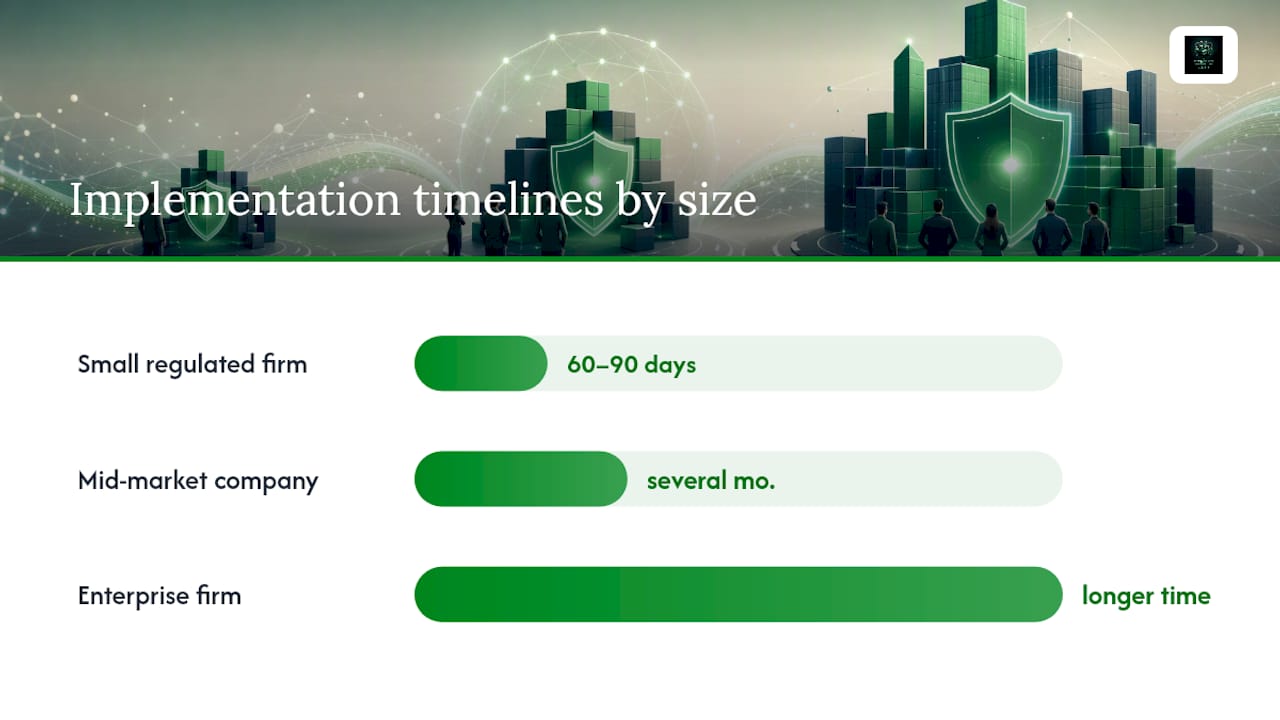
Timelines vary sharply by size. A small regulated firm might complete an initial CSF assessment and hygiene remediation in 60 to 90 days. Mid-market companies juggling multiple compliance frameworks often need several months to reach a defensible baseline. Enterprises with legacy systems and multiple business units can take a longer time to fully map and remediate.
For a concrete example: if your target CSF outcome is "Detect: Anomalies and events are analyzed," that maps to SP 800-53 controls in the AU (Audit and Accountability) and SI (System and Information Integrity) families, and operationally to CIS Benchmark configurations for logging retention and alert thresholds.
Pro Tip: Don't map every CSF subcategory at once. Pick the five or six outcomes tied to your highest-risk assets, map those completely with real evidence, and expand from there. A shallow map across everything produces less audit value than a deep map across a few priorities.
Where to Find Official NIST Documents and Mapping Tools
Skip the third-party summaries and go straight to source documents when you're building your program.
- CSWP 29: The full CSF 2.0 specification and Core taxonomy.
- NIST's CSF landing page: Central hub for the reference tool, informative references, and community profiles.
- SP 1299: Quick-start guides organized by function, the fastest way to begin.
- SP 800-53 Rev. 5: The full control catalog for mapping.
- RMF project page: Step-by-step RMF guidance and templates.
Start with the reference tool and a quick-start guide before attempting a full-scale mapping project.
Practical Priorities: Cyber Hygiene Before Framework Maturity
Most organizations overcomplicate their first ninety days. CISA's guidance is consistent on this point: basic hygiene delivers more risk reduction per dollar than anything else you'll do this year.
- Phishing-resistant MFA on every privileged and remote-access account.
- A working patch and vulnerability management cadence, not an ad hoc one.
- Tested backups, meaning you've actually run a restore, not just confirmed a backup job completed.
- Least privilege and role-based access control enforced, not just documented.
- Endpoint hardening aligned to a recognized baseline.
Pair each hygiene control with its SP 800-53 mapping and a CIS Benchmark configuration. That combination turns a vague CSF outcome like "Protect access to assets" into a specific, testable setting your team can verify. CIS Benchmarks exist precisely to close that gap between outcome and configuration.
Pro Tip: Track your hygiene metrics monthly, not annually. If patch compliance or MFA coverage dips below your threshold for two consecutive months, that's your signal to bring in outside support before it becomes an incident.
Tailoring NIST Frameworks to Your Organization's Size and Sector
A ten-person law firm and a multinational energy operator both benefit from CSF 2.0, but they shouldn't use it the same way. Scope is the lever that matters most.
Small and mid-market regulated firms, think legal practices handling client data or a healthcare clinic under HIPAA, generally do best picking a handful of CSF outcomes tied directly to their highest-risk data, rather than attempting full-Core coverage in year one. A law firm's priority is usually Protect and Respond, since client confidentiality breaches carry both legal and reputational risk.
Energy and oil and gas operators face a different profile. Operational technology environments, industrial control systems, and physical safety implications mean Identify and Protect carry outsized weight, and mapping needs to account for OT-specific considerations that don't apply to a pure IT environment.
Enterprises with federal contracts or multiple business units usually need RMF running in parallel with CSF, since federal systems require formal authorization while the broader commercial environment runs on CSF's more flexible outcome model.
The common thread: your CSF Tier should reflect your actual risk appetite and resources, not an aspirational maximum. A ten-person firm targeting Tier 4 (Adaptive) governance before it has basic asset inventory in place is solving the wrong problem first. Set a target tier that matches your mission, then build toward it in stages.
Common Pitfalls When Adopting NIST Frameworks
The single most common mistake is treating CSF 2.0 as an audit checklist instead of a risk communication tool. It's a taxonomy of outcomes, not a pass/fail exam, and teams that try to "complete" every subcategory at once burn months producing shallow documentation that satisfies no one.
A second pitfall is skipping Govern. Teams jump straight to Protect and Detect because those feel like "real security work," then discover eighteen months in that they have no risk appetite statement, no clear ownership, and no way to explain priorities to the board. Establishing Govern outcomes first, even briefly, sets the risk appetite that everything else should reference.
A third issue: choosing RMF when CSF would serve better, or vice versa. Organizations without FISMA obligations sometimes adopt RMF's rigid lifecycle because it feels more thorough, then get bogged down in authorization paperwork that provides no real security benefit for their situation.
Finally, many teams map controls without building evidence collection into the process. They pass an internal review, then scramble when an external auditor asks for proof. Building evidence generation into your control implementation from day one, rather than retrofitting it before an audit, saves enormous time later. Templates for policy and control documentation can shortcut this considerably if you don't already have a house format.
What Successful NIST Framework Adoption Looks Like in Practice
Organizations that adopt NIST IT security frameworks successfully share a pattern regardless of sector: they start narrow, build evidence habits early, and expand scope only after the first slice proves out.
A mid-market healthcare provider under HIPAA, for instance, typically starts by mapping just the Protect and Respond functions to the handful of systems holding patient data, rather than attempting an organization-wide CSF rollout on day one. That narrow scope lets the security team demonstrate measurable progress within a single quarter, which builds executive buy-in for expanding the program.
Energy sector operators applying NIST guidance to OT environments tend to follow a similar staged pattern: Identify and Protect first, since asset visibility in industrial environments is often the biggest initial gap, followed by Detect once monitoring infrastructure catches up. Sector-specific NCCoE profiles exist precisely because generic CSF guidance doesn't fully address OT nuances like legacy protocols and uptime requirements that override typical patching cadences.
Law firms handling sensitive client and case data generally see the fastest wins from combining a CSF Profile with a prescriptive framework like SOC 2 or CIS Benchmarks. The CSF Profile sets priorities and the language for partner-level conversations, while the prescriptive layer provides the concrete configurations that satisfy client security questionnaires. Firms that skip the prescriptive layer often struggle to answer detailed vendor security assessments even after building a reasonable CSF Profile.
Metrics and Continuous Monitoring for NIST-Aligned Programs
A framework mapping means little without a way to prove the underlying controls actually work. Continuous monitoring is the CSF function most organizations underinvest in, largely because it requires ongoing measurement rather than a one-time project.
Effective metrics tie directly back to CSF outcomes rather than measuring activity for its own sake. Instead of tracking "number of patches applied," track mean time to remediate critical vulnerabilities, since that number reflects actual risk reduction. Instead of "MFA policy exists," track percentage of privileged accounts with phishing-resistant MFA enforced, checked monthly.
Build a small dashboard around four or five metrics maximum: patch compliance rate, MFA coverage on privileged accounts, backup restore test success rate, mean time to detect, and mean time to respond. These map cleanly to Protect, Detect, and Respond outcomes, and executives can track them without a security background.
Continuous monitoring under RMF has a formal step for this reason. CSF doesn't mandate a specific cadence, but quarterly reassessment against your Organizational Profile is a reasonable default for most mid-market organizations, with monthly checks on your core hygiene metrics in between. Reassessing only during audit season guarantees you'll find your worst gaps at the worst possible time.
Connecting NIST Frameworks to Risk Assessment and Incident Response
CSF and RMF don't operate in isolation from your broader risk and incident response processes. They're supposed to feed each other directly.

Your CSF Identify function should produce the asset inventory and risk register that your formal risk assessment process consumes. If those two efforts run separately, you end up with duplicate work and inconsistent risk ratings between your security team and your compliance team.
The Respond and Recover functions should map directly onto your incident response plan, not sit as a separate abstract exercise. When you build an IR plan, each phase, detection, containment, eradication, recovery, should reference the specific CSF outcomes and SP 800-53 controls it depends on. That way, a tabletop exercise that reveals a gap in your containment process points directly back to a specific control you need to strengthen, rather than a vague finding with no clear remediation path. A NIST-aligned incident response template built this way turns your IR plan into a living extension of your framework mapping rather than a document that gathers dust until the next incident.
An Honest Take on Where NIST Adoption Usually Goes Wrong
The teams that struggle most with NIST IT security guidelines aren't lacking technical skill. They skip Govern, treat CSF as a checklist, and build controls with no evidence trail, then scramble at audit time. Bringing in vCISO support early doesn't just add hands. It compresses the timeline from scattered effort to audit-ready evidence by months.
How CisoSafe Accelerates Your NIST Implementation
If you lead security or compliance at a regulated SMB or mid-market firm, whether in legal, energy, or healthcare, building a NIST-aligned program on top of your existing workload is a real bottleneck. CisoSafe closes that gap by pairing hands-on vCISO advisory with a SaaS platform that automates compliance intake, penetration testing, and professional reporting across more than 50 frameworks, including CSF 2.0 and SP 800-53 mappings.
Instead of hiring a full-time CISO or a large consultancy, you get an experienced advisor who builds your Organizational Profile, maps your priority outcomes to concrete controls, and produces audit-ready evidence your leadership can actually present to clients and regulators. For a deeper look at scoping this work for a smaller organization, our guide on security frameworks for SMB firms walks through the same prioritization logic in more detail.
If you're ready to move from a framework on paper to a program with evidence behind it, start a conversation with CisoSafe about a vCISO engagement or a platform trial.
Frequently Asked Questions
Is NIST IT security a legal requirement? NIST frameworks are mandatory for most federal agencies and their contractors under FISMA, which typically means following RMF. For private-sector organizations, CSF adoption is voluntary but increasingly expected by regulators, insurers, and business partners as a baseline for cybersecurity best practices.
Do I need both CSF and RMF? Only if you operate federal systems alongside a broader commercial environment. Most regulated SMBs and mid-market firms outside federal contracting only need CSF paired with SP 800-53 control mappings.
How long does it take to implement NIST security controls? A focused initial assessment and hygiene remediation can take 60 to 90 days for a smaller organization. Full CSF Profile mapping across an enterprise typically takes several quarters to a year, depending on scope and existing maturity.
What's the difference between CSF 2.0 and ISO 27001? CSF 2.0 is a flexible outcomes taxonomy with no certification requirement, while ISO 27001 is a certifiable management system standard with a formal audit process. Many organizations use CSF for internal prioritization and pursue ISO 27001 or SOC 2 when a client or contract requires formal certification.
Where should I start if my organization has no existing framework? Begin with a CSF Core self-assessment, address MFA, patching, and backup gaps immediately, then build an Organizational Profile around your highest-risk systems before attempting a full control mapping.
Sources
- The NIST Cybersecurity Framework (CSF) 2.0 (CSWP 29)
- NIST Risk Management Framework | CSRC
- NIST Releases Version 2.0 of Landmark Cybersecurity Framework | NIST
- NIST Special Publication 800-53 Revision 5 — Security and Privacy Controls for Information Systems and Organizations