

Information security compliance is the set of policies, controls, and evidence processes an organization uses to meet legal, regulatory, and industry security requirements. Put plainly: compliance proves you manage confidentiality, integrity, and availability for the data you are responsible for, and you can demonstrate that proof to an auditor, regulator, or client on demand.
The verdict: compliance is not just a legal obligation. It is a business enabler. Organizations that treat it as a risk management discipline, rather than a one-time project, win contracts, retain clients, and avoid the fines and reputational damage that follow a breach or failed audit.
Start here:
- Scope your data. Identify what types of data you hold (PII, PHI, payment card data, intellectual property) and which systems process or store it.
- Assess your current state. Run a gap analysis against the framework most relevant to your industry before committing to a remediation budget.
- Choose your framework(s). Align to NIST CSF 2.0 for risk communication, ISO/IEC 27001 for certification, and sector-specific rules (HIPAA, PCI DSS, CMMC) for legal obligation.
- Assign ownership. Designate a compliance lead or engage a vCISO before you begin remediation.
- Build for continuity. Plan for continuous monitoring from day one, not just audit-season evidence collection.
Key Takeaways
Information security compliance requires a continuous, risk-based program with defined ownership, automated evidence collection, and executive-level reporting to remain audit-ready and defensible year-round.
| Point | Details |
|---|---|
| Scope before you select a framework | Identify data types, systems, and third parties in scope first; the right framework follows from what you protect. |
| Match frameworks to business drivers | SOC 2 for enterprise contracts, HIPAA for PHI, PCI DSS for payment data, CMMC for DoD work, ISO 27001 for international certification. |
| Build for continuous monitoring | Automated evidence pipelines and control health dashboards reduce audit prep effort and prevent year-end scrambles. |
| Report compliance as risk metrics | Present control coverage rate, time-to-remediate, and audit finding recurrence to boards as quarter-over-quarter trends. |
| CisoSafe for managed compliance | CisoSafe's vCISO services and AI-powered platform deliver gap analysis, automated evidence, and audit readiness for regulated organizations across the United States. |
Table of Contents
- What does information security compliance actually cover?
- Which compliance frameworks and regulations apply to your organization?
- What are the core components of a compliance program?
- What does a realistic implementation roadmap look like?
- How do you map identified risks to specific controls?
- How do you prepare for a compliance audit or certification?
- How do you keep compliance running between audits?
- When should you hire a vCISO or managed compliance partner?
- Why a risk-first compliance program beats a one-off project
- CisoSafe accelerates your path to audit readiness
- Sources
What does information security compliance actually cover?
Compliance programs are broader than most organizations initially expect. The scope covers four interconnected layers: data, systems, people, and third parties.
Data in scope typically includes personally identifiable information (PII), protected health information (PHI), payment card data, and proprietary intellectual property. Each data type carries its own regulatory obligations. PHI triggers HIPAA. Payment card data triggers PCI DSS. PII held on EU residents triggers GDPR, and on California residents, CCPA.
Systems in scope include every platform, application, database, and network segment that stores, processes, or transmits regulated data. Cloud infrastructure, SaaS tools, and remote-access endpoints all count. Organizations frequently underestimate scope because they focus on primary databases and overlook backup systems, developer environments, and third-party integrations.
People and processes are where most compliance programs have gaps. Cybersecurity compliance means adhering to standards and regulatory requirements set by laws, agencies, or authorities, which means the obligation extends to how employees handle data, not just how systems protect it. Training records, access reviews, and change management logs are all evidence items auditors will request.
Third parties represent a significant and growing obligation. Vendors, subprocessors, and managed service providers that touch your data extend your compliance boundary. CSF 2.0's supply chain risk management function and ISO/IEC 27001's supplier relationship controls both address this directly. For a deeper look at managing that exposure, the CisoSafe guide on supply chain cyber risk covers the practical steps business leaders need.
Three core concepts underpin every compliance program:
- CIA triad: Confidentiality (limiting access to authorized users), Integrity (preventing unauthorized modification), and Availability (keeping systems accessible when needed) are the three properties every control is designed to protect.
- Controls vs. processes vs. evidence: A control is a safeguard (e.g., multi-factor authentication). A process is how you operate it consistently (e.g., MFA enrollment and exception handling). Evidence is the documented proof that the control worked as intended during the audit period.
- Attestation vs. self-assessment: Some frameworks (SOC 2, ISO 27001) require an independent third-party auditor to issue an opinion or certificate. Others (HIPAA, CMMC Level 1) allow self-assessment with documented evidence. Knowing which applies to your situation determines your audit budget and timeline.
Which compliance frameworks and regulations apply to your organization?
The answer depends on your industry, your customers, and the data you handle. Most mid-market organizations end up operating under two or three frameworks simultaneously. Understanding how they differ prevents duplicated effort and helps you build a control set that satisfies multiple requirements at once.
NIST Cybersecurity Framework (CSF) 2.0
CSF 2.0 provides a sector- and technology-neutral taxonomy of cybersecurity outcomes, organized around six functions: Govern, Identify, Protect, Detect, Respond, and Recover. It is not a certification standard. No auditor issues a CSF certificate. Its value is as a communication and prioritization tool: it translates technical controls into business outcomes that executives and boards can understand. CSF 2.0 added the Govern function specifically to address risk appetite, roles, and supply chain obligations that earlier versions left implicit. Quick Start Guides make it accessible for smaller organizations that lack a dedicated security team.
ISO/IEC 27001:2026
ISO/IEC 27001 is the world's best-known standard for information security management systems (ISMS) and prescribes requirements for establishing, implementing, maintaining, and continually improving an ISMS. It covers people, processes, and technology holistically. Unlike CSF, ISO 27001 offers formal third-party certification, which carries significant weight in enterprise procurement and international contracts. The 2022 revision reorganized Annex A controls and added new categories for cloud security, threat intelligence, and physical security monitoring.
SOC 2 (AICPA)
SOC 2 is the dominant attestation standard for technology and SaaS companies serving enterprise clients. It is built around five Trust Services Criteria: Security, Availability, Processing Integrity, Confidentiality, and Privacy. A Type I report covers design of controls at a point in time. A Type II report covers operating effectiveness over a period, typically six to twelve months, and is what most enterprise buyers require before signing a contract. SOC 2 does not prescribe specific controls; it evaluates whether your controls achieve the criteria.
HIPAA
The Health Insurance Portability and Accountability Act, administered by HHS, applies to covered entities (healthcare providers, health plans, clearinghouses) and their business associates. The Security Rule requires administrative, physical, and technical safeguards for electronic PHI. HIPAA does not offer certification; compliance is demonstrated through documented risk analysis, policies, and evidence of implemented safeguards. Penalties for violations are tiered by culpability and can reach significant levels per violation category.
PCI DSS
The PCI Security Standards Council governs PCI DSS, and any organization that stores, processes, or transmits payment card data must comply. PCI DSS v4.0 introduced customized implementation options that allow organizations to demonstrate equivalent security through compensating controls, which gives larger merchants more flexibility. Validation level depends on transaction volume: Level 1 merchants (over six million transactions annually) require an on-site assessment by a Qualified Security Assessor (QSA). Smaller merchants may self-assess using a Self-Assessment Questionnaire (SAQ).
CMMC (Cybersecurity Maturity Model Certification)
CMMC applies to organizations in the U.S. defense industrial base that handle Controlled Unclassified Information (CUI) or Federal Contract Information (FCI). It has three levels. Level 1 covers basic cyber hygiene (17 practices). Level 2 aligns to NIST SP 800-171 (110 practices) and requires third-party assessment for most contracts. Level 3 adds NIST SP 800-172 requirements for the most sensitive programs. CMMC is a contract requirement: without the right certification level, an organization cannot bid on or hold covered DoD contracts.
GDPR and CCPA
Both are privacy laws with direct security implications. GDPR (EU) and CCPA (California) require organizations to implement appropriate technical and organizational measures to protect personal data. Neither specifies a control catalog, but both require documented risk assessments, breach notification procedures, and data subject rights processes. GDPR's breach notification window is 72 hours to the supervisory authority. CCPA's security obligations are enforced through the California Privacy Protection Agency and private right of action for data breaches.
Framework comparison
| Framework | Who it applies to | Certification/attestation | Maturity/rigor | Typical implementation | Primary outcome |
|---|---|---|---|---|---|
| NIST CSF 2.0 | Any organization, any sector | None (self-assessed) | Flexible, scales to org size | 2–6 months for initial profile | Risk communication and prioritization |
| ISO/IEC 27001 | Any organization seeking ISMS certification | Third-party certification (accredited CB) | Moderate to high | several months | ISMS certification, audit evidence |
| SOC 2 | Technology/SaaS companies with enterprise clients | CPA firm attestation (Type I or II) | Moderate | a few months | Customer trust, contract enablement |
| HIPAA | Healthcare covered entities and business associates | No certification; self-assessed with evidence | Moderate | several months | PHI protection, regulatory compliance |
| PCI DSS | Any org processing payment card data | QSA assessment or SAQ (by level) | Moderate to high | a few months | Payment data security, card brand compliance |
| CMMC | DoD contractors handling CUI/FCI | Third-party C3PAO assessment (Levels 2–3) | High | several months | DoD contract eligibility |
| GDPR/CCPA | Orgs processing EU/CA resident personal data | No certification; regulatory enforcement | Moderate | several months | Privacy rights, breach readiness |
For organizations deciding which framework to prioritize first: if you serve enterprise clients and need to win contracts, SOC 2 Type II is often the fastest path to revenue impact. If you handle PHI, HIPAA is non-negotiable. If you want a foundation that maps to everything else, start with NIST CSF 2.0 and layer ISO 27001 when international certification becomes a business requirement.
What are the core components of a compliance program?
A compliance program is not a checklist. It is an operating model with defined roles, repeatable processes, and documented evidence. Organizations that treat it as a checklist produce documentation that satisfies an auditor once and then drifts out of alignment within months.
Governance
Governance starts with three decisions: who owns compliance, what the organization's risk appetite is, and what policies govern behavior. The compliance owner, whether an internal CISO, a vCISO, or a compliance committee, must have authority to enforce decisions and budget to fund remediation. Risk appetite statements define how much residual risk leadership will accept after controls are in place. Policies translate that appetite into specific rules: acceptable use, access control, data classification, incident response, and vendor management.

Risk management
A risk register is the operational core of any compliance program. It captures identified risks, their likelihood and impact ratings, the controls assigned to treat them, and the residual risk after treatment. Risk assessments should be conducted at least annually and after material changes to the environment. The output of each assessment feeds directly into the remediation backlog and control selection decisions.
Controls lifecycle
NIST SP 800-53 offers a comprehensive catalog of security and privacy controls designed to be tailored via baselines and overlays. Selecting controls from a recognized catalog, rather than building a custom list, makes it far easier to map evidence to multiple frameworks simultaneously. Once selected, controls must be implemented, tested, and documented. Evidence collection is not a pre-audit activity; it is a continuous operational task.
Operational functions
Four operational functions keep a program running between audits:
- Incident response: A documented IR plan with defined roles, escalation paths, and communication templates. Tabletop exercises validate the plan at least annually.
- Logging and monitoring: Centralized log collection, SIEM alerting, and regular review of security events. Logs must be retained for the period required by each applicable framework.
- Third-party risk management: Vendor assessments, contractual security requirements, and periodic reviews of critical suppliers. For organizations in regulated sectors, this extends to subprocessors and cloud providers.
- Security awareness training: Annual training for all staff, with role-specific modules for privileged users and those handling regulated data. Training completion records are a standard audit request.
Pro Tip: Document your controls in a way that generates evidence automatically. A policy that requires quarterly access reviews is only useful if the review results are captured in a system that produces a dated, signed artifact. If your control documentation does not describe how evidence is generated, auditors will treat the control as unimplemented.
What does a realistic implementation roadmap look like?
Effective compliance programs define scope, perform gap analysis, remediate gaps, manage continuous monitoring, and prepare for audit through evidence collection and documentation. That sequence is correct, but the timeline varies significantly by organization size and starting maturity.
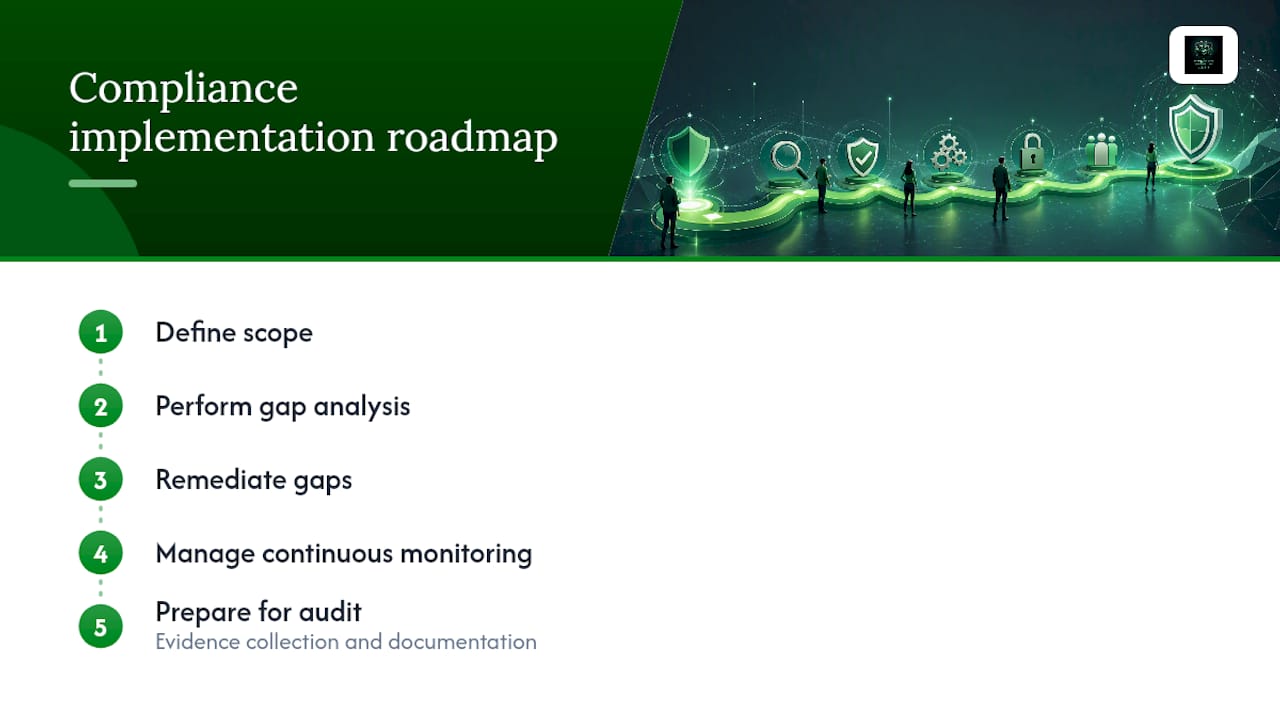
Phased roadmap
Phase 1: Scope and inventory (weeks 1–4). Define data types, systems, and third parties in scope. Assign a compliance owner. Select the target framework(s) based on business drivers.
Phase 2: Gap analysis (weeks 3–8). Assess current controls against the target framework. Produce a prioritized gap list with business impact ratings. This phase often surfaces surprises: undocumented systems, shadow IT, and vendor contracts with no security requirements.
Phase 3: Remediation (weeks 6–24). Address gaps in priority order. Technical remediation (patching, MFA deployment, encryption) typically runs in parallel with policy and process development. Remediation is the most resource-intensive phase and the primary driver of cost.
Phase 4: Controls and evidence (weeks 12–28). Implement evidence collection processes for each control. Shift from manual collection to automated feeds where possible. Automated evidence pipelines, built on log aggregation and configuration management tools, cut audit preparation time and reduce human error.

Phase 5: Audit readiness (weeks 20–36). Conduct an internal readiness assessment or pre-audit. Address findings. Engage the auditor or certification body.
Phase 6: Continuous monitoring (ongoing). Establish control health dashboards, vulnerability management cadence, and a regular review cycle. This phase is what separates organizations that remain audit-ready year-round from those that scramble every audit season.
Timeline by organization size
| Organization type | Typical timeline | Key variables |
|---|---|---|
| SMB (small and medium-sized businesses) | several months | Starting maturity, single framework, limited IT staff |
| Mid-market (mid-sized organizations) | several months | Multiple frameworks, legacy systems, vendor complexity |
| Enterprise (large enterprise organizations) | 12–36 months | Multi-site, complex supply chain, regulatory overlap |
Common cost drivers
- People: Internal staff time for gap analysis, remediation, and evidence collection. Often the largest hidden cost.
- Tooling: SIEM, vulnerability scanners, GRC platforms, and identity management systems.
- Remediation: Infrastructure upgrades, encryption projects, and network segmentation work.
- Audit fees: QSA assessments, ISO certification body fees, and SOC 2 CPA firm engagements.
- External expertise: vCISO retainers or compliance consulting engagements, which typically cost significantly less than a full-time CISO hire.
For mid-market organizations specifically, the CisoSafe guide on security assessments for mid-market companies covers how to integrate CSF with NIST RMF and SP 800-37 during the gap analysis phase.
How do you map identified risks to specific controls?
Risk-to-control mapping is the analytical step that turns a gap analysis into a prioritized remediation plan. Without it, teams fix what is easiest rather than what matters most.
The process follows four steps:
- Step 1: Identify risks. Document each risk as a specific statement: "Unauthorized access to customer PII due to weak authentication on the CRM platform." Vague risk statements produce vague controls.
- Step 2: Prioritize by business impact. Rate each risk by likelihood and potential business impact (financial, operational, reputational, regulatory). High-impact, high-likelihood risks go to the top of the remediation backlog.
- Step 3: Select control families. Match each risk to the relevant control families. A ransomware risk maps to backup and recovery controls, network segmentation, endpoint protection, and user training. A data exfiltration risk maps to data loss prevention, access controls, and logging.
- Step 4: Map to framework functions and clauses. Using a three-column artifact, record the risk statement, the business impact rating, and the candidate controls mapped to both the CSF function (e.g., PR.DS for data security) and the relevant ISO/IEC 27001 clause. This creates a clean audit narrative and accelerates remediation prioritization.
Checklist for a remediation sprint:
- Confirm risk statement is specific and tied to a named system or data type
- Assign a business impact rating (High/Medium/Low) with documented rationale
- Select at least one primary control and one compensating control per risk
- Map each control to the CSF function and ISO 27001 clause (or applicable framework clause)
- Assign an owner and a target remediation date
- Define the evidence artifact the control will produce
- Schedule a control test date within 30 days of implementation
A short mapping example: a ransomware risk against a law firm's document management system maps to backup and recovery controls (NIST PR.DS-1, ISO 27001 A.8.13), network segmentation (NIST PR.AC-5, ISO 27001 A.8.22), and endpoint detection (NIST DE.CM-4, ISO 27001 A.8.7). Each of those controls has a defined evidence artifact: backup test logs, firewall rule exports, and EDR alert reports. Law firms navigating this type of mapping can also reference the CisoSafe guide on cybersecurity frameworks for law firms for sector-specific context.
How do you prepare for a compliance audit or certification?
Audit readiness is not a sprint you run in the weeks before an assessment. It is the cumulative result of operating your controls consistently and collecting evidence throughout the year. Organizations that treat it as a sprint consistently find gaps that take longer to close than the time available.
What auditors expect
- Policies and procedures: Current, approved, and distributed. Auditors check version dates, approval signatures, and evidence of employee acknowledgment.
- Control evidence: Logs, screenshots, configuration exports, and system-generated reports showing controls operated as designed during the audit period.
- Risk assessment documentation: A current risk register with documented treatment decisions and residual risk ratings.
- Change records: Change management logs showing that changes to in-scope systems went through an approved process.
- Training records: Completion records for security awareness training, with dates and employee names.
- Third-party contracts: Vendor agreements with security and data protection clauses, and evidence of vendor assessments.
- Incident response records: Documentation of any security incidents during the period, including response actions and post-incident reviews.
Best practices for evidence collection
- Automate where possible. Log aggregation platforms, configuration management tools, and GRC systems can generate continuous evidence feeds. Manual collection is error-prone and expensive at scale.
- Maintain an evidence repository. A centralized, access-controlled repository with folder structures that mirror your control framework makes auditor requests fast to fulfill.
- Run quarterly internal reviews. Treat each quarter as a mini-audit. Review control health, update the risk register, and close any evidence gaps before they accumulate.
- Pre-audit readiness assessment. Engage an independent reviewer, internal or external, to walk through the same evidence an auditor will request. Findings from a pre-audit are far less costly than findings from the real one.
Common audit pitfalls
- Scope creep: Systems added to the environment without updating the compliance scope. Establish a process that triggers a scope review whenever a new system is onboarded.
- Stale policies: Policies that reference outdated systems, roles, or processes. Assign a policy owner and a review date to every document.
- Missing evidence for the full audit period: A control implemented in month ten of a twelve-month SOC 2 period only covers two months. Auditors will note the gap.
- Undocumented exceptions: Every exception to a policy must be documented, approved, and time-limited. Undocumented exceptions are treated as control failures.
How do you keep compliance running between audits?
Compliance does not pause between audit cycles. The organizations that maintain the strongest posture treat it as an operational discipline, not a project with a start and end date.
Core operational tasks:
- Centralized logging and SIEM: All in-scope systems feed logs to a central SIEM. Alert rules are tuned to flag anomalies relevant to your threat profile. Logs are retained per framework requirements (PCI DSS requires one year; HIPAA requires six years for certain records).
- Vulnerability management: Regular scans of in-scope systems, with a defined patching cadence. Critical vulnerabilities patched within 30 days is a common benchmark; PCI DSS v4.0 sets specific timelines for internal and external scans.
- Control health checks: Monthly or quarterly reviews of each control's operating status. A control that was working in January may have drifted by March due to a configuration change or a staff departure.
- Third-party risk reviews: Annual or event-triggered reviews of critical vendors. A vendor that suffers a breach or changes its subprocessors triggers an immediate review.
- Patch and change management: A documented process for testing and deploying patches, with records that satisfy auditor requests for change history.
KPIs and metrics to report to leadership:
- Control coverage rate: Percentage of required controls with documented, tested evidence. Target: 95%+ for audit readiness.
- Time-to-remediate: Average days from a finding (internal or external) to verified closure. Trending this metric over time shows program maturity.
- Audit finding recurrence rate: Percentage of findings from the prior audit that reappear in the current one. A declining rate signals genuine improvement.
- Vulnerability mean time to patch: Average days from discovery to patch deployment, segmented by severity.
- Training completion rate: Percentage of required personnel who completed security awareness training within the required window.
Boards and executives respond to trends, not snapshots. Present these metrics as quarter-over-quarter trends with a brief narrative explaining material changes. CSF 2.0's governance function provides a useful structure for organizing executive-level reporting, since it frames cybersecurity outcomes in terms of risk and business impact rather than technical control status.
When should you hire a vCISO or managed compliance partner?
Not every organization needs a full-time CISO. But every organization that handles regulated data needs someone with the expertise to design, implement, and defend a compliance program. The question is whether that expertise should be internal or external.
Clear signals you need external help:
- Your organization has grown into a new regulatory obligation (CMMC, HIPAA, PCI DSS) and no one internally has implemented that framework before.
- You have failed or received significant findings in a prior audit and need to rebuild the program.
- Leadership bandwidth is consumed by operational priorities, and compliance tasks are consistently deprioritized.
- You are preparing for a major contract or acquisition that requires a SOC 2 Type II report or ISO 27001 certificate within a defined timeline.
- Your current security team is strong on operations but lacks policy, audit, and governance experience.
Questions to ask when evaluating a vCISO or compliance partner:
- Can you show a sample remediation roadmap tied to measurable KPIs (time-to-remediate, percentage of controls automated, audit finding recurrence)?
- Do you have automated evidence pipelines, or will your team collect evidence manually?
- What is your experience with our specific framework(s) and industry?
- How do you communicate compliance status to executive leadership and boards?
- What does the engagement look like after the initial assessment: retainer, project-based, or a hybrid?
What a vCISO engagement typically delivers:
A mid-market professional services firm with no prior compliance program engaged a vCISO to prepare for SOC 2 Type II. The engagement began with a gap analysis that identified 47 control gaps across access management, logging, and vendor management. The firm achieved a clean SOC 2 Type II report within eleven months of starting the engagement, which directly supported two enterprise contract wins that required the attestation.
The key differentiator in that outcome was not the framework knowledge. It was the combination of automated evidence pipelines and a remediation roadmap tied to specific KPIs, which kept the engagement on track and gave leadership clear visibility throughout.
Why a risk-first compliance program beats a one-off project
The most common mistake organizations make with compliance is treating it as a destination rather than a discipline. A team spends six months achieving SOC 2 Type II, files the report, and then lets the program drift until the next audit cycle. Twelve months later, controls have degraded, evidence is missing, and the remediation cost is nearly as high as the first engagement.
The organizations that build durable compliance programs share one characteristic: they align compliance to business risk, not to audit calendars. That means the risk register drives the remediation backlog, not the auditor's request list. It means control health is monitored continuously, not reviewed in a pre-audit sprint. And it means executive leadership receives regular, quantified updates on compliance posture, so they can make informed decisions about risk tolerance and investment.
CSF 2.0's Govern function exists precisely for this reason. It places risk management strategy, roles, and supply chain obligations at the top of the framework, not as an afterthought. When compliance is governed at the executive level, with clear ownership and a defined risk appetite, the program becomes self-sustaining. When it is delegated entirely to IT without executive alignment, it becomes a documentation exercise.
One communication framework that works well at the board level: present compliance status as a risk dashboard with three metrics (control coverage rate, time-to-remediate trend, and audit finding recurrence) alongside a brief narrative on the top two or three open risks and their business impact. Boards do not need to understand MFA configurations. They need to understand whether the organization's risk posture is improving, stable, or deteriorating, and what it will cost to address the gaps.
CisoSafe accelerates your path to audit readiness
For organizations that need to achieve and maintain compliance without the cost of a full-time CISO or a large consultancy engagement, CisoSafe delivers a practical alternative. The combination of hands-on vCISO services and an AI-powered SaaS platform means your organization gets experienced compliance leadership, automated evidence collection, and a clear remediation roadmap, all in one engagement.
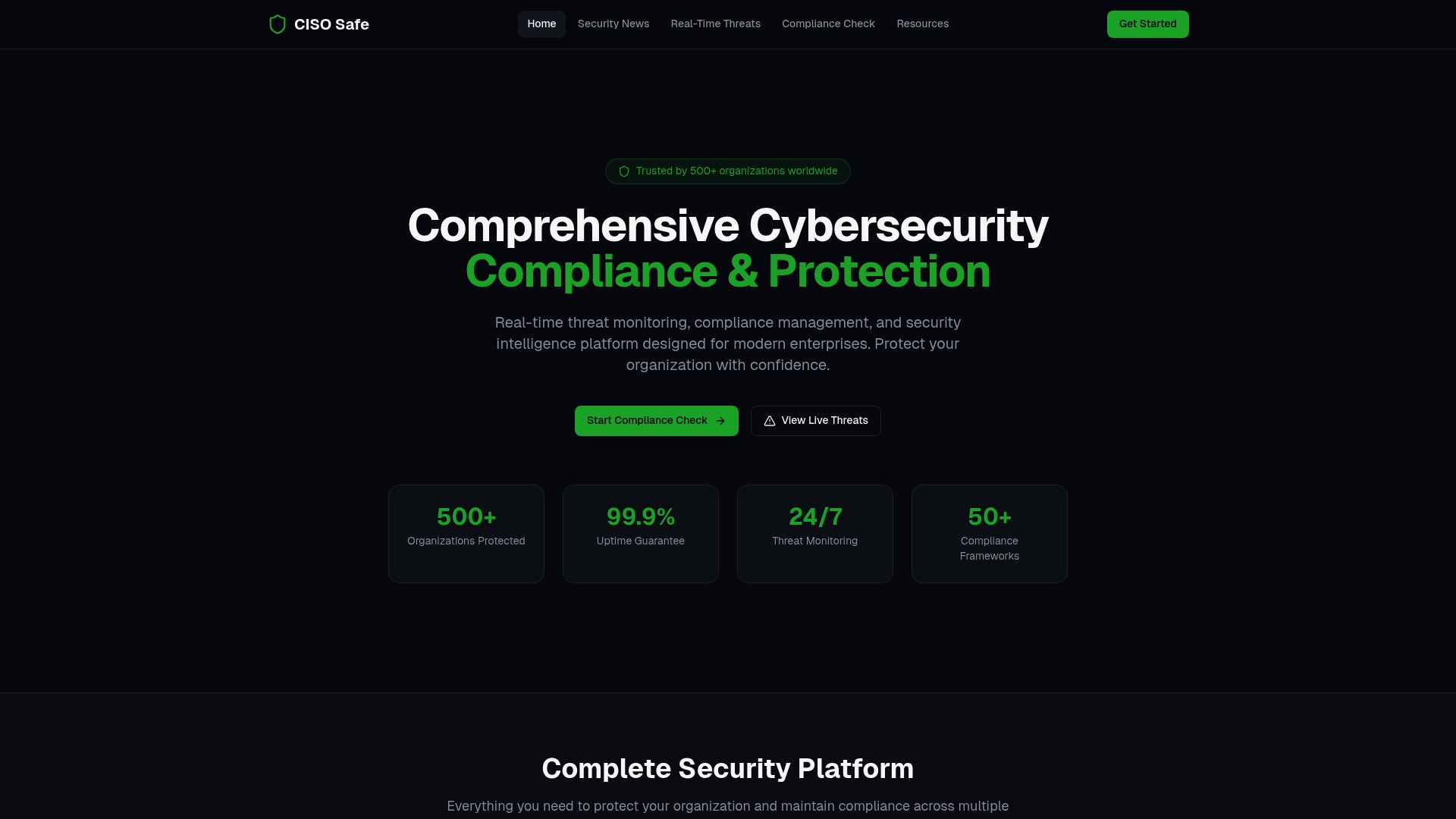
CisoSafe works with law firms, energy operators, healthcare organizations, and other regulated businesses across the United States. Engagements are structured to fit your situation: a focused assessment and remediation sprint for organizations starting from scratch, a retainer for ongoing vCISO advisory and continuous monitoring, or a targeted audit prep package for organizations approaching a SOC 2, HIPAA, PCI DSS, or CMMC assessment. The platform automates penetration testing, compliance intake across 50+ frameworks, and professional reporting, so your leadership team gets clear visibility into risk without requiring a dedicated internal security team to manage the process.
Schedule a security assessment with CisoSafe to get a prioritized gap analysis and a remediation roadmap your team can act on immediately.
Sources
These sources are vetted for authority and are suitable for use in board briefings, RFP language, and audit evidence requests.
- ISO/IEC 27001:2022 - Information security management systems
- The NIST Cybersecurity Framework (CSF) 2.0
- PCI Security Standards Council
When drafting RFP security requirements or audit evidence requests, cite the NIST and ISO sources directly. Auditors and procurement teams recognize these as authoritative, and referencing them signals program maturity.