

Start with CIS policy templates, SANS policy packs, and Microsoft Security Templates as your foundation. Download them, map each policy statement to a specific control, assign an owner, and convert soft language to declarative requirements. That sequence is what separates a filed document from an audit-ready policy.

The term "security template" covers two distinct categories: policy documents (acceptable use, access control, incident response) and technical configuration baselines (Windows GPO exports, CIS Benchmarks, JSON/YAML for infrastructure-as-code). Both are necessary. Neither is plug-and-play.
Start here:
- Policy documents: CIS policy templates (free, mapped to CIS Controls v8/v8.1, IG1-focused), SANS policy packs (free, broad topic coverage), and CompliQuick editable DOCX templates
- Technical baselines: Microsoft Security Templates and GPO baselines, CIS Benchmarks for Windows/Linux/cloud (machine-readable formats available)
- Modular/IaC-friendly: JupiterOne's open-source policy template repository on GitHub (JSON-mapped, controls-linked)
The workflow: download the template that matches your regulatory scope, map each statement to your target framework (CIS Controls, NIST CSF, ISO 27001), assign an accountable owner per policy section, replace permissive language with "must" or "shall," and schedule a review date before you publish.
Table of Contents
- Where do you get authoritative security templates?
- What must every cybersecurity policy template include?
- How do you adapt a generic template to your organization?
- Implementation checklist and timeline for policy rollouts
- Where do you find technical configuration baselines?
- When should you engage a vCISO instead of adapting templates yourself?
- Key Takeaways
- Templates are tools, not programs
- CisoSafe turns your templates into a working compliance program
- Download links, file formats, and maintenance guidance
Where do you get authoritative security templates?
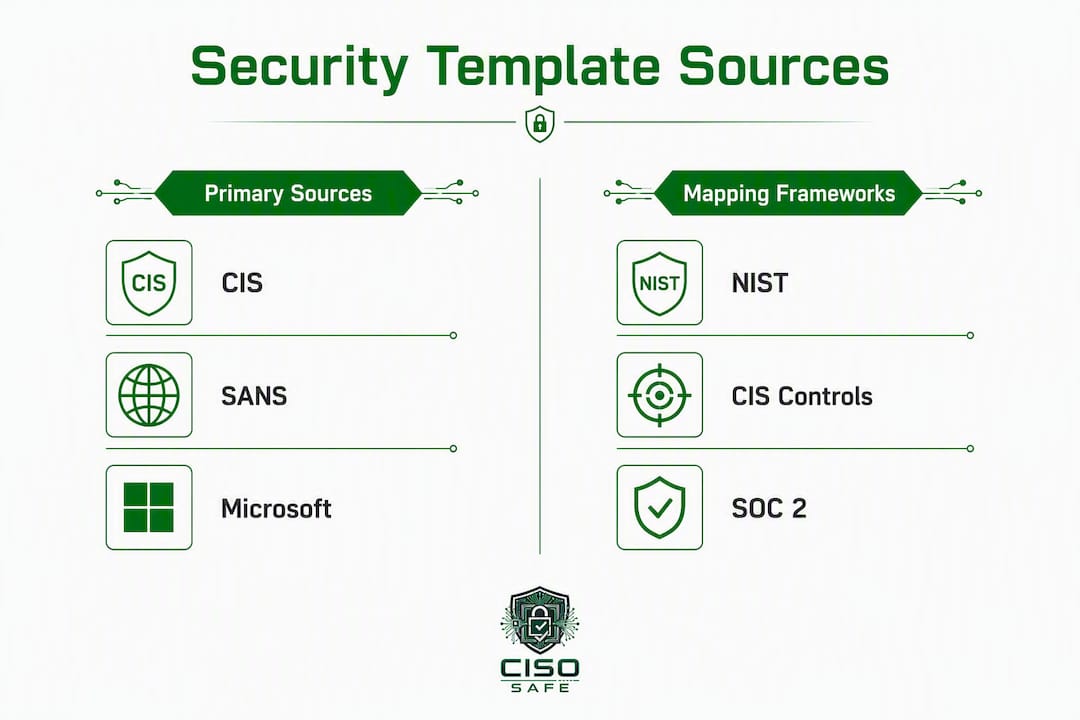
The table below covers the primary sources, what each provides, and how they map to frameworks. Pick based on your maturity level and whether you need a policy document or a technical baseline.
| Source | Mapped Frameworks | Intended Use | Formats | Cost / License | Update Cadence |
|---|---|---|---|---|---|
| CIS Policy Templates | CIS Controls v8 / v8.1, NIST CSF | Policy documents (IG1–IG3) | DOCX, PDF | Free | Updated with CIS Controls releases |
| SANS Policy Templates | NIST CSF, ISO 27001 | Policy documents, broad topic set | DOCX, PDF | Free | Periodic; check sans.org for dates |
| Microsoft Security Templates / GPO Baselines | NIST SP 800-53, CIS Benchmarks | Technical OS/AD configuration | GPO backup, INF, SCM | Free | Tied to Windows release cycles |
| CIS Benchmarks | CIS Controls, NIST SP 800-53 | Technical OS, cloud, app baselines | PDF, JSON, YAML (CIS-CAT) | Free (PDF); CIS SecureSuite for automation | Versioned per product release |
| JupiterOne (GitHub) | CIS Controls, SOC 2, HIPAA, PCI DSS | Modular policy + controls mapping | Markdown, JSON | Open source | Community-maintained |
| CompliQuick | NIST CSF, ISO 27001 | Editable policy document | DOCX | Free | Reviewed periodically |
Choosing by maturity level:
- Mid-market and regulated enterprises: — Layer SANS policy packs and CIS Benchmarks on top of CIS policy templates. Map to NIST CSF 2.0 or NIST SP 800-53 Rev. 5 for federal alignment, or ISO 27001:2022 for international or enterprise-grade ISMS requirements.
The CIS / MS-ISAC NIST Cybersecurity Framework Policy Template Guide makes clear that templates derived from NIST frameworks must be integrated with organization-specific details to function as governance tools rather than checkboxes.
What must every cybersecurity policy template include?
A foundational information security policy requires specific sections to satisfy auditors and give employees enforceable guidance. The structure below reflects what auditors expect under SOC 2, HIPAA, and PCI DSS.
Required sections and measurable examples:
- Purpose and scope: Defines which systems, data, and personnel the policy covers. Example: "This policy applies to all employees, contractors, and third-party vendors with access to [Organization] information systems."
- Roles and responsibilities: Names the policy owner, approver, and enforcement authority. Example: "The CISO is responsible for annual policy review and approval."
- Policy statements: The core requirements, written in declarative language. Use "must" or "shall" for mandatory controls; "should" for recommended practices. Auditors cannot measure a "should" the same way they measure a "must."
- Data classification: Defines tiers (e.g., Public, Internal, Confidential, Restricted) and handling rules per tier. Example: "Restricted data must be encrypted at rest using AES-256 and in transit using TLS 1.2 or higher."
- Access control: Example: "Multi-factor authentication must be enabled for all remote access to production systems."
- Acceptable use: Covers approved and prohibited uses of company assets and networks.
- Incident response: References the incident response plan and states notification timelines. Example: "Security incidents must be reported to the security team within 24 hours of discovery." For organizations in critical infrastructure, see the incident response planning considerations specific to operational environments.
- Change management: Requires documented approval before production changes.
- Vendor and third-party risk: Example: "All third-party vendors with access to Confidential data must complete a security questionnaire annually."
- Encryption standards: Specifies approved algorithms and key management requirements.
- Enforcement and exceptions: States consequences for violations and the process for requesting documented exceptions.
- Review schedule: Example: "This policy must be reviewed at least annually or following a material change to the environment."
Policy experts stress that requirements must be auditable and evidence-collectable to satisfy auditors. A policy statement that cannot be tested or verified against a log, ticket, or configuration record will not survive a SOC 2 or PCI DSS audit.
Pro Tip: Keep the core policy document concise and focused, avoiding overly lengthy documents. Move procedural detail (e.g., password reset steps, patch deployment runbooks) into modular micro-docs linked from the policy. This keeps the governing document stable while procedures evolve.
Modular micro-docs mapped to controls in a JSON or similar format let organizations maintain current policies without monolithic documents becoming obsolete. When a framework updates, you revise the affected module rather than the entire policy set.
How do you adapt a generic template to your organization?
ISO/IEC 27001:2022 positions templates as starting points inside an ISMS, not finished compliance artifacts. Adaptation is where the real governance work happens.
Step-by-step adaptation process:
- Select the right template — Match the template to your primary regulatory obligation. SOC 2 Type II aligns well with CIS Controls v8. HIPAA maps closely to NIST SP 800-53 Rev. 5 controls. PCI DSS 4.0 has specific technical requirements that CIS Benchmarks address directly.
Mapping example: An access control policy statement reading "MFA must be enabled for all privileged accounts" maps to CIS Control 6.3 (Require MFA for Externally-Exposed Applications) and CIS Control 6.5 (Require MFA for Administrative Access). The evidence an auditor expects: a screenshot of MFA enforcement in your identity provider, a list of privileged accounts, and a ticket showing the control was tested.
Common pitfalls:

Implementation checklist and timeline for policy rollouts
The table below gives realistic durations for three organizational profiles. These are typical ranges, not guarantees; complexity, regulatory scope, and available internal capacity all affect the actual timeline.
| Task | SMB (1–100 employees) | Mid-Market (100+) | Regulated Enterprise (Large) | Primary Owner |
|---|---|---|---|---|
| Template selection and download | short duration depending on organization size | IT Manager / CISO | ||
| Gap analysis and controls mapping | duration depends on organization size and complexity | Security team / vCISO | ||
| Policy drafting and customization | duration varies by organization size | Policy owner / vCISO | ||
| Legal and HR review | duration depends on organization size and regulatory requirements | Legal counsel / HR | ||
| Executive approval | duration varies based on organization size | CISO / Board | ||
| Employee communications and training | duration based on organization size and resources | HR / Security awareness lead | ||
| Technical control implementation | duration varies with complexity and resources | IT / Engineering | ||
| Monitoring and evidence collection setup | duration depends on organizational maturity | Security operations | ||
| Post-implementation review | timing varies by organization | Policy owner |
Major cost drivers to plan for:
- Third-party assessment: A gap assessment or readiness review from an external firm typically costs more than the tooling. Budget for it early if an audit is within 12 months.
- Legal review: Employment attorneys and privacy counsel add time and cost, but skipping this step creates liability in states with strong data protection laws (California CCPA, Texas HB 4, etc.).
- Security awareness training: Platforms such as KnowBe4 or Proofpoint Security Awareness Training add per-seat costs but are required evidence for most compliance frameworks.
- Tooling for evidence collection: Automated compliance platforms reduce manual effort significantly. CompliQuick recommends keeping a "last reviewed" date and framework mapping for vendor questionnaires and insurer reviews.
Prioritize the policies that directly map to your highest-risk controls first. For most U.S. SMBs, that means access control, acceptable use, and incident response before tackling vendor risk or change management.
Where do you find technical configuration baselines?
A security template in the technical sense is a configuration file that defines OS settings for analysis and comparison against a known-good state. Microsoft's Security Templates snap-in and CIS Benchmarks are the two canonical sources for this category.
Canonical baseline sources:
- Microsoft Security Templates and GPO baselines: Available through the Microsoft Security Compliance Toolkit. Exports as GPO backups and INF files. Apply via Group Policy Management Console or import into Microsoft Endpoint Configuration Manager. Covers Windows Server, Windows 10/11, Microsoft 365, and Azure.
- CIS Benchmarks: Available at CIS for over 100 technology platforms including Windows, Linux, macOS, AWS, Azure, GCP, Docker, and Kubernetes. PDF format is free; machine-readable JSON and YAML for automated scanning require CIS SecureSuite membership.
- JupiterOne GitHub repository: Provides IaC-friendly policy modules in Markdown and JSON, useful for teams managing infrastructure-as-code pipelines where policy-as-code is the target state.
Format guidance:
- GPO backup files: Import directly into Active Directory. Best for Windows-centric environments with Group Policy infrastructure already in place.
- CIS Benchmark PDFs: Use as the authoritative reference during manual hardening or for training. Not machine-executable on their own.
- JSON/YAML baselines: Feed into tools such as Ansible, Terraform, Chef, or Puppet for automated enforcement. Reduces configuration drift and enables continuous compliance scanning.
Testing and deployment approach: Never apply a baseline directly to production. Test in a staging environment first, then run automated compliance scans with tools such as CIS-CAT Pro, Tenable Nessus, or Qualys to measure deviation from the baseline. After staging validation, deploy to a limited pilot group before full rollout.
Pro Tip: Designate one "canary" host per OS type. Apply the baseline there first and monitor for application compatibility issues for several days before broader deployment. Automated remediation scripts can then be applied with confidence.
When should you engage a vCISO instead of adapting templates yourself?
In-house adaptation works well when your team has security expertise, the regulatory scope is limited to one or two frameworks, and no audit is imminent. The calculus shifts when complexity increases.
Engage a vCISO or policy consultancy when:
- Your organization must meet multiple overlapping frameworks simultaneously (e.g., SOC 2 + HIPAA, or CMMC + NIST SP 800-171)
- An audit, certification, or vendor security review is scheduled within 90 days
- Internal security staff are absent or stretched across other priorities
- A merger, acquisition, or new contract triggers a new compliance obligation
- You operate in a regulated sector such as oil and gas, legal, or healthcare where sector-specific compliance requirements add layers beyond standard frameworks
What a CisoSafe policy customization engagement typically delivers:
- A complete, customized policy document set (10–20 policies depending on scope), written in declarative language and reviewed by a vCISO
- A controls-mapping matrix linking each policy statement to the relevant CIS, NIST, or ISO control, with evidence requirements documented
- An implementation roadmap with task owners, timelines, and prioritized control gaps
- An evidence collection plan specifying what artifacts auditors will request and how to generate them
- Security awareness training materials aligned to the new policies
- Post-engagement support through the first audit cycle
A typical engagement for SMBs targeting SOC 2 Type II readiness runs several weeks from kickoff to a complete, audit-ready policy set. Mid-market organizations with broader scope or multiple frameworks generally require a longer engagement period.
Key Takeaways
Audit-ready security policies require authoritative templates, declarative language, mapped controls, assigned owners, and tested technical baselines working together as a system.
| Point | Details |
|---|---|
| Start with CIS and SANS templates | CIS policy templates (free, mapped to CIS Controls v8/v8.1) and SANS policy packs are the most authoritative starting points for U.S. organizations. |
| Replace "should" with "must" | Declarative language is required for SOC 2, HIPAA, and PCI DSS audits; vague requirements cannot be tested or enforced. |
| Map every statement to a control | Each policy requirement needs a corresponding CIS, NIST, or ISO control and documented evidence so auditors can verify compliance. |
| Test baselines in staging first | Apply GPO baselines and CIS Benchmarks to a staging environment and canary host before production deployment to avoid compatibility failures. |
| CisoSafe for complex engagements | When regulatory scope spans multiple frameworks or an audit is imminent, CisoSafe delivers a complete, audit-ready policy set with controls mapping and evidence planning. |
Templates are tools, not programs
The most common failure mode in security policy work is treating a downloaded template as a finished compliance artifact. A policy document sitting in a SharePoint folder, unread by employees and unenforced by managers, provides no actual protection and will not survive an audit.
What makes a template effective is the operational layer built around it: named owners who understand their responsibilities, exception processes tied to change control, and monitoring that generates the evidence auditors will request. MS-ISAC and CIS both note that template adoption fails when organizations skip owner accountability and exception tracking. That observation holds across every framework.
Modular policy design addresses part of this problem. When policies are structured as discrete, controls-mapped documents rather than a single monolithic file, updates are faster, ownership is clearer, and drift is easier to detect. But even a perfectly structured policy set requires change management. Employees need to know the policies exist, understand what they require, and have a clear path to report exceptions. Without that cultural layer, the best-written template is just documentation.
The practical implication: budget as much time for communication, training, and owner enablement as you budget for drafting. The document is the easy part.
CisoSafe turns your templates into a working compliance program
Downloading templates from CIS, SANS, and Microsoft gives you a strong starting point. Getting from that starting point to an audit-ready program, with mapped controls, assigned owners, tested baselines, and evidence ready for a SOC 2, HIPAA, or PCI DSS review, is where most internal teams run out of bandwidth.
CisoSafe provides vCISO-led policy customization and compliance program development for regulated U.S. organizations, including law firms, energy operators, and healthcare-adjacent businesses. The engagement model is built for teams that need enterprise-grade security expertise without the cost of a full-time CISO. A typical policy engagement delivers a complete, customized policy set, a controls-mapping matrix, an implementation roadmap, and audit support, all within a defined timeline and scope.
Book a vCISO discovery call to get a scoped proposal for your organization's compliance requirements.
Download links, file formats, and maintenance guidance
Canonical download sources:
- CIS Policy Templates: Free DOCX/PDF templates mapped to CIS Controls v8/v8.1; IG1-focused for SMBs
- SANS Policy Templates: Free DOCX policy documents covering a broad topic set; available at sans.org/information-security-policy/
- Microsoft Security Templates / GPO Baselines: GPO backup and INF files via the Microsoft Security Compliance Toolkit
- JupiterOne GitHub repository: Open-source Markdown and JSON policy modules for IaC-friendly environments
- CompliQuick Cyber Security Policy Template: Free editable DOCX with audit-focused structure and framework mapping notes
- NIST Cybersecurity Framework 2.0: Reference framework for mapping policy statements to CSF subcategories
File format reference:
- DOCX: Editable policy text; use for drafting, customization, and version control
- PDF: Read-only reference; use for distribution and audit evidence packages
- GPO backup / INF: Import into Active Directory Group Policy for Windows baseline enforcement
- JSON / YAML: Machine-readable baselines for Ansible, Terraform, and other IaC tools; enables automated compliance scanning and drift detection
Maintenance guidance:
- Review all policies at least annually and after any material change to the environment (new system, regulatory update, significant incident, or organizational restructuring)
- Track version history in each document: include version number, date of change, summary of changes, and approver name
- Record the "last reviewed" date even when no changes are made; auditors treat an undated policy as a stale policy
- For SMBs using security frameworks, set calendar reminders tied to your primary framework's update cycle so template reviews align with control changes