

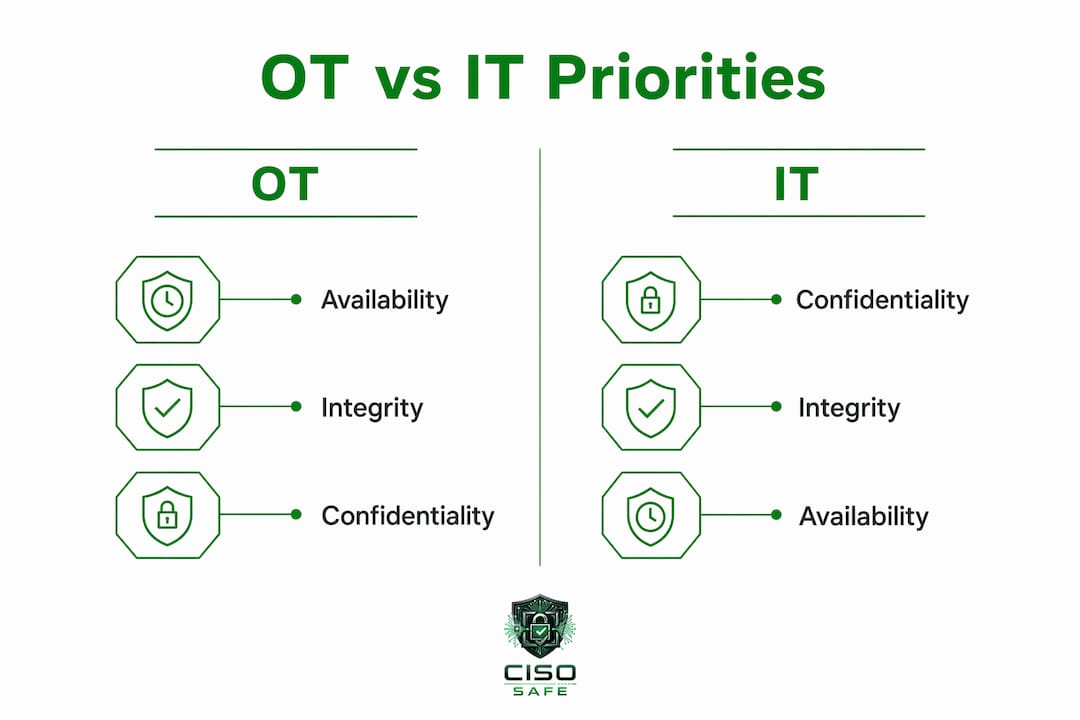
OT cybersecurity protects the hardware, firmware, and control software that directly monitor or control physical processes, including PLCs, SCADA systems, DCS, and RTUs. Unlike enterprise IT, where confidentiality leads the priority order, OT environments rank availability first, safety second, and confidentiality third. A control system that goes offline during an active process is not just a business problem; it can be a safety event.
Quick brief for leadership:
- OT cybersecurity aligns to NIST SP 800-82r3, the primary U.S. guidance document for securing industrial control systems.
- The Purdue Model defines the zone-and-conduit architecture that keeps field devices isolated from enterprise networks.
- Regulated SMBs and mid-market firms should treat every vendor change and controller upgrade as formal security decisions.
- CisoSafe provides vCISO services and AI-powered compliance SaaS purpose-built for regulated U.S. organizations that need OT-aware security programs without a full-time CISO.
Table of Contents
- What is OT cybersecurity, and how does it differ from IT?
- Key OT risks your leadership needs to understand
- What reference architectures and controls actually work in OT
- Which compliance standards apply to your OT environment?
- A six-step OT security roadmap for decision-makers
- How OT incident response differs from standard IR
- When should you bring in a vCISO or OT specialist?
- What does OT security actually cost for an SMB?
- Patch management and vulnerability handling in OT systems
- Key Takeaways
- The OT security gap most organizations ignore
- CisoSafe helps you build a defensible OT security program
- Authoritative references and further reading
What is OT cybersecurity, and how does it differ from IT?
OT covers a wide range of physical-process control assets: PLCs, RTUs, SCADA systems, HMIs, distributed control systems, manufacturing execution systems, building automation controllers, physical access control panels, and distributed energy resources. What unites them is that a compromise does not just expose data; it can alter or stop a physical process.
The protocols these systems use are equally distinct. Modbus, DNP3, OPC-UA, and BACnet were designed for determinism and reliability, not authentication or encryption. Standard IT vulnerability scanners do not decode these protocols correctly, and active scanning can crash field devices that were never designed to handle unexpected traffic bursts.
| Dimension | OT | IT |
|---|---|---|
| Priority order | Availability → Integrity → Confidentiality | Confidentiality → Integrity → Availability |
| Device lifecycle | several decades | 3–5 years |
| Patching cadence | Constrained; long maintenance windows | Frequent; often automated |
| Latency tolerance | Millisecond-precise; deterministic | Generally flexible |
| Primary function | Control physical processes | Store, process, transmit data |
| Scanning risk | Active scans can disrupt or crash devices | Generally safe with standard tools |
Ownership boundaries matter too. OT security typically ends where enterprise log aggregation and business systems begin. That handoff point, often a demilitarized zone between the control network and the corporate LAN, is where IT and OT governance must coordinate explicitly.
Key OT risks your leadership needs to understand
OT environments carry a distinct risk profile that standard IT security programs are not designed to address.
- Legacy, unpatchable devices. Equipment lifespans routinely exceed 20–30 years, meaning many field devices run firmware that vendors no longer support.
- Proprietary protocols. Modbus and DNP3 lack native authentication, making man-in-the-middle attacks feasible on unsegmented networks.
- Unsafe active scanning. Running a standard IT vulnerability scanner against a PLC can flood its communication buffer and trigger an unplanned shutdown.
- Constrained patch windows. Patching often requires a full process shutdown, which may only be possible once or twice a year.
- Vendor-supplied remote access. Machine builders and OEM technicians frequently install their own remote access tools outside IT governance, creating unmonitored ingress points.
- Supply-chain and third-party changes. A firmware update from a trusted vendor can introduce new vulnerabilities if it is not reviewed through a formal OT vendor risk process.
- Insider and operator errors. Misconfigured control logic or an unauthorized USB connection can be as damaging as an external attack.
Real-world incidents illustrate the stakes. The 2021 Oldsmar, Florida water treatment intrusion saw an operator's HMI accessed remotely and sodium hydroxide levels changed to dangerous concentrations. The 2015 Ukraine power grid attack used spear-phishing to pivot from IT networks into OT, cutting power to roughly 230,000 customers. These were not theoretical risks; they were operational failures with physical consequences.
Pro Tip: Never run an IT-style vulnerability scan directly against field PLCs or RTUs. Use passive, protocol-aware discovery tools that listen to existing traffic without injecting packets. The difference between passive and active discovery can be the difference between a clean asset inventory and an unplanned process shutdown.
What reference architectures and controls actually work in OT
The Purdue Model organizes OT assets into five levels: Level 0 (field devices), Level 1 (basic control), Level 2 (supervisory control), Level 3 (site operations), and Levels 4–5 (enterprise IT). Segmentation between these levels, enforced through conduits and protocol-aware firewalls, prevents lateral movement from the corporate network down to safety-critical controllers.

Effective segmentation means defining zones by function and criticality, specifying which protocols are allowed across each conduit, and blocking all other traffic by default. A DMZ between Level 3 and Level 4 is the standard insertion point for data historians and remote access gateways, keeping enterprise traffic from touching control-layer assets directly.
For monitoring, deploy protocol-aware intrusion detection that can decode Modbus, DNP3, and OPC-UA traffic and flag command anomalies, such as an unexpected write to a setpoint register. Behavioral detection, which baselines normal communication patterns and alerts on deviations, catches threats that signature-based tools miss entirely.
For devices that cannot be patched, NIST recommends compensating controls: strict network segmentation, protocol-aware firewalls that whitelist only expected command types, physical access restrictions, and tightly governed maintenance windows. These controls reduce exposure without requiring a reboot or firmware update.
Pro Tip: Place log collectors at the DMZ boundary and at Level 3, not on the PLCs themselves. Polling OT devices for logs adds network traffic that can interfere with deterministic control cycles. Collect passively at the boundary and forward to your SIEM.
Which compliance standards apply to your OT environment?
NIST SP 800-82r3 is the primary U.S. guidance document for OT security. It provides a tailored control overlay that maps to NIST SP 800-53, addresses OT-specific performance and safety requirements, and treats OT security as part of safety and reliability engineering rather than a standalone IT project. For regulated SMBs, it is the most practical starting point for building a defensible program.
Sector-specific rules add mandatory floors in certain industries. NERC CIP applies to bulk electric system operators and sets prescriptive requirements for asset identification, access control, and incident reporting. TSA's cybersecurity directives cover pipeline and surface transportation operators. If your organization touches either sector, those directives are not optional guidance; they carry enforcement consequences.
For framework alignment, the ISO 27001 vs. NIST Cybersecurity Framework comparison is a useful reference when deciding which governance structure fits your organization's existing compliance posture. The key principle across all frameworks is risk-based tailoring: apply controls proportional to the consequence of failure, not as a flat checklist. Document your regulatory obligations in vendor contracts and change governance procedures. An OT upgrade that inadvertently removes a required control creates compliance exposure even when the intent was purely operational.
A six-step OT security roadmap for decision-makers
A phased approach lets you build the program without disrupting operations. Budget ranges below are directional for SMBs and mid-market firms; actual costs vary by environment size and existing tooling.
- Scope and stakeholder alignment (weeks 1–4). Define which OT systems are in scope, identify the operations, safety, and IT stakeholders who must be involved, and establish a governance structure. Cost: primarily internal time.
- Passive asset inventory and risk assessment (weeks 4–12). Deploy passive discovery tools to build a complete industrial cybersecurity assessment baseline. Identify unmanaged devices, unsupported firmware, and open conduits. Budget: moderate amounts for tooling and assessment services.
- Design segmentation aligned to the Purdue Model (weeks 8–16). Define zones, specify conduit rules, and design the DMZ. Engage OT network engineers early; changes to live control networks require careful change management.
- Deploy OT-aware monitoring and compensating controls (weeks 12–24). Install protocol-aware IDS, configure behavioral baselines, and implement compensating controls for unpatchable devices. Budget: moderate amounts depending on environment scale.
- Incident response and resilience testing (weeks 20–28). Develop OT-specific IR playbooks, conduct a tabletop exercise, and validate manual override procedures. See the section below on IR specifics.
- Governance, vendor controls, and continuous improvement (ongoing). Formalize cybersecurity governance, embed security review into procurement and change management, and schedule quarterly program reviews.
Pro Tip: Start with your highest-consequence assets: safety-critical controllers, substation RTUs, and compressor control systems. A risk-ranked asset list lets you direct limited budget where a failure would cause the most harm.
How OT incident response differs from standard IR
OT incident response carries one constraint that IT IR does not: you often cannot isolate a compromised device the way you would a laptop. Shutting down a running PLC mid-process can cause more physical damage than the attack itself.
IR playbooks for OT must include safe isolation procedures that account for process state, defined emergency operator overrides that allow manual control if digital systems are taken offline, and forensic data capture methods that do not require rebooting or installing agents on field devices. Communications protocols with safety teams and, where applicable, regulators must be pre-established, not improvised during an event.
Recovery planning should address failover to backup controllers, manual operating procedures for minimum viable production, and a validated restoration sequence that confirms control integrity before returning to automated operation. Tabletop exercises should simulate a scenario where IT and OT networks are simultaneously affected, because that is the most common real-world pattern. For physical-cyber convergence risks, the exercise should include the safety team, not just IT and security staff.
When should you bring in a vCISO or OT specialist?
Several signals indicate that outside expertise is the right call:
- You have no current visibility into what OT assets you own or what traffic they generate.
- IT and OT networks are being merged or connected as part of a digital transformation project.
- A regulatory audit is approaching and OT controls have not been formally assessed.
- A major vendor change, controller upgrade, or new remote access deployment is planned.
- Your organization has experienced an incident or near-miss in the OT environment.
A vCISO with OT domain expertise brings OT-aware risk assessments, governance policies that account for safety and availability constraints, vendor governance frameworks, and program management for remediation. When evaluating a vCISO or managed OT partner, require demonstrated experience in your sector, references from regulated industries, protocol-aware tooling, documented incident response experience in OT environments, and explicit crosswalks to NIST SP 800-82r3. Engage before major upgrade projects begin, not after. A retainer vCISO typically phases work across assessment, design, implementation support, and ongoing advisory, with the heaviest lift in the first 90 days.
What does OT security actually cost for an SMB?
The honest answer is that OT security costs less than an OT incident. For a mid-market firm with a moderate-complexity OT environment, a full program build typically runs a significant amount in year one, covering assessment, tooling, segmentation design, and policy development. Ongoing annual costs for monitoring, governance, and vCISO advisory generally constitute substantial expenses depending on scope.
The alternative, a full-time OT security engineer or CISO with industrial control system experience, commands a base salary well above $150,000 annually before benefits and tooling. A vCISO model delivers comparable expertise at a fraction of that cost, with the added benefit of a team rather than a single point of failure. For SMBs without dedicated security staff, the vCISO model is frequently the only path to a defensible program within a realistic budget.
Patch management and vulnerability handling in OT systems
Patching OT systems is genuinely harder than patching enterprise IT, and pretending otherwise leads to programs that look good on paper but fail in practice. Most OT devices require a full process shutdown to apply firmware updates, which means patch windows are tied to planned maintenance outages, often quarterly or annually at best.
The practical approach has three components. First, maintain a vulnerability register that tracks known CVEs against your specific device models and firmware versions, prioritized by exploitability and consequence of compromise. Second, apply compensating controls immediately when a critical vulnerability is identified and a patch cannot be applied: tighten firewall rules, restrict physical access, and increase monitoring sensitivity for that device. Third, work with vendors to understand their patch release cycles and test patches in a staging environment before applying them to production controllers. The ISO 27001 risk assessment methodology provides a structured framework for documenting these decisions and demonstrating due diligence to auditors.
Supply chain changes deserve special attention here. A vendor-supplied firmware update or a replacement controller from a different manufacturer can introduce new vulnerabilities or break existing compensating controls. Every such change should go through a formal security review before it touches a production OT environment.
Key Takeaways
OT cybersecurity requires prioritizing availability and safety above all else, aligning controls to NIST SP 800-82r3, and treating every vendor or equipment change as a formal security decision.
| Point | Details |
|---|---|
| Availability and safety first | OT systems rank availability and safety above confidentiality; controls and IR plans must reflect that priority. |
| Align to NIST SP 800-82r3 | Use NIST SP 800-82r3 as your primary control framework and tailor it to your sector's regulatory requirements. |
| Start with passive inventory | Deploy passive, protocol-aware discovery before any other control; active scanning can crash field devices. |
| Treat changes as security decisions | Every vendor change, firmware update, or controller upgrade requires a formal OT-specific risk assessment. |
| Engage CisoSafe early | CisoSafe provides OT-aware vCISO services and AI-powered compliance SaaS for regulated U.S. SMBs before major OT projects begin. |
The OT security gap most organizations ignore
The most consistent failure pattern in OT security is not a technology gap. Organizations that struggle most are the ones that assigned IT staff to OT problems without giving them OT context, or that purchased IT security tools and pointed them at control networks without understanding the consequences.
Forcing IT-centric agents and scanning tools onto OT environments, as NIST SP 800-82r3 documents, can increase risk rather than reduce it. The second failure is treating vendor and upgrade decisions as purely operational choices. In OT, a new controller or a changed firmware version is a security event that requires the same rigor as a network architecture change.
What actually changes outcomes is embedding security into the safety and reliability process from the start, not bolting it on after an incident. Phased vCISO engagements work because they meet operations teams where they are, build trust incrementally, and deliver compliance wins early, which creates organizational buy-in for the harder segmentation and governance work that follows.
CisoSafe helps you build a defensible OT security program
Regulated SMBs and mid-market firms in energy, oil and gas, and other high-stakes industries need OT security expertise that understands both the control system environment and the compliance frameworks that govern it. CisoSafe delivers exactly that combination.
CisoSafe's vCISO services cover OT-aware risk assessments, Purdue Model-aligned segmentation design, vendor governance frameworks, incident response planning, and ongoing strategic advisory. The AI-powered SaaS platform automates compliance intake, penetration testing workflows, and professional reporting across 50+ frameworks, giving your leadership clear risk visibility without overwhelming internal teams. Engagements are structured in phases, with the assessment and design work front-loaded so you see results in the first 90 days.
If a regulatory audit, a major OT upgrade, or a recent incident has put OT security on your agenda, the right time to engage is before the project starts. Request an engagement with CisoSafe to get an OT-aware assessment and a risk roadmap your leadership can act on.
Authoritative references and further reading
The sources below are the primary references for the guidance in this article. Technical teams should start with NIST; compliance teams should cross-reference the DOE guidance and applicable sector directives.
- NIST SP 800-82r3, Guide to Operational Technology Security — The definitive U.S. reference for OT security controls, architecture guidance, and NIST SP 800-53 overlays. Essential for technical teams building or auditing an OT security program.
- NIST SP 800-82r3 Full Publication (PDF) — The complete document including control overlays, Purdue Model references, and compensating control guidance.
- DOE Operational Technology Cybersecurity for Energy Systems — Practical guidance for federal facility and energy sector operators on OT lifecycle management, vendor governance, and continuous monitoring. Most useful for compliance teams in the energy sector.
- CISA/NSA/ASD Principles of OT Cyber Security — Co-sealed by CISA, NSA, and FBI; provides six foundational principles for safe and secure OT environments. Useful for both technical and compliance audiences.