

SSAE 16 was the AICPA attestation standard that governed SOC 1 reports, focusing on controls relevant to a user entity's internal control over financial reporting (ICFR). It has been superseded by SSAE 18, but the SOC 1 framework and its audit requirements remain the standard compliance officers must prepare for today.
Here is what that means in practice:
- When a client, prospect, or regulator asks for "SSAE 16 compliance," they are requesting a SOC 1 report produced under current SSAE 18 standards.
- The SOC 1 report covers controls at your service organization that could affect the financial statements of the companies you serve.
- Management must provide a written assertion about the fairness of the system description and the suitability of control design — a legal and operational commitment auditors rely on as the foundation of the engagement.
Table of Contents
- What is SSAE 16 and how does it fit into today's reporting landscape?
- What does management's written assertion require, and what do auditors test?
- Common misconceptions about SSAE 16 and SOC 1
- A vCISO readiness checklist: from gap assessment to audit-ready evidence
- Key Takeaways
- The gap between point-in-time compliance and continuous assurance
- Authoritative references and further reading
What is SSAE 16 and how does it fit into today's reporting landscape?
SSAE 16 was issued in 2010 to replace the older SAS 70 standard and became effective for periods ending on or after June 15, 2011. The AICPA then superseded it with SSAE 18, effective 2017. The move from SAS 70 to SSAE 16 shifted service-organization guidance into the attestation standards framework, which is why the AICPA's FAQ from that transition period remains a useful reference for understanding why the standard evolved.
For global service organizations, SSAE 16 mirrors ISAE 3402, the international equivalent published by IFAC. If your organization serves clients in multiple countries, both standards are worth understanding together.
| Dimension | SOC 1 (SSAE 16 / SSAE 18) | SOC 2 |
|---|---|---|
| Focus | Controls relevant to user-entity ICFR | Trust Services Criteria (security, availability, confidentiality, privacy, processing integrity) |
| Primary audience | User-entity financial auditors and management | Customers, prospects, regulators evaluating operational security |
| Governing standard | SSAE 18 (formerly SSAE 16) | SSAE 18 |
| Report types | Type I and Type II | Type I and Type II |
| When to choose it | Your service directly affects client financial statements | Your service involves data security, availability, or privacy assurance |
When a stakeholder asks for "SSAE 16 compliance," they almost always want a SOC 1 report. Clarifying that early prevents weeks of wasted preparation on the wrong controls set. For a deeper look at the SOC 2 side of this decision, SOC 2 compliance explained covers the Trust Services Criteria in full.
What does management's written assertion require, and what do auditors test?
Management's written assertion is not a formality. It is a formal statement that the system description is fairly presented, that controls are suitably designed to meet the stated objectives, and for Type II reports, that controls operated effectively throughout the period. Auditors use it as the starting point for their procedures; if the assertion is weak or incomplete, the entire engagement is at risk.
What auditors test against the assertion:
- Whether the system description accurately reflects the services provided and the boundaries of the system.
- Whether each control objective is supported by at least one control that is both designed and operating as described.
- Whether exceptions identified during testing are consistent with what management disclosed in the assertion.
Pro Tip: Draft the management assertion before you finalize the system description, not after. Auditors frequently flag assertions that describe a system that does not match the actual environment, which forces a re-scoping that delays the entire engagement. Have your legal counsel review the assertion language before submission.
A weak assertion typically shows one of three problems: the system boundary is too narrow (excluding relevant infrastructure), the control descriptions are too vague to test, or management asserts operating effectiveness without the evidence to support it. All three are avoidable with a structured pre-audit review.
Common misconceptions about SSAE 16 and SOC 1
SSAE 16 is not a certification. Neither SSAE 16 nor SSAE 18 produces a certification badge like ISO 27001. The output is an independent audit report. There is no pass/fail certificate to display; there is an auditor's opinion that can be shared with user entities and their auditors.
SSAE 16 is not the same as SOC 2. SOC 1 covers controls relevant to financial reporting. SOC 2 covers security, availability, confidentiality, privacy, and processing integrity. Preparing SOC 2 controls when a client wants a SOC 1 report wastes significant time and budget. Practitioners consistently flag this confusion as one of the most common and costly mistakes in service-organization compliance.
"SSAE 16 compliance" requests almost always mean SOC 1. When a client or prospect asks for "SSAE 16 compliance," they are using legacy terminology. The correct response is to confirm they want a SOC 1 report under current SSAE 18 standards, then scope accordingly.
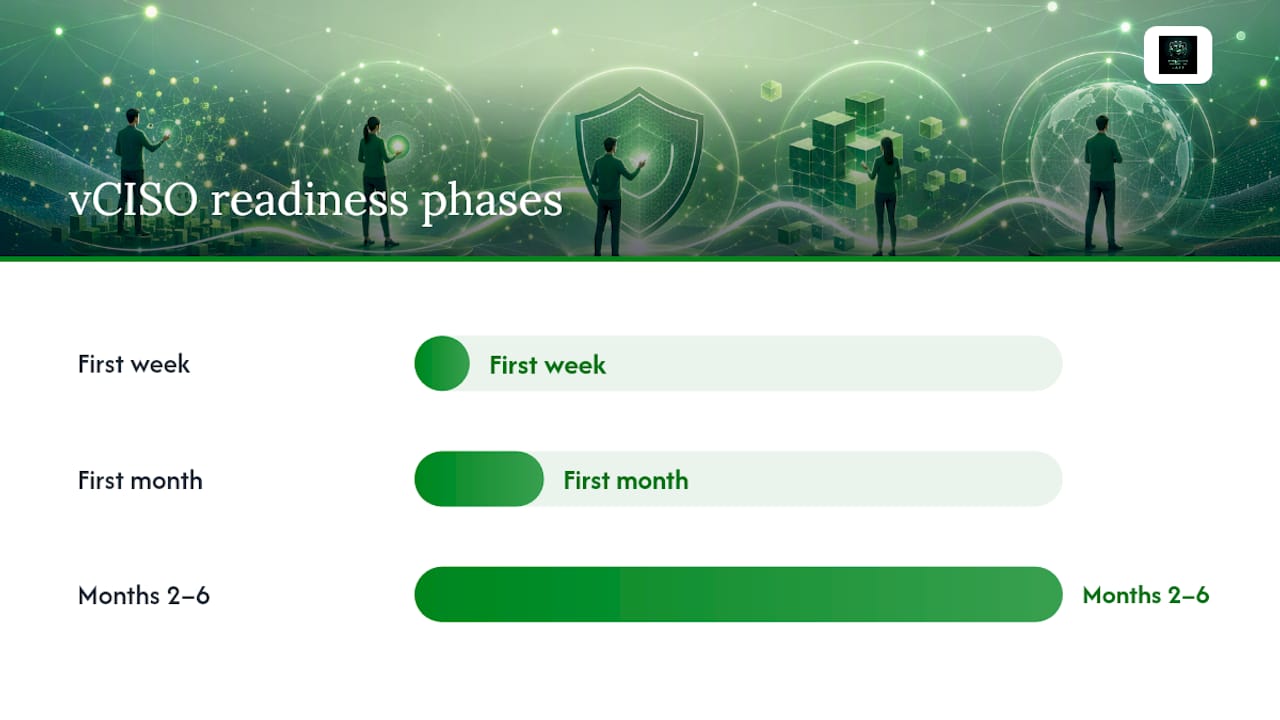
A vCISO readiness checklist: from gap assessment to audit-ready evidence
This is the sprint-based plan a vCISO would use with a service organization moving from zero to audit-ready.
First week: scoping and critical evidence
- Identify all in-scope systems, services, and subservice organizations.
- Confirm report type (Type I or Type II) with stakeholders.
- Pull existing policies, system diagrams, and prior audit reports.
- Identify control owners for each in-scope process.
First month: close critical control gaps
- Complete a formal risk assessment and document the output.
- Map controls to each control objective and identify gaps.
- Implement missing controls with documented effective dates.
- Build a control evidence log template: control ID, owner, evidence type, collection frequency.
Months 2–6: evidence collection and continuous monitoring
- Collect evidence on schedule — access reviews, change tickets, reconciliation reports, exception logs.
- Review subservice organization SOC reports and document findings.
- Update the system description as the environment changes.
- Run a mid-period internal review to catch evidence gaps before they compound.
Pro Tip: Run a mock audit at month 5 or 6. Assign one team member to play the role of auditor and request evidence for each control objective. The gaps that surface in a mock review are almost always the same ones that delay real fieldwork. Fixing them mid-period costs far less than addressing them during live fieldwork.
Suggested artifacts to prepare: a system description template, a control mapping matrix (control ID, objective, owner, evidence type), an evidence log with collection dates, a subservice organization inventory, and a formal risk assessment document. For mid-market organizations building this infrastructure, a security assessment provides the risk baseline that feeds directly into the control mapping matrix.
Key Takeaways
SSAE 16 established the SOC 1 framework for financial-reporting controls, and while SSAE 18 now governs the standard, every audit requirement and management responsibility from that era remains fully in force today.
| Point | Details |
|---|---|
| SSAE 16 is superseded | SSAE 18 governs SOC 1 audits today; "SSAE 16 compliance" requests mean a current SOC 1 report. |
| Type II requires 6–12 months | Evidence collection must begin well before fieldwork; gaps mid-period are hard to recover from. |
| Management assertion is binding | The written assertion is a legal commitment; draft it before finalizing the system description. |
| SOC 1 ≠ SOC 2 | SOC 1 covers ICFR controls; SOC 2 covers Trust Services Criteria — confirm scope before preparing. |
| CisoSafe accelerates readiness | CisoSafe's vCISO services cover gap assessment, control implementation, evidence collection, and mock audits for SOC 1 readiness. |
The gap between point-in-time compliance and continuous assurance
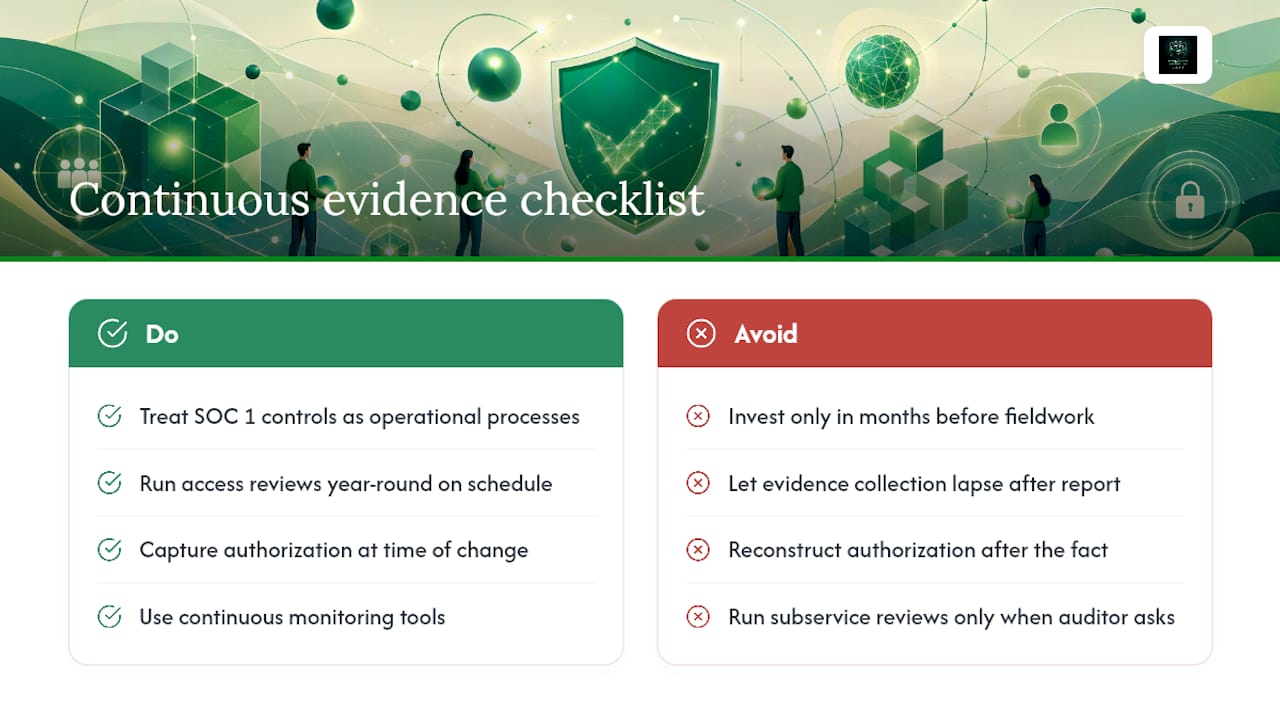
The most persistent challenge in SOC 1 compliance is not passing the audit. It is maintaining the evidence discipline between audit cycles. Most organizations invest heavily in the months before fieldwork, then let evidence collection lapse once the report is issued. Twelve months later, they are scrambling again.
The practical fix is treating SOC 1 controls as operational processes, not audit projects. Access reviews should run on a documented schedule year-round. Change tickets should capture authorization evidence at the time of the change, not reconstructed afterward. Subservice organization reviews should happen on a calendar cadence, not when the auditor asks for them.
Continuous monitoring tools and managed security services can automate much of this evidence collection, reducing the internal burden and shortening future audit cycles. The organizations that achieve the shortest audit timelines are the ones that never fully stop collecting evidence.
Authoritative references and further reading
These are the primary sources compliance officers should consult for authoritative text and deeper reading on SSAE 16, SSAE 18, and SOC 1 reporting.
- AICPA Attestation Standards (SSAE): — The authoritative source for SSAE 18 and all attestation standards. Start here for normative requirements, official guidance, and updates to the SOC reporting framework.
- What Is an SSAE 16 Report and What Is Its Purpose? (Accounting Insights): — A clear practitioner explanation of SOC 1 purpose, report types, and ICFR focus. Useful for compliance officers new to the framework.
- SSAE 16 (Wikipedia): — A concise historical overview of SSAE 16's issuance, effective date, and supersession by SSAE 18. Good for placing the standard in context quickly.
- What's Included in a SOC 1 Report (SOC Reports): — Detailed breakdown of the four components of a SOC 1 report, including management's assertion, system description, control objectives, and auditor testing results.
- SOC 1 Audit Checklist (Network Intelligence): — A practical preparation checklist covering document requirements, common auditor expectations, and readiness steps.