

Continuous compliance monitoring is defined as the automated, real-time verification that an organization's security controls meet regulatory requirements and internal policies at all times. The industry standard term for this practice, formalized in NIST SP 800-137, is Information Security Continuous Monitoring. It replaces the traditional model of quarterly or annual audits with ongoing, automated control assessments. For compliance officers and business leaders in regulated industries, this shift is not optional. Frameworks like SOC 2, HIPAA, PCI DSS, and CMMC now expect organizations to demonstrate continuous audit readiness, not just point-in-time snapshots.
What is continuous compliance monitoring and how does it differ from audits?
Traditional compliance audits consume 3–6 months and leave silent failure gaps of over 90 days. That means a control can fail in january and go undetected until the next scheduled review in april or later. Continuous compliance monitoring closes that window by producing near-real-time control assessments around the clock.

The core difference is cadence and automation. A periodic audit captures a single moment in time. Continuous monitoring captures every moment, producing a live stream of evidence that reflects your actual control state. When a firewall rule changes, an access permission is granted, or a certificate expires, the system flags it immediately rather than waiting for a human reviewer to notice months later.
This is not simply a faster version of the same process. The underlying logic changes entirely. Compliance becomes a property of your daily operations, not a project you run once a year.
How does compliance monitoring work in practice?
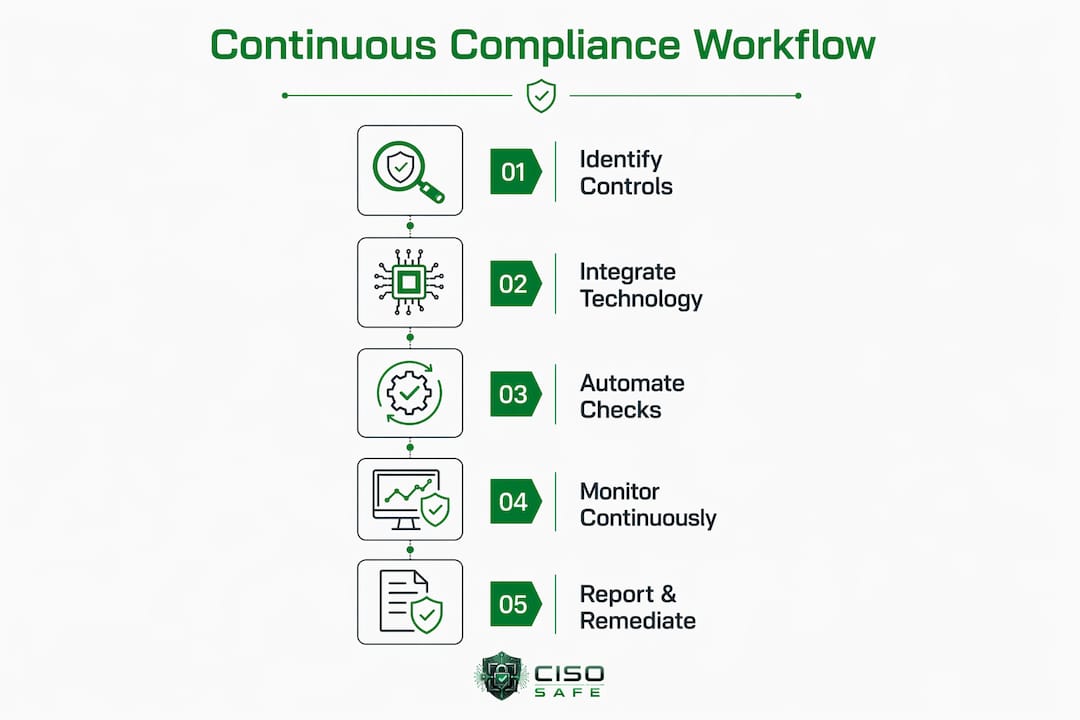
Continuous compliance monitoring works by connecting automated tools to the systems that hold your control data, then evaluating that data against a defined policy set on a continuous basis. Automated tools continuously evaluate configuration states, access permissions, and policy adherence, operating on a cadence of minutes or hours rather than quarters.
The key components in a working program include:
- Control mapping: Each regulatory requirement, such as a SOC 2 access control or a HIPAA encryption standard, is translated into a machine-readable rule.
- Data collection: Agents or APIs pull live data from cloud platforms, identity providers, endpoint management systems, and network devices.
- Evidence capture: Every check produces a timestamped, auditable log. These logs replace the retrospective reports that auditors previously had to reconstruct manually.
- Alerting: When a control drifts out of compliance, the system alerts the responsible owner immediately, not at the next scheduled review.
- Reporting: Dashboards show control status in real time, giving leadership a current view of risk posture at any moment.
Technology integrations are central to this model. Cloud platforms like AWS, Azure, and Google Cloud expose configuration APIs that compliance tools can query continuously. Identity providers feed access data directly into policy checks. Policy-as-code frameworks translate written regulatory requirements into executable rules that run automatically at deployment.
Pro Tip: Map every automated check directly to a named control in your regulatory framework. Generic infrastructure metrics do not satisfy auditors. A check that verifies MFA enforcement must reference the specific SOC 2 or HIPAA control it satisfies.
What are the key benefits of compliance monitoring for regulated organizations?
The benefits of compliance monitoring go well beyond avoiding fines. The operational and financial gains are concrete and measurable.
-
Reduced audit preparation time. Continuous monitoring cuts audit prep time from 8–10 weeks to 2–3 weeks by maintaining live, timestamped evidence rather than scrambling to collect it before an audit window opens. That is a direct reduction in labor costs and staff disruption.
-
Lower financial and reputational risk. Organizations with continuous compliance programs significantly reduce the risk of multi-million dollar penalties and may earn regulatory leniency through demonstrated proactive reporting. Regulators treat organizations differently when they can show a history of self-identified and remediated issues.
-
Faster response to control failures. Real-time alerting on control drift allows control owners to remediate issues before they become reportable incidents. This shifts your posture from reactive to genuinely proactive.
-
Stronger stakeholder trust. Embedding continuous monitoring into daily operations builds accountability that clients, partners, and regulators can see. Transparent, ongoing reporting replaces the annual compliance certificate as the primary trust signal.
-
Lower total compliance cost. Continuous monitoring reduces compliance costs by 25–40% compared to manual audit cycles. The savings come from reduced labor, fewer audit findings requiring remediation, and faster evidence production.
The financial case is clear. The reputational case is equally strong for law firms, energy operators, and healthcare organizations where a single compliance failure can end client relationships.
Common challenges in implementing continuous compliance monitoring
The most common mistake organizations make is confusing system observability with compliance monitoring. Observability tools monitor system health but do not verify compliance against specific regulatory controls. A dashboard showing CPU utilization and uptime tells you nothing about whether your encryption keys are rotated or your access reviews are current.
Specific challenges to anticipate include:
- Checkbox mentality: Teams that treat monitoring as a reporting exercise rather than an operational control will collect data without acting on it. Monitoring must trigger remediation workflows, not just generate reports.
- Credential and configuration drift: Expired certificates, leaked API keys, and misconfigured permissions are the most common causes of compliance failures in cloud environments. These change outside normal human approval processes and require automated detection.
- Generic metric mapping: Pulling infrastructure metrics without mapping them to named regulatory controls produces noise, not compliance evidence. Every data point must connect to a specific framework requirement.
- DevOps and CI/CD integration gaps: Compliance programs that do not integrate with deployment pipelines miss the moment when new configurations are introduced. Validation at deployment is the most effective point of control.
Manual oversight cannot keep pace with the speed of change in modern cloud and identity environments. This is not a criticism of compliance teams. It is a structural reality that automation must address.
Pro Tip: Before selecting any monitoring tool, list every regulatory control you are required to satisfy. Then verify the tool can map directly to each one. If it cannot, the tool is an observability product, not a compliance monitoring solution.
Practical steps to build a continuous compliance monitoring program
Starting or scaling a continuous compliance program follows a clear sequence. Each step builds on the previous one.
-
Assess your current state. Catalog every manual and automated check your team currently performs. Identify which controls have no automated verification and which produce evidence that auditors have previously rejected. This gap analysis is your starting point.
-
Translate requirements into executable rules. Use policy-as-code frameworks to convert written regulatory requirements into machine-readable checks. This is the step that separates genuine compliance monitoring from generic alerting. Your SOC 2 compliance program and HIPAA controls should each have a corresponding automated rule.
-
Build integrations with your infrastructure. Connect your monitoring platform to cloud environments, identity providers, endpoint management systems, and network devices. The goal is full coverage of every system that touches a regulated control.
-
Implement real-time alerting and evidence workflows. Configure alerts to notify control owners the moment a check fails. Pair each alert with an automated evidence capture so the remediation action is logged alongside the original finding.
-
Establish continuous reporting for leadership. Build dashboards that show control status at the framework level, not just the technical level. A compliance officer needs to see "HIPAA encryption controls: 98% compliant" rather than a list of raw configuration states.
The table below summarizes the program maturity stages most organizations move through:
| Maturity stage | Primary activity | Audit readiness |
|---|---|---|
| Manual | Periodic spreadsheet reviews | Weeks of prep required |
| Partially automated | Automated scans, manual evidence | Days of prep required |
| Continuous | Automated checks, live evidence logs | Ready at any time |
Organizations in the energy sector face additional framework requirements that make energy sector compliance particularly dependent on continuous monitoring. The same applies to law firms operating under ABA cybersecurity guidelines, where manual oversight limitations create real exposure.
Key Takeaways
Continuous compliance monitoring is the most direct path from reactive audit preparation to a state of permanent audit readiness, and organizations that automate it reduce compliance costs by 25–40% while cutting audit prep time by more than half.
| Point | Details |
|---|---|
| Definition matters | Continuous monitoring verifies controls in real time against named regulatory frameworks, not just system health. |
| Automation is required | Manual checks cannot track the speed of change in cloud and identity environments. |
| Evidence is the output | Timestamped, auditable logs replace retrospective evidence gathering and cut audit prep from weeks to days. |
| Map to frameworks | Every automated check must reference a specific control in SOC 2, HIPAA, PCI DSS, or your applicable framework. |
| Cost savings are real | Continuous monitoring reduces compliance costs by 25–40% and audit prep time from 8–10 weeks to 2–3 weeks. |
Why continuous compliance is a business decision, not just a security one
After working with compliance-sensitive organizations across law, energy, and healthcare, the pattern I see most often is this: teams invest in monitoring tools but treat them as IT infrastructure rather than business governance. The dashboards run. The alerts fire. Nobody acts on them because the workflow stops at the security team's inbox.
The organizations that get real value from continuous compliance monitoring are the ones that connect it to business outcomes. When a control fails, the alert goes to the control owner with a remediation deadline, not just to a security analyst. When an audit approaches, leadership can pull a real-time report rather than asking the compliance team to spend six weeks gathering evidence. That shift changes how the board, clients, and regulators perceive your organization.
The counter-intuitive insight I share with every compliance officer I work with is this: the goal of continuous monitoring is not to be compliant. The goal is to make non-compliance impossible to hide. When every control state is logged and visible, accountability becomes automatic. That is what builds lasting trust with regulators and clients alike.
The cultural challenge is real. Teams accustomed to the annual audit cycle resist the idea that compliance is a daily operational responsibility. The way through that resistance is not better tools. It is better reporting. When leadership can see the compliance posture in real time, the conversation about daily accountability becomes much easier to have.
— vCISO
How CisoSafe supports your compliance monitoring program
Regulated organizations that need continuous compliance monitoring without the overhead of a full-time security team have a practical option in CisoSafe.
CisoSafe delivers virtual CISO services and an AI-powered compliance platform built specifically for law firms, energy operators, and other regulated businesses. The platform automates compliance intake, evidence collection, and audit reporting across frameworks including SOC 2, HIPAA, PCI DSS, and CMMC. CisoSafe's vCISO team maps your controls to your specific regulatory requirements, builds the integrations your environment needs, and gives leadership real-time visibility into risk posture. The result is a continuous compliance program that is audit-ready at any time, without the cost of a large consultancy or an in-house security department.
FAQ
What is continuous compliance monitoring in simple terms?
Continuous compliance monitoring is the automated, ongoing verification that your organization's security controls meet regulatory requirements at all times. It replaces periodic audits with real-time checks and live evidence logs.
How does continuous compliance monitoring differ from observability?
Observability tools track system health metrics like uptime and performance. Continuous compliance monitoring maps control states directly to regulatory framework requirements, producing auditable evidence rather than infrastructure data.
What frameworks does continuous compliance monitoring support?
Continuous compliance monitoring applies to any framework with defined controls, including SOC 2, HIPAA, PCI DSS, CMMC, and NIST SP 800-137. The key requirement is that each automated check maps to a named control within the framework.
How long does it take to implement a continuous compliance program?
Implementation time depends on the number of systems and frameworks in scope. Organizations typically move from manual to partially automated monitoring within 60–90 days, and reach full continuous monitoring within six months.
What is compliance automation and how does it relate to continuous monitoring?
Compliance automation refers to using software to execute compliance checks, collect evidence, and generate reports without manual effort. It is the technical foundation that makes continuous compliance monitoring operationally feasible at scale.