

Juggling compliance across multiple cybersecurity frameworks often means relying on fragmented tools that stall audits and drain internal resources. Most existing solutions either lack robust automation for evidence collection, force costly professional services for integrations, or hide pricing behind opaque sales calls. This breakdown of top icomply.online alternatives spells out automation, framework coverage, and pricing structures so compliance leads can match the right platform to their team and budget without surprises.
Table of Contents
CISO Safe
At a Glance
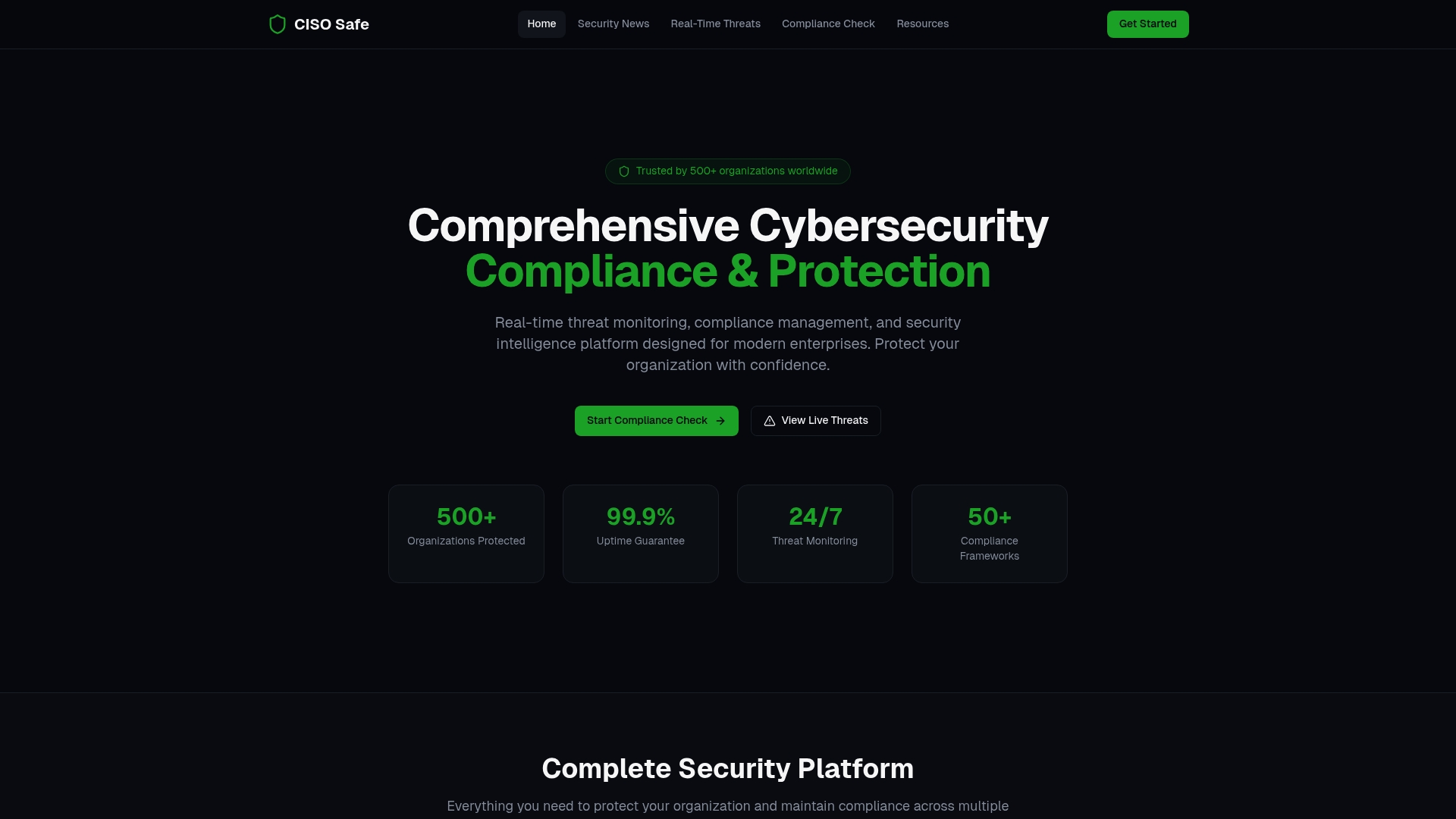
The vendor reports being trusted by over 500 organizations worldwide, a claim that signals traction with regulated buyers. CisoSafe pairs Houston-based virtual CISO services with an AI-enabled, multi-tenant SaaS portal for compliance and threat management.
The platform emphasizes practical program leadership plus automation. That combination aims to reduce reliance on a full-time CISO while giving leadership clear visibility into risk.
Core Features
- Real-time threat monitoring with instant alerts tied to curated vulnerability intelligence and news.
- Compliance management across 50+ frameworks including SOC 2, ISO 27001, HIPAA, PCI DSS, and GDPR.
- Risk assessment tools for prioritizing vulnerabilities and turning findings into guided implementation plans.
- Policy templates, documentation support, and incident response planning backed by virtual CISO advisory.
- A multi-tenant portal that automates penetration testing intake and produces professional reports using advanced AI models.
Key Differentiator
CisoSafe combines hands-on vCISO advisory with a single platform that centralizes compliance workflows, threat detection, and reporting for regulated industries. The firm positions strategic security leadership alongside platform automation so compliance tasks and executive briefings come from the same team and data.
Pros
- Continuous monitoring plus vendor-provided threat intelligence shortens the window between detection and response, which helps security teams focus on prioritized remediation.
- The virtual CISO model reduces the cost of senior security leadership while delivering policy development, risk roadmaps, and incident response planning.
- Broad framework support removes the need to stitch multiple point tools when you must manage SOC 2, HIPAA, and industry-specific standards concurrently.
- Built-in policy templates and guided implementation plans accelerate evidence collection during audits and decrease administrative lift for lean security teams.
- Multi-tenant reporting and automated penetration testing intake turn raw findings into professional reports that executives and auditors can read quickly.
Cons
- Public materials provide limited detail on customizable automation or third-party integration depth, which may matter if you rely on bespoke toolchains.
Who It's For
Mid-sized to large organizations in regulated sectors that want strategic security leadership without hiring a full-time CISO. Typical buyers include finance, legal, energy, and health organizations that must meet multiple frameworks and want a single vendor to own compliance and program governance.
Unique Value Proposition
The automated portal produces compliance intake and professional reporting backed by ongoing vCISO advisory. That mix changes the workflow: your audit evidence, threat telemetry, and executive risk briefings come from coordinated processes rather than separate vendors and slide decks.
This reduces internal coordination overhead and shortens the path from vulnerability discovery to board-level visibility.
Real World Use Case
A financial services firm used CisoSafe to manage SOC 2 readiness, ingest penetration test output, and receive weekly strategic guidance from an assigned virtual CISO. The engagement lowered internal overhead for audit tasks and provided a single escalation path during an active threat.
Pricing
Pricing is not specified in public materials and appears to be customized to organizational size and scope. Expect a scoped retainer or subscription model that scales with advisory hours and platform modules rather than a flat per-seat fee.
Website: https://cisosafe.com
Hicomply
At a Glance
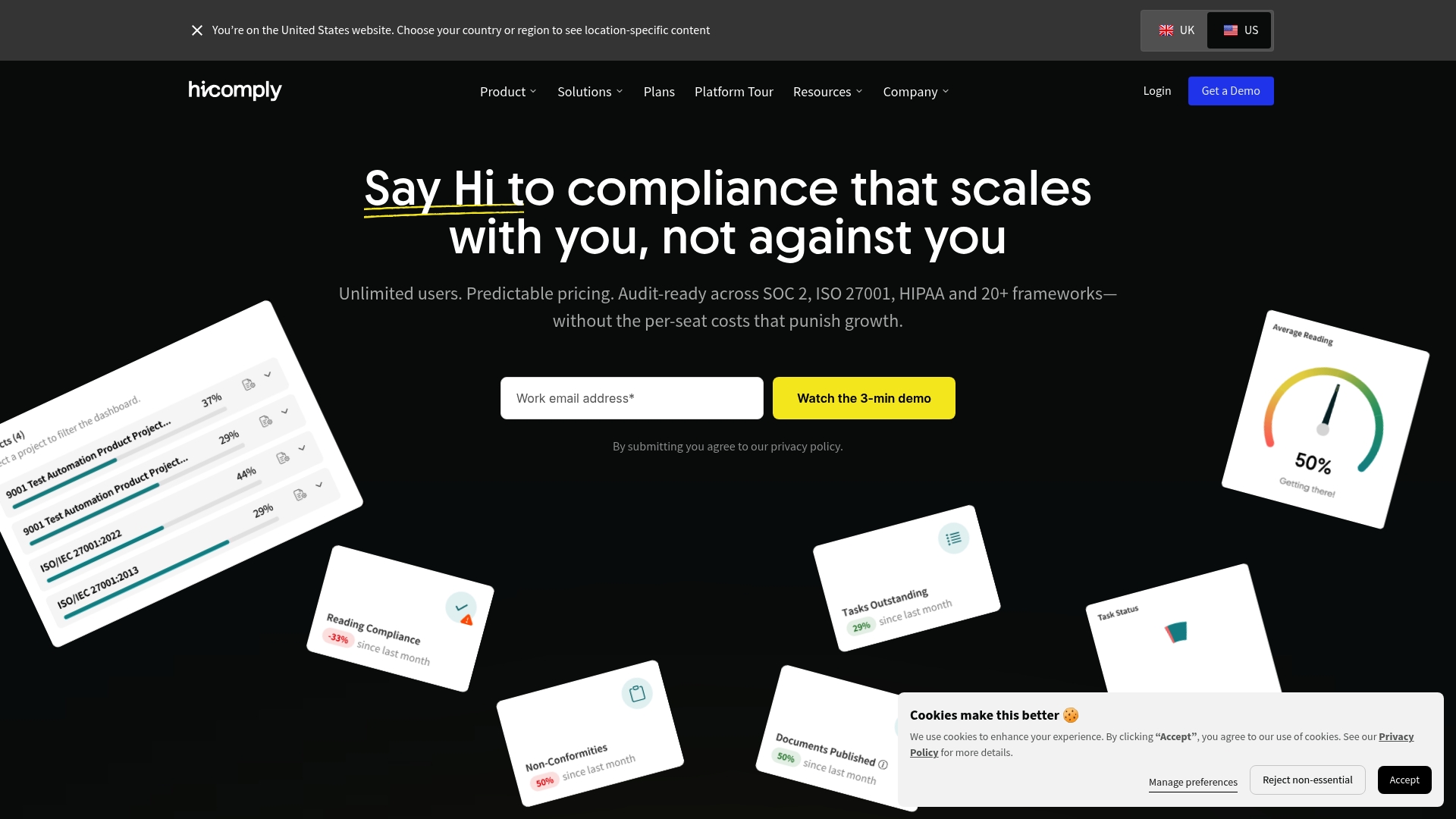
Vendor examples list plan ranges around £5,300 to £13,995 annually for common deployments, which positions the product at enterprise price points rather than small team budgets. The vendor also advertises connections to hundreds of applications and APIs, a claim I reference below as the integrations claim. Assess budget and scale before a demo.
Core Features
Hicomply centralizes policy, risk, incident, and audit records in one portal while automating evidence collection from connected systems. The platform includes version control for policies, an integrated risk register, and structured incident workflows that link to ticketing systems.
The product places emphasis on real-time dashboards for visibility. Ask for a walk-through of the dashboard during evaluation.
Key Differentiator
What separates Hicomply is the focus on integration-led automation. The vendor advertises the ability to pull evidence from many third-party services so audits require less manual upload. For teams managing multiple frameworks across departments, that integrations claim can cut repetitive work. Validate connector coverage for your critical systems before committing.
Pros
-
Centralized evidence collection reduces the number of manual exports and spreadsheets you must maintain. This reduces audit prep time when connectors cover the needed sources.
-
Automated policy version control ties updates to approval records, which helps when you must demonstrate change history to auditors.
-
The platform links incidents to tracking systems like Jira and Azure DevOps so remediation items flow into engineering or service queues without manual handoffs.
-
Dedicated customer success and guided implementation are part of the vendor narrative, which is useful for teams that lack internal compliance program experience.
-
Dashboards provide live views across frameworks and departments so leadership can spot gaps quickly rather than digging through documents.
Cons
-
Several users report the dashboard and tracking views can be confusing or lack clarity, which raises training overhead for non-technical staff.
-
The feature set may not cover niche or highly specialized regulatory requirements without customization or professional services.
-
Pricing details are not fully transparent on the website, which means procurement will need direct vendor discussions to lock down total cost.
When It May Not Fit
If you have fewer than 50 employees or need a low-cost per-user tool, Hicomply’s sample pricing and enterprise positioning make it a poor budget fit. Also skip it if your compliance needs are narrowly specialized and require bespoke workflows out of the box.
Notable Integrations
- Jira
- Zendesk
- Azure DevOps
- FreshService
- GitLab
- Asana
- Microsoft 365
Those connectors map to common engineering and service workflows and relate back to the integrations claim above. Confirm which integrations include automated evidence extraction.
Who It's For
Mid-to-large organizations with 50 or more employees that manage multiple compliance frameworks and need automation to reduce manual audit tasks. Best for teams that can allocate project time to implementation and change management.
Real World Use Case
A multinational firm consolidated separate framework workbooks into Hicomply, connected ticketing and source systems, and moved evidence collection into automated pulls. The centralization cut manual prep for cross-department audits and shortened internal review cycles.
Pricing
Pricing varies by plan and scope. Vendor examples show tiers around £5,300 to £13,995 annually, but the vendor recommends inquiries for exact quotes tailored to connectors and framework coverage. Budget for implementation and potential professional services.
Website: https://hicomply.com
RiseOne
At a Glance
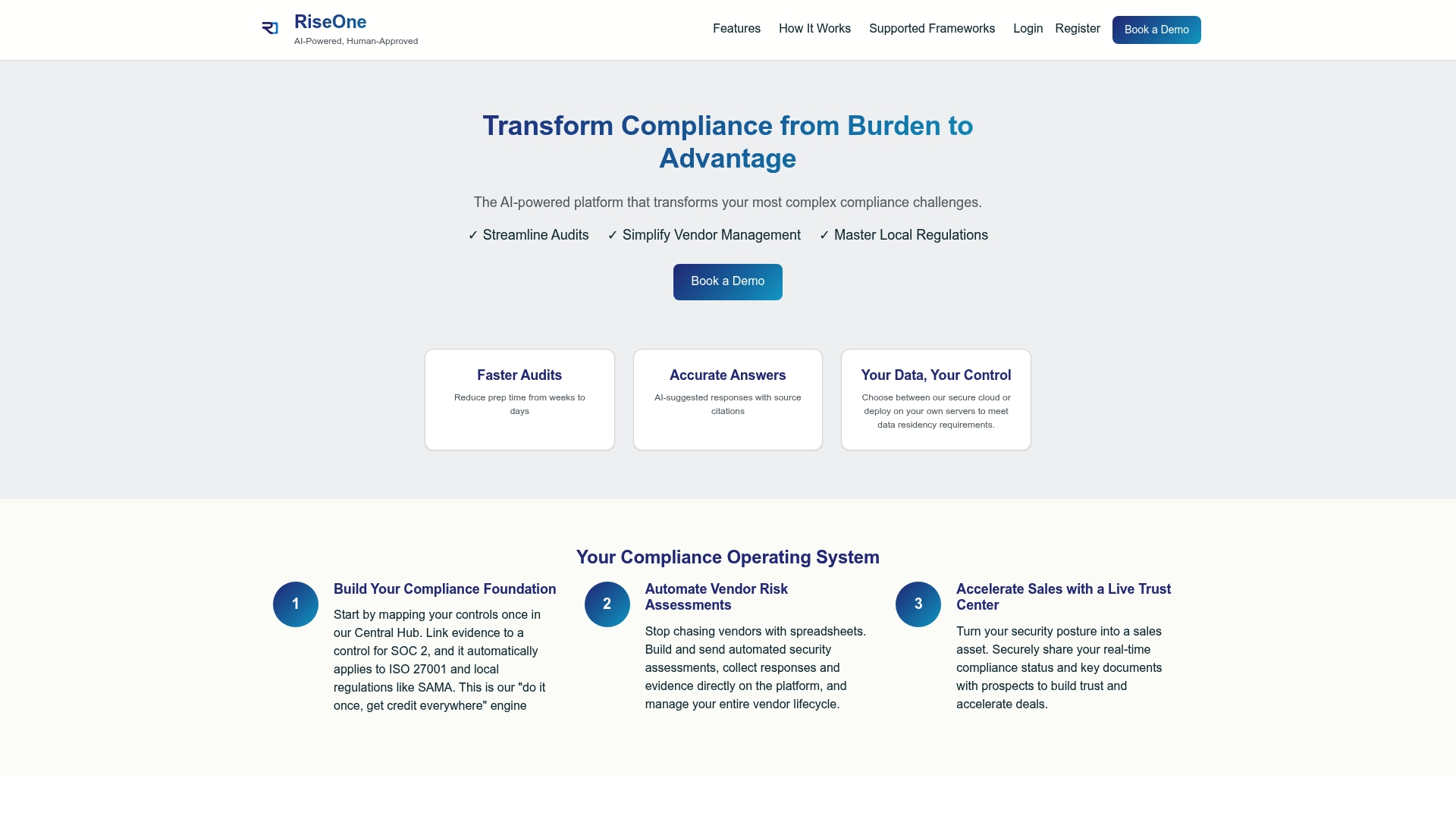
RiseOne's marketing materials claim organizations can save up to 15 days on audit preparation on average. The platform pairs control mapping with AI to reduce repetitive questionnaire work and offers regional deployment options for data residency in Egypt and nearby markets.
Core Features
- Unified Control Mapping that lets you map a single control to multiple frameworks and reuse evidence across audits.
- AI Compliance Copilot for auto-drafting responses to questionnaires and suggesting evidence pulls.
- Automated Vendor Risk Assessments that standardize vendor questionnaires and flag high-risk suppliers.
Key Differentiator
RiseOne centers on a "do it once, get credit everywhere" control mapping approach combined with AI automation. That combination reduces duplicated work when you support ISO 27001, SOC 2, GDPR, and similar frameworks, so attestations and vendor checks reuse the same control set.
Pros
-
The audit prep claim above gives procurement and compliance managers a concrete time-savings figure to evaluate when planning assessments.
-
Centralized evidence management means auditors see the same artifacts the first time, cutting back-and-forth during review.
-
The live Trust Center provides a client-facing view of compliance posture, which helps security teams demonstrate status to prospects during sales cycles.
-
Custom deployment options let teams keep data in region when regulatory requirements demand local residency.
Cons
-
Third-party reviews note limited advanced automation compared with specialist enterprise tools, which can leave gaps for highly bespoke regulatory workflows.
-
Several user reports mention unclear billing details and friction around cancellation, creating procurement questions during vendor selection.
-
Integrations list is limited in the product data, so teams relying on broad API ecosystems may need additional integration work.
When It May Not Fit
If your environment requires deep, programmatic automation across many bespoke regulations, RiseOne may feel too lightweight. Also, procurement teams that need clear, line-item pricing and simple cancellation terms should factor the reported billing concerns into vendor evaluation.
Who It's For
Mid-sized to large organizations operating in regulated industries across the Middle East and Africa that want to reduce audit overhead and centralize control evidence. Good for teams that value regional deployment and reuse of mapped controls across multiple standards.
Real World Use Case
A regional financial services provider maps controls once in RiseOne, automates responses to common audit questionnaires, and publishes a live compliance snapshot for clients. That setup accelerated contract close times and reduced manual evidence pulls during audits.
Pricing
Pricing is not publicly listed in the product data and is described as informational only. Prospective buyers should contact RiseOne for a tailored quote and to confirm deployment and billing terms.
Website: https://riseone.co
Comparative Analysis of Cybersecurity Compliance Software
Selecting the right cybersecurity compliance software relies on understanding the differences in capabilities, operational focus, and target use cases. Here is an comparison to help identify which option best aligns with organizational needs.
Integration Design and Automation
Hicomply emphasizes integration-led automation, standing out for its ability to pull compliance evidence directly from connected systems such as Jira and Azure DevOps. This approach reduces manual uploads, which can save substantial time during audit preparation. However, users have noted that its dashboard design might pose challenges for non-technical staff in interpretation. In contrast, RiseOne offers centralized evidence reuse across audits focusing on unified control mapping, ideal for organizations adhering to multiple interconnected frameworks without excessive customization demands. CisoSafe shines with its multi-tenant AI-powered platform that automates penetration testing intake and professional reporting while integrating strategic security leadership.
Regional Deployment and Specialized Focus
RiseOne serves as a stronger candidate for organizations needing localized data residency options, particularly in the Middle East and Africa. This regional focus suits industries with stringent jurisdictional requirements. While CisoSafe and Hicomply cater more broadly to industries requiring compliance with diverse frameworks, RiseOne’s geographic specificity gives it a unique edge. CisoSafe’s real-time threat monitoring and advisory-backed compliance management, though not geographically specific, provide deeply strategic insight shaped by regulatory demands.
Best Fit Recommendations
- CisoSafe: For mid-sized to large organizations in regulated industries requiring program leadership integrated with automated compliance management covering multiple frameworks simultaneously.
- Hicomply: Ideal for organizations needing extensive third-party tool integration and streamlining evidence collection within engineering and service workflows.
- RiseOne: Best suited for teams in regions emphasizing local data residency and benefiting from reusing mapped controls to reduce audit preparation time.
- Organizations prioritizing manual control: Those requiring tailored automation beyond standard offerings might find these options restrictive.
Our Pick: CisoSafe
CisoSafe provides a balanced solution with strategic virtual CISO advisory and advanced automation capabilities within a centralized portal. Notable for combining hands-on guidance with efficient task execution, it outmatches competitors in operational transition from vulnerability detection to compliance reporting. If regional deployment or extensive tool integrations are, alternatives may better serve.
Cybersecurity Compliance Software Comparison
Choosing the right cybersecurity compliance platform is crucial for addressing regulatory frameworks, streamlining processes, and reducing operational overhead. The following comparison highlights the key features and notable limitations of top solutions to assist in your decision-making process.
| Product Name | Core Functionality | Key Differentiator | Best For | Pricing | Notable Limitation |
|---|---|---|---|---|---|
| CisoSafe | Compliance management under 50+ frameworks | vCISO advisory combined with platform automation | Regulated industries needing leadership and automation | Not disclosed | Limited detail on integrations provided |
| Hicomply | Policy, risk, and incident management | Integration-led automation supporting multiple frameworks | Businesses needing automation for audit evidence | £5,300–£13,995 annually | Requires technical training to utilize fully |
| RiseOne | Unified control mapping for multiple frameworks | Centralized "do once, use everywhere" compliance approach | Organizations valuing evidence reuse and time savings | Not disclosed | Limited automation for niche workflows |
Discover a Smarter Way to Manage Compliance with CisoSafe
For organizations exploring icomply.online alternatives, one key challenge is handling multiple compliance frameworks efficiently while reducing audit overhead. CisoSafe addresses this by combining expert virtual CISO advisory with an AI-powered SaaS platform designed to automate compliance workflows, threat monitoring, and reporting. This integrated approach helps regulated businesses in sectors like law and energy gain clear visibility into risk and meet standards such as SOC 2, HIPAA, and PCI DSS without the cost of a full-time CISO.
Ready to reduce your compliance workload and improve risk management with a platform built for regulated industries? Visit CisoSafe to explore how real-time threat alerts and automated penetration testing intake simplify your audit preparation and risk planning. Book a consultation today and start turning complex compliance demands into manageable, actionable outcomes.
Frequently Asked Questions
How does CisoSafe facilitate compliance management across multiple frameworks?
CisoSafe offers compliance management across over 50 frameworks, including SOC 2, ISO 27001, HIPAA, PCI DSS, and GDPR. This broad framework support allows organizations to manage complex compliance requirements without needing multiple point tools. Consider using CisoSafe if your organization must meet diverse regulatory standards efficiently.
What is the difference between CisoSafe and Hicomply regarding integration capabilities?
Hicomply excels with its integration-led automation, allowing automated evidence collection from hundreds of applications and APIs. In contrast, CisoSafe focuses on combining vCISO advisory with a central platform for compliance workflows, making it a better choice for firms needing strategic guidance alongside automation. Evaluate your organization's specific integration needs when considering these two options.
Which platform offers better support for incident response planning: CisoSafe or RiseOne?
CisoSafe provides comprehensive incident response planning backed by virtual CISO advisory, which is essential for real-time threat management. RiseOne, while beneficial for control mapping and questionnaire automation, does not emphasize incident response as strongly as CisoSafe. If incident response is a priority for your compliance requirements, CisoSafe would be the more suitable choice.
Can I use CisoSafe if my organization has budget constraints?
CisoSafe's pricing is customized based on the organization's size and scope, which may help align costs with your budget. It operates on a scoped retainer or subscription model rather than a strict per-seat fee, potentially making it more adaptable for mid-sized organizations. If budget flexibility is a concern, reach out to CisoSafe for a tailored quote that fits your financial needs.
How does CisoSafe's virtual CISO model reduce the need for a full-time CISO?
CisoSafe's virtual CISO model delivers senior security leadership at a lower cost, efficiently providing policy development and risk roadmaps without hiring a full-time CISO. This model effectively reduces internal overhead while granting organizations the strategic guidance they require. If your organization needs expert input without the commitment of a full-time resource, CisoSafe is worth considering.
Does RiseOne support automated vendor risk assessments like CisoSafe?
RiseOne does offer automated vendor risk assessments to standardize vendor questionnaires, which helps in flagging high-risk suppliers. However, CisoSafe integrates similar functionalities within its broader compliance management suite, making it tailored for organizations needing comprehensive risk management alongside compliance workflows. If maintaining vendor assessments is crucial for your compliance strategy, review both options carefully.