

The SEC requires public companies to disclose material cybersecurity incidents on Form 8-K Item 1.05 within four business days of determining materiality and to include annual cybersecurity risk management, strategy, and governance disclosures under Regulation S-K Item 106 in Form 10-K. These are not aspirational guidelines. They are enforceable obligations with specific timelines, documentation standards, and amendment duties.
Before your next board meeting, your compliance team should have these five items confirmed:
- Materiality workflow: A documented, repeatable process for determining whether a cyber incident is material, with assigned decision authorities and legal sign-off requirements.
- Evidence preservation protocol: Timestamped logs, triage notes, and impact assessments that can survive regulatory scrutiny.
- Investor communications template: A pre-approved Form 8-K Item 1.05 draft framework ready to populate within hours of a materiality determination.
- XBRL tagging plan: Coordination with your XBRL provider for both block text and detail tagging of cybersecurity disclosures.
- Annual disclosure inventory: A current record of your risk management processes, board oversight structure, and management expertise descriptions for Item 106.
Named authorities to cite in counsel memos: SEC Final Rule Release Nos. 33-11216 and 34-97989, Form 8-K Item 1.05, and Regulation S-K Item 106.
Pro Tip: Assign a single disclosure committee owner for the four-business-day clock. The moment a materiality determination is made, that person's calendar clears. Ambiguity about who owns the clock is the most common reason companies miss the deadline.
Key Takeaways
The SEC's cybersecurity disclosure rules impose two firm obligations: a four-business-day incident reporting deadline tied to the materiality determination and annual governance disclosures that must be decision-useful to a reasonable investor.
| Point | Details |
|---|---|
| Four-business-day clock | The deadline runs from the materiality determination, not discovery; assign a single disclosure committee owner before an incident occurs. |
| Materiality documentation | Build a timestamped evidence folder covering detection logs, impact estimates, legal memos, and board briefings to survive regulatory examination. |
| Annual Item 106 disclosures | Describe specific governance processes, board oversight structure, and management expertise, not generic statements, in every Form 10-K. |
| XBRL tagging preparation | Engage your XBRL provider at least 90 days before the first tagged filing; block text tagging for narratives is the most commonly missed element. |
| CisoSafe vCISO engagement | CisoSafe provides materiality workflows, audit-ready documentation, and incident-to-filing coordination for SEC disclosure readiness across the United States. |
Table of Contents
- What the SEC cybersecurity disclosure rules actually cover
- Form 8-K Item 1.05: what you must disclose and when
- Annual disclosures under Regulation S-K Item 106 and Item 16K
- How to build a defensible materiality framework
- Coordinating incident response, legal counsel, and investor communications
- Inline XBRL tagging: what the SEC requires and where teams get it wrong
- SEC enforcement priorities and how to avoid common disclosure failures
- How a vCISO partner helps you operationalize SEC disclosure obligations
- The compliance gap most companies are still ignoring
- CisoSafe gives compliance officers a faster path to SEC disclosure readiness
- Sources
What the SEC cybersecurity disclosure rules actually cover
The SEC final rule (Release Nos. 33-11216; 34-97989) rests on two distinct pillars. The first is current incident reporting: when a registrant determines a cybersecurity incident is material, it must file Form 8-K Item 1.05 within four business days. The second is annual governance disclosure: registrants must describe their cybersecurity risk management processes, strategy, and board oversight in Form 10-K under Regulation S-K Item 106.
The rule covers domestic registrants, foreign private issuers (FPIs), and business development companies (BDCs). Smaller reporting companies (SRCs) are subject to the same substantive requirements but received extended compliance timelines for incident reporting. FPIs follow a parallel structure: annual disclosures appear in Form 20-F under Item 16K, and material incidents are furnished on Form 6-K rather than filed on Form 8-K.
The SEC's small-business compliance guide sets out the phased compliance schedule clearly:
| Requirement | Non-SRC Domestic Registrants | SRCs | FPIs |
|---|---|---|---|
| Annual Item 106/16K disclosures | Fiscal years ending on or after December 31, 2023 | Same start date | Form 20-F, same period |
| Form 8-K Item 1.05 incident reporting | 90 days after Federal Register publication | 270 days after Federal Register publication | Form 6-K, same trigger |
| Inline XBRL tagging | One year after annual/incident reporting start | Same delayed start | Same delayed start |
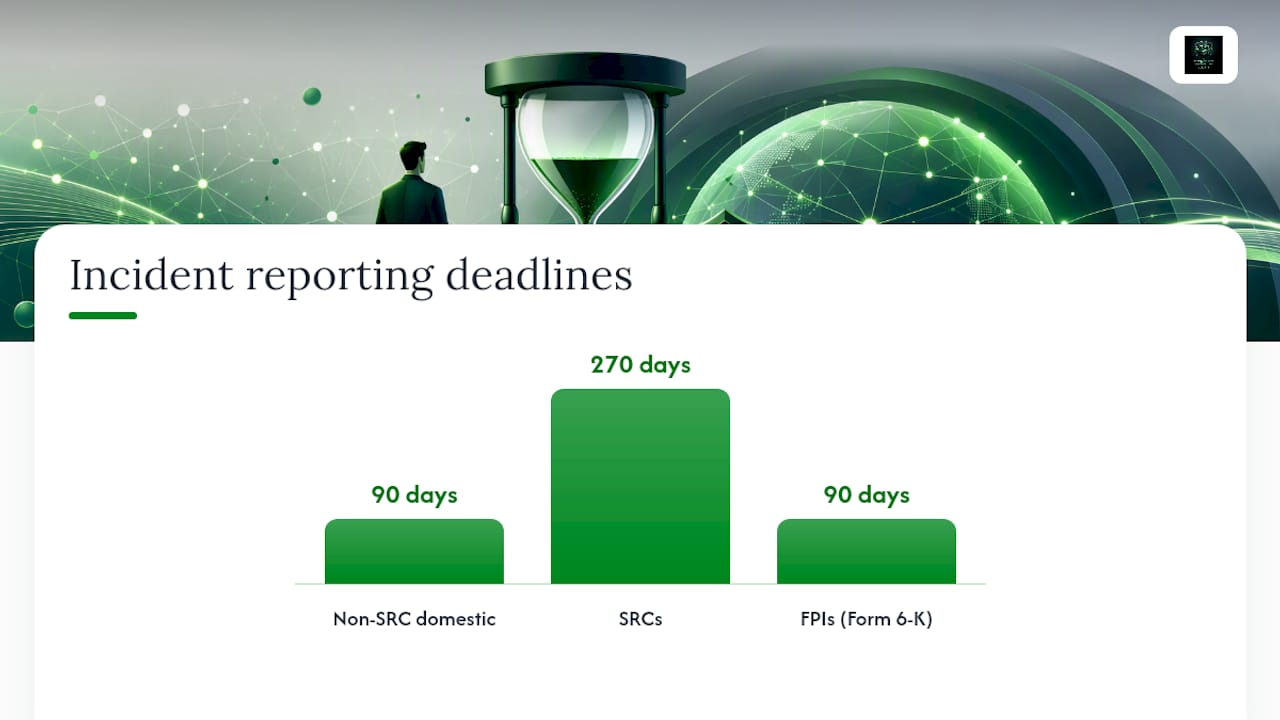
SRCs had an extended period to begin incident reporting. All registrants now face the full set of obligations, including XBRL tagging requirements that phased in one year after the primary compliance dates.
Form 8-K Item 1.05: what you must disclose and when
The filing trigger is the registrant's own determination that an incident is material, not the moment of discovery. That distinction carries real operational weight. A company can experience a breach, investigate for days, and still have the four-business-day clock sitting at zero until the disclosure committee makes a formal materiality determination. The clock starts then, and the adopting release expects that determination to happen "without unreasonable delay" after discovery.
Required disclosure elements under Item 1.05:
- The material aspects of the incident's nature (type of attack, systems affected at a high level)
- The incident's scope (breadth of data or systems involved)
- Timing (when the incident occurred or was discovered)
- The material impact or reasonably likely material impact on the registrant's financial condition and results of operations
What the rule does not require is equally important. Registrants are not obligated to disclose specific technical remediation steps, system vulnerability details, or security architecture information that could worsen the company's exposure. The SEC deliberately narrowed the disclosure scope to protect companies from inadvertently aiding threat actors through their own filings.
Amendment obligations are a frequently overlooked compliance gap. If material information about a previously filed Item 1.05 incident becomes available after the initial filing, the registrant must amend the Form 8-K. This applies to updated impact assessments, newly discovered scope, or changes in the company's understanding of the incident's financial consequences.
Permitted disclosure language:
- "The Company determined on [date] that the incident is material based on its assessment of potential financial impact, customer data exposure, and operational disruption."
- "The incident affected systems supporting [general function], and the Company is unable to estimate the full financial impact at this time but believes it is reasonably likely to be material."
- "The Company has engaged external forensic counsel and is cooperating with law enforcement."
Language to avoid:
- Specific vulnerability names, CVE identifiers, or unpatched system descriptions
- Detailed remediation timelines that signal incomplete fixes
- Statements that definitively quantify losses before a defensible estimate exists
Annual disclosures under Regulation S-K Item 106 and Item 16K
Regulation S-K Item 106 requires registrants to give investors enough process detail to make an informed judgment about how the company manages cybersecurity risk. Generic statements like "we take cybersecurity seriously" do not satisfy the standard. The SEC expects descriptions that a reasonable investor would find decision-useful.
Item 106 disclosure checklist for Form 10-K:
- Risk management processes: Describe how the company assesses, identifies, and manages material cybersecurity risks, including whether and how third-party assessors, auditors, or consultants are used.
- Material effects: Describe whether any cybersecurity risks have materially affected or are reasonably likely to materially affect the company's business strategy, results of operations, or financial condition.
- Governance — board oversight: Identify which board committee or the full board oversees cybersecurity risk. Describe how and how often management reports to the board, and what triggers an escalation.
- Governance — management roles: Describe the positions or committees responsible for assessing and managing cybersecurity threats, and the relevant expertise of those individuals.
- Management expertise: Link specific experience to concrete governance outcomes. Listing credentials alone is insufficient. Connecting a CISO's background managing regulated critical infrastructure incidents to the company's current monitoring routines is the kind of specificity the SEC expects.
FPIs follow the same substantive framework under Item 16K in Form 20-F. Material incidents are furnished on Form 6-K rather than filed on Form 8-K, but the content requirements for describing nature, scope, timing, and material impact are parallel.
The Inline XBRL tagging requirement applies to these annual disclosures. Block text tagging covers the narrative sections; detail tagging applies to quantitative amounts. The one-year delayed start means most registrants had their first XBRL-tagged cybersecurity disclosures due in fiscal year 2025 filings.
How to build a defensible materiality framework
A defensible materiality decision requires a documented process that can be audited. The four-business-day clock runs from the determination, so rapid but documented analysis is the goal. Here is a sequential workflow counsel can operationalize:
- Detection and initial triage: The incident response team logs the event with a timestamp, classifies the incident type, and notifies legal counsel within a defined window (typically 24 hours of detection for significant events).
- Quantitative impact assessment: Finance and operations estimate direct financial losses, remediation costs, revenue disruption, and potential regulatory fines. Even preliminary ranges are better than no estimate.
- Qualitative impact assessment: Legal counsel evaluates reputational exposure, customer and vendor relationship risk, litigation probability, and regulatory notification obligations under state breach laws or sector-specific rules.
- Materiality decision: The disclosure committee, with legal counsel, applies the standard: would a reasonable investor consider this information important in making an investment decision? The decision is documented in a written memo with the date and time of the determination.
- Disclosure approval and filing: The Form 8-K draft is reviewed, approved, and filed within four business days of step 4.
- Amendment monitoring: Legal counsel tracks new information post-filing and triggers an amendment if material updates emerge.
Documentation checklist for the materiality folder:
- Timestamped detection logs and initial triage notes
- Forensic vendor engagement letter and preliminary findings
- Financial impact estimate (with methodology and assumptions)
- Legal memo documenting the materiality analysis and conclusion
- Board or committee briefing record (date, attendees, summary)
- Form 8-K draft with version history and approval sign-offs
- Retention schedule tied to the company's document retention policy
Pro Tip: Build the materiality folder as a shared, access-controlled workspace that your disclosure committee, legal counsel, and external forensics team can all write to in real time. Reconstruct-after-the-fact documentation rarely survives a regulatory examination. Contemporaneous records do.
Coordinating incident response, legal counsel, and investor communications
Disclosure obligations and incident response run in parallel, not in sequence. The most common operational failure is treating them as sequential: finish the technical investigation, then call legal. By the time that happens, the four-business-day clock may already be running.
Roles and responsibilities to assign before an incident occurs:
- Incident response lead: Owns technical containment and forensic investigation; feeds factual updates to legal counsel on a defined schedule.
- Legal counsel / disclosure committee chair: Owns the materiality determination, the Form 8-K draft, and the filing decision.
- Board liaison: Briefs the relevant board committee within 24 hours of a potential material incident and again at the materiality determination.
- Investor relations: Prepares investor messaging aligned with the Form 8-K language; coordinates with exchanges if trading halts or unusual activity is anticipated.
- vCISO or external forensics vendor: Provides technical findings in a format legal counsel can translate into disclosure language without exposing remediation details.
The Attorney General delay mechanism is narrow and should not be treated as a default option. Under the adopting release, a written determination by the U.S. Attorney General that disclosure would pose a substantial risk to national security or public safety permits a short delay. Companies must coordinate with the Department of Justice directly. The FBI provides guidance to victims of cyber incidents on how to request this delay and how to work with law enforcement during the reporting process. Most companies will never qualify for this exception. Plan your disclosure process assuming the four-business-day deadline is firm.
Investor communications must be consistent with the Form 8-K. Statements to analysts, press releases, and social media posts that contradict or expand on the filed disclosure create enforcement exposure. Brief investor relations on the exact language in the filing before any external communication goes out.
Inline XBRL tagging: what the SEC requires and where teams get it wrong
The SEC's structured data requirements mandate Inline XBRL tagging for cybersecurity disclosures in two forms: block text tagging for narrative disclosures (the full Item 106 and Item 1.05 text blocks) and detail tagging for any quantitative amounts within those disclosures.
The one-year delayed start gave registrants time to prepare, but many reporting teams underestimated the coordination required. Block text tagging for narratives is the element most often overlooked until the filing deadline is close.
Practical preparation steps:
- Engage your XBRL provider at least 90 days before the first tagged filing is due.
- Map which narrative blocks in your Form 10-K correspond to Item 106 disclosures and flag them for block text tagging.
- Identify any quantitative amounts in your cybersecurity disclosures (estimated losses, affected records counts) that require detail tagging.
- Review prior filings for consistency: XBRL tags must align with the underlying disclosure language, and inconsistencies across filings attract staff comment letters.
- Assign an internal owner to review the tagged output before filing, not just the narrative text.
Common errors to avoid:
- Tagging the wrong narrative block (e.g., tagging a general risk factor instead of the Item 106 process description)
- Omitting detail tags on quantitative amounts embedded in narrative text
- Inconsistent taxonomy element selection across annual periods
- Failing to update tags when disclosure language changes materially between filings
SEC enforcement priorities and how to avoid common disclosure failures
The SEC's enforcement focus on cybersecurity disclosures centers on three areas: timeliness of the materiality determination, consistency between public statements and filed disclosures, and the defensibility of the materiality analysis itself. Companies that delay the formal determination to buy time before the four-business-day clock starts face the highest scrutiny.
Common disclosure mistakes:
- Delayed determinations: Treating the materiality decision as something that happens after the technical investigation is complete, rather than a parallel legal analysis that begins at detection.
- Inconsistent public statements: Executives making reassuring public comments about an incident that contradict the materiality assessment in the Form 8-K.
- Over-disclosure of technical detail: Including specific vulnerability names, patch timelines, or system architecture details that the final rule explicitly does not require and that could worsen security exposure.
- Under-disclosure of financial impact: Filing a Form 8-K that describes the incident in vague terms without any assessment of material impact on financial condition or results of operations.
- Missing amendments: Failing to amend a prior Item 1.05 filing when new material information, such as a revised scope assessment or updated loss estimate, becomes available.
Mitigation controls:
- Pre-approved Form 8-K Item 1.05 templates with placeholder language for each required element, reviewed by counsel in advance.
- A centralized incident log that captures every event, triage decision, and escalation with timestamps.
- Quarterly training for disclosure committee members on the materiality standard and the four-business-day obligation.
- A post-incident review process that checks whether any amendment obligation was triggered and documents the conclusion either way.
If an audit or examination identifies a disclosure gap, the path forward is an amended Form 8-K with a clear explanation of the new information, coordinated with outside counsel and, where appropriate, proactive communication with SEC staff.
How a vCISO partner helps you operationalize SEC disclosure obligations
A vCISO engagement closes the gap between having a cybersecurity program and having one that produces the documentation, workflows, and board-ready narratives the SEC's disclosure rules require. The two are not the same thing, and many companies discover the difference only when an incident occurs.

CisoSafe provides vCISO services specifically designed for regulated organizations that need to meet SEC cybersecurity compliance requirements without the cost of a full-time CISO or a large consulting firm. The engagement covers program documentation, materiality workflow design, evidence retention architecture, and incident response planning that integrates directly with the disclosure process.
What a vCISO engagement delivers for SEC disclosure readiness:
- A documented materiality determination workflow with assigned roles, decision thresholds, and legal sign-off checkpoints.
- An audit-ready evidence retention system that timestamps detection logs, triage notes, impact assessments, and board briefings in a format that survives regulatory examination.
- Board briefing materials that translate technical findings into the governance language Item 106 requires.
- Continuous monitoring feeds that support real-time materiality assessments rather than post-incident reconstruction.
- Coordination support between incident response, forensics vendors, legal counsel, and investor relations during an active incident.
The workflow from incident detection to Form 8-K filing looks like this: the vCISO team receives the initial detection alert, conducts a rapid technical triage, and delivers a structured impact summary to legal counsel within hours. Legal counsel applies the materiality standard to that summary, documents the determination, and initiates the Form 8-K drafting process. The vCISO team supports the amendment monitoring process post-filing, flagging any new technical findings that could trigger an amendment obligation. For cybersecurity governance in regulated sectors, this integrated model is the standard that holds up under examination.
The compliance gap most companies are still ignoring
The conventional advice on SEC cybersecurity disclosure rules focuses almost entirely on the four-business-day deadline. That is the wrong place to spend most of your preparation time.
The four-business-day clock is a symptom. The underlying problem is that most public companies do not have a documented, repeatable materiality determination process that can survive a regulatory examination. They have incident response plans. They have legal counsel on retainer. What they lack is the connective tissue: a workflow that moves a technical finding from the security team to a defensible legal conclusion in hours, not days, with contemporaneous documentation at every step.
The SEC's annual disclosure requirements under Item 106 reveal a second gap. Many companies describe their cybersecurity governance in terms that are accurate but not decision-useful. Saying the board "receives periodic updates" on cybersecurity risk tells an investor almost nothing. Describing the specific committee, the reporting cadence, the escalation triggers, and the management expertise that feeds those briefings is what the rule actually requires. Companies that treat Item 106 as a boilerplate checkbox are filing disclosures that invite staff comment letters.
The practical priority order is this: build the materiality workflow first, because it is the most time-sensitive and the most likely to fail under pressure. Then build the annual disclosure narrative, because it is the most visible and the most scrutinized over time. XBRL tagging is third, and it is largely a coordination problem, not a substantive one. Get your XBRL provider engaged early and the rest follows.
CisoSafe gives compliance officers a faster path to SEC disclosure readiness
Meeting the SEC's cybersecurity disclosure requirements demands more than legal awareness. It requires documented workflows, audit-ready evidence, and a governance structure that holds up under examination. CisoSafe delivers exactly that for regulated organizations across the United States, without the overhead of a full-time CISO or a large consulting engagement.
A CisoSafe vCISO retainer gives your compliance team a materiality determination workflow, an evidence retention system, board briefing templates, and incident response coordination built specifically for SEC disclosure obligations. The first engagement begins with a gap assessment against Item 1.05 and Item 106 requirements, a timeline estimate for closing identified gaps, and a retainer structure sized to your organization's needs. To schedule a readiness review, visit CisoSafe and request a consultation. Your disclosure committee will have a clear compliance roadmap within the first 30 days.
Sources
The following primary sources are the authoritative legal texts for counsel memos and board presentations on SEC cybersecurity disclosure obligations. The adopting release (Federal Register entry) is the document to cite in formal legal memoranda.
- Final Rule: Cybersecurity Risk Management, Strategy, Governance, and Incident Disclosure
- 17 CFR § 229.106 - (Item 106) Cybersecurity. | Electronic Code of Federal Regulations (e-CFR) | US Law | LII / Legal Information Institute
- Federal Register: Cybersecurity Risk Management, Strategy, Governance, and Incident Disclosure (adopting release)
This article is general information, not a substitute for advice from a qualified lawyer. Consult a qualified legal professional about your own circumstances before acting on anything here.