

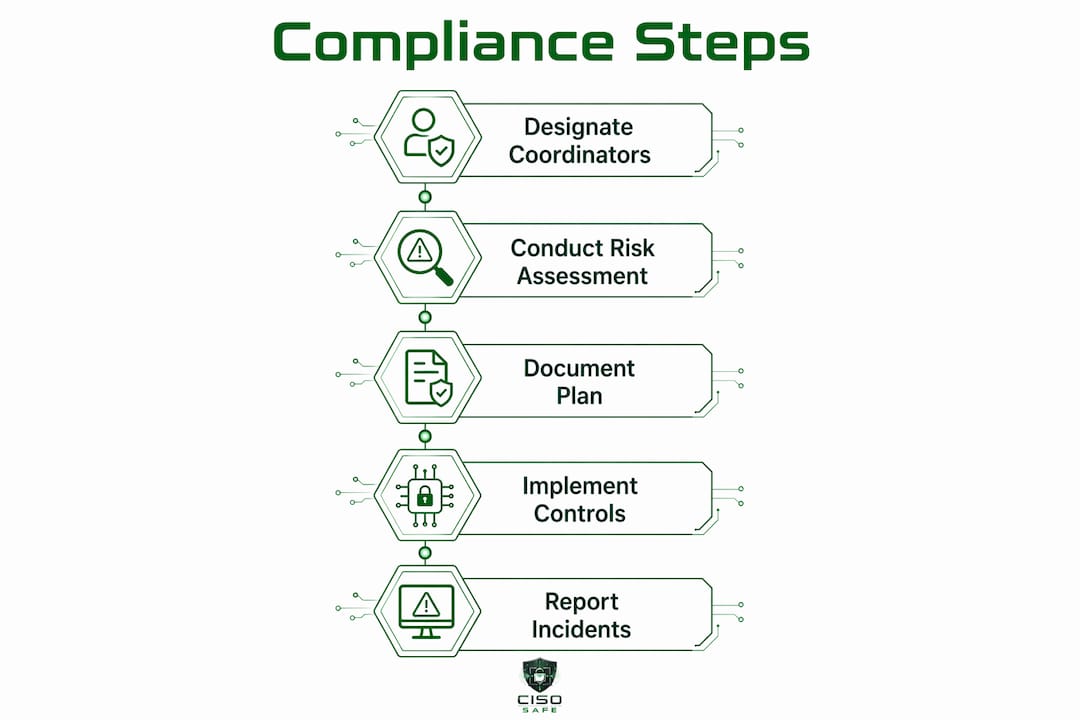
TSA cybersecurity directive compliance requires covered surface transportation and pipeline operators to establish formal Cyber Risk Management Programs under the authority of the Transportation Security Administration and the Cybersecurity and Infrastructure Security Agency. These programs are not optional frameworks. They carry federal enforcement weight and mandate specific roles, documented controls, annual risk assessments, and incident reporting to CISA within defined windows. Compliance officers and business leaders in regulated industries need to understand the full scope of these requirements, including the transition from renewable Security Directives to a permanent regulatory rule introduced through a November 2024 Notice of Proposed Rulemaking.
What roles and responsibilities are required for TSA cybersecurity directive compliance?
Every covered operator must designate both a primary and an alternate Cybersecurity Coordinator at the corporate level. These individuals serve as the principal points of contact for TSA and CISA on all cybersecurity matters, including intelligence sharing, incident communication, and program oversight. The role carries real accountability. Coordinators must be reachable at all times, not just during business hours.
Citizenship and program membership requirements add a layer of complexity that many organizations overlook. At least one designated coordinator must be a U.S. citizen. Non-U.S. citizens serving in this role must hold active membership in a TSA-approved trusted traveler program. Non-U.S. citizen coordinators must be enrolled in NEXUS, Global Entry, or an equivalent TSA-approved program, with documentation submitted to TSA. This requirement took effect january 15, 2026.

The practical risk here is significant. Coordinator vetting gaps are most likely to surface during personnel transitions or onboarding, when compliance teams are focused on operational handoffs rather than regulatory credentials. A coordinator who does not meet citizenship or program membership requirements creates an immediate compliance deficiency.
Coordinator responsibilities include:
- Serving as the primary TSA and CISA contact for all cybersecurity incidents and intelligence
- Maintaining current knowledge of the organization's Cyber Risk Management Program
- Coordinating with internal IT and operations teams on incident response activation
- Submitting required documentation to TSA, including program updates and vulnerability assessment forms
- Verifying that alternate coordinators meet the same eligibility standards
Pro Tip: Build coordinator eligibility verification into your annual HR review cycle. Trusted traveler program memberships expire, and a lapsed membership creates a compliance gap that TSA can identify during a review.
How to conduct and document a cybersecurity risk assessment to meet TSA requirements
A cybersecurity risk assessment under TSA guidelines is not a one-time exercise. It is an annual, documented process that identifies critical cyber systems, maps realistic threat scenarios, and validates that prioritized controls are actually working. The TSA Pipeline Security Guidelines Section 7 and the evolving NPRM frameworks both provide the structural basis for what this assessment must cover.
The most common failure mode is copying the prior year's assessment forward without a genuine refresh. Threat environments change. New operational technology gets added. Personnel and vendor relationships shift. An assessment that does not reflect the current state of your environment does not satisfy the requirement and does not protect your organization. For energy and pipeline operators, the benefits of annual risk assessments go well beyond regulatory compliance.
Conduct your annual assessment using these steps:
- Inventory critical cyber systems. Identify all IT and OT assets that, if compromised, would affect safety, operations, or service continuity.
- Define threat scenarios. Document realistic attack paths specific to your sector, including ransomware, supply chain compromise, and insider threats.
- Evaluate existing controls. Test whether current controls actually mitigate the identified threats, not just whether they exist on paper.
- Prioritize gaps. Rank control gaps by likelihood and impact, and assign remediation owners with deadlines.
- Document everything. TSA requires written documentation. Verbal assessments and informal reviews do not satisfy the requirement.
Pro Tip: Treat your risk assessment as a living document. Schedule a mid-year review to capture any significant changes to your environment, even if the formal annual cycle has not yet arrived.
What must be included in a cybersecurity operational implementation plan and vulnerability assessment?
The Cybersecurity Implementation Plan is the operational core of your compliance program. TSA requires written documentation of controls covering IT and OT network segmentation, multi-factor authentication access controls, vulnerability management, and logging. Plans must be submitted to and approved by TSA, and they must include completed vulnerability assessment forms with remediation timelines.
Network segmentation between IT and OT environments is a non-negotiable control. Flat networks that allow lateral movement from corporate systems into operational technology create unacceptable risk in pipeline and surface transportation environments. MFA must be applied to all remote access and privileged accounts, not just external-facing systems.
The vulnerability assessment component requires more than a scan report. TSA expects operators to complete agency-provided forms that document identified vulnerabilities, their severity ratings, compensating controls where patching is not immediately possible, and projected remediation dates. This is a structured accountability mechanism, not a checkbox.
| Control Category | Requirement | Documentation Expected |
|---|---|---|
| Network segmentation | IT and OT environments separated | Architecture diagrams, firewall rule sets |
| Access control | MFA on all remote and privileged access | Access policy, MFA configuration records |
| Vulnerability management | Patching with compensating controls documented | Patch logs, vulnerability assessment forms |
| Logging and monitoring | Continuous logging with defined retention | SIEM configuration, log retention policy |
| Backup and recovery | Tested backup procedures with recovery timelines | Backup test records, recovery runbooks |
Supply chain risk is an emerging area of focus within implementation plans. Operators who assess third-party vendor security as part of their program are better positioned for both current directives and the permanent rule framework ahead.
How to meet TSA cybersecurity incident reporting and response plan requirements
Covered operators must report cybersecurity incidents to CISA as soon as practicable. The 72-hour reporting window is the hard deadline for covered cybersecurity incidents as of april 2026. This clock starts at the moment of incident identification, not at the moment of confirmed breach. Waiting for full forensic certainty before reporting is not compliant.
Your Cybersecurity Incident Response Plan must be more than a generic document. Response plans must name roles, incorporate reporting timelines, and coordinate notification flows to TSA, CISA, and the FBI as applicable. Every person named in the plan must know their responsibilities before an incident occurs.
"Tabletop exercises involving Cybersecurity Coordinators are the most reliable way to validate that your reporting chain actually works under pressure. A plan that has never been tested is a plan that will fail at the worst possible moment."
Align your TSA reporting obligations with CIRCIA now, before the law's full implementation. Harmonizing TSA and CIRCIA timelines reduces operational duplication because both frameworks anticipate 72-hour incident triage and 24-hour ransom payment reporting windows. Organizations that build a single, unified incident response workflow satisfy both requirements without running parallel processes.
The steps for a compliant incident response process are:
- Identify and classify. Determine whether the event meets the definition of a covered cybersecurity incident under TSA guidelines.
- Notify the Cybersecurity Coordinator immediately. The coordinator activates the response plan and initiates the reporting clock.
- Report to CISA within 72 hours. Use the CISA reporting portal and document the submission timestamp.
- Notify TSA and FBI as applicable. Certain incident types require parallel notification.
- Preserve evidence and begin remediation. Document all actions taken during response for post-incident review.
What are the new permanent rules replacing TSA's annual Security Directives?
TSA is moving away from renewable emergency Security Directives toward a permanent regulatory framework. The november 2024 NPRM introduced a formal Cyber Risk Management Program rule for surface transportation operators. TSA's transition to permanent rules includes controls like network segmentation and MFA, with operators encouraged to operationalize these controls immediately rather than waiting for a final rule.
The distinction between the current directive model and the permanent framework matters for how you plan your program. Annual Security Directives created a renewal cycle that some operators treated as a point-in-time compliance event. The permanent rule eliminates that cycle. Compliance becomes continuous, and TSA expects controls to be embedded in daily operations.
| Feature | Current Security Directives | Proposed Permanent Rule |
|---|---|---|
| Duration | Annual renewal required | Permanent, no renewal cycle |
| Enforcement basis | Emergency authority | Formal rulemaking |
| Compliance model | Point-in-time submission | Continuous operationalization |
| Supply chain scope | Limited | Expanded, including vendor risk |
| Assessment program | Voluntary for some operators | Formal Cybersecurity Assessment Program required |
Operators who treat the current directives as a baseline and build toward the permanent rule's expectations are the ones who will face the least disruption when the final rule takes effect. The energy sector compliance frameworks that already incorporate continuous monitoring and supply chain risk management are the model to follow.
Key takeaways
TSA cybersecurity directive compliance requires a continuous, documented Cyber Risk Management Program covering designated coordinators, annual risk assessments, written implementation plans, and 72-hour incident reporting to CISA.
| Point | Details |
|---|---|
| Coordinator eligibility | Non-U.S. citizen coordinators must hold active NEXUS or Global Entry membership and submit documentation to TSA. |
| Annual risk assessment | Assess critical cyber systems, threat scenarios, and control gaps every year with full written documentation. |
| Implementation plan controls | Document IT/OT segmentation, MFA, patching, logging, and backup procedures in a TSA-approved written plan. |
| 72-hour incident reporting | Report covered incidents to CISA within 72 hours of identification, not confirmation. |
| Permanent rule preparation | Operationalize controls now to meet the continuous compliance model of the incoming permanent regulatory framework. |
The compliance trap I see most often in regulated industries
The single most damaging misconception I encounter is treating TSA directives as a filing exercise. Organizations submit their implementation plan, check the box, and move on until the next renewal cycle. That approach worked poorly under the directive model. Under the permanent rule framework, it will create serious exposure.
Directives serve as a baseline for Cyber Risk Management Programs, not as the ceiling. The organizations that handle TSA audits and incident reviews with confidence are the ones that have woven these controls into their daily operations. Their coordinators know the response plan. Their IT teams run patching cycles against documented timelines. Their logs are actually reviewed.
Executive engagement is the other gap I see consistently. Cybersecurity coordinators cannot carry this program alone. When leadership treats TSA compliance as an IT problem rather than a business risk, the program stagnates. The permanent rule's continuous compliance model will make that gap visible in ways that annual renewals never did.
The practical advice is straightforward. Map your current controls against both the existing directive requirements and the NPRM's expanded expectations. Identify where you are relying on compensating controls that need a remediation path. Run a tabletop exercise with your coordinators before your next TSA review. And align your incident response workflow with CIRCIA now, because running two separate reporting processes under pressure is a failure waiting to happen.
— vCISO
How CisoSafe supports your TSA compliance program
Regulated organizations that need to build or mature a TSA-compliant Cyber Risk Management Program often lack the internal resources to do it well. CisoSafe provides virtual CISO services and AI-powered compliance support built specifically for high-stakes industries including pipeline operators, energy companies, and surface transportation organizations.
CisoSafe's team handles cybersecurity risk assessments, policy development, implementation plan documentation, and incident response planning. The firm's vCISO advisors work directly with your compliance officers and leadership to build programs that satisfy current TSA Security Directives and position your organization for the permanent rule ahead. For organizations that need enterprise-grade expertise without the cost of a full-time CISO, CisoSafe delivers practical, audit-ready outcomes.
FAQ
What is TSA cybersecurity directive compliance?
TSA cybersecurity directive compliance is the requirement for covered pipeline and surface transportation operators to maintain a formal Cyber Risk Management Program that includes designated coordinators, annual risk assessments, written implementation plans, and incident reporting to CISA.
Who must be designated as a Cybersecurity Coordinator?
Operators must designate a primary and an alternate Cybersecurity Coordinator at the corporate level. At least one must be a U.S. citizen, and non-U.S. citizen coordinators must hold active membership in NEXUS, Global Entry, or a TSA-approved equivalent program.
How quickly must cybersecurity incidents be reported to CISA?
Covered operators must report cybersecurity incidents to CISA within 72 hours of identification. The clock starts at identification, not at confirmed breach.
What controls must be documented in a Cybersecurity Implementation Plan?
The plan must document IT and OT network segmentation, multi-factor authentication, vulnerability management with patching timelines, logging and monitoring, and backup and recovery procedures, all submitted to and approved by TSA.
How does the proposed permanent rule differ from current Security Directives?
The permanent rule replaces annual renewable directives with a continuous compliance model. Operators will be required to maintain and operationalize controls as an ongoing business practice rather than submitting documentation on a renewal cycle.