

RMF stands for Risk Management Framework, and in U.S. information-security practice, it refers specifically to the structured process published by the National Institute of Standards and Technology. NIST defines RMF as a disciplined, structured, and flexible process that integrates security, privacy, and cyber supply chain risk management activities into the system development life cycle (SDLC). The practical payoff for your organization: a documented, defensible path to an Authorization to Operate (ATO) and a continuous monitoring posture that replaces point-in-time audits.
While acronym repositories list over 35 definitions for "RMF" across different domains, the information-security meaning is unambiguous for anyone working in U.S. federal or regulated environments.
Key facts to anchor your understanding:
- Primary reference: NIST SP 800-37 is the governing publication for RMF structure and process.
- Core outcome: A formal ATO decision by an Authorizing Official (AO), supported by documented controls and ongoing monitoring.
- Scope: Applicable to all federal information systems and broadly adopted by contractors, regulated-sector organizations, and private-sector entities with high-risk systems.
- Replaces: The older Certification and Accreditation (C&A) and DIACAP processes that relied on three-year certification cycles.
Key Takeaways
RMF is the NIST-defined lifecycle for managing information-system risk, and NIST SP 800-37 is the authoritative reference every U.S. organization should start with.
| Point | Details |
|---|---|
| RMF definition | Risk Management Framework: a structured NIST process integrating security, privacy, and supply-chain risk into the SDLC. |
| Primary reference | NIST SP 800-37 governs the RMF lifecycle; SP 800-53 provides the control catalog used in the Select step. |
| Six core steps | Categorize, Select, Implement, Assess, Authorize, and Monitor — each producing specific artifacts that support the ATO decision. |
| Who must apply RMF | Federal agencies (FISMA-required), federal contractors, FedRAMP cloud providers, and high-risk private-sector organizations. |
| CisoSafe next step | CisoSafe's vCISO services and compliance platform accelerate RMF adoption from scoping through ATO readiness across the United States. |
Table of Contents
- What is the origin and official scope of RMF?
- How does the RMF process work step by step?
- Who should use RMF and when does it apply?
- How does RMF relate to NIST CSF, SP 800-53, FedRAMP, ISO 27001, and CMMC?
- What roles and responsibilities does RMF require?
- How do you get started with RMF in the first 90 days?
- Practitioner tips for operationalizing RMF effectively
- Why RMF remains the right framework for structured risk decisions
- RMF implementation support from CisoSafe
- Sources
What is the origin and official scope of RMF?
RMF emerged from a joint effort between NIST and the Joint Task Force (JTF), a collaboration that includes the Department of Defense, the Intelligence Community, and the Committee on National Security Systems. The framework replaced the older C&A and DIACAP models, shifting federal security practice from periodic certification cycles to continuous monitoring and ongoing authorization decisions.
Two NIST publications anchor the framework:
- NIST SP 800-37 ("Risk Management Framework for Information Systems and Organizations") defines the lifecycle steps, roles, and process requirements.
- NIST SP 800-53 ("Security and Privacy Controls for Information Systems and Organizations") provides the control catalog that organizations draw from during the Select step.
Supporting publications extend the framework further. NIST Internal Reports (IRs) and the SP 1800 practice guide series demonstrate RMF principles applied to specific technologies and sectors. For systems classified as national security systems, CNSS issuances add requirements beyond the base NIST guidance and must be consulted separately.
RMF is sector-agnostic by design. Federal agencies are required to apply it under FISMA. Contractors handling federal data, cloud service providers seeking FedRAMP authorization, and private-sector organizations in healthcare, energy, and financial services increasingly adopt it voluntarily because the lifecycle rigor transfers directly to audit readiness and board-level risk governance.
How does the RMF process work step by step?
The RMF lifecycle, as defined in NIST SP 800-37, consists of six core steps (with a preparatory "Prepare" step that precedes them in the current revision). Each step produces specific artifacts that feed the next, culminating in an ATO decision and an ongoing monitoring program.
| RMF Step | Goal | Typical Artifacts |
|---|---|---|
| Prepare | Establish organizational context and risk tolerance | Risk management strategy, system inventory, mission/business process mapping |
| Categorize | Determine the system's impact level | FIPS 199 categorization worksheet, system boundary documentation |
| Select | Choose and tailor a control baseline | System Security Plan (SSP) draft, tailoring rationale, continuous monitoring strategy |
| Implement | Deploy and document controls | Updated SSP with implementation details, configuration baselines, evidence packages |
| Assess | Evaluate whether controls work as intended | Security Assessment Report (SAR), assessor findings, test plans |
| Authorize | Accept residual risk and issue or deny ATO | Authorization package (SSP + SAR + POA&M), ATO letter or denial |
| Monitor | Track control effectiveness over time | Ongoing assessment results, Plan of Action and Milestones (POA&M) updates, status reports |
The Categorize step relies on FIPS 199 to assign a Low, Moderate, or High impact level based on the potential consequences of a confidentiality, integrity, or availability breach. That impact level directly determines which SP 800-53 control baseline you start with in the Select step, so getting categorization right is the single most consequential early decision in the process.
The Assess step is where many organizations underestimate the workload. A qualified Security Control Assessor (SCA) must independently verify that each implemented control actually functions as documented. The output, the Security Assessment Report, is the primary evidence the AO uses to make the authorization decision.

Pro Tip: Scope your system boundary tightly before categorization. A boundary that includes loosely related subsystems inflates your control count and assessment labor. Where a subsystem has its own authorization boundary, treat it as a separate system or leverage inheritance from a common control provider to reduce duplication.
Who should use RMF and when does it apply?
RMF is mandatory for federal agencies under FISMA and for any information system that processes, stores, or transmits federal information. Beyond that statutory floor, several practical triggers should prompt an organization to adopt or align with RMF:
- Federal contracts: Contract clauses referencing FISMA, FedRAMP, or DFARS cybersecurity requirements effectively mandate RMF-aligned controls and documentation.
- FedRAMP authorization: Cloud service providers seeking to sell to federal agencies must complete a FedRAMP authorization process built directly on the RMF lifecycle.
- CMMC compliance: Defense contractors pursuing Cybersecurity Maturity Model Certification (CMMC) Level 2 or 3 work with control families drawn from NIST SP 800-171 and SP 800-53, making RMF familiarity directly useful.
- High-impact private systems: Organizations running systems where a breach would cause severe harm — financial infrastructure, critical utilities, healthcare records — benefit from RMF's structured risk acceptance model even without a federal mandate.
- Sector-specific regulation: In healthcare, HIPAA's Security Rule shapes which controls are non-negotiable, and RMF's tailoring mechanism accommodates those constraints within the standard SP 800-53 baseline.
A typical trigger scenario: A mid-sized IT services firm wins a contract to manage a federal agency's cloud infrastructure. The contract references FedRAMP Moderate authorization as a condition of performance. The firm must now complete a full RMF lifecycle — categorize the system, select and implement Moderate baseline controls from SP 800-53, engage a Third-Party Assessment Organization (3PAO) for the Assess step, and obtain an ATO from the agency's Authorizing Official before going live. Without RMF familiarity, that process routinely takes 12–18 months and costs more than anticipated because the firm underestimated documentation requirements.
For energy companies and critical infrastructure operators, RMF also maps well to sector-specific requirements under NERC CIP and similar standards, making it a practical unifying lifecycle even when another regulation is the primary driver.
How does RMF relate to NIST CSF, SP 800-53, FedRAMP, ISO 27001, and CMMC?
RMF does not exist in isolation. Most organizations already operate within one or more other frameworks, and understanding how RMF maps to each prevents redundant work.
- RMF and NIST CSF: The Cybersecurity Framework organizes security outcomes into five functions (Identify, Protect, Detect, Respond, Recover). RMF provides the lifecycle and authorization model; CSF provides the outcome vocabulary. Treat CSF as the "what" and RMF as the "how" for federal and high-stakes systems. Control selections from SP 800-53 map directly to CSF subcategories.
- RMF and SP 800-53: SP 800-53 is the control catalog RMF draws from. The Select step in RMF is essentially the process of choosing, tailoring, and documenting which SP 800-53 controls apply to your system. The two are inseparable in practice.
- RMF and FedRAMP: FedRAMP is RMF applied specifically to cloud services for federal use. It standardizes the authorization package format, requires a 3PAO for assessment, and maintains a shared authorization model so a single ATO can be reused across agencies. Organizations familiar with RMF will recognize every FedRAMP step.
- RMF and ISO 27001: ISO 27001 is a management-system standard focused on establishing, operating, and improving an Information Security Management System (ISMS). RMF is a risk-acceptance lifecycle. When mapping the two, treat RMF as the authorization and control-implementation model; map SP 800-53 control families to ISO 27001 Annex A controls rather than trying to replace one standard with the other. NIST's own guidance supports this approach.
- RMF and CMMC: CMMC Level 2 aligns with NIST SP 800-171, which itself derives from SP 800-53 Moderate. Organizations already in an RMF program can leverage their existing SSP and control evidence to satisfy a significant portion of CMMC assessment requirements, reducing duplication.
For organizations managing supply chain cyber risk, RMF's Prepare and Select steps include explicit provisions for cyber supply chain risk management (C-SCRM), making it one of the few frameworks that formally addresses third-party risk within the authorization lifecycle.
What roles and responsibilities does RMF require?
RMF assigns accountability deliberately. The most common implementation failure is treating the framework as an IT project rather than an organizational risk decision. Federal training material is explicit: the Authorizing Official must formally accept residual risk, and that acceptance cannot be delegated to a technical team.
Core roles and their primary responsibilities:
- Authorizing Official (AO): Senior executive who accepts residual risk and issues or denies the ATO. Accountable for the authorization decision.
- System Owner: Responsible for the overall procurement, development, integration, and operation of the system. Drives SSP development and control implementation.
- Information System Security Officer (ISSO): Day-to-day security operations for the system; maintains the SSP, tracks POA&M items, and coordinates with the assessor.
- Security Control Assessor (SCA): Independent evaluator who tests controls and produces the SAR. Must be organizationally separate from the implementation team.
- Information Owner / Steward: Responsible for the data the system processes; provides input on categorization and data-handling requirements.
- Common Control Provider: Supplies inherited controls (e.g., physical security, network infrastructure) that multiple systems can leverage, reducing per-system assessment burden.
| RMF Activity | Responsible | Accountable | Consulted |
|---|---|---|---|
| System categorization | System Owner / ISSO | AO | Information Owner |
| Control selection and tailoring | ISSO | System Owner | Common Control Provider |
| Control implementation | System Owner / IT team | System Owner | ISSO |
| Security assessment | SCA | AO | ISSO |
| Authorization decision | AO | AO | Senior Agency Official for Privacy |
| Continuous monitoring | ISSO | System Owner | SCA |
How do you get started with RMF in the first 90 days?
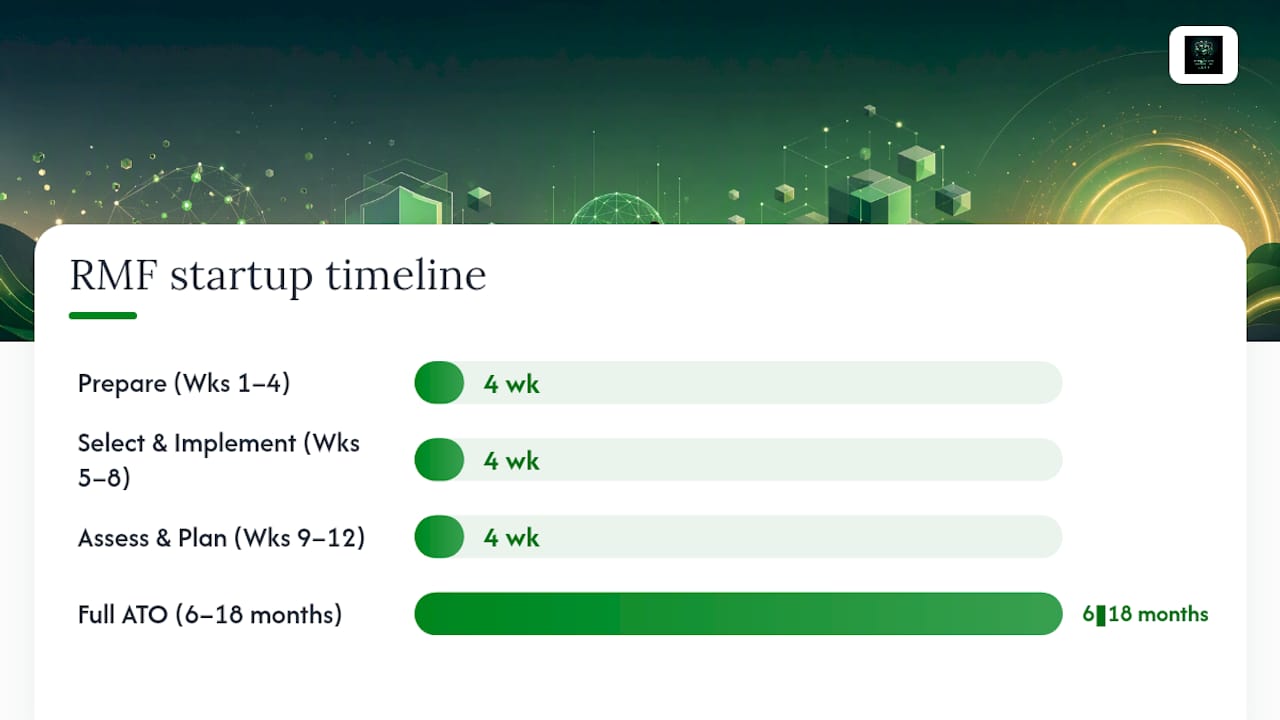
A structured start prevents the most common early mistake: beginning control implementation before the system boundary and impact level are agreed upon. The following checklist and timeline give security leaders a concrete starting point.
Pre-work (before Day 1):
- Inventory all information systems in scope and identify their business owners.
- Classify data types processed by each system using FIPS 199 criteria (confidentiality, integrity, availability impact levels).
- Confirm which systems require a new ATO versus which can inherit controls from an existing authorization.
- Identify your Authorizing Official and confirm their availability and authority level.
Weeks 1–4: Prepare and Categorize
- Define system boundaries and document interconnections.
- Complete FIPS 199 categorization worksheets for each in-scope system.
- Draft the initial System Security Plan structure (system description, boundary, users, data flows).
- Review applicable NIST SP 1800 practice guides for your technology stack to identify relevant control implementation patterns.
Weeks 5–8: Select and Begin Implementation
- Select the SP 800-53 control baseline matching your impact level (Low, Moderate, or High).
- Tailor the baseline: add controls required by sector regulation (e.g., HIPAA for healthcare systems), remove controls that do not apply, and document all tailoring decisions.
- Assign control implementation owners for each control family.
- Begin populating the SSP with implementation details as controls are deployed.
Weeks 9–12: Assess Readiness and Plan Authorization
- Conduct an internal gap assessment against the selected baseline.
- Build your POA&M for any identified gaps, with realistic remediation timelines.
- Select or engage a Security Control Assessor (independent of the implementation team).
- Establish your continuous monitoring metrics and reporting cadence.
A full ATO process typically takes 6–18 months depending on system complexity, impact level, and the organization's documentation maturity. High-impact systems with large control sets and limited prior documentation consistently land at the longer end of that range. Building a security risk roadmap before starting RMF work helps leadership set realistic expectations on timeline and resource requirements.
For SMBs and mid-market organizations new to formal frameworks, the Prepare step investment pays the largest dividend: organizations that enter categorization with a clean system inventory and defined data classifications consistently complete the Select and Implement steps faster.
Practitioner tips for operationalizing RMF effectively
The gap between organizations that complete RMF efficiently and those that spend 18 months in remediation usually comes down to a handful of avoidable decisions.
Common pitfalls:
- Treating RMF as an IT-only task. Control implementation is technical, but the authorization decision is a business risk acceptance. Without active AO engagement from the Prepare step forward, organizations often complete implementation only to find the AO has concerns that require rework.
- Oversized system boundaries. Including every loosely related application in one authorization boundary multiplies the control count and assessment labor. Tightly scoped boundaries with explicit inheritance from common control providers reduce both cost and cycle time.
- Underestimating assessor workload. A Moderate baseline assessment covers hundreds of controls. Organizations that schedule the assessor before implementation is complete consistently experience delays and additional assessment fees.
- Ignoring continuous monitoring from the start. Continuous monitoring is not a post-ATO add-on. The monitoring strategy must be defined during the Select step, and tooling must be in place before the Assess step begins.
Practical shortcuts that preserve rigor:
- Baseline reuse and control inheritance: Where a common control provider (e.g., a FedRAMP-authorized cloud platform) already has an ATO, inherit those controls rather than re-implementing and re-assessing them. This can reduce your control count substantially for cloud-hosted systems.
- Control tailoring: SP 800-53 baselines are starting points, not fixed requirements. Tailoring allows you to add controls for sector-specific risks and remove controls that genuinely do not apply, keeping the assessment scope proportionate to actual risk.
- Automated evidence collection: Manual evidence gathering for hundreds of controls is where most programs stall. Tools that automate log collection, configuration scanning, and compliance reporting against SP 800-53 control families reduce assessor labor and improve the quality of the SAR. NIST SP 1800-16 provides concrete monitoring patterns that translate directly into automated check requirements.
- SSP templates and control libraries: Starting from a pre-built SSP template aligned to your impact level saves weeks of formatting work and reduces the risk of missing required sections.
Pro Tip: When a vCISO or third-party assessor is not feasible for the full lifecycle, prioritize external help for two specific steps: categorization (where scoping errors compound throughout the process) and the Assess step (where independence is both a regulatory requirement and a quality control). Handling Select, Implement, and Monitor internally is reasonable for organizations with capable security staff.
A concrete example of where scoping pays off: an organization that correctly identifies a low-impact subsystem and separates it from a Moderate boundary eliminates the need to apply Moderate controls to that subsystem entirely, reducing the control count and assessment scope for that component to the Low baseline. For a system with significant infrastructure, that boundary decision alone can reduce assessment labor by weeks.
Why RMF remains the right framework for structured risk decisions
RMF's value is not primarily about compliance checkboxes. The authorization model forces a discipline that lighter frameworks do not: someone with organizational authority must formally accept the residual risk of operating a system. That accountability structure changes how security investments get prioritized and how quickly remediation happens.
Organizations that adopt RMF beyond federal mandates consistently find that the SSP and POA&M artifacts become their most useful internal risk communication tools. A well-maintained SSP tells leadership exactly what controls are in place, what gaps exist, and what the remediation plan looks like. That clarity is difficult to achieve with a framework that produces only a maturity score or a gap report.
Where RMF is sometimes criticized for being heavyweight, the criticism usually targets poor scoping and manual processes rather than the framework itself. A tightly scoped system with inherited controls and automated monitoring is neither slow nor expensive to maintain. The organizations that struggle are those that treat every system as a single large boundary and manage evidence collection in spreadsheets.
For high-risk systems, regulated data environments, or any organization that must demonstrate security posture to a federal customer or regulator, RMF remains the most defensible lifecycle available. Lighter frameworks like NIST CSF are valuable for program-level visibility, but they do not produce the authorization artifacts that federal contracts and FedRAMP require. When the stakes are high enough to warrant a formal risk acceptance decision, RMF is the right tool.
RMF implementation support from CisoSafe
Getting through an RMF lifecycle without experienced guidance costs more time and money than most organizations budget. The documentation burden alone — SSP, SAR, POA&M, categorization worksheets, continuous monitoring plans — requires both technical depth and process discipline that most internal teams are building for the first time.
CisoSafe's vCISO services cover the RMF tasks that create the most risk when handled internally: system scoping and boundary definition, control selection and tailoring, SSP development, assessor coordination, and continuous monitoring program design. The CisoSafe compliance platform complements that advisory work with automated evidence collection, control libraries mapped to SP 800-53, and real-time reporting that keeps your ATO package current rather than stale. For organizations pursuing FedRAMP, CMMC, or FISMA compliance, that combination of hands-on vCISO expertise and automated tooling compresses the path to ATO readiness significantly compared to building the capability in-house.
Contact CisoSafe to request an RMF readiness assessment and get a clear picture of where your program stands before the authorization clock starts.
Sources
The sources below are the authoritative references for RMF policy, control catalogs, and applied implementation guidance.
- Risk Management Framework | CSRC
- Introduction to the RMF (CDSE student guide)
- CNSS Issuances
- Laws & Regulations | HHS HIPAA