

For regulated U.S. organizations, risk mitigation software centralizes risk registers, automates mitigation workflows, and delivers auditable reporting across IT, security, and compliance. The most effective model combines an AI-enabled SaaS platform with ongoing vCISO advisory. That hybrid approach reduces manual audit effort, accelerates evidence collection, and keeps your program aligned to SOC 2, HIPAA, CMMC, PCI DSS, and other frameworks without requiring a full-time internal security team.
CisoSafe is built on exactly this architecture: an AI-powered compliance platform paired with hands-on vCISO services for law firms, energy operators, healthcare providers, and other regulated organizations across the United States.
Before you evaluate vendors, take three immediate steps:
- Scope your compliance frameworks. List every framework your organization must satisfy (SOC 2, HIPAA, CMMC, PCI DSS) and confirm which controls overlap.
- Map required integrations. Identify your vulnerability scanners, ITSM tools, SIEM, IAM, and cloud providers. Any platform that cannot connect to these will create data silos.
- Assign an executive sponsor. Risk programs stall without a named owner at the leadership level who controls budget and can enforce cross-department participation.
Pro Tip: Start with your most pressing audit deadline, not your broadest risk inventory. A focused pilot against one framework surfaces integration gaps faster and builds internal confidence before an org-wide rollout.
Table of Contents
- What should enterprise risk mitigation software actually do?
- How do you choose the right risk management platform for your organization?
- What does a realistic enterprise deployment look like?
- What advanced capabilities should you evaluate beyond the basics?
- What do risk mitigation platforms cost, and how do you calculate ROI?
- Which organizations benefit most from enterprise risk solutions?
- Key Takeaways
- The case for platform plus advisory over point tools
- CisoSafe brings the hybrid model to regulated U.S. organizations
- Authoritative sources and further reading
What should enterprise risk mitigation software actually do?
The core job of any enterprise risk management platform is to replace fragmented spreadsheets, email threads, and disconnected point tools with a single, auditable system of record. Here is what that looks like in practice.
Central risk register and taxonomy
Every risk, its owner, current status, and full change history lives in one place. That single source of truth is what auditors want when they request evidence for SOC 2 or HIPAA. Without it, your team spends days assembling documentation that a well-configured platform exports in minutes. Pre-mapped controls to common frameworks reduce configuration time from months to weeks.
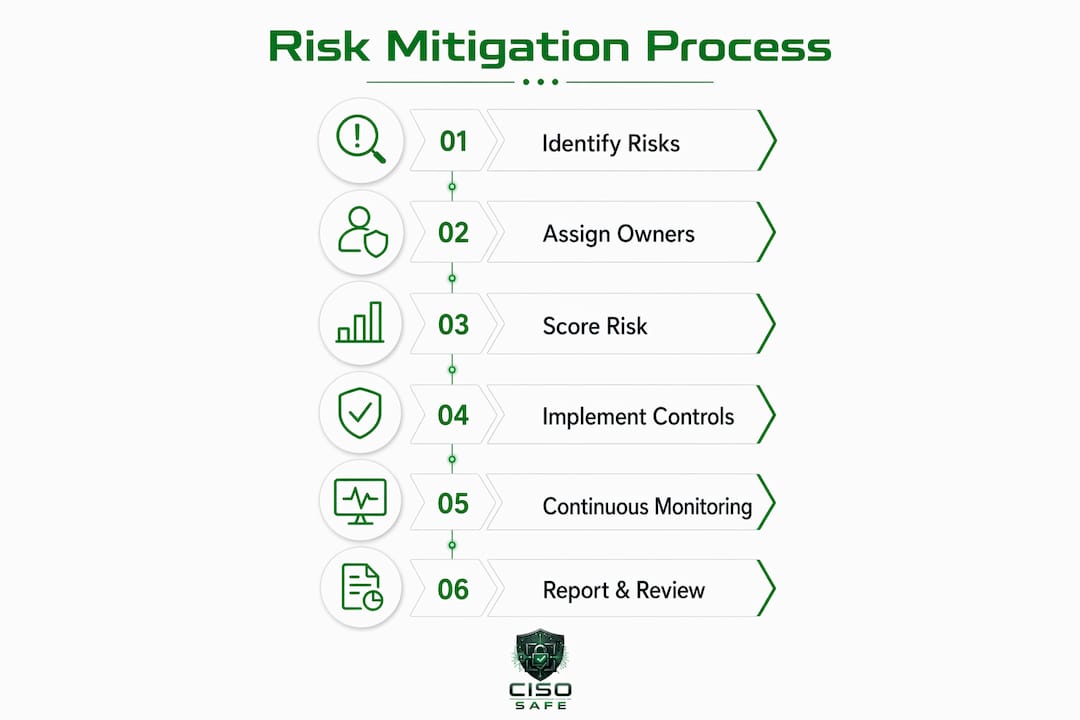
Risk scoring and analytics
Qualitative scoring (likelihood × impact matrices) is table stakes. Mature platforms add configurable scoring algorithms, heat maps, and KRI/KPI dashboards that aggregate inherent and residual risk across business units. Multi-dimensional assessments and heat maps give leadership a portfolio view rather than a list of individual findings. For capital-intensive organizations, probabilistic outputs (P10/P50/P85) from Monte Carlo simulations translate risk into monetary terms that CFOs and boards can act on.

Continuous monitoring and integrations
Real-time ingestion from vulnerability scanners, IAM platforms, SIEM tools, and supplier feeds is what separates a living risk program from a quarterly snapshot. Open APIs and enterprise integrations centralize GRC data and enable real-time reporting for auditors and management. Without these feeds, your risk register is always stale.
Mitigation workflows and issue management
Automated ticket creation, SLA tracking, and remediation playbooks close the loop between identifying a risk and proving it was addressed. Auditors need artifacts, not assurances. Platforms that auto-generate evidence records and link them to specific control requirements cut the time your team spends on audit prep significantly.

Controls library and compliance mapping
Pre-built control libraries and assessment templates accelerate deployment and reduce the professional services hours required to go live. Platforms that ship with mappings to SOC 2, HIPAA, CMMC, and PCI DSS let your team start assessing against real requirements on day one rather than building a control taxonomy from scratch.
Reporting and stakeholder views
Board-ready dashboards, auditor exports, and executive summaries serve three different audiences with three different needs. A CISO needs drill-down detail; a board member needs a one-page risk posture summary; an auditor needs exportable evidence tied to specific controls. Platforms that cannot produce all three force your team to manually reformat data for each audience.
| Feature | What it delivers | Compliance relevance |
|---|---|---|
| Central risk register | Single source of truth for risks, owners, and status | SOC 2, HIPAA, CMMC audit trails |
| Configurable risk scoring | Heat maps, KRI dashboards, inherent/residual views | Supports framework-specific thresholds |
| Continuous monitoring | Real-time feeds from scanners, SIEM, IAM | Ongoing compliance posture visibility |
| Mitigation workflows | Automated tickets, SLAs, remediation artifacts | Auditor-ready evidence packages |
| Controls library | Pre-mapped controls to major frameworks | Faster deployment and gap analysis |
| Stakeholder reporting | Board summaries, auditor exports, executive dashboards | Demonstrates program maturity |
Key insight: AI-enabled GRC platforms are shifting internal workload from manual classification to strategic advisory work. When issue creation is automated, security teams can focus on remediation prioritization and policy decisions rather than data entry.
How do you choose the right risk management platform for your organization?
Selection decisions made under deadline pressure tend to prioritize price over fit. For regulated enterprises, that trade-off is costly. Here is a weighted framework built for compliance-sensitive U.S. organizations.
Weighted evaluation criteria
| Criterion | Suggested weight | What to verify |
|---|---|---|
| Security and data handling | — | Encryption at rest/in transit, SOC 2 Type II certification, infrastructure posture |
| Compliance mapping | — | Pre-built mappings for SOC 2, HIPAA, PCI DSS, CMMC; exportable evidence |
| Integrations | — | Connectors for your scanners, SIEM, IAM, ITSM, and cloud providers |
| Scalability | — | Multi-tenant architecture, user/asset volume limits, performance at scale |
| Managed services and SLAs | — | vCISO or advisory availability, remediation SLAs, monitoring options |
| Cost and TCO | 10% | Total cost including onboarding, integrations, and ongoing advisory |
Service model trade-offs
Three service models dominate the market. A pure SaaS platform gives you the tooling but leaves governance, framework interpretation, and audit prep entirely to your internal team. A platform plus professional services adds project-based consulting for implementation but leaves ongoing advisory gaps. A platform plus ongoing vCISO retainer provides continuous governance, remediation prioritization, and auditor readiness support. For mid-market regulated organizations without a full-time CISO, the third model typically delivers the fastest time-to-value and the lowest audit friction.
Integration checklist before you sign
- Confirm pre-built connectors for your vulnerability scanner (Tenable, Qualys, Rapid7, or equivalent)
- Verify SIEM integration (Splunk, Microsoft Sentinel, or equivalent)
- Test IAM feed compatibility (Okta, Azure AD, or equivalent)
- Confirm ITSM connector (Jira, ServiceNow, or equivalent)
- Validate cloud provider telemetry (AWS, Azure, GCP)
- Request a sample auditor export in your required format before procurement
Pro Tip: Ask every vendor for a proof-of-concept data flow during the pilot. A vendor that cannot demonstrate live integration with your existing stack during evaluation will not resolve that gap after you sign.
What does a realistic enterprise deployment look like?
Most enterprise risk program rollouts follow five phases. Understanding the sequence helps you set realistic expectations with your board and avoid the most common implementation failures.
Phase 1: Discovery and scope (weeks 1–3). Inventory your IT assets, compliance frameworks, and existing controls documentation. Incomplete asset inventories are one of the leading causes of extended pilots. Missing data feeds from vulnerability scanners or cloud telemetry create gaps that surface during the first audit cycle.
Phase 2: Integrations and data mapping (weeks 3–6). Connect your vulnerability scanners, SIEM, IAM, and ITSM tools. Validate that data flows are complete and that risk records are populating correctly. This phase often takes longer than planned when cloud environments lack consistent tagging or when legacy systems require custom connectors.
Phase 3: Control library alignment (weeks 5–8). Map your compliance frameworks to the platform's control library. Platforms with pre-built control libraries and template-based assessments make pilot-to-production timelines predictable. Custom framework builds add weeks.
Phase 4: Pilot assessments and remediation workflows (weeks 7–12). Run your first formal risk assessment against one framework. Validate that mitigation tickets are created, assigned, and tracked correctly. Confirm that evidence artifacts are generated and exportable.
Phase 5: Org-wide rollout (months 3–6+). Expand to additional business units, frameworks, and third-party risk programs. Timeline depends heavily on organizational complexity, number of integrations, and change management maturity.
Who must be in the room
- Executive sponsor: Controls budget, resolves cross-department conflicts, and sets the governance tone
- IT and cloud owners: Own the integration feeds and asset inventory
- Security operations: Manages vulnerability data and incident response workflows
- Compliance and audit: Defines evidence requirements and framework mappings
- Legal: Reviews data handling, vendor contracts, and regulatory obligations
- Procurement and vendor management: Owns third-party risk onboarding
Common pitfalls to avoid
- Launching without a complete asset inventory
- Skipping integration validation before go-live
- Assigning risk ownership without clear accountability structures
- Underestimating change management for teams accustomed to spreadsheet-based processes
- Treating the platform as a one-time project rather than an ongoing program
Pro Tip: Set three measurable pilot KPIs before you start: reduction in manual evidence-collection hours, time from risk identification to ticket creation, and percentage of controls with documented evidence. These numbers justify the program to your CFO within 90 days.
What advanced capabilities should you evaluate beyond the basics?
Once core features are in place, the platforms that separate themselves offer AI automation, quantitative modeling, and scenario simulation. These capabilities change how your organization makes risk investment decisions.
AI-assisted automation
AI-enabled GRC platforms automate issue classification, suggest remediation plans, and collect evidence without manual intervention. The operational benefit is real: teams that previously spent hours categorizing findings can redirect that time to remediation strategy. However, AI suggestions require governance. Every automated classification and remediation recommendation should be reviewed by a qualified human before it is acted upon. Bias in training data or incorrect framework mappings can produce confident-looking but wrong outputs.
Quantitative risk modeling with Monte Carlo simulation
Enterprise platforms can run Monte Carlo simulations to quantify portfolio-level risk and produce probabilistic outputs such as P10, P50, and P85. These outputs translate risk into monetary terms that support budget allocation decisions. A P85 output tells leadership the dollar exposure that will not be exceeded in 85% of simulated scenarios. That framing is far more useful to a CFO than a red/yellow/green heat map. Quantitative outputs must be accompanied by clear assumptions and sensitivity analysis so leadership does not over-interpret a single-point estimate.
Scenario analysis and S-curve visualizations
Portfolio-level scenario simulations let you model the impact of different mitigation investment levels and communicate funding confidence to executive leadership. S-curve visualizations show how risk exposure changes as mitigation spend increases, which helps prioritize where additional investment produces the greatest reduction in residual risk.
Governance requirements for advanced features
- Require model governance documentation from any vendor offering AI-driven recommendations
- Establish a human-in-the-loop review process for all automated classifications
- Maintain audit trails for every AI-suggested action, including the model version and input data
- Validate Monte Carlo assumptions with your vCISO or risk committee before presenting outputs to leadership
Pro Tip: When evaluating AI features, ask vendors for explainability documentation. If a platform cannot tell you why it classified a finding a certain way, you cannot defend that classification to a regulator.
What do risk mitigation platforms cost, and how do you calculate ROI?
Pricing structures vary significantly across the market, and total cost of ownership is almost always higher than the headline subscription fee.
Common pricing models
- Per-user licensing: Predictable for small teams; scales poorly for org-wide programs
- Per-asset or per-module: Aligns cost to scope but can create incentives to under-inventory assets
- Enterprise seat plus professional services: Fixed platform fee with project-based consulting billed separately
- Platform plus vCISO retainer: Subscription plus ongoing advisory; highest upfront cost but lowest internal workload and fastest audit readiness
Sample TCO framework
| Cost category | One-time | Annual |
|---|---|---|
| Platform onboarding and configuration | Yes | — |
| Annual SaaS subscription | — | Yes |
| Integration development (custom connectors) | Yes | Maintenance |
| vCISO retainer or advisory services | — | Yes |
| Internal staff time (compliance, IT, security) | Partial | Yes |
ROI levers that matter to CFOs
- Reduction in manual audit preparation hours
- Faster remediation cycles (fewer control failures reaching audit)
- Lower cyber insurance premiums tied to demonstrated control maturity
- Reduced incident impact from earlier risk identification
- Avoided cost of a full-time CISO or large consultancy engagement
RMIS platforms that consolidate claims, policies, and exposure data also improve total cost of risk calculations, which is directly relevant to insurance negotiations. For regulated organizations, demonstrating a mature, documented risk program often translates to measurable premium reductions.
Pro Tip: Build your CFO presentation around three numbers: current annual cost of manual audit prep, projected reduction after platform adoption, and the cost of a single control failure or breach. The third number usually closes the budget conversation.
Which organizations benefit most from enterprise risk solutions?
Risk management platforms deliver the clearest value when compliance complexity, distributed IT environments, and third-party dependencies make manual processes untenable.
Industries with the highest return
Legal firms face client data protection obligations, bar association cybersecurity guidelines, and increasing malpractice exposure tied to data breaches. Cyber compliance directly reduces malpractice risk for law firms managing sensitive client information.
Healthcare providers must satisfy HIPAA's technical, administrative, and physical safeguard requirements continuously, not just at audit time. Continuous monitoring feeds from EHR systems and access logs are essential.
Energy and oil and gas operators operate under NERC CIP, state-level regulations, and increasingly stringent OT/IT convergence requirements. Cyber risk assessments for energy firms address both IT and operational technology environments.
Financial services and regulated SaaS companies managing SOC 2, PCI DSS, or FedRAMP requirements benefit from automated evidence collection that keeps audit packages current between formal assessments.
Common use cases by department
- Security operations: Vulnerability-to-remediation orchestration, continuous monitoring, and incident response workflow integration
- Compliance and audit teams: Pre-certification readiness (SOC 2, HIPAA, CMMC), evidence package assembly, and auditor portal access
- IT operations: Asset inventory management, patch status tracking, and integration with ITSM for remediation ticketing
- Legal and procurement: Third-party and vendor risk management, contract risk scoring, and supplier assessment workflows
Signs you are a strong fit for an enterprise platform
You are likely ready for an enterprise risk management platform if you manage multiple compliance frameworks simultaneously, rely on third-party vendors with access to sensitive data, operate a distributed IT estate across multiple cloud environments, or spend significant time per audit cycle manually assembling evidence.
Pro Tip: Third-party risk is often the largest unmanaged exposure for regulated organizations. Prioritize platforms that include vendor assessment workflows and supplier risk scoring, not just internal risk registers.
Key Takeaways
The most effective risk mitigation software for regulated U.S. organizations combines an AI-enabled SaaS platform with ongoing vCISO advisory to deliver auditable compliance, continuous monitoring, and faster time-to-value than point tools alone.
| Point | Details |
|---|---|
| Hybrid model wins for regulated orgs | Platform plus vCISO advisory reduces audit friction and centralizes evidence more effectively than standalone tools. |
| Integration readiness is a prerequisite | Validate connectors for your scanner, SIEM, IAM, and ITSM before procurement to avoid extended pilots. |
| AI features require governance | Enforce human-in-the-loop review for all automated classifications and AI-suggested remediation actions. |
| TCO exceeds the subscription fee | Budget for onboarding, custom integrations, and ongoing advisory alongside the annual platform cost. |
| CisoSafe delivers the hybrid model | CisoSafe combines an AI-powered compliance platform with hands-on vCISO services for regulated U.S. organizations. |
The case for platform plus advisory over point tools
The conventional wisdom in enterprise security procurement is that best-of-breed point tools, stitched together with APIs and a skilled internal team, outperform integrated platforms. For large enterprises with mature security operations and dedicated GRC staff, that argument has merit. For mid-market regulated organizations, it usually does not hold.
Point tools are faster to procure and cheaper upfront. A vulnerability scanner, a GRC spreadsheet, and a compliance checklist tool can be operational in days. The problem surfaces at audit time: evidence is scattered across systems, ownership is unclear, and your compliance team spends two weeks manually assembling a package that an integrated platform would export in an afternoon. That manual overhead compounds every quarter.
The platform plus vCISO model addresses a different constraint: most mid-market regulated organizations do not have the internal expertise to interpret framework requirements, prioritize remediation, and maintain audit readiness simultaneously. A vCISO brings that expertise without the cost of a full-time hire. When paired with a platform that automates evidence collection and continuous monitoring, the combination produces faster audit cycles, cleaner findings, and a security program that actually improves over time rather than resetting before each audit.
The honest limitation: this model requires organizational commitment. A vCISO retainer is not a set-it-and-forget-it purchase. It works when leadership engages with the advisory process, assigns clear ownership to remediation tasks, and treats the platform as a living program rather than a compliance checkbox. Organizations that are not ready for that level of engagement will get more value from a phased approach: start with the platform, build internal familiarity, and layer in advisory services as the program matures.
CisoSafe brings the hybrid model to regulated U.S. organizations
Regulated organizations that have evaluated the criteria in this article consistently face the same gap: the platform they need exists, but the internal expertise to operate it at audit-ready standards does not. CisoSafe closes that gap directly.
CisoSafe's AI-powered SaaS platform automates evidence collection, continuous monitoring, and compliance assessments across 50+ frameworks, including SOC 2, HIPAA, CMMC, and PCI DSS. Paired with hands-on vCISO services covering risk roadmaps, policy development, incident response planning, and auditor readiness, it delivers the hybrid model this article recommends at a cost well below a full-time CISO or large consultancy engagement. Integration support for ITSM, vulnerability scanners, and cloud providers is included in the engagement, not billed as a separate project.
The practical starting point is a vCISO scoping call or a pilot engagement that tests your integrations and produces a sample evidence export against your most pressing compliance framework. Schedule a scoping call with CisoSafe to confirm fit and define pilot success metrics before any long-term commitment.
Authoritative sources and further reading
Technical and procurement teams evaluating risk management platforms should consult these primary sources alongside vendor documentation.
Standards and frameworks
- ISO 31000 Risk Management: The international standard for risk management principles and guidelines; the baseline reference for any enterprise risk program
- NIST Risk Assessment Template: Structured, repeatable frameworks for cybersecurity risk evaluation and consistent audit documentation
- RIMS Risk Knowledge: The Risk and Insurance Management Society's library of ERM frameworks, benchmarks, and procurement guidance
Platform and capability references
- P3M Tech probabilistic risk modeling: Monte Carlo simulation methodology and P10/P50/P85 output interpretation for portfolio risk prioritization
- Sphera advanced risk assessment software: Process safety and enterprise risk assessment platform reference for configurable templates and closed-loop risk management
Internal resources on the CisoSafe blog
- Continuous compliance monitoring guide: Practical playbook for setting up continuous controls monitoring and alerting
- Compliance software alternatives and migration strategies: Vendor-agnostic guidance for organizations replacing legacy compliance tools
- Energy sector compliance frameworks overview: Framework guidance for regulated energy and oil and gas operators
- Legal data compliance requirements guide: Framework mapping and evidence artifact requirements for legal teams
This article is general information for educational purposes. Confirm current regulatory requirements and framework obligations with a qualified compliance professional or the relevant standards body for your specific situation.