

A security risk roadmap is defined as a strategic, time-phased plan spanning 12–36 months that translates cybersecurity goals into sequenced, prioritized initiatives aligned with business objectives and regulatory requirements. The industry standard term is "cybersecurity risk roadmap," though "security risk roadmap" is widely used by compliance officers and executives to describe the same document. With the average data breach costing $4.88 million, a formal security risk management plan is no longer optional for regulated industries. Frameworks like the NIST Cybersecurity Framework provide the structural backbone most organizations use to build one. This guide explains what goes into a security risk roadmap, how to create one, and why it matters for your organization's resilience and compliance standing.
What is a security risk roadmap and why does it matter?
A security risk roadmap is a structured document that connects your current cybersecurity posture to a defined future state. It does not list every possible threat. Instead, it sequences the most critical risks into time-bound initiatives with owners, deadlines, and measurable outcomes.
The distinction from a general security risk management plan is worth noting. A security risk management plan defines policies and procedures. A roadmap translates those policies into a calendar of prioritized actions. One is a rulebook; the other is a schedule.
For business leaders in regulated industries, the roadmap serves three functions at once. It guides internal security teams on what to fix and when. It gives compliance officers documented evidence of active risk management. It gives executives and boards a clear view of where the organization stands and where it is headed.

Cyber threats evolve rapidly, which means a roadmap built once and filed away loses value quickly. The most effective roadmaps are treated as living documents, reviewed and updated at least annually or after any significant change to the business or threat environment.
What are the essential components of a security risk roadmap?
Five structural elements separate an effective roadmap from a document that collects dust.
| Component | Purpose |
|---|---|
| Risk-based assessment | Identifies and scores threats by probability and impact |
| Governance and ownership | Assigns named accountability for each risk and initiative |
| Treatment planning | Defines specific mitigation actions with deadlines |
| Compliance mapping | Links controls to regulatory requirements and audit evidence |
| Review cadence | Schedules regular updates to keep the roadmap current |
Risk-based assessment and prioritization form the foundation. Using defined probability scales, such as "rare" for threats with less than a 10% chance of occurring and "almost certain" for those above 80%, gives your team a defensible basis for prioritization. Without defined scales, risk scoring becomes subjective and inconsistent across teams.
Governance and ownership determine whether anything actually gets done. Every risk on the roadmap needs a named owner, not a department or a team. A named individual is accountable. A department is not.
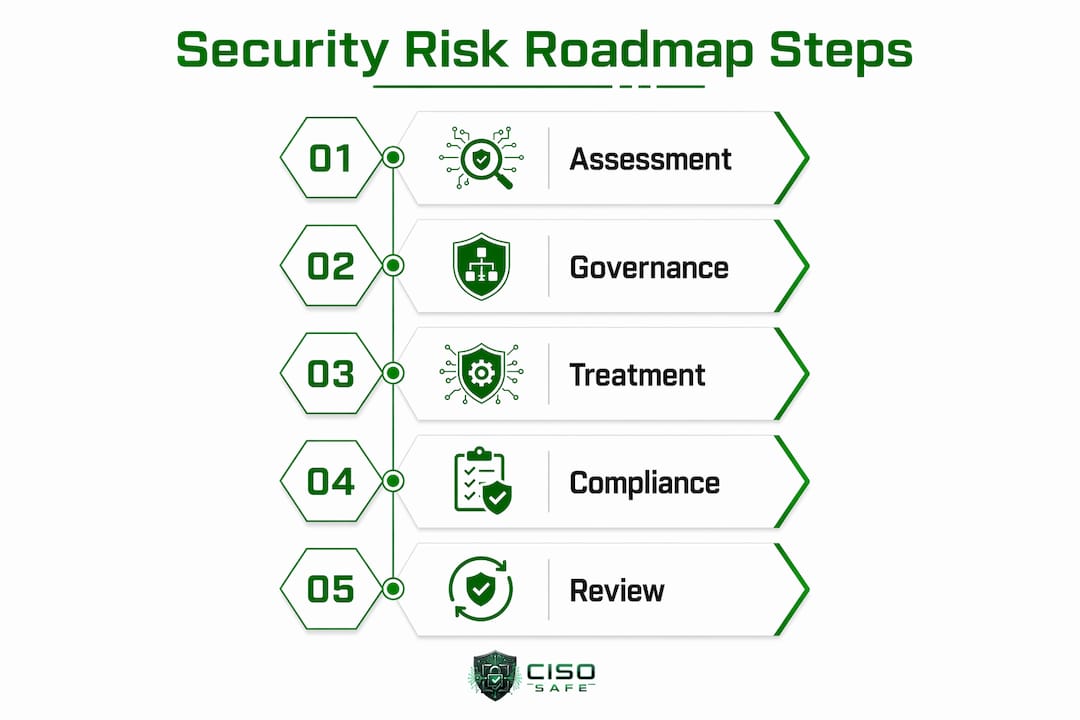
Treatment planning specifies what will be done, by whom, and by when. Vague instructions like "monitor the situation" are the most common failure point in security risk management plans. Concrete mitigation actions with assigned owners and firm deadlines are what separate plans that reduce risk from plans that document it.
Compliance mapping connects each mitigation action to the relevant control in frameworks like SOC 2, HIPAA, PCI DSS, or CMMC. This connection is what makes your roadmap useful during an audit. Documented evidence of active controls linked to specific mitigation actions is what auditors look for.
Pro Tip: Schedule your roadmap review immediately after any major regulatory update, merger, or significant infrastructure change. Waiting for the annual cycle after a material event leaves your organization exposed.
How does a security risk roadmap support resilience and compliance?
A roadmap shifts your organization from reactive incident response to proactive risk management. That shift has measurable consequences for both security outcomes and regulatory standing.
"Roadmaps transform cybersecurity conversations from technical jargon to business-aligned outcomes, helping secure executive funding and board oversight. Boards increasingly expect demonstrable cyber risk oversight, and roadmaps bridge technical and business discussions with measurable improvements."
When an incident occurs, organizations with active roadmaps recover faster. They have pre-defined response paths, assigned owners, and documented controls. Organizations without them improvise, and improvisation during a breach is expensive.
The compliance benefits are equally direct. Regulatory bodies under HIPAA, PCI DSS, and CMMC do not just ask whether you have security controls. They ask whether you can prove those controls are actively managed. A roadmap with systematic control mapping and audit-ready evidence answers that question before the auditor asks it.
The communication benefit is often underestimated. A well-built roadmap gives compliance officers a single document that speaks to both the board and the audit committee. It translates technical risk into financial exposure and business continuity terms. That translation is what secures budget and executive support for security investments. For a deeper look at how cyber risk affects firm reputation, the connection between documented risk management and stakeholder trust is direct and significant.
How to create and maintain a security risk roadmap
Building a roadmap that works requires six concrete steps. Skipping any one of them produces a document that looks complete but fails under pressure.
-
Establish your current security baseline. Catalog all assets, existing controls, and known vulnerabilities. This is your security risk assessment guide starting point. You cannot prioritize what you have not identified.
-
Score each risk using defined probability and impact scales. Apply consistent criteria across your entire risk register. High risks require escalation within 48 hours of identification. Low risks can be scheduled for the next review cycle.
-
Resolve scoring disagreements immediately. When team members score the same risk differently, do not average the scores. Averaging hides disagreements that often reveal critical assumptions about the business. Discuss the gap and reach a documented consensus.
-
Assign a named owner and define specific actions for each risk. Every mitigation task needs a person, a deadline, and a success criterion. "Patch the VPN appliance by March 15, 2026, verified by a follow-up scan" is a mitigation action. "Improve patch management" is not.
-
Map each action to the relevant compliance control. Link your mitigation tasks to the specific requirements in SOC 2, HIPAA, CMMC, or whichever framework governs your industry. This mapping is what makes your roadmap audit-ready.
-
Schedule reviews and define escalation triggers. Set a minimum annual review date. Define the conditions that trigger an unscheduled update, such as a new regulatory requirement, a significant breach in your industry, or a major infrastructure change.
Pro Tip: Focus your roadmap on the 20% of risks that drive 80% of your exposure. Routine work with well-understood risks does not need a roadmap entry. Reserve the document for high-impact, high-uncertainty areas where structured management creates real value.
The maintenance discipline matters as much as the initial build. A roadmap must be updated regularly to remain relevant against evolving threats and business conditions. Treat it the same way you treat your financial forecast: a living document that reflects current reality, not a historical artifact.
What challenges exist in implementing a security risk roadmap?
The main barrier to roadmap adoption is organizational, not technical. Securing executive buy-in requires framing the roadmap as a business continuity tool, not a security burden. Presenting the roadmap as a business priority rather than an IT project significantly improves acceptance at the leadership level.
Several specific challenges appear consistently across regulated industries:
- Static documents. Teams build the roadmap once and stop updating it. A roadmap that does not reflect current threats is worse than no roadmap, because it creates false confidence.
- Vague ownership. Assigning risks to departments instead of named individuals guarantees that accountability diffuses and deadlines slip.
- Tool sprawl. Organizations accumulate security tools without mapping them to specific risks on the roadmap. This makes it impossible to demonstrate that investments are reducing documented risk.
- Cross-team communication gaps. Legal, IT, and operations teams often manage overlapping risks in isolation. The roadmap should be the single source of truth that all three teams reference.
- Averaging risk scores. As noted in the creation steps, averaging conflicting scores hides the assumptions that drive accurate prioritization.
Pro Tip: Present roadmap progress in board meetings using business metrics, not technical ones. Frame updates as "we reduced our exposure in the payment processing environment by completing X control" rather than "we patched 47 servers." Boards fund what they understand.
Supply chain risks deserve specific attention in the roadmap. Third-party and supply chain cyber risks are among the fastest-growing threat categories for regulated industries, and they require explicit entries in your risk register with vendor-specific ownership and review schedules.
Key Takeaways
A security risk roadmap is the most direct tool available to translate cybersecurity risk into business decisions, compliance evidence, and executive accountability.
| Point | Details |
|---|---|
| Define it clearly | A roadmap is a time-phased plan, not a policy document or a list of security tools. |
| Score risks consistently | Use defined probability and impact scales; resolve disagreements rather than averaging scores. |
| Assign named owners | Every risk needs a person, a deadline, and a measurable success criterion. |
| Map to compliance frameworks | Link each mitigation action to SOC 2, HIPAA, CMMC, or the relevant standard for audit readiness. |
| Treat it as a living document | Review annually at minimum and update immediately after any material change to the business or threat environment. |
Why most roadmaps fail before they are ever tested
After working with compliance officers and business leaders across regulated industries, the pattern is consistent: the roadmap fails not because the risks were wrong, but because the document was never connected to real accountability.
The most common version I see is a well-formatted spreadsheet with color-coded risk scores and no named owners. It gets presented to the board once, filed, and never opened again until the next audit. At that point, the team scrambles to show evidence of mitigation that was never actually tracked.
The second failure mode is treating the roadmap as a technical document. When only the IT team understands it, the board cannot fund it, legal cannot defend it, and operations cannot act on it. A roadmap that does not speak to business outcomes will not survive budget season.
What actually works is treating the roadmap as a governance instrument. It belongs in the same conversation as your financial risk register and your business continuity plan. When compliance officers present roadmap progress in terms of reduced financial exposure and improved audit readiness, executives engage. When they present it as a list of patched systems, eyes glaze over.
The organizations that get this right also build escalation triggers into the document from day one. They do not wait for the annual review to respond to a new threat. They define in advance what conditions require an immediate update, and they hold someone accountable for calling that trigger.
— vCISO
How CisoSafe supports your security risk roadmap
Building and maintaining a security risk roadmap requires expertise that most regulated organizations do not have in-house.
CisoSafe provides virtual CISO services built specifically for law firms, energy operators, oil and gas companies, and other compliance-sensitive organizations. The CisoSafe team translates your risk assessment findings into a structured, audit-ready roadmap aligned with SOC 2, HIPAA, PCI DSS, and CMMC requirements. Ongoing advisory support keeps the roadmap current as threats and regulations evolve, so your leadership team always has an accurate picture of your risk posture. If your organization needs a roadmap that works beyond the first board presentation, CisoSafe delivers the expertise to build and sustain it.
FAQ
What is a security risk roadmap in simple terms?
A security risk roadmap is a time-phased plan that lists your organization's cybersecurity risks in priority order and assigns specific actions, owners, and deadlines to address them. It typically spans 12–36 months and aligns security work with business objectives.
How often should a security risk roadmap be updated?
A roadmap should be reviewed at least annually and updated immediately after any major change, such as a new regulatory requirement, a significant breach in your industry, or a material change to your infrastructure or business operations.
What is the difference between a security risk roadmap and a security risk management plan?
A security risk management plan defines your policies and procedures for handling risk. A roadmap translates those policies into a calendar of prioritized, time-bound actions with named owners and measurable outcomes.
Which compliance frameworks does a security risk roadmap support?
A well-built roadmap maps directly to frameworks including SOC 2, HIPAA, PCI DSS, and CMMC. Each mitigation action on the roadmap should link to a specific control requirement, creating the audit evidence regulators expect.
What is the most common reason security risk roadmaps fail?
The most common failure is vague ownership and static documents. Risks assigned to departments instead of named individuals, and roadmaps that are not updated after material changes, lose their value and leave organizations exposed during audits and incidents.