

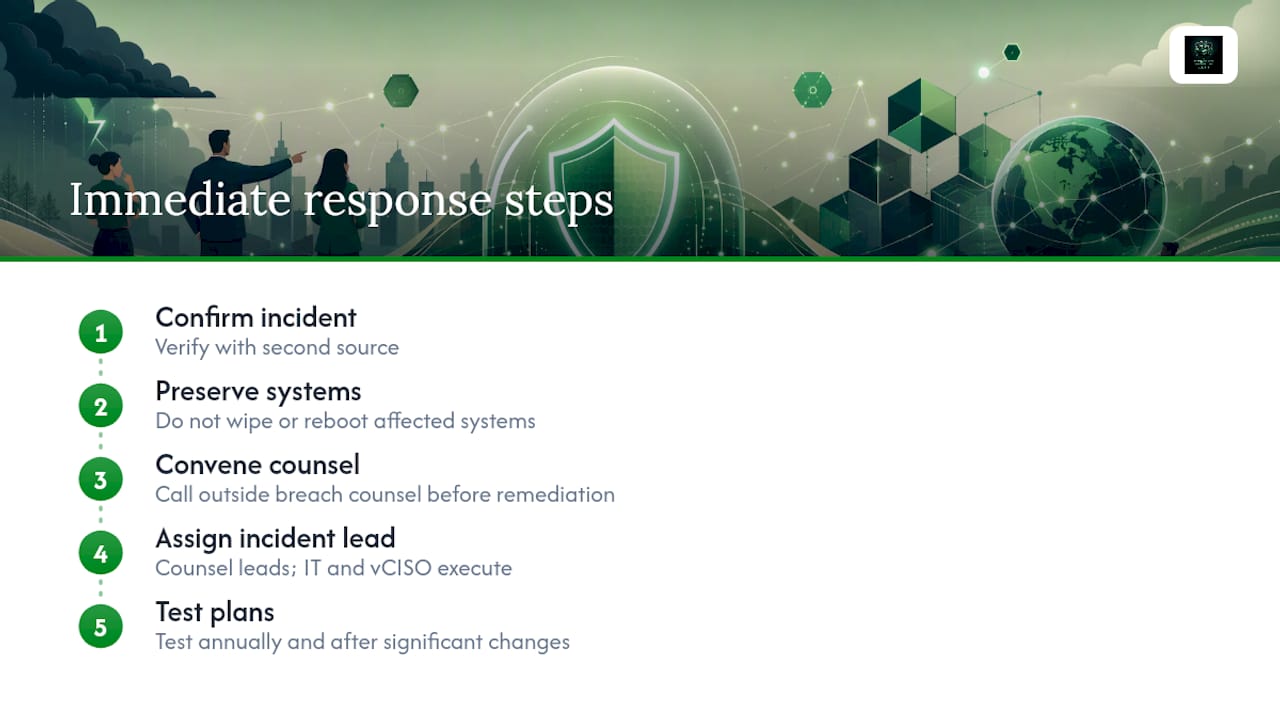
A legal sector incident response plan is a counsel-led protocol that governs how a firm detects, contains, and reports a cybersecurity incident while protecting attorney-client privilege at every step. The first hour matters more than any other in the plan. Confirm the incident through a second source, preserve systems exactly as found without wiping or rebooting, and convene outside breach counsel before you touch a keyboard for remediation.
That third step is where most firms stumble. IT teams reflexively want to contain and clean; lawyers know that engaging forensic vendors through counsel is often what preserves privilege over the forensic report later. CISO Safe builds these plans around that sequencing, informed by NIST SP 800-61 for technical runbooks and ABA Formal Opinion 483 for the ethical notification duty.
A functioning plan needs, at minimum:
- A defined incident response team with named decision authority
- Containment and forensic procedures that preserve chain of custody
- Client notification protocols tied to "as soon as reasonably practicable"
- A communications playbook for regulators, carriers, and the press
- A post-incident review that feeds back into policy updates
Key Takeaways
A legal sector incident response plan works only when counsel leads the process from activation through notification, with forensic preservation and privilege protection built into every step rather than added after the fact.
| Point | Details |
|---|---|
| Act in the first hour | Confirm the incident, preserve systems without wiping them, and convene counsel before remediation begins. |
| Separate IRP from BCP | Design the incident plan around privilege and forensics, not just system uptime. |
| Name real people | Build a roster with individuals and backups, not just job titles, for every IR role. |
| Test annually at minimum | Run a tabletop exercise at least once a year and after any major system change. |
| Route forensics through counsel | Engage forensic vendors via outside breach counsel to protect privilege over the findings. |
| Get expert help operationalizing it | CisoSafe's vCISO retainers build, test, and coordinate legal sector incident response plans end to end. |
Table of Contents
- Why Law Firms Need a Tailored Incident Response Strategy, Not a Generic BCP
- Core Components Every Legal Sector Incident Response Plan Must Include
- What Happens at Each Stage of the Incident Lifecycle
- Who Should Be on the Incident Response Team
- When and How to Notify Clients, Regulators, and the Public
- How Often Should Firms Run Tabletop Exercises?
- Connecting the Incident Response Plan to Business Continuity and Insurance
- What Are the Regulatory Deadlines Firms Should Plan Around
- How a vCISO Engagement Operationalizes the Plan
- The Part of Incident Response Planning Most Firms Get Backward
- Building and Operationalizing Your Plan With CISO Safe
- Frequently Asked Questions
- Sources
Why Law Firms Need a Tailored Incident Response Strategy, Not a Generic BCP
A business continuity plan asks one question: how fast can we get systems back online? A legal sector incident response plan asks a harder one: how do we get back online without destroying evidence, waiving privilege, or breaching a duty to a client whose confidential file just got exposed. The American Bar Association recommends a two-pronged approach: prevention controls paired with an incident response plan that is distinct from, and more forensically rigorous than, a standard continuity plan.
Consider three scenarios unique to firms: an associate's inbox gets compromised and privileged settlement emails leak to opposing counsel, a document management system gets hit with ransomware mid-discovery, or a paralegal's stolen laptop contained unencrypted client files. None of these are solved by "restore from backup." Each triggers a distinct duty analysis under state bar rules and the types of cyber threats specific to law firms.
Formal Opinion 483 makes clear that lawyers must notify affected clients of a data breach as soon as reasonably practicable, and that duty exists independent of whether a statute technically requires it.
That distinction, ethical duty versus statutory trigger, is the entire reason a copy-pasted IT incident plan does not hold up in a law firm.
Core Components Every Legal Sector Incident Response Plan Must Include
A complete plan reads less like a memo and more like a runbook with legal checkpoints built in. Here is what belongs in the document your partners actually sign off on:
- Scope and purpose statement defining what counts as an "incident" versus routine IT trouble
- Activation criteria with severity thresholds (see below)
- IR team roster naming individuals, not just titles, with backups for each role
- Privilege-preserving vendor engagement clauses specifying that forensic firms are retained through outside counsel
- Forensic procedures and chain-of-custody documentation requirements
- Client notification templates pre-drafted and reviewed by counsel
- Regulatory trigger checklist mapped to your operating states
- Communications playbooks for staff, clients, press, and regulators
- Insurance notification steps with policy numbers and carrier contacts on file
- BCP handoff protocol for when the incident resolves into a recovery phase
Sample activation criteria might look like this:
- Low severity: isolated phishing attempt, no data accessed, no client impact
- Medium severity: single workstation compromised, contained within four hours, no confirmed exfiltration
- High severity: confirmed unauthorized access to client files, ransomware deployment, or DMS outage exceeding two hours
- Critical severity: confirmed exfiltration of privileged material, multi-office impact, or ransomware demand received
Escalation authority should never sit with one person. The managing partner or general counsel declares the incident officially; the designated privacy lead or vCISO engages outside breach counsel; and no communications, internal or external, go out without counsel sign-off. That last rule sounds bureaucratic until the first time an associate sends a "heads up" email from the compromised account itself.
Pro Tip: Structure your forensic vendor's engagement letter so outside breach counsel retains the firm directly, not your IT department. Reports commissioned this way are far more likely to be treated as attorney work product if litigation follows, according to guidance in the law firm data breach response playbook.
What Happens at Each Stage of the Incident Lifecycle
The standard cycle, prepare, detect, contain, eradicate, recover, review, gets a legal overlay at every phase.
- Prepare: Draft and approve the plan, pre-negotiate vendor retainers, and run at least one tabletop exercise before you need the real thing.
- Detect: Timestamp the discovery immediately and preserve logs before anyone starts troubleshooting. This is also when you decide, formally, whether the threat intelligence you have on hand suggests scope beyond the initial finding.
- Contain: Consult counsel before any broad system shutdown. Aggressive containment can look responsible but risks destroying volatile evidence a forensic examiner needs later.
- Eradicate: Remove the threat only after forensic imaging is complete, not before.
- Recover: Restore systems in coordination with the BCP team, verifying integrity before reconnecting to client-facing networks.
- Review: Conduct a formal post-incident review, ideally privileged, documenting what worked and what needs to change in the written plan.
The containment stage carries the sharpest legal risk. Move too fast and you risk spoliation claims; move too slow and you risk continued exfiltration turning into a malpractice exposure. Planning the containment threshold with breach counsel in advance, not during the incident, is what prevents that dilemma from becoming a crisis.
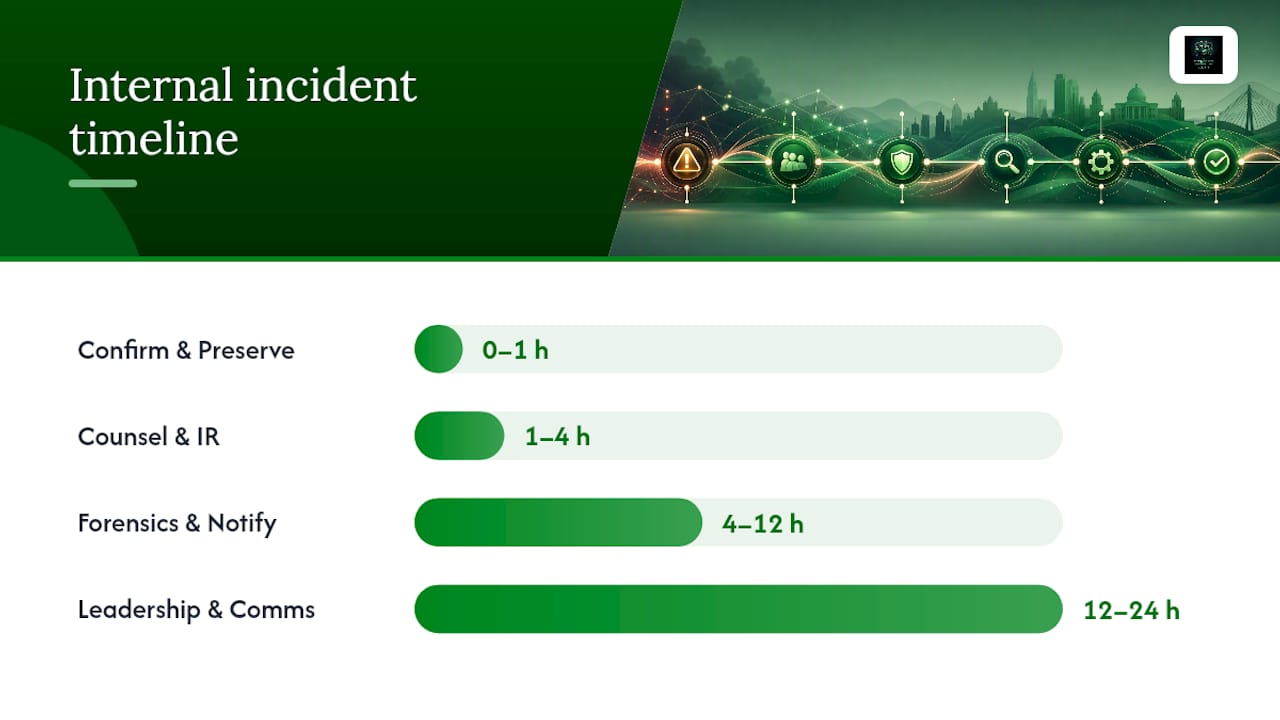
A rough internal timeline for a confirmed incident: by hour 0 to 1, confirm and preserve; by hour 1 to 4, convene counsel and the core IR team; by hour 4 to 12, engage the forensic vendor and notify the malpractice or cyber carrier per policy windows; by hour 12 to 24, brief leadership and begin drafting client communications. Never wipe a compromised device, and never use a potentially compromised email account to coordinate the response itself.
Who Should Be on the Incident Response Team
The roster matters as much as the plan document itself. A functioning legal sector incident response team typically includes the managing partner or firm administrator, general counsel or a designated privacy lead, the IT or vCISO lead, outside breach counsel, a forensic vendor on retainer, and a public relations contact. Larger firms increasingly formalize this into a standing crisis practice group, a structure Harvard's Center on the Legal Profession has documented as standard among top-performing firms because multidisciplinary teams shorten the time between detection and decision.
| Severity Level | Who Is Notified | Who Holds Decision Authority |
|---|---|---|
| Low | IT lead, privacy lead | IT lead |
| Medium | Above, plus managing partner | Privacy lead or general counsel |
| High | Above, plus outside breach counsel, insurer | General counsel |
| Critical | Full IR team, board or partnership, PR contact | Managing partner with counsel |
Pre-negotiating retainer terms with breach counsel, a forensic firm, and a communications vendor before an incident happens removes hours of delay when speed counts most. Firms and consultancies that emphasize crisis readiness consistently point to pre-arranged vendor relationships as the single biggest accelerant in early response.
When and How to Notify Clients, Regulators, and the Public
Notification decisions follow a strict order: confirm scope first, consult counsel second, then notify. ABA Formal Opinion 483 sets the ethical floor at "as soon as reasonably practicable" for client notice, a standard that exists regardless of whether a state breach statute technically applies to your situation.
Build your notification checklist around these triggers:
- Confirmed unauthorized access to client confidential information (client notice, per Rule 1.6 duty)
- Personal data of state residents exposed (state attorney general notice, timeline varies by state)
- Protected health information involved, if the firm handles healthcare clients (HHS notice may apply)
- Ransom demand received (insurer and, in some cases, law enforcement notice, plus review of OFAC sanctions exposure before any payment is considered)
Draft your holding statement before you need it: acknowledge the incident, state that outside experts are engaged, commit to updates, and say nothing about scope or cause until confirmed. Give staff a one-page internal FAQ so the receptionist and the managing partner give the same answer to a reporter's call.
Pro Tip: Route every external notification, client, press, or regulator, through a single approved channel. A well-meaning partner "clarifying" the situation on an individual call is how holding statements fall apart.
How Often Should Firms Run Tabletop Exercises?
At least once a year, and after any material change to your systems or vendor stack, according to model policy handbooks built for law firms. A tabletop exercise is a scripted walk-through of a realistic failure, email outage, DMS ransomware, a stolen laptop, run with the actual IR team in the room.
- Open with a scenario inject (e.g., "IT reports unusual encryption activity on the DMS at 9:15 AM")
- Walk each role through their first three decisions
- Introduce a complication mid-exercise (a client calls asking about a leaked document)
- Close with a decision-point debrief: what would we actually do right now
- Write an after-action report and update the plan within two weeks
Track time-to-detection, time-to-containment, and time-to-client-notification across each run. Pro Tip: Simulate the loss of your primary email system during the exercise itself. Teams that have never rehearsed communicating over a phone tree or backup channel waste critical hours reinventing one during a real event.
Connecting the Incident Response Plan to Business Continuity and Insurance
The handoff from active response to recovery is where plans quietly fail. Once containment is confirmed, the IR team formally transfers ownership to the business continuity team for system reconstitution, keeping a documented handoff so nothing falls through the gap between "incident resolved" and "back to normal operations."
Notify your cyber insurance carrier promptly and per your policy's exact language. Carriers often have approval rights over which forensic vendor and breach counsel you use, so confirming this in advance avoids a coverage dispute layered on top of an active incident.
A post-incident remediation checklist should include:
- Formal forensic review documenting root cause and scope
- System hardening based on findings, patched and verified, not just patched
- Follow-up client communications confirming resolution
- Updated vendor risk documentation for any third party involved
- Lessons-learned session feeding directly into the next plan revision
What Are the Regulatory Deadlines Firms Should Plan Around
Deadlines vary by state and by the type of data involved, so treat every generic timeline as a starting point, not a legal answer. Budget for these cost drivers up front:
- Forensic investigation fees, often the largest single line item
- Outside breach counsel hours
- Notification and call-center costs if client volume is high
- Public relations support for high-visibility incidents
- Ransomware-specific costs, including the OFAC sanctions review before any payment is considered
Pre-approving a retainer spend threshold with your managing partner, before an incident, removes a decision-making bottleneck when the invoice arrives at hour six. Verify every jurisdictional window with counsel rather than relying on a generic checklist. Reducing this uncertainty is also why cyber compliance maturity correlates with lower malpractice exposure in the first place.
How a vCISO Engagement Operationalizes the Plan
A written plan is only as good as the team that can execute it under pressure, which is where a vCISO engagement earns its keep. A vCISO-led model typically delivers:
- Playbook drafting aligned to NIST SP 800-61 technical structure
- Retainer setup with breach counsel and forensic vendors negotiated in advance
- Tabletop facilitation at least annually
- Forensic coordination during an active incident
- Compliance reporting mapped to your firm's regulatory obligations
The workflow in practice: an incident triggers, the vCISO convenes the internal team, counsel engages the forensic vendor directly to preserve privilege, and reports route back through counsel before reaching leadership. This structure, detailed further in how vCISO services support law firms, keeps technical response and legal duty moving in parallel instead of in conflict, which is the single biggest driver of reduced regulatory and malpractice exposure after an incident.
The Part of Incident Response Planning Most Firms Get Backward
Most firms treat incident response as an IT project with a legal sign-off at the end. That sequencing is backward. The plan should be drafted with counsel in the room from the first page, not brought in to review a document IT already finalized. Formal Opinion 483 does not say "notify clients when convenient," and a plan built without that duty as its organizing principle will fail the first time it is tested for real.
The overrated fix is a thick binder nobody has opened since it was signed. The underrated fix is a short, tested plan with named people, pre-negotiated vendors, and one annual tabletop that actually simulates losing your email system. If you do only three things this month: name your IR team roster with real people, get a retainer signed with breach counsel, and run one tabletop before you need the real thing. Everything else in a mature program builds on that foundation.
Building and Operationalizing Your Plan With CISO Safe
Most firms do not lack awareness that they need an incident response plan. They lack the time and specialized bandwidth to build one that actually holds up under ABA scrutiny and regulatory review. CisoSafe closes that gap by pairing hands-on vCISO expertise with a structured, counsel-first methodology, so the plan you get is built for how law firms actually operate, not repurposed from a generic IT template.
CisoSafe's engagement for legal sector clients includes:
- vCISO retainers with ongoing strategic advisory, not a one-time deliverable
- Custom incident response playbooks aligned to NIST SP 800-61 and ABA guidance
- Tabletop exercise facilitation with role-specific injects
- Privileged forensic vendor coordination structured through counsel
- Support preparing insurance claims documentation after an incident
Every engagement is handled with the confidentiality your practice requires, and retainer terms can be structured in advance so you are not negotiating scope while an incident is active. If your firm does not yet have a tested, counsel-led plan on file, request an assessment from CisoSafe to see where your current gaps sit and what a NIST-aligned plan would look like for your practice.
Frequently Asked Questions
What is the difference between a legal sector incident response plan and a standard business continuity plan? An incident response plan focuses on forensics, privilege preservation, and ethical notification duties. A business continuity plan focuses on restoring operations and uptime. Firms need both, integrated through a clear handoff protocol.
Does ABA Formal Opinion 483 legally require client notification? It establishes an ethical duty under Rule 1.6 to notify affected clients as soon as reasonably practicable, separate from whatever state breach notification statute may also apply.
How often should a law firm test its incident response plan? At least once a year, per model policy handbooks, and again after any significant change to systems, vendors, or firm structure.
Should IT or legal counsel lead the incident response? Counsel should lead, with IT and a vCISO executing the technical response. This sequencing protects privilege over forensic findings and keeps notification timing aligned with ethical duties.
What is the first thing a firm should do after discovering a possible breach? Confirm the incident through a second source, preserve affected systems without wiping or rebooting them, and convene outside breach counsel before starting remediation.
This article is general information, not a substitute for advice from a qualified lawyer. Consult a qualified legal professional about your own circumstances before acting on anything here.
Sources
- A two-pronged approach to cyber security and incident response planning (American Bar Association)
- The Law Firm Data Breach Response Playbook (TitanFile)
- Crisis management at law firms (Harvard Center on the Legal Profession)
- Cybersecurity Policy Handbook (NJSBA)