

Managing partners, not IT directors, own the outcome of firmwide security training. That accountability cannot be delegated away. If you lead a law firm or another regulated business, the role of security training for managing partners comes down to three moves: designate an accountable partner or committee with a clear reporting line, require executive-level training tied to your ethical obligations under the ABA Model Rules and your incident response plan, and schedule a tabletop exercise soon.
Here is where to start this week:
- Name one partner or a standing committee to own security governance and report to leadership on a fixed cadence.
- Mandate an executive training module covering incident notification roles and professional-responsibility obligations, not just password hygiene.
- Book a vCISO-led tabletop exercise, using a provider like CisoSafe, before the quarter ends.
Key Takeaways
Partner-led governance, documented ownership, CLE-aligned curriculum, and regular tabletop practice determine whether security training actually reduces firm risk.
| Point | Details |
|---|---|
| Ownership can't be outsourced | Partners remain accountable for due care even when a vendor handles daily operations. |
| Governance structure comes first | Designate a partner or committee with documented authority and a reporting line to leadership. |
| Curriculum needs the right depth | Use case-based, "just-enough" technical training rather than generic or overly technical modules. |
| Tabletop exercises reveal real gaps | Simulated incidents test whether partners know their notification and confidentiality roles under pressure. |
| CisoSafe supports the full rollout | CisoSafe pairs vCISO advisory with CLE-ready training, tabletop facilitation, and compliance reporting for regulated firms. |
Table of Contents
- The Role of Security Training in Managing Partner Governance
- What Belongs in an Executive Security Training Curriculum
- How to Implement Partner-Level Security Training
- Measuring Training Effectiveness for Partners
- Common Pitfalls That Undermine Partner Security Training
- Your 30/60/90-Day Security Training Checklist
- Get CisoSafe's Help Rolling Out Partner Training
- Frequently Asked Questions
- Sources
The Role of Security Training in Managing Partner Governance
Cyber risk is not a technology problem sitting downstream of your practice. It is a firmwide strategic risk that touches client confidentiality, professional responsibility, and malpractice exposure directly. When a breach hits a firm handling privileged client data, the first question regulators and plaintiffs' counsel ask is not "what did IT do." It's "what did leadership know, and what did leadership do about it."
That question is why governance integration matters more than any single technical control. Firms that designate a partner or committee with documented authority, maintain written security policies, and keep training records build the evidence trail that shows leadership exercised reasonable care. Firms that skip this step are betting the practice on the hope that nothing ever goes wrong.
The ethical stakes compound the risk. Notification triggers vary by state and by regulator, and courts have tested delayed notification as a due-care failure in its own right. You cannot outsource that accountability to a vendor or an IT manager, even if you outsource the operational work.
Cybersecurity now implicates professional responsibility, regulatory compliance, and litigation exposure at once. Treating it as a governance priority, not a back-office function, is what separates firms that recover quickly from firms that don't.
Three governance controls prove you exercised due care before an incident, not after one:
- A named partner or committee with documented authority over security decisions.
- Training records showing who completed which module and when.
- A reporting line that puts risk exposure in front of firm leadership on a schedule, not only after a crisis.
What Belongs in an Executive Security Training Curriculum
Most partner-level training fails for one of two reasons: it's too technical to hold a nontechnical leader's attention, or it's too generic to change any actual decision. The fix is a curriculum built around what partners actually decide, not what engineers configure.
Six modules cover the ground that matters:
- Ethical obligations and ABA-aligned duties. What client confidentiality actually requires when data moves through email, cloud storage, and third-party tools.
- Incident response roles and notification triggers. Who calls the regulator, who calls the client, and on what timeline.
- Vendor oversight and third-party risk. How to evaluate and monitor the vendors handling client data on your behalf.
- Secure client communications and data handling. Practical rules for encryption, file sharing, and mobile access.
- Access controls and authentication. Why multi-factor authentication is now a baseline expectation, not an option.
- AI and acceptable-use policy for legal workflows. Guardrails for generative tools touching privileged material, informed by frameworks like those covered in AI observability guidance.
Design principle: just enough technical detail, delivered through case-based scenarios and interactive assessments rather than slide decks full of network diagrams. A CLE-style program modeled on this approach typically bundles ethical obligations, threat awareness, and incident planning into a single executive track, with tabletop simulations layered on top to test decision-making under pressure.
Pro Tip: Run the tabletop exercise before you finalize the curriculum. The gaps partners reveal during a simulated breach tell you exactly which modules need more depth and which ones you can shorten.
How to Implement Partner-Level Security Training
Rolling out executive training is a governance project first and a training project second. Get the roles right and the schedule follows.
- Designate the owner. A partner or standing committee defines scope, sets the reporting cadence, and signs off on curriculum content.
- Assign operational roles. A vCISO or external provider delivers the curriculum and runs tabletop exercises; your internal legal or compliance lead aligns content with CLE and ethics requirements; IT handles technical briefings and metrics; people operations manages enrollment and recordkeeping.
- Set the timeline. Most firms can stand up an executive module and a baseline tabletop inside 90 days, with quarterly refreshers after that.
Budget signals to plan around:
- Executive-only modules for a small partnership costs less than a full firmwide rollout covering associates and staff.
- A vCISO engagement typically compresses timeline and cost compared to hiring a full-time security executive or engaging a large consultancy for a one-off project.
- Packaged, CLE-aligned modules reduce the internal hours needed to build training from scratch, which is where firms usually overspend.
Vendor selection matters here too. Confirm any training partner can document vendor risk clauses and incident-response coordination as part of the curriculum, not as an afterthought bolted onto a generic phishing course.
Measuring Training Effectiveness for Partners
A training program that cannot show its own impact will not survive the next budget cycle, and it shouldn't. Track a small set of metrics that map directly to risk reduction, not attendance for its own sake.
- Tabletop readiness scores from each simulated incident, tracked over time.
- Phishing and simulation click rates, plus how fast flagged incidents get remediated.
- Completion and pass rates for executive modules, broken out by partner versus associate.
- The share of high-risk vendor contracts with updated security clauses.
Report operational metrics monthly to the teams running the program, and roll those numbers into a quarterly executive summary for partners that shows trend lines, not just a single snapshot. A one-page scorecard, covering controls status, the top three open risks, recent tabletop results, and remediation progress, works well as a standing agenda item at partner meetings. Documented training records also matter after an incident: they're often the clearest evidence that leadership exercised reasonable safeguards before anything went wrong.
Common Pitfalls That Undermine Partner Security Training
Checkbox training is the most expensive mistake a firm can make, because it looks like compliance while doing almost nothing to reduce risk. Watch for these patterns:
- Training designed to check a box rather than transfer any real skill or judgment.
- Sessions so technical that nontechnical partners disengage within the first ten minutes.
- No documented training records, which leaves you with no evidence trail if a regulator or plaintiff asks what leadership actually did.
- Curriculum that ignores vendor risk and incident-response roles entirely, focusing only on generic phishing awareness.
During rollout, watch for red flags: low completion rates among partners specifically (associates finishing while leadership skips it), metrics that never connect back to actual risk reduction, zero tabletop exercises scheduled, or a governance structure where accountability got outsourced to a vendor without any documented oversight. Fix each one the same way: tie training directly to a governance decision, require a vCISO to verify the curriculum meets its stated goals, and set clear acceptance criteria before signing off on any vendor-delivered module.
Your 30/60/90-Day Security Training Checklist
Use this timeline to move from decision to documented program.
- Days 1 to 30: Designate the accountable partner or committee. Commission a vCISO-led security assessment. Require executive module enrollment and schedule a baseline tabletop exercise.
- Days 31 to 60: Run the first tabletop exercise. Collect baseline metrics on phishing simulations and completion rates. Update your vendor risk checklist. Present a one-page scorecard at the next partner meeting.
- Days 61 to 90: Refine the curriculum based on what the tabletop exposed. Lock in a recurring reporting cadence. Set an annual training calendar tied to CLE and ethics deadlines.
Quick checklist for the first meeting where you introduce this to fellow partners:
- Confirm who owns reporting and how often they report.
- Confirm the first tabletop date is on the calendar, not just "planned."
- Confirm vendor risk clauses are part of the curriculum, not a separate project.
Where This Guidance Comes From
This playbook reflects vCISO practice experience combined with published governance guidance for regulated firms. The recommendation to designate a partner or committee draws on Bloomberg Law's governance framework, the due-care standard comes from Law.com's analysis of partner accountability, and the "just-enough" training design principle follows Harvard's executive cybersecurity curriculum.
You can outsource the operational work of running a security program. You cannot outsource the accountability for whether it worked.
What Actually Predicts a Program's Success
The programs that hold up under scrutiny share one trait: a partner who shows up to the tabletop exercise, not just one who signs the budget approval. I have seen firms with strong technical controls still stumble during a simulated breach because no partner in the room knew who was authorized to call the regulator. I have also seen leaner firms handle a real incident cleanly because the managing partner had run through that exact scenario twice before.

The single best predictor of program success is not budget size. It's whether governance is documented, an owner and a reporting line exist on paper, and a partner has personally sat through a tabletop exercise before a real one happens. If your firm hasn't run one yet, put a vCISO-facilitated tabletop on the calendar for the next 60 days. It is the fastest way to find out what your current training actually covers.
Get CisoSafe's Help Rolling Out Partner Training
Building this program from scratch, drafting CLE-aligned modules, scheduling tabletop exercises, and setting up vendor risk review, takes months if your firm handles it entirely in-house. CisoSafe compresses that timeline by pairing vCISO advisory with ready-built executive training content, so your firm gets governance-ready training without hiring a full-time security executive or paying large consultancy rates.
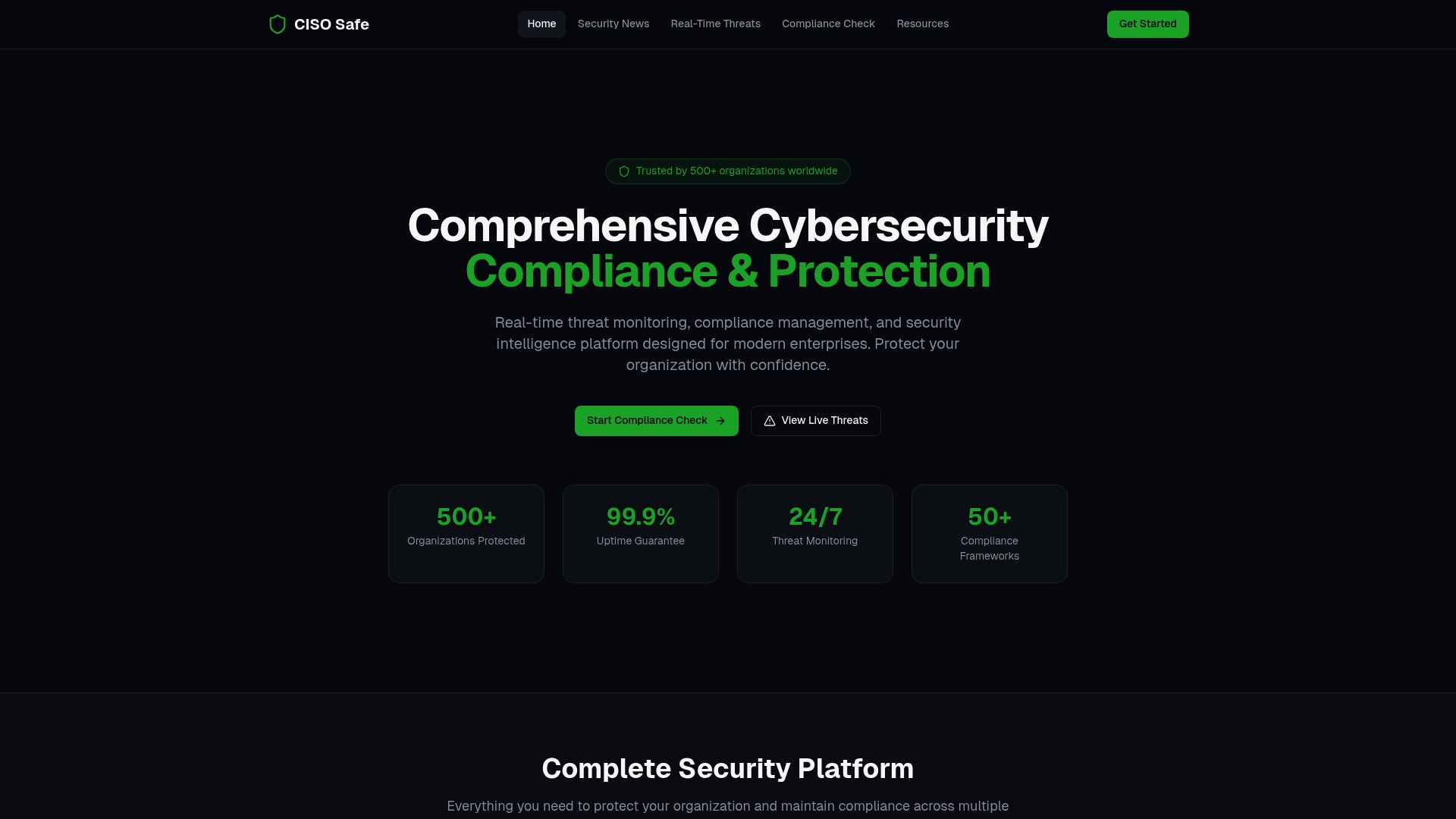
The advisory work covers what this article outlined step by step: a designated point of contact who runs your risk assessment, CLE-ready modules mapped to your ethical obligations, tabletop facilitation that tests your actual incident response plan, and a reporting cadence that gives partners a real evidence trail for due care. That combination matters most for firms that need to show regulators, clients, or insurers proof of reasonable safeguards, not just a training completion certificate.
If your firm hasn't designated an accountable owner or scheduled a tabletop yet, request a vCISO-led assessment to see where your current program stands and what a 90-day rollout would look like for your partnership.
Frequently Asked Questions
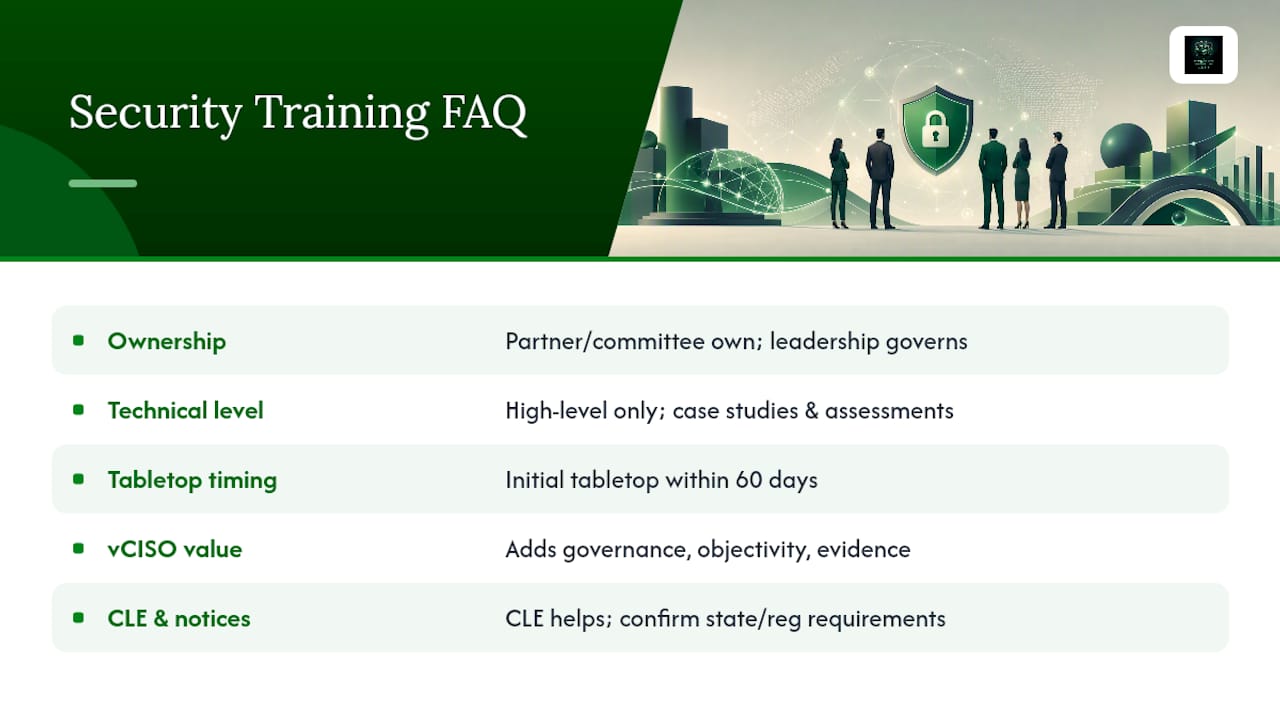
Who should own security training at a law firm, if not IT? A designated partner or standing committee should own it, with IT and a vCISO handling delivery. Governance and reporting stay with leadership because due care obligations cannot be delegated away.
How technical should executive security training be? It should cover just enough technical detail for partners to make risk-based decisions, using case studies and interactive assessments rather than deep technical instruction, following the approach used in executive cybersecurity programs.
How often should partners run tabletop exercises? Regular exercises are recommended for most regulated firms, with an initial tabletop scheduled within the first 60 days of launching or refreshing a program.
What does a vCISO add that internal IT staff cannot? A vCISO brings governance experience across multiple regulated clients, facilitates tabletop exercises objectively, and helps build the documented evidence trail that internal staff often lack time or independence to produce.
Does CLE-aligned training satisfy regulatory notification obligations? CLE-aligned training builds the knowledge partners need to meet notification obligations, but the actual triggers and timelines vary by state and regulator, so firms should confirm specific requirements with counsel.
This article is general information, not a substitute for advice from a qualified lawyer. Consult a qualified legal professional about your own circumstances before acting on anything here.
Sources
- Law Firms Must Embed Cybersecurity in Governance to Protect Data
- Cybersecurity for Business Leaders: Risk & Resilience | Harvard P&ED
- Protecting your data and systems: ethical obligations and practical steps for law firm owners
- Every Law Firm Should Make Cybersecurity a Governance Priority
- Law