

Before any protected data leaves your organization, three controls must be in place: a written authorization policy, a documented approval workflow, and a signed Business Associate Agreement (BAA) when protected health information (PHI) or electronic PHI (ePHI) is involved. These are not optional best practices. Under HIPAA's Privacy and Security Rules, the Gramm-Leach-Bliley Act (GLBA), and SOC 2's privacy controls, the absence of any one of them creates direct regulatory exposure. Note that, for some requirements—including approval workflow and risk scoring—the details differ depending on the data type and regulatory scope (e.g., DDOC/committee review is recommended for high-risk PHI, NPI, or PII transfers per AHIMA, and expedited paths may be used for low-risk tiers). Organizational authorization is thus a tiered process, not a single blanket rule.
The term "consent for release of information" in this context means your organization's authorization program: the policies, approval gates, contracts, and technical safeguards that govern when and how protected data reaches a third party. This is distinct from individual patient or consumer release forms.
Act now:
- Pause any pending third-party data transfers that lack a signed BAA or written assurance of safeguards.
- Inventory all active data-sharing relationships and classify each by data type (PHI, nonpublic personal information/NPI, PII).
- Route all new requests to a Data Disclosure Oversight Committee (DDOC) or equivalent governance body.
- Require a draft BAA or documented vendor security assurance before any access is granted.
Key Takeaways
A defensible consent-for-release program requires an organizational authorization policy, a signed BAA for PHI, documented technical controls, a multidisciplinary approval workflow, and a complete audit trail before any protected data reaches a third party.
| Point | Details |
|---|---|
| Policy before transfer | No data release proceeds without a written authorization policy, risk score, and executed BAA or written assurance. |
| BAA must cover 45 CFR 164.504(e) | Permitted uses, safeguards, breach reporting, return/destruction, and subcontractor flow-down are all required elements. |
| SOC 2 supports HIPAA evidence | A vendor's SOC 2 Type II report documents controls relevant to HIPAA's satisfactory assurance standard, but pair it with targeted technical due diligence. |
| DDOC governance is the control | A multidisciplinary committee with a defined approval matrix prevents business urgency from bypassing risk controls. |
| CisoSafe delivers the program | CisoSafe's vCISO retainer and SaaS platform provide policy templates, BAA checklists, automated intake logging, and audit artifacts within a 90-day engagement. |
This article is general information, not a substitute for advice from a qualified lawyer. Consult a qualified legal professional about your own circumstances before acting on anything here.
Table of Contents
- How do you build a stepwise process for authorizing data releases?
- What must your organizational authorization policy actually contain?
- What contracts and technical safeguards should you require before any release?
- Who approves releases, and how should governance be structured?
- How do you audit releases and respond when something goes wrong?
- What does it realistically cost and how long does implementation take?
- What mistakes will expose you to regulatory risk?
- What should authorization forms look like for different data types?
- How should you train employees on authorization procedures?
- How does EHR and client system integration strengthen your authorization program?
- How do you keep authorization policies current as regulations change?
- CisoSafe gets your authorization program audit-ready in 90 days
- A vCISO's perspective on implementing consent-for-release programs
- Sources
How do you build a stepwise process for authorizing data releases?
A repeatable, auditable workflow is the operational core of any authorization program. AHIMA's guidance on third-party data disclosure documents the use of multidisciplinary oversight, risk scoring, and standardized processing guidelines as the model for governing external transfers.
- Intake and classification. Capture the requester's identity, legal basis for the release, specific data types requested, and the minimum-necessary purpose. Log this as the official request record.
- Inventory and risk scoring. Map each requested data field to its sensitivity category (PHI, NPI, PII) and assign a risk tier. Low-risk requests may follow an expedited path; moderate and high-risk requests route to the DDOC for full review.
- Technical review. Confirm the proposed transfer method, encryption standards, access controls, logging capability, and whether a BAA or written contract is required. This step happens before any approval is finalized.
- Multidisciplinary approval. Route the request to privacy, security, legal, and the relevant business owner. Each approver records a written sign-off and rationale. The decision and all supporting artifacts are retained.
- Contracting and controls. Execute the BAA or service-level agreement, include subcontractor flow-down clauses, and document remediation and termination rights. No access is granted until contracts are fully executed.
- Transfer, logging, and post-transfer verification. Conduct the transfer over a secure, encrypted channel. Ingest the transfer log into your audit system. Confirm receipt with the recipient and document any deletion obligations.
What must your organizational authorization policy actually contain?
A policy that satisfies HIPAA, GLBA, and SOC 2 reviewers needs more than a statement of intent. It needs operational precision.
- Scope and definitions. Define "organizational authorization" explicitly, distinguishing it from individual patient consent. Align definitions with HIPAA's covered entity and business associate categories, and with GLBA's definition of financial NPI.
- Minimum necessary principle. State how your organization determines which data fields are released, for what purpose, and for what duration. Purpose limitation language must be specific enough to be auditable.
- Preconditions for release. No transfer proceeds without: a completed risk score, an executed BAA (for PHI/ePHI), documented technical safeguards, and evidence of vendor assurances. Northwell Health's BAA policy requires execution of a BAA before a business associate performs any services involving PHI and mandates a security review prior to granting access.
- Recordkeeping. Log the request form, approver identities, contract reference, transfer logs, and access logs. Retain records for an appropriate period for HIPAA-covered data, consistent with the Privacy Rule's documentation requirements.
- Roles and training. Assign named owners: requester, data owner, privacy lead, security lead, and legal counsel. Each role requires documented training on the policy at least annually.
For financial data, GLBA requires clear privacy notices and a reasonable opt-out mechanism before disclosing NPI to nonaffiliated third parties. The CFPB's 2024 final rule adds an express informed consent requirement for third-party access to covered financial data.
What contracts and technical safeguards should you require before any release?
Contracts and controls are two sides of the same obligation. Neither substitutes for the other.
BAA essentials under 45 CFR 164.504(e):
- Permitted uses and disclosures of PHI, limited to what the agreement specifies.
- Required safeguards: administrative, physical, and technical.
- Breach and security incident reporting obligations.
- Return or destruction of PHI at contract termination.
- Downstream subcontractor obligations: any subcontractor that handles ePHI must be bound by equivalent terms. 45 CFR §164.314 requires contracts that bind subcontractors and mandate security incident reporting.
Technical controls to require from every third party:
- Encryption at rest and in transit (strong cryptographic protocols such as AES-256 and TLS 1.2 or higher are current baselines).
- Multi-factor authentication and role-based access control with least privilege.
- Data masking or de-identification where full data sets are not operationally necessary.
- Secure file transfer protocols (SFTP, HTTPS) rather than unencrypted email.
- Comprehensive logging with tamper-evident audit trails and defined retention periods.
Controls as evidence. SOC 2 privacy and security attestations overlap directly with HIPAA Privacy Rule standards. A vendor's current SOC 2 Type II report can serve as documentation of safeguards relevant to HIPAA's satisfactory assurance expectations. Pair it with penetration test reports and independent audit findings for higher-risk vendors. HHS confirms that cloud service providers handling ePHI are business associates and that covered entities may require additional assurances based on risk. See SOC 2 compliance for business leaders for a practical mapping of controls to regulatory requirements.
Pro Tip: Require in every BAA a right to audit or to receive third-party attestations on a schedule tied to the vendor's risk tier. Annual attestations for high-risk vendors; biennial for low-risk.
Who approves releases, and how should governance be structured?
Governance is what makes approvals defensible. A single approver with no oversight is a liability; a committee with no clear authority is a bottleneck.
- DDOC composition. Seat representatives from privacy/compliance, legal, IT/security, the relevant clinical or business unit, and procurement. AHIMA documents the DDOC model as best practice for preventing narrow business agendas from overriding risk controls.
- Approval matrix. Low-risk requests (de-identified data, established vendors with current SOC 2) may be auto-approved by the privacy lead with a logged rationale. Moderate-risk requests require security and legal sign-off. High-risk requests (PHI bulk transfers, new vendors, sensitive NPI) require full DDOC review and a written decision memo.
- Meeting cadence. The DDOC reviews high-risk transfers on a defined schedule (monthly or as needed) and maintains an expedited path for vetted low-risk requests with a 48-hour SLA.
Pro Tip: Assign a named approver to every request at intake. When an exception to policy is taken, require the approver to document the specific risk mitigation that justifies it.
How do you audit releases and respond when something goes wrong?
Audit artifacts to retain for every release:
- Completed intake form with risk score.
- Written approvals from each required reviewer.
- Executed BAA or contract with effective date.
- Transfer logs showing timestamp, method, and recipient confirmation.
- Third-party attestations (SOC 2 reports, pen test summaries) current at time of transfer.
Ongoing monitoring. Conduct periodic risk reassessments for active vendor relationships, at minimum annually for high-risk vendors. Trigger an unscheduled audit after any security incident, significant vendor change, or regulatory update that affects the data type in scope. For third-party vendor risk management, documented reassessment cycles are a primary audit evidence requirement.
Incident response for authorized disclosures:
- Contain: suspend the vendor's access immediately upon confirmed or suspected unauthorized disclosure.
- Assess: determine whether the disclosure meets HIPAA's definition of a breach (unsecured PHI accessed by an unauthorized person, with no applicable exception).
- Notify: alert covered entity stakeholders, legal counsel, and the DDOC within 24 hours of discovery.
- Remediate or terminate: invoke the BAA's cure provision if the vendor can remediate within the contractual period; terminate and require data return/destruction if they cannot.
- Report: HHS breach notification to affected individuals is required within 60 days of discovery for breaches affecting 500 or more individuals; smaller breaches are reported in the annual log.
What does it realistically cost and how long does implementation take?
Standing up an authorization program is a phased effort. Trying to do everything at once typically stalls at the contracting stage.
- Policy and governance design (2–4 weeks). Draft the authorization policy, define the DDOC charter, and build the approval matrix. Primary resource: privacy lead and legal counsel.
- Tooling and intake automation (4–8 weeks). Deploy or configure an intake workflow, risk scoring logic, and audit logging. Risk mitigation software for regulated organizations can accelerate this phase significantly.
- Contract remediation (ongoing, prioritized over 6–12 months). Audit existing vendor agreements for BAA gaps and subcontractor flow-down deficiencies. Prioritize PHI and high-NPI vendors first.
- Pilot and training (2–6 weeks). Run the new workflow with a defined set of active vendors, train staff on roles and the intake process, and collect the first audit artifacts.
Primary cost drivers:
- Legal and contracting hours for BAA drafting and remediation.
- Vendor assessment and audit fees for high-risk third parties.
- Tooling and licensing for consent management and logging automation.
- vCISO or consulting retainer for policy development and governance design.
A cross-functional team of four (privacy lead, security engineer, legal counsel, and a project manager) can deliver audit-ready controls within 90 days when scope is limited to the highest-risk data flows.
What mistakes will expose you to regulatory risk?
- Treating the BAA as a legal checkbox. Signing a BAA without assessing the vendor's actual technical controls leaves the covered entity exposed. The contract and the controls must both be verified.
- Allowing subcontractors without flow-down clauses. If your vendor uses a cloud provider or subprocessor that handles ePHI without a binding agreement, your organization bears the residual risk.
- Over-sharing data fields. Releasing more data than the stated purpose requires violates the minimum necessary principle and creates unnecessary breach exposure.
- Accepting verbal assurances. Undocumented vendor claims about security practices are not evidence. Require written attestations, SOC 2 reports, or audit findings before every high-risk transfer.
What should authorization forms look like for different data types?
Organizational authorization templates vary by data type and governing regulation. A single form rarely satisfies all scenarios.
For PHI transfers (HIPAA-covered entities): The authorization template should capture the specific data elements being released, the receiving entity's identity and role (business associate or non-BA), the legal basis for disclosure (treatment, payment, operations, or specific exception), the transfer method and encryption standard, the BAA reference number, and the approver's name and date.
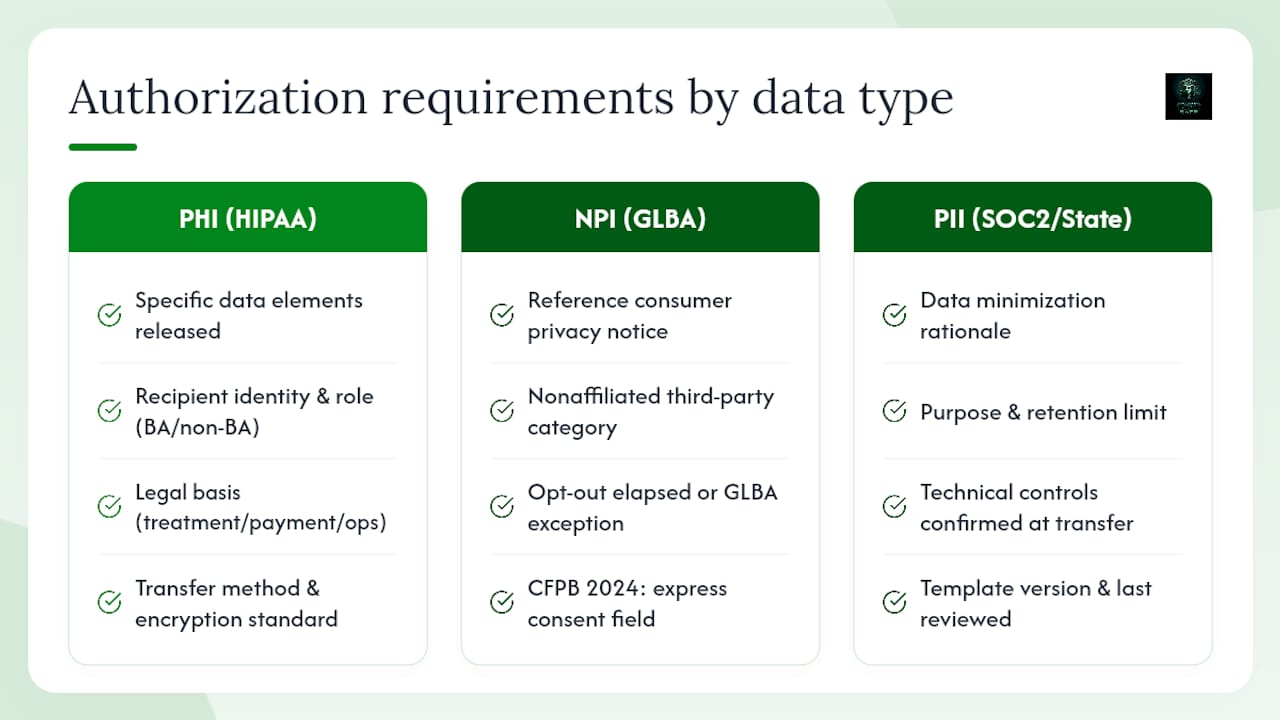
For financial NPI (GLBA-covered institutions): The template must reference the privacy notice already provided to the consumer, document the nonaffiliated third-party category, and confirm that the opt-out period has elapsed or that a GLBA exception applies. The CFPB's 2024 rule adds an express consent field for covered financial data access.
For general PII (SOC 2 or state privacy law scope): The form should document the data minimization decision (why these fields, not more), the purpose and retention limit, and the technical controls confirmed at time of transfer.
Maintain a version-controlled template library, with each template tied to its governing regulation and last-reviewed date.
How should you train employees on authorization procedures?
Training is where policy becomes practice. A well-drafted policy that staff cannot apply is a compliance gap waiting to be found.
Annual training is the floor, not the ceiling. Staff who handle data release requests, vendor onboarding, or contract management should complete role-specific training that covers the intake workflow, risk scoring criteria, and their specific approval authority. General workforce training should cover what constitutes a data release request, how to escalate, and what not to do (sending data via unencrypted email, approving verbal requests).
Track completion in your learning management system and retain records as audit evidence. After any policy update triggered by a regulatory change, issue a targeted refresher within 30 days rather than waiting for the annual cycle.
How does EHR and client system integration strengthen your authorization program?
Manual approval workflows break down at volume. Integrating consent management with your electronic health records (EHR) system or client management platform automates the intake, routes approvals to the right reviewers, and generates a timestamped audit trail without relying on email threads.
Most enterprise EHR platforms (Epic, Oracle Health) support configurable disclosure management modules that can enforce the minimum necessary principle at the field level, blocking export of data elements not included in the approved request. For non-healthcare firms, client management platforms with workflow automation can replicate the same logic: intake form triggers risk score, score routes to approver queue, approval generates a logged release record.
The audit trail produced by an integrated system is significantly stronger evidence than a reconstructed paper trail. Regulators and SOC 2 auditors both expect to see system-generated logs, not manually compiled spreadsheets.
How do you keep authorization policies current as regulations change?
Regulations affecting data release are not static. The CFPB's 2024 personal financial data rights rule, state-level privacy laws, and ongoing HHS guidance updates all require policy owners to maintain an active review cycle.
Schedule a formal policy review at least annually, tied to a calendar date rather than a reactive trigger. Assign a named policy owner who monitors regulatory updates from HHS, the FTC, and relevant state attorneys general. When a material change occurs (a new rule, a significant enforcement action, or a change in your data processing activities), trigger an out-of-cycle review within 60 days.
Document every review in a policy change log: what was reviewed, what changed, who approved the update, and the effective date. This log is direct evidence of a mature compliance program during an audit.
CisoSafe gets your authorization program audit-ready in 90 days
Regulated SMBs and mid-market firms face a real gap: the compliance work is well-defined, but the internal bandwidth to execute it is not. CisoSafe closes that gap without the cost of a full-time CISO or a large consultancy engagement.
CisoSafe delivers the complete program: authorization policy templates, DDOC charter design, BAA compliance checklists mapped to 45 CFR 164.504(e), vendor assessment playbooks, SOC 2 alignment workstreams, and an automated intake and logging portal that centralizes approvals and produces audit-ready artifacts from day one. The vCISO engagement model means you get senior security and compliance expertise on retainer, scoped to your actual risk profile, not a generic framework exercise.
The 90-day pilot engagement covers inventory, risk scoring, a live approval workflow, and the first set of audit artifacts. For firms that need to demonstrate compliance quickly to a client, auditor, or regulator, that timeline is the difference between a defensible program and an open finding. Schedule a vCISO consultation at CisoSafe to scope your authorization program and get your first audit artifacts on the calendar.
A vCISO's perspective on implementing consent-for-release programs
The organizations that struggle most with data release governance are not the ones that lack policy. They are the ones that have policy but no operational teeth: no intake form, no risk score, no named approver, no audit trail. The policy exists; the evidence does not.
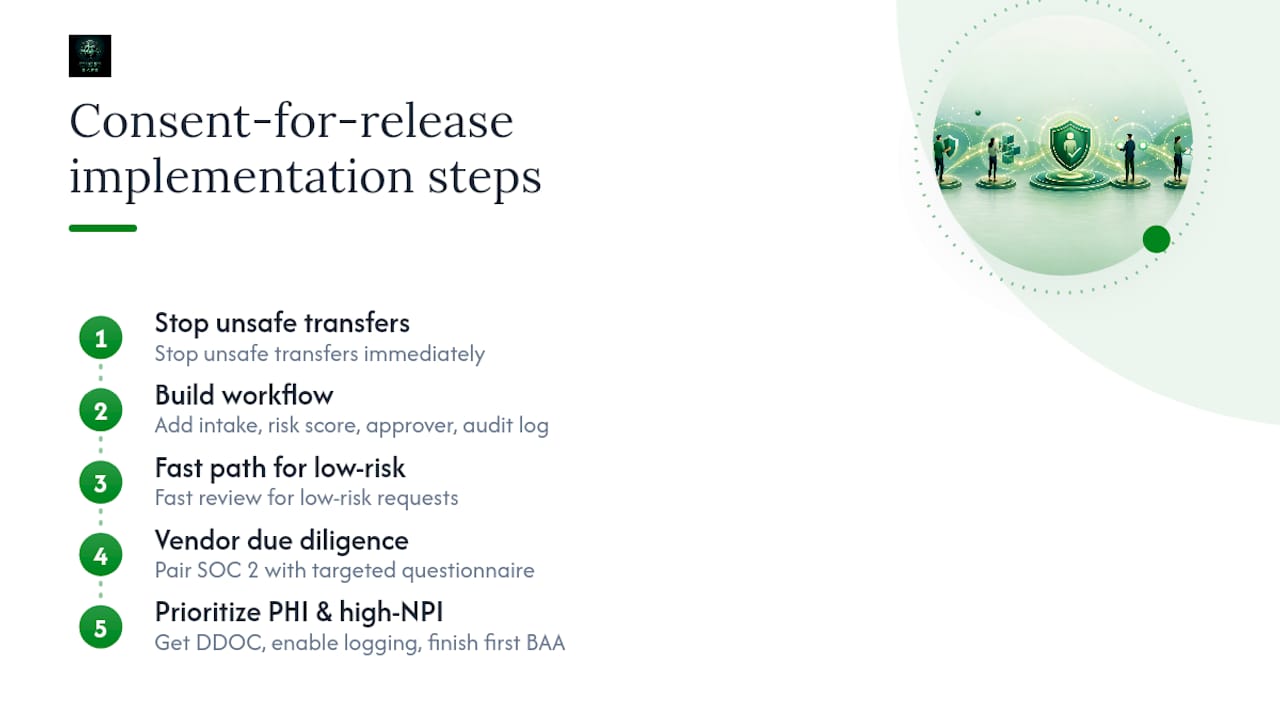
The right sequence is: stop unsafe transfers first, then build the workflow that enables compliant ones. Business stakeholders will push back on the pause, citing urgency. The answer is not to skip controls but to run an expedited review path for genuinely low-risk requests while the full program is built. That keeps business moving and keeps the DDOC credible.
The other common failure is treating SOC 2 attestations as a complete substitute for vendor-specific due diligence. A SOC 2 Type II report is strong evidence, but it covers the vendor's own control environment at a point in time. It does not tell you whether the specific data flow you are authorizing uses the controls the report describes. Pair the attestation with a targeted technical questionnaire for every high-risk transfer.
Start with PHI and high-NPI data classes. Get the DDOC functioning, get the tooling logging, and get the first BAA audit cycle complete. Then expand controls to lower-risk tiers. A program that works consistently for your highest-risk data is worth more than a theoretically complete program that no one follows.
Sources
- Hhs
- § 164.314 - Organizational requirements. | e-CFR | LII / Cornell Law
- Third‑Party Data Disclosure Risk Management for Healthcare Organizations — AHIMA
- CFPB personal financial data rights — Small entity compliance guide (October 2024)
- How to comply with the privacy of consumer financial information rule — FTC
- HIPAA Business Associate Policy — Northwell Health (June 2026)