

What is cyber threat hunting, and why does it matter?
Cyber threat hunting is a proactive, iterative process of actively searching through networks, endpoints, and cloud environments to uncover threats that automated defenses have missed. Unlike reactive security monitoring, which waits for an alert to fire, threat hunting operates under a foundational assumption: a breach may already exist, and the attacker is already inside. The goal is to find them before they cause serious damage.
This discipline sits at the intersection of human expertise and data analysis. Tools like SIEM (Security Information and Event Management), EDR (Endpoint Detection and Response), and MDR (Managed Detection and Response) provide the data. Skilled analysts provide the judgment. Organizations like CrowdStrike, IBM, and Microsoft Security have built entire practice areas around this model, and the CrowdStrike 2026 Global Threat Report reinforces that adversaries are growing faster at evading automated controls.
Key components of effective threat hunting include:
- Continuous, hypothesis-driven search for unknown threats
- Human analysis and domain knowledge applied to raw data
- Iterative refinement of detection methods based on findings
- Reduction of attacker dwell time within the environment
- Conversion of manual discoveries into automated detection rules
Threat hunting does not replace your SOC or your SIEM. It extends them, covering the blind spots that alerts alone cannot reach.
Primary methodologies used in cyber threat hunting
Security teams draw from three core methodologies, often combining them based on organizational maturity, available data, and the nature of the threat environment.
1. Hypothesis-driven hunting
The analyst forms a theory about how an attacker might behave inside the environment, then searches for evidence that confirms or disproves it. This approach draws heavily from frameworks like MITRE ATT&CK, which catalogs adversary tactics, techniques, and procedures (TTPs). A hunter might hypothesize that a threat actor is using living-off-the-land techniques to move laterally, then query endpoint telemetry for anomalous use of PowerShell or WMI. CrowdStrike's three-step methodology centers on this model, treating hypothesis formation as the starting point for every hunt.
2. Intelligence-driven hunting
Here, the trigger is external: a new threat report, a government advisory, or a fresh set of Indicators of Compromise (IOCs) tied to a known adversary group. The hunter uses that intelligence to search for matching artifacts in the environment. This method is reactive in its trigger but proactive in its execution. The UK National Cyber Security Centre notes that ad-hoc hunting based on intelligence tips reduces risk to some degree, though it is insufficient as a standalone practice.
3. Analytics and machine learning-driven hunting
This approach uses behavioral analytics, user and entity behavior analytics (UEBA), and machine learning models to surface statistical anomalies in large datasets. The analyst does not start with a hypothesis; the data surfaces the anomaly, and the analyst investigates from there. It scales well across high-volume environments but requires careful tuning. Poorly designed models produce high false-positive rates, which drain analyst capacity quickly.
Each methodology has its place. Mature security programs cycle through all three, using intelligence to seed hypotheses and analytics to catch what human intuition misses.
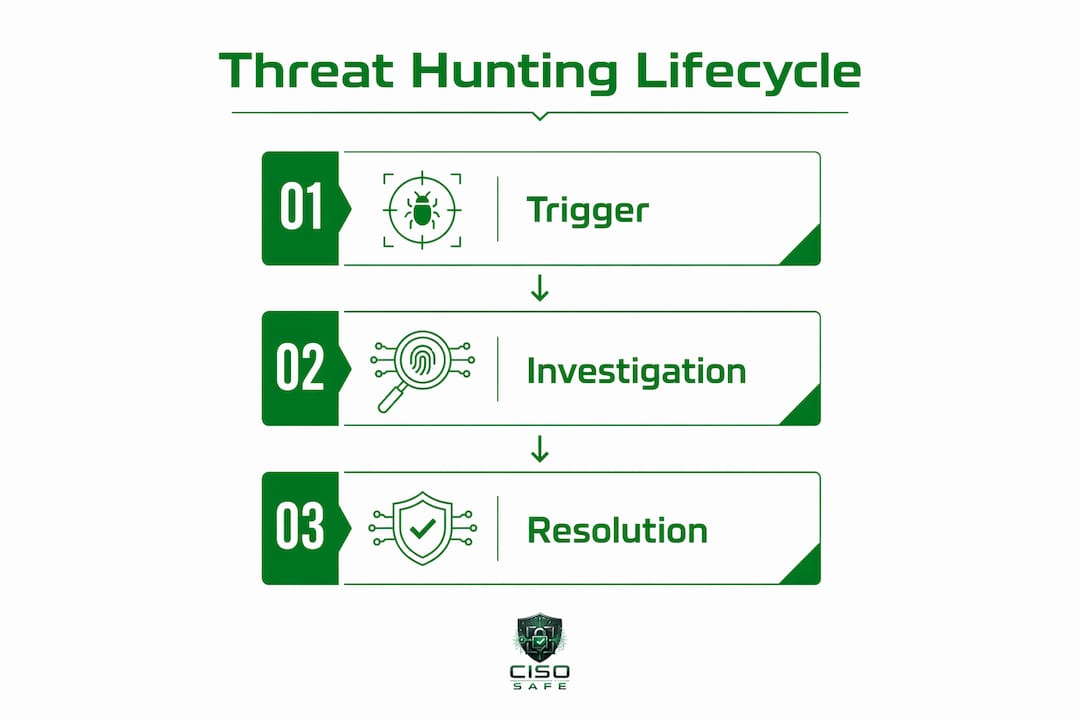
The threat hunting lifecycle: trigger, investigation, and resolution
Every threat hunt follows a three-phase lifecycle. Understanding each phase helps security teams allocate resources, set expectations, and measure outcomes.
1. Trigger
The hunt begins with a trigger: an anomaly surfaced by analytics, a new piece of threat intelligence, a hypothesis formed during a team review, or a tip from an external source. The trigger defines the scope and focus of the investigation. Without a clear trigger, hunts tend to drift and produce little actionable output.
2. Investigation
This is the core of the hunt. Analysts perform deep manual data analysis using EDR telemetry, SIEM log queries, network traffic analysis, and memory forensics. The investigation is iterative: each finding either confirms the hypothesis, refutes it, or opens a new line of inquiry. Analysts examine process trees, authentication logs, lateral movement indicators, and command-and-control traffic patterns. This phase demands both technical skill and contextual knowledge of the specific environment being hunted.

3. Resolution
Resolution is where the hunt delivers lasting value. Analysts document findings, escalate confirmed threats to incident response, and, critically, convert manual findings into automated detection rules. A hunt that finds nothing still produces value if it validates a hypothesis and tightens the detection logic. The NCSC's Cyber Assessment Framework explicitly recognizes turning threat hunts into automated detections as a marker of mature security operations.
The lifecycle is not linear in practice. Investigators often loop back to the trigger phase as new evidence reshapes the hypothesis, making continuous refinement the norm rather than the exception.
Types of threat hunting your team should know
Organizations approach threat hunting through several distinct models, each suited to different risk postures and operational contexts.
- Hypothesis-driven hunts start with a specific theory about attacker behavior, typically grounded in TTPs from MITRE ATT&CK or recent incident data. These are the most structured hunts and tend to produce the most targeted findings.
- Anomaly or baseline-based hunts require analysts to first establish what normal looks like: authorized software, typical authentication patterns, expected network flows. Deviations from that baseline become the focus. This type works well in stable environments where normal behavior is well-documented.
- Advanced analytics-based hunts rely on machine learning and UEBA to flag statistical outliers across large datasets. The analyst's role shifts from hypothesis formation to anomaly triage and investigation.
- Situational hunts concentrate on specific high-risk assets, users, or data sets. If a risk assessment identifies a particular business unit or system as a high-value target, hunters direct their efforts there rather than across the entire environment.
- Reactive hunts are triggered by a confirmed incident or breach discovery. While the name sounds passive, the execution is active: analysts hunt for related activity, lateral movement, and persistence mechanisms tied to the known event.
Traditional SOC investigations start from an alert. Threat hunting starts from a question. That distinction shapes everything about how the work is structured and what it can find. For security teams in law firms or energy companies, where law firm cyber threats often involve targeted, low-and-slow intrusions, situational and hypothesis-driven hunts tend to deliver the most relevant results.
Tools and techniques that support effective threat hunting
Threat hunting depends on a layered technical stack, but the tools only work when analysts know how to use them.
- SIEM platforms aggregate logs from endpoints, network devices, cloud services, and applications into a single queryable dataset. Hunters use SIEM to run complex queries across historical data, correlate events across sources, and identify patterns that no single log source would reveal alone.
- EDR solutions provide granular endpoint telemetry: process execution, file system changes, registry modifications, and network connections at the host level. EDR is often the primary data source for hypothesis-driven hunts targeting lateral movement or persistence techniques.
- MDR services combine technology with human analyst coverage, extending threat hunting capacity for organizations that lack in-house expertise. MDR providers typically run continuous hunts on behalf of their clients, escalating confirmed threats for response.
- Threat intelligence feeds supply context: known malicious IPs, domains, file hashes, and adversary TTPs. Feeds from sources like MITRE ATT&CK, ISAC sharing groups, and government advisories inform both intelligence-driven and hypothesis-driven hunts.
- Behavioral analytics and UEBA tools model normal user and system behavior, then flag deviations. These are particularly effective at detecting insider threats and credential abuse, where the attacker is using legitimate access in illegitimate ways.
- Manual techniques remain irreplaceable. Deep log inspection, memory analysis, and network packet capture require analyst judgment that no automated tool replicates. Threat hunting is human-centric by design; tools extend analyst reach but do not substitute for domain expertise.
Pro Tip: Before deploying any hunting tool, audit your logging coverage first. Gaps in endpoint, network, or cloud log collection will blind your hunts regardless of how capable the tooling is.
Why threat hunting matters: core objectives and organizational impact
The primary objective of threat hunting is risk reduction through early adversary identification. Finding an attacker on day three of their intrusion is categorically different from finding them on day ninety. The earlier the detection, the smaller the blast radius.
- Reducing attacker dwell time limits the window during which an adversary can exfiltrate data, establish persistence, or move laterally to higher-value systems.
- Proactive identification of stealthy threats catches advanced persistent threats (APTs) and human-operated ransomware groups that specifically design their TTPs to evade automated detection.
- Complementing incident response by surfacing threats before they escalate into full incidents, reducing the cost and complexity of response operations.
- Validating security controls through the process of hunting itself. A hunt that finds nothing still confirms that existing controls are working as intended, or reveals gaps that need addressing.
- Improving the overall detection stack by feeding findings back into SIEM rules, EDR policies, and firewall configurations. Threat hunting complements but does not replace SOC monitoring; the two functions reinforce each other when properly integrated.
Organizations operating in regulated sectors face an additional driver: compliance frameworks increasingly expect evidence of proactive threat detection, not just reactive alerting.
Best practices for running threat hunts that actually work
Effective threat hunting requires more than good tools and talented analysts. It demands operational discipline.
- Build logging coverage before you hunt. Effective threat hunting requires comprehensive visibility across endpoints, network traffic, and cloud workloads. Without that foundation, hunts produce incomplete pictures and miss critical evidence.
- Establish a hunting cadence aligned with your risk profile. The NCSC's Cyber Assessment Framework identifies risk-matched hunting frequency as a best-practice marker. Ad-hoc hunts in response to intelligence tips offer some benefit but fall short of what a scheduled, repeatable program delivers.
- Ground every hunt in a documented hypothesis. Undirected hunting wastes analyst time. Each hunt should begin with a written hypothesis tied to a specific threat scenario, adversary group, or TTP cluster.
- Document everything, then automate what you can. Every completed hunt should produce written records of the hypothesis, methodology, data sources queried, and findings. Where findings reveal repeatable attacker behaviors, convert them into automated detection rules to prevent recurrence.
- Invest in analyst development. Threat hunting skill is not a product you can purchase. It develops through experience, structured training, and exposure to diverse threat scenarios. Teams that rotate analysts through hunting rotations build institutional knowledge that compounds over time.
- Integrate hunting with your broader security program. Hunting findings should feed directly into risk assessments, vulnerability management, and incident response playbooks. Isolated hunting programs that do not connect to the wider security operation deliver a fraction of their potential value.
Pro Tip: Use MITRE ATT&CK Navigator to map your current detection coverage before each hunt cycle. The gaps in your coverage matrix are your highest-priority hunting targets.
Threat hunting in regulated U.S. industries: a practical perspective
Regulated industries face a compounding challenge. Not only must they detect and respond to sophisticated threats, they must also demonstrate that their detection practices meet specific compliance requirements. For law firms handling privileged client data, energy operators running operational technology networks, and oil and gas companies subject to CMMC or NERC CIP requirements, threat hunting is both a security practice and a compliance obligation.
The table below maps common regulated sectors to the compliance frameworks most relevant to their threat hunting programs.
| Industry | Relevant Frameworks | Key Threat Hunting Focus Areas |
|---|---|---|
| Law firms | SOC 2, HIPAA | Privileged data exfiltration, insider threats, email compromise |
| Oil and gas | CMMC, NERC CIP | OT/IT convergence, supply chain intrusions, ransomware targeting ICS |
| Energy operators | NERC CIP, SOC 2 | Control system anomalies, remote access abuse, third-party risk |
| Healthcare adjacent | HIPAA, PCI DSS | Patient data access patterns, credential abuse, lateral movement |
CisoSafe works directly with organizations in these sectors to align threat hunting with their specific compliance obligations, building hunt programs that produce both security outcomes and audit-ready documentation. For energy firms specifically, the intersection of cyber risk and operational continuity makes proactive detection a board-level priority, as detailed in CisoSafe's analysis of cyber risk in drilling operations.
Skills and expertise required for effective threat hunting
Threat hunting demands a rare combination of technical depth and analytical thinking. Analysts need hands-on proficiency with EDR and SIEM platforms, but the more differentiating skill is the ability to form and test hypotheses under uncertainty. That requires a working knowledge of adversary TTPs, familiarity with the MITRE ATT&CK framework, and enough network and system knowledge to recognize when something is genuinely anomalous versus merely unusual.

Scripting and query skills matter too. Hunters who can write KQL queries in Microsoft Sentinel, SPL in Splunk, or Python scripts for log parsing move significantly faster than those who depend entirely on GUI-based tools. Threat intelligence analysis, memory forensics, and network traffic analysis round out the technical profile. Beyond the technical side, effective hunters communicate clearly. A finding that cannot be explained to a security manager or documented for compliance purposes has limited organizational value.
Challenges and limitations in threat hunting programs
Threat hunting is resource-intensive by design, and that creates real operational constraints. Skilled threat hunters are scarce, and building an in-house team capable of running mature hunt programs requires sustained investment in hiring, training, and tooling. Many organizations, particularly mid-market firms, lack the analyst headcount to run continuous hunts alongside their day-to-day SOC responsibilities.
Data quality is another persistent obstacle. Hunts are only as good as the logs feeding them. Incomplete endpoint coverage, inconsistent log retention policies, and gaps in cloud telemetry all create blind spots that attackers can exploit. Machine learning-based hunting tools help with scale but introduce their own challenges: high false-positive rates require analyst triage time, and poorly tuned models can generate more noise than signal. Finally, threat hunting produces value that is difficult to quantify. Finding nothing on a hunt is not evidence of failure, but it is hard to justify budget for a program whose success is measured partly by absence of findings.
Examples of successful threat hunting operations
One of the most instructive real-world examples of threat hunting at scale involves the response to the SolarWinds supply chain compromise, discovered in late 2020. Organizations that had mature threat hunting programs in place were able to search their environments for the specific TTPs associated with the SUNBURST backdoor, including anomalous outbound DNS traffic and unusual authentication patterns from service accounts, before those behaviors triggered automated alerts. Hunters using hypothesis-driven methods, grounded in early threat intelligence from FireEye and CISA advisories, identified compromised systems days or weeks ahead of organizations relying solely on automated detection.
Microsoft Security's threat hunting teams have documented similar patterns in their investigations of human-operated ransomware groups like LAPSUS$ and Midnight Blizzard. In both cases, the attackers used legitimate credentials and living-off-the-land techniques specifically designed to evade automated controls. Hypothesis-driven hunts targeting anomalous use of remote management tools and unusual privileged account activity were the primary detection mechanism. These cases reinforce a consistent finding: the threats most likely to cause serious damage are precisely the ones that automated detection misses, and that threat hunting is designed to find.
Metrics and KPIs that measure threat hunting effectiveness
Measuring threat hunting effectiveness requires metrics that capture both operational performance and security outcomes. Dwell time reduction is the most direct measure: tracking the average time between initial compromise and detection, then comparing it across periods before and after a mature hunting program is in place. Mean time to detect (MTTD) and mean time to respond (MTTR) are standard SOC metrics that hunting programs should move in a favorable direction over time.
Hunt coverage rate tracks what percentage of the environment is actively hunted within a given period, helping teams identify gaps in their program scope. The number of new detection rules created from hunt findings measures how effectively the program converts manual discoveries into automated defenses, which is a key marker of program maturity per the threat hunting framework whitepaper. False-positive rate on hunt-generated alerts, analyst hours per confirmed finding, and the ratio of confirmed threats to total hunts completed round out a practical KPI set. None of these metrics work in isolation; the most useful programs track a balanced scorecard that captures both efficiency and effectiveness.
How threat intelligence strengthens every hunt
Threat intelligence is the fuel that makes hypothesis-driven and intelligence-driven hunting precise rather than speculative. Structured intelligence, particularly at the TTP level from sources like MITRE ATT&CK, gives hunters a concrete starting point: if a known adversary group targeting your sector uses a specific technique, that technique becomes the basis for a hunt hypothesis. Raw IOC feeds (IP addresses, file hashes, domain names) are useful but represent the lowest tier of intelligence value. They age quickly and tell hunters where an attacker has been, not how they operate.
Higher-value intelligence describes adversary behavior: how they establish persistence, how they move laterally, how they exfiltrate data. That behavioral context lets hunters search for patterns rather than artifacts, which is far more effective against sophisticated actors who rotate infrastructure regularly. For organizations in the legal and energy sectors, sector-specific intelligence sharing through ISACs and government advisories provides targeted context that generic commercial feeds often miss. CisoSafe's guide to cyber threat intelligence covers how to build and operationalize an intelligence program that directly feeds your hunting cycles.
How CisoSafe supports your threat hunting program
Building a threat hunting program from scratch requires expertise, tooling, and time that most mid-market organizations cannot spare. CisoSafe's virtual CISO services give law firms, energy operators, and compliance-sensitive organizations access to enterprise-grade threat hunting guidance without the cost of a full-time security executive. From establishing logging foundations and selecting the right EDR and SIEM stack to designing hunt playbooks aligned with SOC 2, HIPAA, PCI DSS, and CMMC requirements, CisoSafe delivers a program built for your specific risk environment. Contact CisoSafe to discuss how a structured threat hunting program fits your security roadmap.
Key Takeaways
Cyber threat hunting reduces organizational risk by finding advanced threats before automated defenses detect them, converting manual discoveries into permanent detection improvements.
| Point | Details |
|---|---|
| Proactive by design | Threat hunting assumes a breach may already exist and actively searches for hidden adversary activity. |
| Three core methodologies | Hypothesis-driven, intelligence-driven, and analytics-driven hunting each address different threat scenarios. |
| Lifecycle drives outcomes | The trigger, investigation, and resolution phases convert hunt findings into automated detection rules. |
| Logging coverage is a prerequisite | Gaps in endpoint, network, or cloud telemetry directly limit what any hunt can find. |
| Compliance alignment matters | Regulated industries require hunt programs that produce both security findings and audit-ready documentation. |